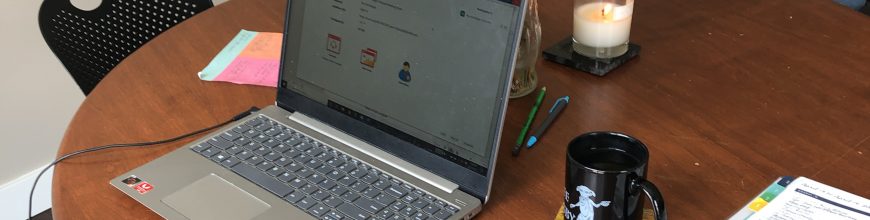
Since I’m sharing our home today with three dogs (we’re dog-sitting for my in-laws), my husband (who is doing an all-day virtual professional development training in his home office), and our friend who just moved here and is staying with us until her apartment is ready, I thought I’d share a post from nearly four years ago about home as a co-working space. Though things have changed (Jordan is back at his worksite most days; I have a permanent workspace in the corner of our living room; we regularly get a wide variety of birds at our feeder, and I’m learning their names pretty well), I think the ideas explored in this post are still worth considering.
Author Archives
What I’m thinking of when I’m listening to Appalachian Spring: a prose poem
This post, like my last one, has nothing directly to do with online teaching and learning, but I’ve been listening to a lot of Aaron Copland lately, and I’m interested in what people see in their minds when they listen to instrumental music. So here you go. If you’ve never listened to the Appalachian Spring ballet suite, please do: https://open.spotify.com/track/59L730gafjB2cjVOYQaHes?si=098d63e5383d422a
I am thinking of the smell of water running over rocks. I am thinking of the hallways at Fallingwater, how they were like caves. I am thinking of the shadows of leaves on the walls.
The open chords at 3:05 make me think of Out West. This is Copland dancing across the Great Plains, like he forgot where Appalachia is. But he’ll be back. The spring is calling him back.
I am thinking of a spring, water bubbling up under leaves, cold as the earth. I am also thinking of the spring, when white petals pop out on the branches and frame the photo of Fallingwater you are taking from across the stream. A spring in the spring. And now we are back to small things, quiet melodies, tiny drops of water sliding down the rock you are standing on.
Suddenly, a cascade. The water is bubbling up and spilling over in mirth. The snow is melting.
And now I am thinking of simple gifts. They’re in the lyrics you only hear in your head, and they’re also in the melody. You can sing this part, even if you don’t know the words. This music is a gift; this place is a gift. Take your shoes off like a dancer, and stand on the earth as the spring sun warms it. Stay here a long time. It’s a gift to be free.
Now I am thinking of nightfall, how quiet it is here as the sun goes down behind the mountain, and you slip back into your house and all you can hear is the bubbling of the spring. I am thinking of the smell of water running over rocks.
Sunrise over the Sea of Tiberias
In my last post (which was longer ago than I realized!), I mentioned that I’m working on a couple of short stories based on the life of Jesus. I want to share the latest draft of one of those stories with you. This is based on chapter 21 of the gospel of John. I feel like it needs one more paragraph to bring it to a close at the end, so if you have any suggestions, I’m open!
The sun was just starting to rise over the Sea of Tiberias. An orange glow crossed by thin dark clouds. The air was still chilly.
Some of us had gone fishing overnight. It had been Peter’s idea; he’d said he wanted to do something with his hands.
“But we’re not fishermen anymore,” Andrew had pointed out.
“What are we, then?” Peter had argued. That had silenced Andrew. “Besides, we’re not going to sell them,” Peter had said. “I just want to do something.”
Not all of us were trained as fishermen, but those who were gave us things to do, to keep us busy. We sat in the boat all night, quiet in the dark, drained of stories from the past week.
As the sun began to rise, we headed back to shore. A silhouette of a man was standing there. I shivered. He called out: “I guess you guys didn’t catch any fish?”
I thought I recognized the man’s voice, but I didn’t want to say it. I glanced at the others.
“No,” Peter called out. He didn’t sound irritated, just tired.
The man called back: “Let down your net on the right side of the boat. I think you’ll find what you’re looking for.”
Someone gasped. I saw John smile and nod. “Do it,” said Peter. Of course we did. I wasn’t there three years ago, but I’d heard the story dozens of times.
Immediately, the net was full of fish. This was not a surprise—again we all knew what to expect—but it still took my breath away. I paused to gasp some air into my lungs. “Grab the net!” James hollered. I did. But even with all of us pulling, we couldn’t get the net into the boat.
“Drag it in,” said Peter. “I’m going to talk to Jesus.” He took off his coat and jumped into the chilly water.
The orange glow was spreading up from the horizon. James and John got us into the little boat, not the main boat, so we could pull the net into shore without having to weigh anchor. My job was to hold onto the net for dear life.
When we got to shore, there was a small coal fire with bread toasting over it. Just when I realized I was hungry, the man raised his head from the deep consultation he had been in with Peter and smiled. It was unmistakably Jesus. There was a moment when I forgot he had been dead a week before. I remembered when he pushed his hair off his forehead and when I saw the ugly scar in his hand. “I’m making breakfast for us,” he said. “Hand me a couple of those fish.”
I grabbed two of the fish from the teeming pile. They were cold, and a ray of sun shone off their silver scales. I placed them in Jesus’ hands, which were warm from the fire. “Thank you,” he said, looking in my eyes, and it sounded like a blessing. I didn’t know what to say, and Peter looked eager to continue their talk, so I turned back toward the net. “We should count these,” Thomas said.
“Why?” I frowned. “We’re not going to sell them.”
“Someone will want to record the number.” He gestured toward the others. At least two of them were writing down their experiences with Jesus. I was just trying to make sense of it all in my head.
“Is the number important?” I looked at the net. It was just a small one, not a big commercial net like I’d seen some of the fancier-looking fleets have. But it was bursting, a multitude of fish now glowing with the fire of the mostly risen sun.
Thomas shrugged, already spreading out a canvas for them to dry. “Anything might be important.”
So, I helped. As Peter remained in hushed conversation with Jesus, who listened carefully as he turned the fish over the fire, as James and John mended a net just on the edge of their discussion, as Nathanael walked the beach alone, picking up driftwood for the fire, I helped Thomas count the fish. There were 153.
The sun had fully risen when Jesus said, “Breakfast is ready.” He broke the bread and passed it around. He burned his fingers on the fish as he divided it up. The skin was salty and crispy and the flesh flaky, and I didn’t know if it was because God had cooked this fish or because Jesus of Nazareth just had a lot of practice preparing food in the open air. But it was perhaps the best fish I had ever eaten. The bread, too, was soft on the inside with a faint char on the outside, and this surprised me not at all.
Jesus looked out to sea, toward the sun in its strength. Then he looked back to us, casting his gaze around the circle, where we all sat licking our fingers. “Remember,” he said. “You are the light of the world. You are the salt of the earth. You are the fishers of men.” He smiled. “But you are shepherds now, too. As I just told Peter, I am sending you to feed my sheep.”
Peter ducked his head and gave a grin that looked uncharacteristically shy. I thought about how Jesus had called himself the good shepherd. Now he was asking us to be the same.
writing goals for 2024
As I think about my goals for the new year, I’m considering how I want writing to fit into my life in 2024. I have always seen myself as a writer, but after a few highly productive years leading up to the completion of a novel in 2019, I’ve been in a dry spell, at least by comparison. I do a lot of writing for my work–mainly emails and grading feedback–but in this post, I’m thinking about writing that is both more enjoyable and less ephemeral than those, important as they may be. So here are some writing goals I’d like to focus on in the new year.
- Get back into the habit of writing in my notebook for 15 minutes a day. I started doing this in September after I read Writing Down the Bones by Natalie Goldberg and wanted to rediscover the joy of writing, especially in longhand (a practice Goldberg speaks highly of). Throughout that month, I wrote for 15 minutes every morning. Most of what I wrote will never be shown to the world (though this post was a result of one particularly productive day), but it was a good practice, and I’d like to get back into it consistently in 2024.
- Research and revise two short stories based on incidents in the life of Christ that I drafted in 2023. These stories resulted from my daily writing practice. They are quick sketches that need research give them accuracy and authenticity. I may use my research and revision process to help me develop some resources for my students (I wrote about this idea here), but even if I don’t end up doing that, I would like to get these stories into a state that I’m happy with.
- Reread Sam’s Town to help me decide whether I want to work on the sequel. Sam’s Town is the novel I self-published in 2019. Soon after I completed it, while still riding a writing high, I started the sequel, Sam’s Home. But then I got married, moved, and lived through the pandemic, and the few brief attempts I’ve made to pick the manuscript back up haven’t really gone anywhere. So in 2024, I’d like to reread Sam’s Town in hopes of recapturing some of that excitement. Even if I ultimately decide not to make writing the sequel one of my goals for this year, I think I’ll enjoy revisiting those characters who played such an important role in my life for several years.
Three is a magic number when it comes to goal-setting, so I’ll stop there. What are some of your goals for 2024, writing-related or otherwise?
ode to The Muppet Christmas Carol
Instead of a post about teaching and learning, today I want to share with you a brief homage to one of my favorite Christmas movies (though, now that I think about it, there’s a lot of teaching and learning going on in A Christmas Carol). Earlier this month, my parents treated their kids and our spouses to a delightful gift: a screening of The Muppet Christmas Carol in Pittsburgh’s beautiful Heinz Hall, the music track replaced with a live performance by the Pittsburgh Symphony Orchestra (which was fascinating–I heard things in the music that I’ve never noticed while watching the DVD or VHS). This gift prompted me to write the following reflection in my journal. Regardless of your favorite adaptation of A Christmas Carol (I know this can be a heated debate), I hope this post brings a little joy to your Christmas celebration. God bless us, every one!
What do I love about The Muppet Christmas Carol? First and foremost, it’s Michael Caine’s performance as Scrooge. He holds nothing back; there is not “I’m acting opposite puppets” wink in his eye. He is one of the sincerest, most sinister, and yet most sympathetic Scrooges ever.
Another thing I love is the script. Though Muppet jokes and silliness abound, the language of Charles Dickens (who loved jokes and silliness where appropriate) permeates the movie. I give it a large share of the credit for why I fell in love with Dickens’ writing. Similarly, the film’s set–which, now that I’m an adult, I can see isn’t going to win any production design Oscars–still gave me an early love for the close-knit, crowded, alternately dark and brilliant world of Dickens’ London.
The music, of course, is what prompted the live screening we attended. The songs have a very Muppety essence to them, but that doesn’t stop them from containing some of the profoundest lines in the whole Christmas movie canon. The score is tonally spot-on: very British in is instrumentation, ominous when it needs to be and joyous when it needs to be, Christmasy all the way through.
Of course, there are nostalgic reasons too. I can’t picture a Stockslager family Christmas without it. I don’t remember when we started watching it on Christmas Eve night because “after all, there’s only one more sleep ’til Christmas,” but I know we’ve been watching it every year pretty much since it came out in 1992.
Watching the movie with a huge crowd and hearing their reactions was really special. Of course, laughter is the easiest reaction to hear, as well as the one we’re most likely to express aloud in public, so we heard a lot of laughter. But it was all at tonally appropriate times (unlike some cringy inappropriate laughter responses I’ve heard during live theater performances), and besides, both Dickens and the Muppets would love knowing that their work brought a crowd together with laughter, especially at “this most festive season of the year.”
a quick bite of food for thought about grading time
Yesterday, I was watching a video about creating a teaching calendar (which I can’t share here because it’s part of a paid professional development package one of my universities subscribes to), and I heard some research findings that caught my attention. The study was conducted by the video presenter, B. Jean Mandernach, Executive Director of the Center for Innovation in Research and Teaching at Grand Canyon University, and her colleagues.
Here’s a summary: The research team approached a group of doctoral-level faculty who taught writing-heavy courses and asked them how long it took them, on average, to grade a paper. They monitored their grading time and came up with an average of one hour per paper. The researchers asked if they could lower this to 30 minutes. The faculty expressed doubt, but limited themselves to 30 minutes per paper. In a third round of grading, the faculty then limited themselves to 20 minutes per paper. Next, an objective rater scored the quality of the professors’ feedback, and there was no qualitative difference between the three sets of papers.
I’m just going to leave you with that. I think the data speaks for itself. I’ll simply say that as English professor who tends to reflexively equate more feedback with better teaching–but who feels overwhelmed by the volume of writing I have to respond to each week–I found these results to be encouraging. Let me know what you think! And if you’re not a teacher, could these findings apply to other areas of life?
a prayer for humility
I wrote this prayer in my journal a few weeks ago. For clarity, Jordan is my husband, and BSF stands for Bible Study Fellowship.
When I think I know how Jordan is feeling and I really don’t
When I think I have the most insightful comment that could be made at that moment in my BSF group
When I assume a student’s tone in an email
Lord, help me to pause.
Help me to remember how little I know, and how good that is.
encore post: This just keeps getting more relevant.
Hi everyone, I went back to reread the post below this morning after an interaction with a student who’s just starting an online program and is justifiably skeptical about the value of online education. I hope I addressed his concerns in my email. I considered sending him this post, but I didn’t want to start off our time together by making him think of me as a pushy author promoting my brand, so instead I read the post to remind myself, once again, of the crucial need to be a real person with my students. Even though I published this post just a few months ago, I thought I’d share it again. Its central concepts keep getting more relevant, and not just in the education field.
Don’t ask your students to do anything you haven’t done yourself.
This post is part of a series on bringing a human touch to online education. See the series introduction here.
I recently wrote a rough draft of a story, provisionally titled “Sunrise at the Sea of Tiberias,” and I know it needs some historical research. So I have an idea: I’m going to do the Writing in Your Field Project, the major multi-step assignment in my graduate writing class, along with my students.
I have never done the project, and I know that’s a classic teacher mistake: expect my students to do something I haven’t done myself. I know what some of the common challenges of the project are based on student feedback, but as I often tell my students regarding their research, there’s no substitute for firsthand experience.
I’m thinking of taking notes on my experience as I go through it (maybe using a combo of written and voice notes), then creating some supplemental videos/documents I can share with students and maybe eventually make an official part of the course. I would also like to write about this experience, with a teacher audience in mind, on the blog!
I hope to start this project soon, when (I’m hopeful) some extra space will be opening up in my grading schedule. Stay tuned for details!
lessons from Hogwarts for teachers
Today, I’m wearing my new t-shirt that says, “Hogwarts wasn’t hiring so I teach Muggles instead.” (You can read about the shirt I was wearing last Thursday here.) But I’ve often wondered whether I’d actually want to teach at Hogwarts, considering all the danger and distractions from a consistent learning environment, not to mention the governmental interference in the person of Dolores Umbridge that plagued the school during Harry Potter’s fifth year. I read an interesting scene in Harry Potter and the Order of the Phoenix yesterday afternoon, and I thought I’d share it here. I won’t provide any commentary afterward because I want you to be able to draw your own conclusions; I’ll simply hint that this scene touches on a lot of the issues I worry about as a teacher: the subjectivity of grades, the place of politics and other personal commitments in the learning environment, anxiety over whether administration really has my back, and perhaps most importantly, the extent to which a teacher can really make a difference in a student’s life, present and future.
Context: Harry is in a required career consultation with his head of house, Professor McGonagall, and overbearing Headmistress Umbridge (who is also the Defense Against the Dark Arts professor) is unwelcomely sitting in. Harry has just said that he might want to pursue a career as an Auror, and Umbridge keeps trying to interrupt McGonagall’s advice about what classes Harry should take.
Professor Umbridge gave her most pronounced cough yet.
“May I offer you a cough drop, Dolores?” Professor McGonagall asked curtly, without looking at Professor Umbridge.
“Oh, no, thank you very much,” said Umbridge, with that simpering laugh Harry hated so much. “I just wondered whether I could make the teensiest interruption, Minerva?”
“I daresay you’ll find you can,” said Professor McGonagall through tightly gritted teeth.
“I was just wondering whether Mr. Potter has quite the temperament for an Auror?” said Professor Umbridge sweetly.
“Were you?” said Professor McGonagall haughtily. “Well, Potter,” she continued, as though there had been no interruption, “if you are serious in this ambition, I would advise you to concentrate hard on bringing your Transfiguration and Potions up to scratch. I see Professor Flitwick has graded you between ‘Acceptable’ and ‘Exceeds Expectations’ for the last two years, so your Charmwork seems satisfactory. As for Defense Against the Dark Arts, your marks have been generally high, Professor Lupin in particular thought you–are you quite sure you wouldn’t like a cough drop, Dolores?“
“Oh, no need, thank you, Minerva,” simpered Professor Umbridge, who had just coughed her loudest yet. “I was just concerned that you might not have Harry’s most recent Defense Against the Dark Arts marks in front of you. I’m quite sure I slipped in a note.”
“What, this thing?” said Professor McGonagall in a tone of revulsion, as she pulled out a sheet of pink parchment from between the leaves of Harry’s folder. She glanced down it, her eyebrows slightly raise, then placed it back into the folder without comment.
“Yes, as I was saying, Potter, Professor Lupin thought you showed a pronounced aptitude for the subject, and obviously for an Auror–“
“Did you not understand my note, Minerva?” asked Professor Umbridge in honeyed tones, quite forgetting to cough.
“Of course I understood it,” said Professor McGonagall, her teeth clenched so tightly the words came out a little muffled.
“Well, then, I am confused . . . I’m afraid I don’t quite understand how you can give Mr. Potter false hope that–“
“False hope?” repeated Professor McGonagall, still refusing to look round at Professor Umbridge. “He has achieved high marks in all his Defense Against the Dark Arts tests–“
“I’m terribly sorry to have to contradict you, Minerva, but as you will see from my note, Harry has been achieving very poor results in his classes with me–“
“I should have made my meaning plainer,” said Professor McGonagall, turning at last to look Umbridge directly in the eyes. “He has achieved high marks in all Defense Against the Dark Arts tests set by a competent teacher.”
Professor Umbridge’s smile vanished as suddenly as a light bulb blowing. She said back in her chair, turned a sheet on her clipboard and began scribbling very fast indeed…
[Now that you get the idea of the conversation, I’m skipping a section for brevity’s sake. Notice that Harry didn’t speak once during the passage above. McGonagall at least tries to direct her comments toward him, but this is primarily an argument between the professors, raising interesting questions about student agency. Harry does get a word in during the part I’m skipping, but the main interaction continues to be between the professors.]
“Potter has a criminal record,” said Umbridge loudly.
“Potter has been cleared of all charges, “said McGonagall, even more loudly.
Professor Umbridge stood up. She was so short that this did not make a great deal of difference, but her fussy, simpering demeanor had given place to a hard fury that made her broad, flabby face look oddly sinister.
“Potter has no chance whatsoever of becoming an Auror!”
Professor McGonagall got to her feet, too, and in her case this was a much more impressive move; she towered over Professor Umbridge.
“Potter,” she said in ringing tones, “I will assist you to become an Auror if it is the last thing I do! If I have to coach you nightly, I will make sure you achieve the required results!”
“The Minister for Magic will never employ Harry Potter!” said Umbridge, her voice rising furiously.
“There may well be a new Minister for Magic by the time Potter is ready to join!” shouted Professor McGonagall.
“Aha!” shrieked Professor Umbridge, pointing a stubby finger at McGonagall. “Yes! Yes, yes, yes! Of course! That’s what you want, isn’t it, Minerva McGonagall? You want Cornelius Fudge replaced by Albus Dumbledore! You think you’ll be where I am, don’t you: Senior Under-secretary to the Minister and Headmistress to boot!”
“You are raving,” said Professor McGonagall, superbly disdainful. “Potter, that concludes our careers consultation.”
Rowling, J.K. Harry Potter and the Order of the Phoenix. Scholastic, 2003.
 the Dr. Tess blog