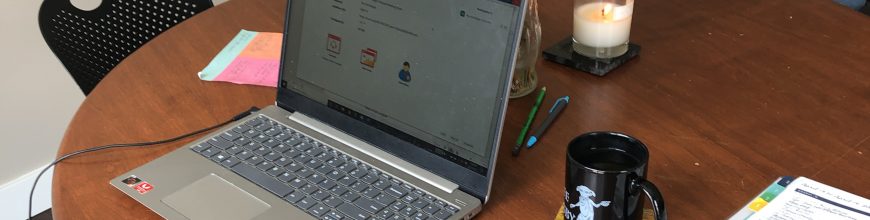
app recommendation: Forest

I’m writing to you today at the end of a productive and surprisingly relaxing day of grading Week 7 assignments (the big, culminating projects on which I try to give students their money’s worth in grading comments) for my online classes. I graded six assignments today (on track with the schedule I made yesterday), plus I did this week’s laundry, had lunch and watched a Friends episode with my husband, and even took a yoga break. I attribute my success and Zen-like calm partly to the fact that my classes are fairly small this term, but also to one of my favorite apps, Forest, which I’d like to recommend to you.

Several years ago, I learned about the Pomodoro method, a popular productivity technique that simply involves working for a period of time (usually 25 minutes) and then taking a short break (usually five minutes). There are plenty of apps for this, let alone the fact that you could easily replicate it with any timer or clock, but my favorite one is Forest, which I’ve been using for about a year. I believe it was my good friend Allison who introduced it to me, and I think I happened to be in England when she texted me about it. I actually did a fair bit of grading during my vacation in the village of Knutsford last summer—I was there visiting my dad, who was on a work project, and during the weekdays, he went to work, and I sat in the flat and graded, punctuating my work sessions with little breaks in the charmingly walkable streets of the village. I remember choosing my first Forest tree style while I was waiting for my takeaway sandwich at a delightful cheese shop/cafe.

So, about those trees: Forest is simple—if you succeed in focusing on your task for your selected span of time (I usually do 25 minutes but have also done 30 with equal success), a little virtual tree (or mushroom, grass tuft, bush…you get to pick) grows in your little virtual forest. If you use the app in Deep Focus mode, which I always do, your tree will die if you do anything else on your phone for more than about five seconds, and that’s a devastating enough consequence to keep me on task. There are gamified aspects to Forest—you can earn coins to unlock fancier tree styles, and you can even choose to have a real tree planted in your honor if you earn a large enough number of coins. But for me, the basic functionality is enough (though I have leveled up my trees a few times). It’s simple and charming (like Knutsford!), and it’s been making grading less dreadful for me since June 2019. Find it in the app store and let me know what you think!

what historical fiction readers really want

Last week’s post on the challenges of writing historical fiction garnered more copious feedback than my posts typically do, including a book recommendation from my uncle; some thoughts on the benefits and challenges of research from my former student Kandy Crosby-Hastings, a historical fiction writer herself (read her savvy observations in the comments to last week’s post), and some comments from my dad, which I’ll return to shortly. I also received a nuanced response and respectful critique from another former student and my occasional Twitter interlocutor (occasional because I’m really bad at Twitter), @Andy__Ford, and it is his epic series of ten tweets that I would like to spend most of my post engaging with today. And that’s because I realized, after reading his comments, that my previous post presented an unfairly generalized portrayal of historical fiction readers. Today, I’d like to complicate that portrayal a bit.

My post last week was directed toward historical fiction writers, not readers. I was also trying to be amusing, which sometimes gets me into trouble. I was also trying to keep my post relatively short. So I fell back on the bogeyman story that I tell the students in my creative writing research class: If you don’t do your research, those cranky historical fiction fans will find all your mistakes and eat you alive in a public forum!!! Although it supports the basic premise of my course—research is important—this story is based on a caricature, and like all caricatures, it is rather unkind. Here is Andy’s response: “I don’t think those Goodreads trolls actually exist, and if they do, they’re probably in the minority….As a reader I am happy to suspend my disbelief so I can enjoy a story, and I think most readers are like that.” In other words, historical fiction fans aren’t waiting to pounce on writers for committing an anachronism; they just want to enjoy a well-told story like readers of any genre do. My conversation with my dad reinforced this point: he sent me a really bad review that he gave a book classified as historical fiction. But he criticized the book for bad writing, not for historical inaccuracy, and so he applied the same standards that he would to any book. As Andy said in another of his tweets, “I don’t think the details matter as much as the feeling”–the feeling, that is, of what it must have been like to live in the world where the story is set.

While writing this post, I remembered something. Last week, I claimed that I had never written historical fiction except for a Civil War story I handwrote in elementary school. But just now, I remembered the short story called “Dinner Party, 1885” that I wrote at the end of the summer between the two years of my master’s program. I had spent the summer maxing out my check-out limit at my university’s interlibrary loan department, reading everything I could get my hands on from and about the Victorian period, including a number of 19th-century health and hygiene manuals, which related directly to the topic of the thesis I was about to start writing. By the end of the summer, I felt like I was a Victorian, and so that short story flowed out of me in a way that no piece of writing has since then (certainly not these blog posts!). I was proud of that story, and it ended up being published in my university’s literary magazine. (P.S. A long shot–If anyone still has that issue of Lamp, could you scan a copy for me? I don’t have the story anymore.) But here’s the key: I don’t think I spent much if any time looking up details like what the exact cut of my protagonist’s waistcoat would likely have been. I wrote the story from the feeling I got from reading all those books, from immersing myself in the period. Yes, if I were to expand that story into a book and/or try to market it to a wider audience, I would probably do some fact-checking. But that would be an afterthought, not the heart of the story. And so we return to the point I made at the end of my last post: no amount of accuracy can make up for a bad story with stilted characters.

I hope I’ve done some greater justice to historical fiction writers and readers this time around. Keep the comments coming!


the challenges of historical fiction

I had fun last week interviewing Jordan! Thanks for the questions you submitted and the great feedback you gave me afterwards. If you send more questions, I’d be happy to do a part two (and Jordan will do it whether he’s happy about it or not), so if there’s anything else you want to know about Jordan, please let me know in the comments below or via your favorite method of getting in touch with me.

This week’s topic was suggested by reader Robert Stiles, a prolific writer and a YouTuber at Channel Legendarium, where he explores a variety of historical, literary, and mythological topics. Robert, who’s been doing some research for a new historical fiction work, suggested that I write about the challenges historical fiction writers face. He said, “Stanley Kubrick noted that you have to inform your audience about the period enough to get the story, while still telling a story first and foremost.” (By the way, Robert, if you know the source of that statement, could you let me know? I didn’t come across it in my highly detailed [not] research, which consisted of googling “Stanley Kubrick historical fiction.”)

Although my enjoyment of historical fiction goes all the way back to my early elementary school years, when I had the American Girls catalog memorized, I have never attempted writing in this genre myself. (Exception: A short story called “The Considerate General” that I hand-wrote around third grade, at the peak of my childhood Civil War obsession.) In fact, you probably couldn’t pay me to touch it. There’s no way I’m opening myself up to the criticism of fans who really know their medieval weapons or Regency fashions and who won’t hesitate to call out a mistake on Goodreads. Astute readers of historical fiction can catch anachronisms much more subtle than the standard example I give my students–a cell phone in a Shakespeare play. Here’s the thing: I don’t have the discipline to do the research it would take to write a quality work of historical fiction. But I do teach a class on research for creative writing, and I’ve found (well, I knew this before developing the class, but the class has confirmed it) that historical fiction is probably the most research-heavy fictional genre, with only sci-fi giving it a run for its money.

Brief digression: This is not to say that other genres don’t require research. The whole point of my class is that creative writing never just comes out of the writer’s head. For Sam’s Town, a contemporary novel about an improbable event that nobody, to date, can fact-check (the zombie apocalypse), I still had to do research on everything from broken legs to the Ohio Turnpike. I also wanted my novel to fit into one specific strain of zombie apocalypse lore, so I had to research the rules of that body of lore.

So one of the risks of writing historical fiction is that you won’t do enough research and your readers will expose you as a screwup. (I’m only slightly exaggerating.) But the equal and opposite risk is that you’ll get so bogged down in your research and your world-building (what would you call this in historical fiction? world-recreating? world-evoking?) that you’ll forget you’re actually writing a story. I see this often with my students in the class I mentioned, especially those who choose to write historical and science fiction (or both–I currently have a student who’s researching for a project that involves both time travel and the Black Death). Their proposals are full of excitement about the research they’re going to do, but when I ask them what’s going to happen in the story, they’re at a loss. Or they end up turning in a thinly-veiled research paper, in which all the dialogue consists of characters reporting the author’s findings. I hope this doesn’t come across as mean-spirited toward my students; they have only four weeks to pull off the daunting task I’m asking them to do. And many of them do it quite well. But that risk is always there.

If you’ve written historical fiction, what were some of the challenges you faced? Next week, I might look at this topic from a reader’s perspective, so if you’re a reader of historical fiction, let me know some of your favorite books and authors, as well as some of your pet peeves.

in praise of my students

I am currently teaching six classes, three in online programs and three that started out as on-campus classes and have moved to the weird jerry-rigged sort-of online hybrid-ish format that many colleges and universities have implemented in recent weeks. I just want to write a quick post in praise of my students. I am so proud of the resilience they are all showing, from the online student I talked with on the phone yesterday who’s behind in her work because she’s been working ten days straight in a healthcare facility, to the on-campus students who had to quickly move out of their dorms this past weekend. They are all still writing thoughtful, thorough, intellectually curious discussion board posts. They are taking the time to encourage each other and me. I should probably be telling them this instead of writing it in a blog post–perhaps I’ll send this to them tomorrow. But for now, I would like to encourage you to join me in telling someone that you’ve noticed how wonderful they are. If you want, shout those people out in the comments below!

one of my periodic existential crises

This afternoon, a colleague who edits a theological journal came to my office and invited me to contribute an article to an upcoming issue on theology and literature. He assured me that I wouldn’t need to write an entirely new piece but could update something I wrote, say, during my doctoral studies. Knowing my love for Harry Potter, he said that a piece on the series would be enthusiastically welcomed. I said I’d be happy to contribute, and the conversation left me feeling honored and excited.

Now, a few hours later, I’m feeling more worried than anything else, for two main reasons. One has to do with the fact that I produced the bulk of my academic writing before cloud storage existed, or at least before I was using it regularly. I have a few PhD. papers in my Dropbox, as well as my dissertation (which–shameless plug–you can read on ProQuest), but the only academic work I still have from my master’s and bachelor’s programs are my respective theses, which are also accessible through library databases. One might correctly argue that most of what I wrote during those first two degree programs is not worth resurrecting, but I can think of a few papers from those years that, with some revision, would fit well with the theme of the journal issue–such as the first paper I ever presented at a conference (in 2008, during my master’s program), which connected Dorothy Sayers’ analogy of the Trinity with the author-character relationship in the film Stranger Than Fiction. This paper, which actually made a lot of sense, exists now only as a line on my CV.

My other, bigger concern has to do with the imposter syndrome I regularly experience, which leads me to believe that I’ve lost the ability to write. I realize the irony of expressing this fear in a blog post, but I worry specifically that I’ve lost the ability to write academically. A few weeks ago, while organizing the files in my Dropbox, I made a folder called “things I’ve written,” and I was pleasantly surprised by the number of written and oral contributions I’ve been able to make in the almost five years since I finished my doctorate–a short reflective essay published in Collegial Exchange (a publication of the professional organization for women educators, Delta Kappa Gamma), two lectures given at meetings of the local creative writing group I belonged to in Virginia, a short story written for my current employer’s annual magazine. I’m proud of these, but not one of them was scholarly in nature. I did present at an academic conference last year, but even that paper was a humor-laced analysis of the character of Loki in the Marvel movies, skimpy on sources and not rigorous enough for publication in a journal.

So I’m nervous. I haven’t written anything truly scholarly since my dissertation. Perhaps I can comb through said dissertation for segments that I might be able to expand into a journal article, but the problem is that there’s no obvious connection to theology or faith in my dissertation. There’s kind of a sideways connection, which I mention in the introduction, but I’m not sure if it would make sense as an article outside the context of the full study.

Underneath this nervousness, though, I still have to admit I’m a little bit excited. This will give me an excuse to go back and read at least parts of my dissertation and see if I still think they’re good. I have a feeling that there’s something there that might work for this assignment. The ideas are vague and formless, but watching an idea take shape was always my favorite part of writing for school. I’m ready to get started.

teachers, students, and empathy

Last week I was waiting for one of my students to make me a drink at the campus coffee shop when another university employee, who is my fellow student in the online faculty training course I mentioned a couple of weeks ago, came over and started chatting with me about the course. I mentioned that I’d lost a lot of points on one of the assignments because I didn’t cite sources. I said that even though the rubric (“which I know I should have looked at”) specified the research requirement, the instructions did not, and I made the comment that requirement should have been stated in both places. My classmate agreed and said that she had lost points on the same assignment because her APA format wasn’t correct. This had been news to her, since she’d done APA that way all through her online master’s degree program, and no professor had ever told her the formatting was wrong. She said that there should be more consistency among the faculty, and I agreed. Oh, and somewhere in that conversation, I made a comment like “I know this isn’t a real class.” I meant that it isn’t part of a degree program, but as someone who used to teach a zero-credit course that many people did not consider “real,” I should have thought about how dismissive such a comment can sound.

The embarrassing part about all this, I now realize, is that my student was hearing all this as she stood there making my dirty chai. We were making the exact same kinds of comments that students make in my class and that I tend to respond to with stock answers like “The rubric was there the whole time,” or “I can’t help what your previous professors did, but this is what the APA manual says,” or “What do you mean this isn’t a real class?” I’m not going to presume to guess what was going through my student’s head while she listened to our conversation, but contemplating the irony of the situation has taught me an important lesson–well, really reinforced something I already knew: “Do unto your students as you would have your professors do unto you.”

This lesson was driven home for me today with humbling clarity when I decided to ask the instructor of the training course for an extension of the homework deadline this week. I laid out all my reasons in a polite email, explaining that I’d had an unusually heavy grading load over the past week and that I’d had family visiting over the weekend. I said I could probably rush to get everything turned in tonight, but it wouldn’t be of good quality. I apologized for not turning in “timely” work. This was all quite surreal for me because I have never been the sort of student who asks for extensions. One time, my sophomore year of college, I was excessively late for a class because I was finishing up the paper due that day in that class, but I did arrive about halfway through class, my paper in hand. That was probably the latest I’ve ever turned anything in. So today, for the first time, I found myself on the other side of a negotiation I’ve engaged in many times from the teacher’s side.

My instructor granted me the extension, but there’s one more bit to the story: I almost forgot to thank her. I almost waltzed away with my wish granted and no word of thanks for the giver, like those nine healed lepers who didn’t thank Jesus…or like those “entitled” students we like to complain about in the breakroom.

my teaching philosophy

I’m taking an online class about how to teach online (it’s a totally understandable standard requirement for first-time online instructors at my new school, even those of us who have taught online elsewhere), and I have to write a paper about my teaching philosophy! With sources! What? I didn’t sign up for this! And now I feel exactly like my students feel in every single one of my classes. It seems the course designers were trying to teach us a lesson in empathy (ya think?). I think I have a teaching philosophy somewhere that I wrote for a previous purpose, but I thought it might be self-plagiarism if I turned it in for this class (again, this is the kind of stuff my students worry about). So I thought I’d try out some ideas in this post.

The first aspect of my teaching philosophy [Comment: This is kind of a clunky transition. Can you think of a way to introduce your topic without announcing?] is that teachers should model their expectations. If I want my students to get into the habit of consulting a manual for APA format, I should show them how to look up information in the manual, not pretend I know all the APA answers from memory because I’m the teacher. If I want my students to be able to perform a close reading of a story, it’s okay if I spend most of the class period retelling Poe’s “The Cask of Amontillado” (which I’m not sure if my students read in the first place even though I told them to) with an open textbook in front of me, pausing to ask questions (and admit that I don’t know all the answers and explain that some questions have many possible answers) and point out the kinds of literary elements I want my students to be looking for. If I don’t want my students to be on their phones during class, maybe I shouldn’t always be playing on mine while they’re taking quizzes (yikes, that’s a hard one!). [I don’t have a source for this. Can we use personal experience in this paper?]

Teachers should also make themselves available to their students, but with boundaries. [Comment: There, that’s a better transition!] During the workday, I try to respond to emails as quickly and as thoroughly as possible; I keep my office hours even though students rarely come by (and I keep my door open during office hours, which seems obvious to me but apparently isn’t universal practice), and I will always pause during class to answer a student’s question (but that’s mainly because I’m pretty sure I have adult-onset ADD and can’t ignore a raised hand). I see myself as an approachable helper, not an elusive oracle who speaks only in enigmatic proverbs. But I also set boundaries (e.g., I usually don’t check email in the evenings and on Sundays) not only for my own mental health, but also because I want my students to develop problem-solving skills and patience and learn not to panic when they don’t receive an immediate response from me. [Still no sources. Maybe I can throw in a gratuitous reference to Boundaries by Cloud and Townsend?]

Finally, I believe [Comment: No need to say “I believe”; I know you are the author.] that teachers should show the mercy and grace they have been shown. For example, the necessary flip side of my being unavailable on Sundays is that I’m usually a little lenient with Monday deadlines (shh…don’t tell my students)–i.e. if a student is waiting for a response to a question he/she emailed me over the weekend, I will usually allow that student to turn in the assignment a little late and/or resubmit it if it was submitted incorrectly. (Unless the question was stupid. Wait, there are no stupid questions! Don’t we all tell our students that? It’s mostly true.) I know some professors who approach students with skepticism (at least claim that they do so), muttering comments like “I bet his grandmother really didn’t die; he just doesn’t want to come to class.” I have to admit that I’ve had similar uncharitable thoughts before, especially about online students, whose faces I don’t see and voices I don’t hear, so it becomes far too easy to think of them as machines rather than people. That’s why I believe that it’s imperative, especially with online students, to assume positive intent and give students the benefit of the doubt. I’d rather be defrauded by one student (even though I HATE the thought of being lied to) than take a disbelieving stance toward every student. Like Albus Dumbledore, I want to believe the best about people, and it’s usually a good policy, except when hiring Defense against the Dark Arts teachers (Rowling, Books 1-7). [There! I got a citation in.]

Well, hopefully I can copy and paste some of this into my paper and just add some big words make it sound a little more academic. But would that be self-plagiarism?

the dig list

It’s time for one of my periodic lists of stuff I dig right now.

  1. Music with close vocal harmonies. Throughout the past week, I have been listening to two bands whose music showcases the capabilities of the male voice in harmony with others. One is Queen. Have you ever noticed–well, I’m sure you have; I’m stating the obvious here–that if you stripped away the wailing guitars, many of their songs would make wonderful barbershop quartet numbers? The other band is Lord Huron, whose moody music conjures the lowering darkness of an overcast autumn day–specifically, of clouds gathering over a lake, probably Lake Huron. (Some of their songs reference lakes too.) Their harmonies are tiiiiiight (in two senses of the word).
  2. The Pickwick Papers. I decided that while I’m reading Michael Slater’s biography of Charles Dickens, I’m going to watch, in order of novel publication, my collection of BBC Dickens adaptations. Saturday and Sunday, I watched the 1985 Pickwick Papers miniseries. I can’t put my finger on what’s so delightful about watching rotund middle-aged men act like adult children and get into the same tight spots (figuratively and sometimes literally) over and over again, but maybe it’s that in this novel and only this novel within Dickens’ repertoire, everyone is so genuinely good-hearted. Even the blood-sucking lawyers Dodson and Fogg are ultimately harmless. Pickwick and his friends triumph because they choose to believe the best about everyone. Maybe that’s not the way the world really works, but it’s something to strive for. Watching this mini-series is kind of like watching Parks and Recreation, which manages to be hilarious even while being refreshingly un-cynical. All the duels, lawsuits, and other confrontations in Pickwick are funny in the same way that it’s funny when the other characters make fun of Jerry on Parks and Rec. They’re like little kids trying to be mean but succeeding only in being cute.
  3. Fazoli’s. Okay, look. It may not be “authentic Italian food,” though I’m not sure that phrase really means much in America, where we’ve adopted Italian cuisine as one of our own and enacted tons of bizarrely creative, often successful variations on it. (I mean, just look at pizza.) But I ordered a Caesar side salad, baked ziti, breadsticks, and a blood orange Italian ice online, picked it up, and was back home within half an hour. It was faster than flying to Sicily. And it was good.
  4. Peer review day. One of my favorite things to do as a teacher is to walk around the classroom and briefly engage with pairs of students as they read and constructively critique each other’s papers. My short attention span appreciates the short interactions, and instead of standing in front of a classroom babbling until my throat hurts, I get to swoop in, answer questions and sound very knowledgeable, and move on to the next group. All kidding aside (not kidding about that stuff, though), peer review can be a great instructional strategy, teaching students the important life skills of reflection and of giving feedback without being vague or unkind. Fortunately, I’m teaching two writing classes and have lots of peer review days to look forward to this semester.

What are you digging right now? Let me know if the comments.

back to school

Today was the first day of classes at my new institution. Last time I wrote about the first day of classes, I wrote about being so scatterbrained that I could barely organize my thoughts for a blog post. While I wasn’t exactly a chilled-out guru sitting on a mountaintop in mountain pose with a cup of green tea today, I was considerably more focused and less stressed because now teaching is my entire job, not something I try to fit in around meetings and administrative tasks.

It’s an unusually hot day in western Michigan, and this morning it was raining, so my office has been a little damp all day. But at least it has air conditioning, unlike the room where I taught this afternoon. (There were fans blowing, but only the students who sat in the back of the room got to benefit from those, I realized when I went over to talk to one of them after class.) I like to wear a cardigan while teaching because of the pockets, so there was sweat actually dripping down my back and my legs after about an hour of class. On the positive side, my classroom has windows, and it also has an upright piano, which I doubt we’ll ever use, but it looks cool to have in the background. Actually, maybe I’ll see if any of my students can bang out a rendition of “A Mighty Fortress Is Our God” on October 31, when we have the Reformation/All Saints Day party that I really did schedule on the syllabus. (It may end up being a Halloween party as well, but I wanted to get a sense of who my students are before I start foisting pagan celebrations upon them.)

All classes here are 90 minutes long, and I was worried about filling that much time on intro day, but I neatly rounded out the first hour by taking attendance and rambling about myself, the syllabus, and the textbooks (I am a champion rambler), and then I had my students write a literacy narrative during the remaining half-hour. I’d read about literacy narratives in composition journals–apparently they are rather passe now–but I had never assigned one myself. My off-the-cuff version of the assignment probably didn’t exactly conform to the standards of the genre, but not only did it use up a good chunk of class time; reading the results also taught me quite a bit about my students as writers and readers (e.g. several of them are Harry Potter fans; some lack confidence about writing, and all of them have decent handwriting)–and my students got a 10-point completion grade. Win, win, win.

Eleven of my twelve students are women, so I promised the token male student I would not single him out in class. All but two are brand new freshmen, though a couple of them have parents who work at the university and/or took pre-term classes, which means they probably know more about this school than I do. Still, they all looked sincere and eager to learn, many of them were taking notes during my course introduction (and I didn’t penalize them for doing so, like Snape did to Harry Potter), and one of them asked approximately ten questions during the syllabus review. She apologized for having so many questions, but I thanked her and told her that others probably had the same questions. The best student feedback I received today, though, probably wasn’t meant for my ears. Before class, I heard one of the students saying to the person next to her, “I’m so excited about this class.” I don’t think I’ve ever heard a student say that about a freshman writing class. I wonder if she still felt the same way after class.

I wrote a brief note on each student’s literacy narrative, and in many of them, I asked the student to talk with me about something–not incorrect grammar or ineffective transitions, but Harry Potter, creative writing, or some other such enjoyable topic. I hope they will come see me, even the ones who are shy about their writing or terrified about starting college. Especially those ones.

I don’t have any classes tomorrow, so I’ll have time to prepare for my Wednesday classes, which I think are in a room with air conditioning. Every time I walk into a class for the first time, I’m nervous that I’ll be met with faces that are judgmental, sarcastic, or completely checked out, and occasionally that happens, but most of my students really want to be in college. I just hope that after sitting through my class on day 1, they want to stay.

Unite my heart

Yesterday, I was looking at some notes from a solitude retreat I took last August. At the time, I was feeling overcommitted and distracted, and I was trying to decide which of the good things in my life were helping me to glorify God by living a fulfilled life and which were not. So during the retreat (which took the form of a solo hike), I spent some time praying for focus and looking at scripture about having an undivided heart. Let me quote a few of the notes I took at the top of the mountain:

Today’s theme: asking God for focus. I feel like my mind is scattered among tasks and passions and I’m not giving my best to any of it (or truly enjoying any of it). I’ve often said that God’s promise of wisdom in James 1 is one of the only places in Scripture where God promises something without any qualification (e.g. You must be an Israelite). But that isn’t true–the qualification is that you must ask without doubting–“because he who doubts is like a wave of the sea, blown and tossed by the wind. That man should not think he will receive anything from the Lord; he is a double-minded man, unstable in all he does” (Jas. 1:6-8). (I didn’t do a very good job clarifying this in my original notes, but the key word there for my purposes is “double-minded.” God’s gift of wisdom comes to those who are single-minded.)

“Be thou my vision” = Be thou my focus?

This mountain is a good place to be thinking about perspective. The birds are flying below where I’m sitting right now.

Ps. 86:11–“Teach me your way, O LORD, and I will walk in your truth; give me an undivided heart, that I may fear your name.” (KJV–“Unite my heart to fear thy name.”)

Then follows a discussion of things I was going to quit and other things I was going to commit to instead (almost none of which really happened) and a list of things I needed wisdom about, most of which are no longer relevant (which I guess is an answer to prayer?).

This deep desire to be single-minded and united in heart, to be able to focus on one thing and stop my mind from racing down crossroads, is one reason–perhaps the greatest reason–why I decided to “quit everything” (the title, incidentally, of a Dawes song I’ve been thinking about a lot) and move to a new state where my only commitment, so far, is to my job (which is only three days a week this fall!). I’ve been describing this move as “hitting reboot on my life”–a cheesy metaphor, I know, but it’s what this feels like to me.

We’ve been talking about this united heart thing for a long time in Christian circles. I remember I used to feel so guilty when we would sing that song that goes “Give me one pure and holy passion, give me one magnificent obsession”–until I realized that the song is a prayer, not a declaration that we already have one pure and holy passion (“Hey, God. Check this out.”). But I think the secular world is also beginning to articulate the deep discomfort we feel when we are distracted, inattentive, and trying to justify our place in the world by showing all the different ways in which we can contribute. Lately, we have been seeing data about how multitasking is bad for productivity, studies about “flow” (the phenomenon, named by psychologist Mihaly Csikszentmihalyi, of getting caught up in a fulfilling task), and radical suggestions for strategies like putting our phones away during face-to-face conversations. As is so often the case, the Bible gave us a really good idea thousands of years ago, and we’re just starting to get it.

I know that having a heart singly focused on God is not the same thing as eliminating distractions and getting in the zone while completing a fulfilling task. But the two confirm the same truth: We were created to serve one master, to do one thing really well, to have one ruling passion under which all of our other passions are ordered. We were created to have a united heart.