
My Month with Kenneth

Kenneth Branagh, that is.  See what I did with the title, there?

I’ve loved Kenneth Branagh and his art ever since my mom made me read Much Ado about Nothing and watch his exuberant 1993 adaptation when I was in middle school.  I love his non-Shakespeare stuff too; in Harry Potter and the Chamber of Secrets, he makes the cringe-worthy Gilderoy Lockhart funny and even likeable.

A few weeks ago, I watched Branagh’s 1994 film Mary Shelley’s Frankenstein twice within the space of four days.  I wanted to show it to the book club I’m faculty advisor for, but first I wanted to watch it (it had been quite a few years since I’d seen it) to make sure I could show it to the students in good conscience, considering that it’s rated R.  I decided that I could, but I prefaced our group viewing with a warning about why it’s an R-rated movie (mostly what the MPAA calls “thematic elements”–it is, after all, about a guy who sews and splices dead human body parts together).  Then I gave them another warning: There’s nothing subtle about this movie.  There’s weeping!  Screaming!  A huge house fire!  A bombastic soundtrack!  Dramatic gestures and facial expressions!  I told the students that I think part of the reason for this lack of subtlety is that it’s an adaptation of a novel from the Romantic period, a novel full of heightened language and unabashed displays of emotion.  (If I had a dollar for every time in the book that Victor Frankenstein flings himself into or out of a conveyance, or his eyes gush with tears…)  The dialogue in the 1994 adaptation is actually pretty understated, but the Romantic emotionalism appears elsewhere in the cinematic elements I mentioned above.

But I don’t think that’s the only reason for the heightened–well, the heightened everything of Mary Shelley’s Frankenstein, because the same over-the-top qualities appear in other Kenneth Branagh films.  I think the reason is that Branagh, like many film actors and directors from the UK, was first a stage actor and is still actively involved in live theater.  (More on this later.)  But unlike many others, Branagh has continued to bring that stage sensibility to the films with which he’s involved.  Everything is bigger on the stage because there’s no camera or audio equipment to swoop in and catch the flicker of an eyelash or a quiet sigh.  Over the years, the film industry has taught us to valorize intimacy and subtlety, and to view “stagey” as a derogatory term.  Kenneth Branagh’s films often challenge those conventions.  Just watch his wild and colorful Much Ado about Nothing, with its triumphant Patrick Doyle score, and compare it with Joss Whedon’s snarky black and white 2012 adaptation, with its smooth jazz score.

I thought about this more last night when I re-watched Thor (2011), which Kenneth Branagh shocked Hollywood by choosing to direct.  (The one that really shocked me was Jack Ryan: Shadow Recruit–I’m still not sure what Kenneth was doing there.)  Because I’m preparing to write an essay about the Thor movies (I’m sure I’ll say more about this in future blog posts), I was taking notes and paying particular attention to the Shakespearean allusions and the stage conventions that appear in this first film.  I noticed that the dialogue, at least in the Asgard scenes, is very different from the snappy, jokey language typical in superhero movies.  This is a Shakespearean family inheritance drama.  Stakes are high, voices are raised, accusations are flung, tears are shed.  I think that may partially explain why some die-hard Marvel fans didn’t care for this movie–it didn’t fit their expectations.
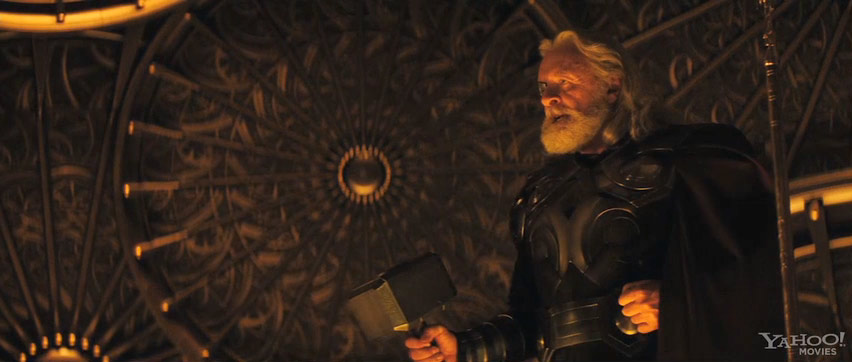
GET OUT OF MY HOUSE, UNGRATEFUL PUNK!!!!

GET OUT OF MY HOUSE, UNGRATEFUL PUNK!!!!

FINE!!  AND I'M NEVER COMING BACK!

FINE!! AND I’M NEVER COMING BACK!

"WHY DIDN'T YOU TELL ME I WAS ADOPTED???!!!" "BECAUSE I KNEW YOU'D FREAK OUT LIKE THIS!!!!"

“WHY DIDN’T YOU TELL ME I WAS ADOPTED???!!!”
“BECAUSE I KNEW YOU’D FREAK OUT LIKE THIS!!!!”

Anyways.  I’m not very good at creating memes.  My point is that there are some fantastic actors in this movie, so we can’t attribute all that yelling, nor those facial expressions (!), to bad acting.  In fact, several of them are also stage actors, and my guess is that they were totally on board with Branagh’s unconventional choice to make a superhero movie look a lot like a live production of Henry V.  (I chose that particular Shakespeare play for a reason, since Branagh on numerous occasions has compared the two stories.  See this fascinating article for details.)

I’ll close this post by saying that next Monday night, my parents are going to see Kenneth Branagh in Harlequinade, a very meta comedy about a troupe putting on A Winter’s Tale, at the Garrick Theatre in London.  (You know that part in the Bible that says, “Thou shalt not covet thy parents’ theater tickets”?)  If this rambling post has been accurate, they will be watching Kenneth Branagh do on stage what he has been doing on film (and directing others to do) for years now in defiance of Hollywood convention.  Stick it to ’em, Kenneth.

I am not fast.

A brief explanation to the people I’ve been road-running with (that is, in the wake of) recently.

My running style can best be understood if you keep in mind that I am basically a hobbit.  I’m about 5’2″ and (this is a nice and fairly accurate way of putting it) solidly built.  I like to walk barefoot and can be quiet and light on my feet, but never graceful like an elf.  I enjoy and am quite good at hiking long distances, like to the Old Forest on the borders of the Shire.  I can carry my dearest (emaciated) friend up the side of Mount Doom, no problem.  But if you expect me to be fast, there we encounter a problem, unless you intend to give me a piggyback ride as Boromir did for Merry and Pippin.

Speed is not my skill.  Endurance is.  I’m well aware that endurance is not glamorous.  It is hard to depict in literature or film, and boring to read or watch.  For me, though, it’s something to be quietly proud of.  I take pride in the fact that during the Virginia Ten-Miler, I keep running steadily up Farm Basket Hill when most of the runners around me, some of them generally faster than I, are slowing down to walk.

Apparently I also have endurance in other areas of my life.  My chiropractor says I have a high pain tolerance, which is kind of an ugly cousin to endurance.  The first time I had a phone conversation with my dissertation chair, whom I’d never met in person, he said he thought I had grit, another close relative of endurance.  I’d like to believe it was the steely note of determination in my voice, but I think he was probably just bluffing.  Still, he must have been right, because I finished my dissertation (relatively quickly, I think, considering some of the logistical difficulties I encountered), and anyone who completes a doctoral dissertation must have grit.

I composed this post in my head during a recent run when I was feeling really bad about the fact that the second-slowest runner was so far ahead I couldn’t even see him.  I’ve framed it as an explanation to my fellow runners, but I think it’s actually just validation for me.  And I’m sharing it on my blog because there may be some other hobbits out there who need to look at their boring endurance trait from a new perspective.  Keep trudging, my friends.

world’s quickest interview, with Penelope Clearwater

Anonymous Interviewer: So, Penelope, are you ever going to post on your blog again?

Penelope Clearwater: Yes.

AI: Ok, good.  Like, when you watch another good movie, or…?

PC: When I finish my dissertation.

AI: Oh!  And how much of that do you still need to write?

PC: In the body proper, about 17 pages.

AI: Cool!  I’ll let you get back to that.


Penelope Clearwater will return in An Epic Celebration.


The Author Who Loved

The title of this post is a pun on “The Author Who Lived,” the title of the doctoral dissertation I’m working right now, which in turn is a pun on Harry Potter’s famous nickname “The Boy Who Lived.”  (My dissertation is about Charles Dickens’s and J. K. Rowling’s unusual relationships with their audiences; you can read a piece of the proposal here.)  All I want to do right now is to share with you a quote I was delighted to come across in my Dickens research.  It was written late in Dickens’s career/life by the respected critic Charles Eliot Norton.  The first sentence could be interpreted as a snide back-handed compliment, but keep reading; it isn’t.  I know there are writers who would disagree with me, but I think Norton in this statement gives Dickens the greatest praise anyone could give a writer.  And perhaps the second-to-last sentence will remind you of someone else.

No one thinks first of Mr Dickens as a writer.  He is at once, through his books, a friend.  He belongs among the intimates of every pleasant-tempered and large-hearted person.  He is not so much the guest as the inmate of our homes.  He keeps holidays with us, he helps us to celebrate Christmas with heartier cheer, he shares at every New Year in our good wishes: for, indeed, it is not in his purely literary character that he has done most for us, it is as a man of the largest humanity, who has simply used literature as the means by which to bring himself into relation with his fellow-men, and to inspire them with something of his own sweetness, kindness, charity, and good-will.  He is the great magician of our time.  His wand is a book, but his power is in his own heart.  It is a rare piece of good fortune for us that we are the contemporaries of this benevolent genius.

Knowing your audience

I just wrote a contribution to the Faith Learning Integration Gallery on the website of the Center for Teaching Excellence at the university where I work.  I decided to share it with you, but since I don’t want to violate the principle my essay is about–understanding and showing consideration for one’s audience–I should let you know that the originally intended audience of this piece consisted of Christian faculty members at a Christian university.  If you’re not one of those people, please don’t feel alienated if you’re not included in the “we” that I refer to throughout the essay.  I think you’ll get at least something from it regardless of whether you’re part of that audience.

In both the Center for Writing and Languages and many of the writing courses offered here at Liberty, we place quite a bit of emphasis on the genres of writing.  Not only is academic writing just one correct way to write among many, but there are also many ways to do academic writing—a research paper, a lab report, a discussion board, a conference presentation.  Each genre has its own conventions, and each is appropriate to a particular context and audience.  Trying to apply the conventions of one genre in the wrong context—for example, following the rules of the literary analysis genre while writing a legal brief—can lead to confusion for both writer and audience.

As Christians charged with communicating a message, we need to remember a similar principle.  The gospel is a constant, unchanging message that can take on an infinite variety of forms.  As is the case when choosing a genre of academic writing, knowing one’s audience is crucial when communicating the gospel.  It’s even more crucial, actually, because although there may be some general principles for sharing the gospel with a particular demographic, such as children, God speaks, and uses us to speak, in a unique way to each person.

Speaking God’s words to real, non-abstract people takes emotional intelligence.  It takes empathy.  It takes the ability to analyze a situation and choose the right course of action.  As it turns out, it takes a lot of the same qualities that make a good writer. 

Scholars with wand collections

I’ve discovered recently that there’s a word for people like me–the people I describe in the title of this post, those of us who see no incongruity between loving a text and studying a text.  The word is aca-fan, and it’s been attributed to media scholar Henry Jenkins, whose blog is called Confessions of an Aca-Fan (henryjenkins.org).  Skim over Confessions and you’ll see basically what I want my blog to be.  Jenkins’s book, Textual Poachers: Television Fans and Participatory Culture (1992), is perhaps the foremost and certainly one of the earliest texts that showed the world that fans aren’t glassy-eyed drooling idiots, and yet somehow I missed out on it while doing my preliminary dissertation research.  (I put in an inter-library loan request for it tonight, and I plan to read passages from it to my Walking Dead fan community next Sunday night.  Just kidding–or am I?)

I also learned tonight that there’s a term for what wizard rock is, except it’s a broader category and existed long before wizard rock (or indeed, Harry Potter) was a thing.  The term is filk, and apparently it comes from a misspelling of folk on a conference program.  (I learned that from Henry Jenkins.)  Essentialy, it refers to nerdy music about fictional characters.  Am I the only person who didn’t know about this?

Ok, one more post about the survey.

I checked my Harry Potter canonicity survey today, and I’ve received 200 responses, which is a good round sum. Also, the responses have lately been trickling rather than pouring in. So I’ve decided to deactivate the survey. Now I can share the results with you!

I’m not going to post the table of all the responses, because it’s a little overwhelming to decipher. (Let me know if you want it in a Word document.) Basically, though, the average respondent ranked the novels as the most canonical source of information about the Harry Potter world and fan fiction as the least. (Not really a surprise there.) J.K. Rowling’s statements ranked as second most canonical. The movies and Pottermore are essentially at a tie for third place based on my cursory glance at the results, but I’m sure that some deeper statistical analysis would reveal some interesting differences. (If I find any, I’ll let you know.)

Thank you to everyone who completed the survey! I hope I get to meet you at LeakyCon someday. 🙂 Now that the survey is closed, feel free to wax verbose about your responses in the comments to this post.

Re: survey

Tonight I checked the results of my survey on Harry Potter canonicity, and I was surprised and delighted to see that I’d received 195 responses!  Thank you all so much for taking the survey and sharing it with others.  I am still collecting responses, so if you haven’t taken the survey yet, or you want to send it to someone else, there’s still time.  Here’s the link: https://qtrial.qualtrics.com/SE/?SID=SV_4PJzrBq5xWEkQVD.

There’s one thing I want to check on.  I said in the instructions that survey respondents could indicate a tie between two or more items by typing the same number for each of the tied items.  I tried to make sure that Qualtrics (the survey platform) would allow a tie in this type of survey, but I’m still having some doubts about that.  If you had two tied items, or if you tried unsuccessfully to create a tie, would you let me know in a comment on this post?  You don’t have to tell me what the tied items were.

By the way, I do realize how badly I’m slacking off in my blogging.  I haven’t forgotten you, dear readers, and I intend to post something non-survey related soon (as in, during October).

I need your help: One-question survey

As part of my dissertation research, I am attempting to gauge Harry Potter fans’ perceptions of the relative canonicity of different sources of information about the universe of the story.  The term canon generally refers to an entire fan community’s collective understanding of what constitutes accepted information about the world of the shared text, but in a large and highly participatory fan community like the Harry Potter one, each person may have a different opinion about what sources are canonical and what makes them that way.  This survey is an attempt to find out how different fans rate the canonicity of several major sources of Harry Potter lore.  Please read the prompt carefully and answer the question thoughtfully.  Also, I’d like to get as large a sample as possible, so please send the survey link to other fans.

https://qtrial.qualtrics.com/SE/?SID=SV_4PJzrBq5xWEkQVD

I want your sympathy.

I’m reading The Casual Vacancy, J. K. Rowling’s 2012 debut “adult” novel, with the intention of having read all of her published works before I really get started writing my dissertation.  (I’m going to wait another week or two to see if inter-library loan can get me The Cuckoo’s Calling before I give up and order it from Amazon.)  I had heard multiple versions of two different, but compatible, assessments of The Casual Vacancy: that it was “racy” (invariably that was the word used) and that it was depressing because the characters were hard to like.

I’ve just finished Part One and found both of these evaluations to be true.  But I’ve also found something I didn’t expect: The Casual Vacancy reminds me strongly of a George Eliot novel.  What tipped me off to the resemblance was the name “Fairbrother”–it’s the last name of the man who dies at the beginning of Rowling’s novel, setting the story in motion, and it’s awfully close to “Farebrother,” the surname of a character in Middlemarch.  But this is just one of many resemblances between The Casual Vacancy and the Eliot canon, especially Middlemarch; others include themes of small-town life (and the pettiness that often accompanies it), sharply accurate depictions of mismatched marriages, long descriptions of characters’ interior thoughts, discussions of the problems of urbanization, and a particular focus on characters moving up or down the English social class scale, which appears in Vacancy to be fascinatingly (and depressingly) little changed since the nineteenth century.

What I don’t see in The Casual Vacancy, at least not yet, is any attempt on the author’s part to help us identify with the characters, especially the ones we don’t like.  Eliot did this a lot, and she did it masterfully, though not very subtly, often using direct second-person commands (“Ask yourself whether you would. . .”), all in an effort to develop the quality of “sympathy” (a key term for Eliot) in her readers.  Sympathy here is not feeling sorry for someone, and it’s not a naive ignorance of anyone’s faults.  It’s the ability to put ourselves imaginatively into another character’s situation and come to the conclusion that we would probably be inclined to act in a very similar way.  The point here is not to make a moral judgment about what would be the right thing to do in the situation, although that would be a logical next step.  The point is to be honest about ourselves.  I think all good realist novelists want their readers to develop sympathy; they just aren’t all as deliberate about it as George Eliot.  I think J. K. Rowling wants that for her readers too; she just isn’t making it very easy in The Casual Vacancy.  But a hard-won sympathy is probably more lasting than the knee-jerk kind anyway.  I’ll reserve my final judgment until I finish the book.

Let me make two more quick points about sympathy in a shameless effort to drag Charles Dickens and Harry Potter into this post:

1. It often takes multiple readings of a book to develop sympathy for a particular character.  When I first read David Copperfield, I thought David’s “child-wife” Dora was an annoying little twit, but now that I’ve read it several times I can see that she is remarkably self-aware in her own way and that she has a better grasp of the flaw in their marriage than David, apparently the more analytic one, does.  You gotta watch out for those first-person narrators.  They think they know everything.  (KATNISS EVERDEEN)

2. One valid reason for writing fan fiction is to try to develop sympathy with an unlikable, “minor,” or even villainous character.  Possibly this may be why there’s a lot of Draco Malfoy fanfic.  Certainly, some of it is of the shallow sort (“He looked extremely sexy and vulnerable as he knelt there weeping onto his elegantly cut black suit”), but I would also imagine–I haven’t actually read any Draco fanfic–that there’s some good stuff that explores, for example, what growing up in Malfoy Manor as an only child with those parents would do to a kid psychologically.

I promise I didn’t intend to write a literary criticism post this week; my original intention was to post pictures of my cute decorations for the afternoon party I hosted yesterday.  But I forgot to take pictures, so this is what you get.  I hope you’ll give me some sympathy.