
Solitude.

Last week I wrote about my plan to observe a weekly Sabbath rest; now, as the next step in plotting out my rule of life (see my July 15 post for a full explanation), I’d like to tell you about my experience with solitude this past Saturday and how I intend to fit this practice into my life.

On Saturday, I spent three hours in one of the group study rooms in the library at my university, which is quiet on a Saturday afternoon at this time of year.  Not by any particular plan (except maybe God’s), I ended up in a room looking out on the rooftop garden, so I got to see a lot of bees pollinating flowers, which ended up figuring into one of the spiritual observations I recorded in my journal.  I don’t think it’s any accident that some of Jesus’ most famous teachings began with invitations to look at the birds and consider the flowers.

I spent these three hours in fulfillment of a post-class assignment in the Regent College course Taking Your Soul to Work, which inspired my effort to create a rule of life.  I was instructed to spend three hours in complete solitude, using the Bible and the book Taking Your Soul to Work (by the course’s instructors, R. Paul Stevens and Alvin Ung) to identify and meditate on my greatest workplace sin/struggle (I chose anger) and the fruit of the spirit that corresponds to it (gentleness, according to Stevens and Ung).  The prospect of three hours of complete solitude was no big deal; I live alone and enjoy being alone, so I occasionally spend entire days without seeing anyone.  But three hours of slow reading, prayer, and thought, without anything tangible to show for it besides some navel-gazing journal entries–that isn’t something I generally do for fun.

I should be honest: I didn’t spend the whole three hours in that one room.  I got up a few times to use the restroom and the vending machines, and I did see a few people; I just didn’t interact with them.  Yes, I ate some snacks; fasting is a separate discipline that I might write about in a future post.  And I did listen to some instrumental music on my iPod; silence is also a separate discipline that is often combined with solitude but is not essential to the practice.  Different people might want to try the discipline of solitude for different reasons, but for me, the main point of the exercise was to 1) focus my concentration on a single activity for a long period of time (this is very difficult for me, which may surprise people who know that I love to read and have written a dissertation) and 2) meditate slowly and deliberately on what God wants to say to me, without immediately jumping to application (this is very difficult for a lot of evangelicals, I would venture to say).

I wouldn’t say that I received any earth-shattering revelations during those three hours, but I did fully recognize–in some cases for the first time–some things about God’s gentleness, my own deep desire to control everything, and the absolute necessity of contentment to the Christian life.  Of course, another topic of meditation might have taught me something entirely different, and that’s the lovely thing about solitude–what you do with the solitude is up to you, so the experience can be different every time.  I plan to incorporate this discipline by taking one of these three-hour mini-retreats quarterly–i.e., every three months.  I should add, by the way, that the three hours seemed to go by much more quickly than I expected.

If you’d like to share your own experiences with either Sabbath rest or solitude, or if you’d like to tell how you plan to incorporate these disciplines into your own life, please comment below!
Am I not smart anymore?

Here’s what I’m a little bummed about right now: I haven’t written what I consider a real blog post (primarily text, longer than a few lines, and not recycled) since “My month with Kenneth,” published on November 10.  When I think about writing an articulate, coherent post that has a meaningful message, I feel really tired.

For example, you need to have transitions in good writing.  Transitions are really hard to write!  (Maybe I need to lay off on my English 102 students.)  I don’t know how to transition into my next paragraph, so I’m just going to jump topics, if that’s okay with you.

There’s a difference between having ideas for writing and actually writing.  I experience the former all the time.  I have so many screenplay ideas in my head, I would probably have a good statistical probability of winning an Oscar if I actually wrote all of them and saw them made into movies.  Examples: Best Adapted Screenplay: Dickens’s A Tale of Two Cities, starring Tom Hiddleston and J. J. Feild (because the screenwriter gets to do the casting, obviously); Best Original Screenplay: Sam’s Home (there’s a pun in that title), a bittersweet comedy about a 30-ish guy with depression who’s had some setbacks and is now back living with his parents and working in the same Italian restaurant he worked at in high school (it sounds like it’s been done before, but I have fresh angles).

See, that paragraph was easy to write!  Because I didn’t have to put sentences together logically; I just used a lot of parentheses.

I used to be able to write really brilliant stuff.  The other day I was thinking about some of my best work: my master’s thesis about eating and bodies in George Eliot’s novels, the short story about Cain and Esau in a diner that I wrote in 2009, the paper I wrote on Moneyball and masculinity in a doctoral film class.  I’ve even written some blog posts that I’m pretty proud of.  (See my archives, at left.)  But now, this is the kind of writing I do every day: “Hey guys, we need to have a meeting about Topic X and Topic Y.  How does June 15 sound?”  After a day of writing that kind of stuff, I’m too mentally tired to write a blog post, or to actually start penning one of those screenplays (although I did read a couple of books on screenplay last summer), or (are you kidding me?) write something scholarly.

Does this mean that my creativity is sapped, that my argumentation skills have significantly waned, that my vocabulary has shrunk, or–as my title sadly suggests–that I’m just not smart anymore?

Or, is one of these three more optimistic things true (I know; “things” is a weak noun)?

  1. I just have to set aside time for writing, as Daniel Silvia has told me in How to Write a Lot.  Perhaps I was lucky in the past and was frequently struck with inspiration, but I shouldn’t expect that to be par for the course (ugh, cliche!).  Maybe if I actually sat down and said, “I’m going to write now,” I would come up with something brilliant.
  2. I can still write pretty decent prose–I mean, I’m writing this post!
  3. The “Hey guys” emails, the comments I write on my students’ papers, the Instagram photo captions–maybe those are actually just as brilliant as those old papers and stories I’m really proud of.  They’re just different kinds of brilliance for different contexts.  Maybe?

#hobbitlife

Several times on this blog, I’ve stated or hinted that I feel I have quite a bit in common with a hobbit.  (See, for example, I am not fast” and my comments on “Another schizophrenic post.”) Yesterday, I formulated my most thorough, yet succinct, statement of this resemblance to date.  I wrote it for a different venue, but I thought I’d share it here.  Enjoy.

If you want to understand me pretty well, you really just need to think of Bilbo Baggins. Like Bilbo, I love my house, and I’m quite proud of keeping it tidy and homey. I like my routine, my alone time, and my square meals. But if you show up at my door and ask me to go on an adventure–well, I might need a little prodding, and I might freak out about forgetting my pocket handkerchiefs, but once you get me on the road, you’ll find me a dependable traveling companion, and I might even pleasantly surprise you with my resourcefulness and (occasionally) courage.

Just as a clarification, I don’t have big ears or hairy feet.

My Month with Kenneth

Kenneth Branagh, that is.  See what I did with the title, there?

I’ve loved Kenneth Branagh and his art ever since my mom made me read Much Ado about Nothing and watch his exuberant 1993 adaptation when I was in middle school.  I love his non-Shakespeare stuff too; in Harry Potter and the Chamber of Secrets, he makes the cringe-worthy Gilderoy Lockhart funny and even likeable.

A few weeks ago, I watched Branagh’s 1994 film Mary Shelley’s Frankenstein twice within the space of four days.  I wanted to show it to the book club I’m faculty advisor for, but first I wanted to watch it (it had been quite a few years since I’d seen it) to make sure I could show it to the students in good conscience, considering that it’s rated R.  I decided that I could, but I prefaced our group viewing with a warning about why it’s an R-rated movie (mostly what the MPAA calls “thematic elements”–it is, after all, about a guy who sews and splices dead human body parts together).  Then I gave them another warning: There’s nothing subtle about this movie.  There’s weeping!  Screaming!  A huge house fire!  A bombastic soundtrack!  Dramatic gestures and facial expressions!  I told the students that I think part of the reason for this lack of subtlety is that it’s an adaptation of a novel from the Romantic period, a novel full of heightened language and unabashed displays of emotion.  (If I had a dollar for every time in the book that Victor Frankenstein flings himself into or out of a conveyance, or his eyes gush with tears…)  The dialogue in the 1994 adaptation is actually pretty understated, but the Romantic emotionalism appears elsewhere in the cinematic elements I mentioned above.

But I don’t think that’s the only reason for the heightened–well, the heightened everything of Mary Shelley’s Frankenstein, because the same over-the-top qualities appear in other Kenneth Branagh films.  I think the reason is that Branagh, like many film actors and directors from the UK, was first a stage actor and is still actively involved in live theater.  (More on this later.)  But unlike many others, Branagh has continued to bring that stage sensibility to the films with which he’s involved.  Everything is bigger on the stage because there’s no camera or audio equipment to swoop in and catch the flicker of an eyelash or a quiet sigh.  Over the years, the film industry has taught us to valorize intimacy and subtlety, and to view “stagey” as a derogatory term.  Kenneth Branagh’s films often challenge those conventions.  Just watch his wild and colorful Much Ado about Nothing, with its triumphant Patrick Doyle score, and compare it with Joss Whedon’s snarky black and white 2012 adaptation, with its smooth jazz score.

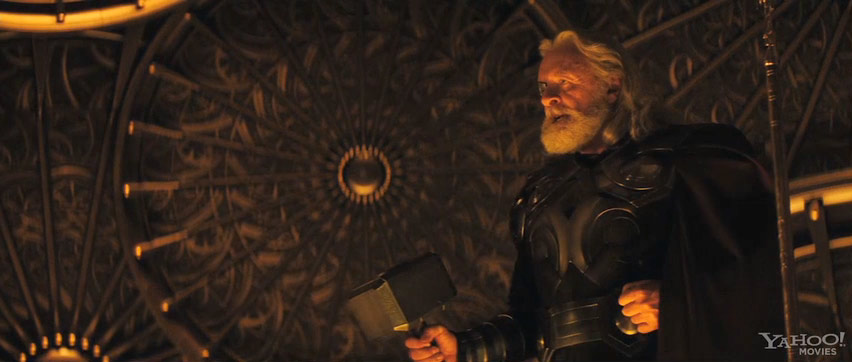
I thought about this more last night when I re-watched Thor (2011), which Kenneth Branagh shocked Hollywood by choosing to direct.  (The one that really shocked me was Jack Ryan: Shadow Recruit–I’m still not sure what Kenneth was doing there.)  Because I’m preparing to write an essay about the Thor movies (I’m sure I’ll say more about this in future blog posts), I was taking notes and paying particular attention to the Shakespearean allusions and the stage conventions that appear in this first film.  I noticed that the dialogue, at least in the Asgard scenes, is very different from the snappy, jokey language typical in superhero movies.  This is a Shakespearean family inheritance drama.  Stakes are high, voices are raised, accusations are flung, tears are shed.  I think that may partially explain why some die-hard Marvel fans didn’t care for this movie–it didn’t fit their expectations.

GET OUT OF MY HOUSE, UNGRATEFUL PUNK!!!!

GET OUT OF MY HOUSE, UNGRATEFUL PUNK!!!!

FINE!!  AND I'M NEVER COMING BACK!

FINE!! AND I’M NEVER COMING BACK!

"WHY DIDN'T YOU TELL ME I WAS ADOPTED???!!!" "BECAUSE I KNEW YOU'D FREAK OUT LIKE THIS!!!!"

“WHY DIDN’T YOU TELL ME I WAS ADOPTED???!!!”
“BECAUSE I KNEW YOU’D FREAK OUT LIKE THIS!!!!”

Anyways.  I’m not very good at creating memes.  My point is that there are some fantastic actors in this movie, so we can’t attribute all that yelling, nor those facial expressions (!), to bad acting.  In fact, several of them are also stage actors, and my guess is that they were totally on board with Branagh’s unconventional choice to make a superhero movie look a lot like a live production of Henry V.  (I chose that particular Shakespeare play for a reason, since Branagh on numerous occasions has compared the two stories.  See this fascinating article for details.)

I’ll close this post by saying that next Monday night, my parents are going to see Kenneth Branagh in Harlequinade, a very meta comedy about a troupe putting on A Winter’s Tale, at the Garrick Theatre in London.  (You know that part in the Bible that says, “Thou shalt not covet thy parents’ theater tickets”?)  If this rambling post has been accurate, they will be watching Kenneth Branagh do on stage what he has been doing on film (and directing others to do) for years now in defiance of Hollywood convention.  Stick it to ’em, Kenneth.

You and I are Edmund Pevensie.

I’m listening to the Focus on the Family Radio Theatre production of The Lion, the Witch, and the Wardrobe.  (By the way, I’m pretty much addicted right now to the FOTF Radio Theatre adaptations of classics, and I’ve nearly exhausted my church library’s stash.  If you have any recommendations in that series or other audio dramatizations I might enjoy, let me know, and I will start looking elsewhere.)  I’m remembering how much I love this story.  The title of my post is pretty obvious to anyone who’s even shallowly considered the Christian implications of C. S. Lewis’s classic.  Duh, of course Edmund represents the sinner who is redeemed by Christ’s (Aslan’s) sacrificial death.

But this time, I’ve been thinking about why it’s so easy for me to identify with this rather unpleasant little English boy from a time before I was born.  I’ve always liked Edmund most of the four siblings–Lucy is basically just cute; Peter is too heroic, and Susan (I hate to say it) is pretty boring.  But that doesn’t explain why I’m so overcome at that point when Aslan comes out of the tent with Edmund and says, “Here is your brother.  There is no need to talk to him about what is past.”  Certainly, I’m moved by the truth behind the scene, but allegory, true as it may be, can often be cold and dry.

I think the reason I identify with Edmund, and why most people, if honest with themselves, probably do too, is that his sins are so mundane.  He is not trying to take over the world; he is not flagrantly cruel; he does not craft audacious lies or tempt with the voice of Satan.  Those are the White Witch’s sins.  Edmund’s sins are a child’s sins: He is jealous of his older brother, pettily mean to his little sister, and generally cross with all of his siblings.  He does tell a few lies, but not the kind that could hurt anyone (so he thinks).  He wants people to recognize that he’s important.  And yeah, he loves sweets a bit too much.

These are a child’s sins, but adults don’t grow out of them.  All of these have been my sins, some of them often.  So that’s why this story means so much to me.  Jesus doesn’t just save flamboyantly evil sinners; he also saves sinners who are cranky, greedy, cowardly, and prideful despite not having very much to be proud about.

For more on unpleasant English boys (in Narnia and at Hogwarts), see my post Sometimes humility must come through humiliation.

I am not fast.

A brief explanation to the people I’ve been road-running with (that is, in the wake of) recently.

My running style can best be understood if you keep in mind that I am basically a hobbit.  I’m about 5’2″ and (this is a nice and fairly accurate way of putting it) solidly built.  I like to walk barefoot and can be quiet and light on my feet, but never graceful like an elf.  I enjoy and am quite good at hiking long distances, like to the Old Forest on the borders of the Shire.  I can carry my dearest (emaciated) friend up the side of Mount Doom, no problem.  But if you expect me to be fast, there we encounter a problem, unless you intend to give me a piggyback ride as Boromir did for Merry and Pippin.

Speed is not my skill.  Endurance is.  I’m well aware that endurance is not glamorous.  It is hard to depict in literature or film, and boring to read or watch.  For me, though, it’s something to be quietly proud of.  I take pride in the fact that during the Virginia Ten-Miler, I keep running steadily up Farm Basket Hill when most of the runners around me, some of them generally faster than I, are slowing down to walk.

Apparently I also have endurance in other areas of my life.  My chiropractor says I have a high pain tolerance, which is kind of an ugly cousin to endurance.  The first time I had a phone conversation with my dissertation chair, whom I’d never met in person, he said he thought I had grit, another close relative of endurance.  I’d like to believe it was the steely note of determination in my voice, but I think he was probably just bluffing.  Still, he must have been right, because I finished my dissertation (relatively quickly, I think, considering some of the logistical difficulties I encountered), and anyone who completes a doctoral dissertation must have grit.

I composed this post in my head during a recent run when I was feeling really bad about the fact that the second-slowest runner was so far ahead I couldn’t even see him.  I’ve framed it as an explanation to my fellow runners, but I think it’s actually just validation for me.  And I’m sharing it on my blog because there may be some other hobbits out there who need to look at their boring endurance trait from a new perspective.  Keep trudging, my friends.

Easter every day

This morning, it was my turn to lead our weekly devotions at work, and I tried (through my scratchy allergy voice) to talk to about how Christ’s resurrection is not only a crucial historical event that means a great deal for the believer’s future, but that it also impacts the believer’s everyday life in the present.  This same theme came up later on as I was praying with a student over the phone and I said something about how we live in Christ’s resurrection power.  So you can imagine my delight this evening when I was reading Brennan Manning’s Abba’s Child and I came across chapter six, “Present Risenness.”  Manning says everything I was trying to say today, and more.  I hope you’ll forgive me for quoting at length from the chapter.

Standing on a London street corner, G. K. Chesterton was approached by a newspaper reporter.  “Sir, I understand that you recently became a Christian.  May I ask you one question?”

“Certainly,” replied Chesterton.

“If the risen Christ suddenly appeared at this very moment and stood behind you, what would you do?”

Chesterton looked the reporter squarely in the eye and said, “He is.”

Is this a mere figure of speech, wishful thinking, a piece of pious rhetoric?  No, this truth is the most real fact about our life; it is our life.  The Jesus who walked the roads of Judea and Galilee is the One who stands beside us.  The Christ of history is the Christ of faith.

Biblical theology’s preoccupation with the resurrection is not simply apologetic–i.e., it is no longer viewed as the proof par excellence of the truth of Christianity.  Faith means receiving the gospel message as dynamis, reshaping us in the image and likeness of God.  The gospel reshapes the hearer through the power of Jesus’ victory over death.  The gospel proclaims a hidden power in the world–the living presence of the risen Christ.  It liberates men and women from the slavery that obscures in them the image and likeness of God.

What gives the teaching of Jesus its power?  What distinguishes it from the Koran, the teachings of Buddha, the wisdom of Confucius?  The risen Christ does.  For example, if Jesus did not rise we can safely praise the Sermon on the Mount as a magnificent ethic.  If He did, praise doesn’t matter.  The sermon becomes a portrait of our ultimate destiny.  The transforming force of the Word resides in the risen Lord who stands by it and thereby gives it final and present meaning.

I will say it again: The dynamic power of the gospel flows from the resurrection.  The New Testament writers repeated this: “All I want is to know Christ and the power of his resurrection” (Philippians 3:10).

When through faith we fully accept that Jesus is who He claims to be, we experience the risen Christ. . . .

. . . In other words, the resurrection needs to be experienced as present risenness.  If we take seriously the word of the risen Christ, “Know that I am with you always; yes, to the end of time” (Matthew 28:20), we should expect that He will be actively present in our lives.  If our faith is alive and luminous, we will be alert to moments, events, and occasions when the power of resurrection is brought to bear on our lives.  Self-absorbed and inattentive, we fail to notice the subtle ways in which Jesus is snagging our attention.

I’ll stop here, but you should really read the whole book.  It can be hard for a Christian writer or speaker to convey a message that is kind, tender, and joyful without sliding off into doctrinal squishiness or compromise.  Brennan Manning walks that middle road with great care and wonderful effect.

Charles Dickens on Christmas (no, not THAT story)

Good evening, readers, whom I have been sadly neglecting this year.  And merry Christmas.  I am probably losing some of you due to the fact that every time I have posted recently, my post has been about Charles Dickens.  It’s just that I love him, and you know how it is when you’re in love.  I actually bought a Charles Dickens finger puppet/refrigerator magnet the other day.  Yes, I did.

I promise that after this post, I’ll take a break from Charles Dickens.  But I want to quote him in this, my annual Christmas post.  (For previous years’ posts, click the “holidays” category in the menu on the left.  There’s an Easter post and a Thanksgiving post in there, but other than that, they’re all about Christmas.  Most years I’ve written more than one annual Christmas post.)  Every year, whether I write something funny or something profound, or a little of each, my goal is to get you to think about Jesus.  Christmas is his day, after all, even beyond the sense in which every day is his day.

Last night I read a few stories from a massive volume entitled The Selected Illustrated Works of Charles Dickens, purchased in the same transaction as the puppet/magnet.  I came across a piece I’d never read before, “The Seven Travellers,” composed of three short stories.  The piece ends with a description of the narrator’s walk home on a cold, quiet Christmas morning, during which everything reminds him of Jesus.  As soon as I read these few paragraphs, I knew I’d be letting Charles write my annual Christmas post for me.  Please enjoy this excerpt, and may the Founder of Christmas bless you richly.  [Note: A couple of the biblical references are a little obscure–a good reason to read, or re-read, the gospels!]

When I came to the stile and footpath by which I was to diverge from the main road, I bade farewell to my last remaining Poor Traveller, and pursued my way alone.  And now the mists began to rise in the most beautiful manner, and the sun to shine; and as I went on through the bracing air, seeing the hoarfrost sparkle everywhere, I felt as if all nature shared in the joy of the great Birthday.

Going through the woods, the softness of my tread upon the mossy ground and among the brown leaves enhanced the Christmas sacredness by which I felt surrounded.  As the whitened stems environed me, I thought how the Founder of the time had never raised his benignant hand, save to bless and heal, except in the case of one unconscious tree.  By Cobham Hall, I came to the village, and the churchyard where the dead had been quietly buried, “in the sure and certain hope” which Christmas time inspired.  What children could I see at play, and not be loving of, recalling who had loved them!  No garden that I passed was out of unison with the day, for I remembered that the tomb was in a garden, and that “she supposing him to be the gardener,” had said, “Sir, if thou have borne him hence, tell me where thou hast laid him, and I will take him away.”  In time, the distant river with the ships came full in view, and with it pictures of the poor fishermen, mending their nets, who arose and followed him–of the teaching of the people from a ship pushed off a little way from shore, by reason of the multitude–of a majestic figure walking on the water, in the loneliness of night.  My very shadow on the ground was eloquent of Christmas; for did not the people lay their sick where the mere shadows of the men who had heard and seen him might fall as they passed along?

Thus Christmas begirt me, far and near, until I had come to Blackheath, and had walked down the long vista of gnarled old trees in Greenwich Park, and was being steam-rattled through the mists now closing in once more, towards the lights of London.  Brightly they shone, but not so brightly as my own fire, and the bright faces around it, when we came together to celebrate the day.


my continuing Dickens obsession

I have an ongoing love for Charles Dickens, but my devotion sometimes hits these especially high peaks, and I’ve been on one of them for the past couple of weeks.  I finished reading A Tale of Two Cities last weekend (see my last post for an earlier observation), and I read A Christmas Carol yesterday and today.  (Of course, this wasn’t my first time through either book.)  I can’t wait to lead a discussion of Carol at the Liberty University Bookstore on December 2.  In the meantime, I’ve engaged in two particularly nerdy expressions of my love for Charles.  Please enjoy.

1. The story of Jerricho Cotchery.  I’ll try to make the frame narrative short: I’m eating out with two of my work colleagues, and there’s a Thursday night football game on TV.  One of us mentions McSweeney’s delightful piece called “NFL Players Whose Names Sound Vaguely Dickensian.”  Later I look up at the game and notice Jerricho Cotchery, who catches my eye because he’s a former Steeler (current Panther).  I realize that if Jerricho Cotchery were in a Dickens novel, he would definitely be a Methodist minister.  He would have a lean and starved appearance, and his ears would stick out from his head at exaggerated angles.  When he preached, his voice would take on a ranting cadence.  Then my co-worker/friend Kristen and I rapidly concoct a plot in which Dickens attempts, unusually for him, to sympathize with a Methodist minister.  I wish I’d written down some notes from this impromptu creative session, but I do remember that Jerricho Cotchery is in love with a happy, useful, and modest young parishioner named Evangeline, and that in the past he did some undefined injustice to Oliver Twist, for which he now feels horribly remorseful.  I hope to return to this story at some point, so if you have any good ideas for Jerricho, let me know in the comments.

2. The Sydney Carton playlist.  I’m really obsessed with A Tale of Two Cities right now.  I went so far as to make a Spotify playlist for Sydney Carton, and it’s a far, far better playlist than I have ever made.  (Actually, it’s my first Spotify playlist.)  You should be able to find it by searching “Sydney Carton.”  If you find a 10-song playlist by Tess Stockslager, you’ve got it.  Here’s your guide to the songs: The first four are anthems for a wasted/purposeless life, with a particular emphasis on songs about drinking, because–let’s face it, friends–Sydney is an alcoholic.  The next three songs are about unrequited love and/or heartbreak; I think it’s pretty clear why those are on there.  (As Lucie says at one point, “He has a heart he very, very seldom reveals, and . . . there are deep wounds in it. . . . I have seen it bleeding.”)  The next two are about people deciding they don’t want to waste their lives anymore; this corresponds to that point in ATOTC when Sydney starts hanging out with the Darnays in the evening instead of with his stupid boss/”friend”/enabler Stryver.  And the last song is about what Sydney wants to do, and finally succeeds in doing, for Lucie and her family.

So, put on the playlist, and get ready to dance, then cry, then dance again, then cry again.  Or, put on the playlist and read A Tale of Two Cities.  And while you’re at it, don’t forget about Jerricho Cotchery.

my literary crushes

First of all, you’ll all be glad to know that I’ve completed the first draft of the body of my dissertation.  Still to go: revisions, introduction and conclusion, and defense.

I thought I’d write a quick post to address something I’ve been saying a good bit lately.  I’ve been telling people that I “have a crush” on several different fictional characters.  What makes this notable is that I’m not talking about characters in movies, who have the benefit of being played by a cute actor.  I’m talking about characters from books.  Some of them have been portrayed in movies, but not in a way that impressed me in the particular way that I’m talking about.  I’m just going to address three here–two classics and a newcomer–but I’m sure I could come up with more if I thought about it.

1. Hamlet.  I hate it when people reduce Hamlet to the adjectives dark, brooding, and indecisive.  (I don’t think that last one is fair, anyway.  He’s trying to make up his mind about things like whether to believe a ghost and whether to kill his uncle.  These are not decisions to be made quickly.)  He’s also very funny in a reckless sort of way, a devoted son with conflicted but deep feelings about his dead father and his living mother, and a pretty deft swordsman.  He’s got a razor-sharp intellect, but that’s not his defining characteristic.

By the way, the main reason I’m thinking about Hamlet right now is that a friend and I tried to figure out his Myers-Briggs type today.  We settled on INFP.  I would date that.

2. The Deathless Man from Tiger’s Wife by Téa Obreht.  My book club recently read this 2011 magical realist novel.  The deathless man is this guy who shows up from time to time and basically fulfills the function of Brad Pitt’s character in Meet Joe Black, without the social awkwardness.  I fell in love with him early in the novel, when he was described as having large eyes, a feature I find very attractive.  (For a visual, look up a picture of JJ Feild RIGHT NOW.)  He continued to win me with his polite, calm, and occasionally gently sardonic manner, and then he totally stole my heart near the end when he ordered this fantastically sumptuous meal at a hotel in order to make a dying waiter happy, but clearly enjoyed it for what it was, not just for the good deed angle.  I like a man who likes to eat good food.

3. Sydney Carton from A Tale of Two Cities.  I guess it’s a cliché to fall in love with the guy who says, “It is a far, far better thing that I do than I have ever done.”  If so, I’m happy to be a cliché.  This is our current book club selection, and I’m about 100 pages in and remembering how much I love this man who sacrifices himself (in so many ways throughout the novel, not just at the end) without being an insufferable martyr, who is bitter without being cruel, and who loves long and hopelessly without being a sentimental sap.*  I’ve long noticed a similarity in stories between Sydney Carton and Severus Snape, but Carton is a more pleasant character because he doesn’t take himself so seriously.  (Note that this is a theme for me.)

While we’re on this topic: There hasn’t been a good Tale of Two Cities movie in a long time, so I’m taking suggestions for two actors who look similar enough to play Sydney Carton and Charles Darnay.  You can’t have the same actor play them, because then you’d have this weird fantasy doppelganger thing, which would take the focus off what’s really going on.  Please leave me your suggestions, along with your own literary crushes, in the comments.

*Which he could have easily become if Dickens hadn’t restrained himself.  I love Charles Dickens very much, but I’m willing to admit that he sometimes warms my heart so much I want to throw up.