
I’m working on my Moneyball paper, and I’m afraid I’m about to argue myself out of the point I’m trying to make. I want to argue that Moneyball isn’t really about money; it’s about worth, something for which money is merely a symbol. But the evil little Marxist inside my head keeps saying that everything is about money, and that by silencing the issue, the film is complicit in the economic disparity it initially gestures toward critiquing. I think the evil little Marxist’s argument is reductive, but I don’t know how to refute it. I just can’t buy that everything is about money. Similarly, as intrigued as I am by Freud’s ideas, I just can’t buy that EVERYTHING is a phallic symbol. Someone did a presentation on Star Wars yesterday in which it seemed that pretty much every scene was a castration, and I was really frustrated. I think I just need to get OUT OF HERE and back to people who talk about normal stuff.
Category Archives: books
Swallowed in the sea
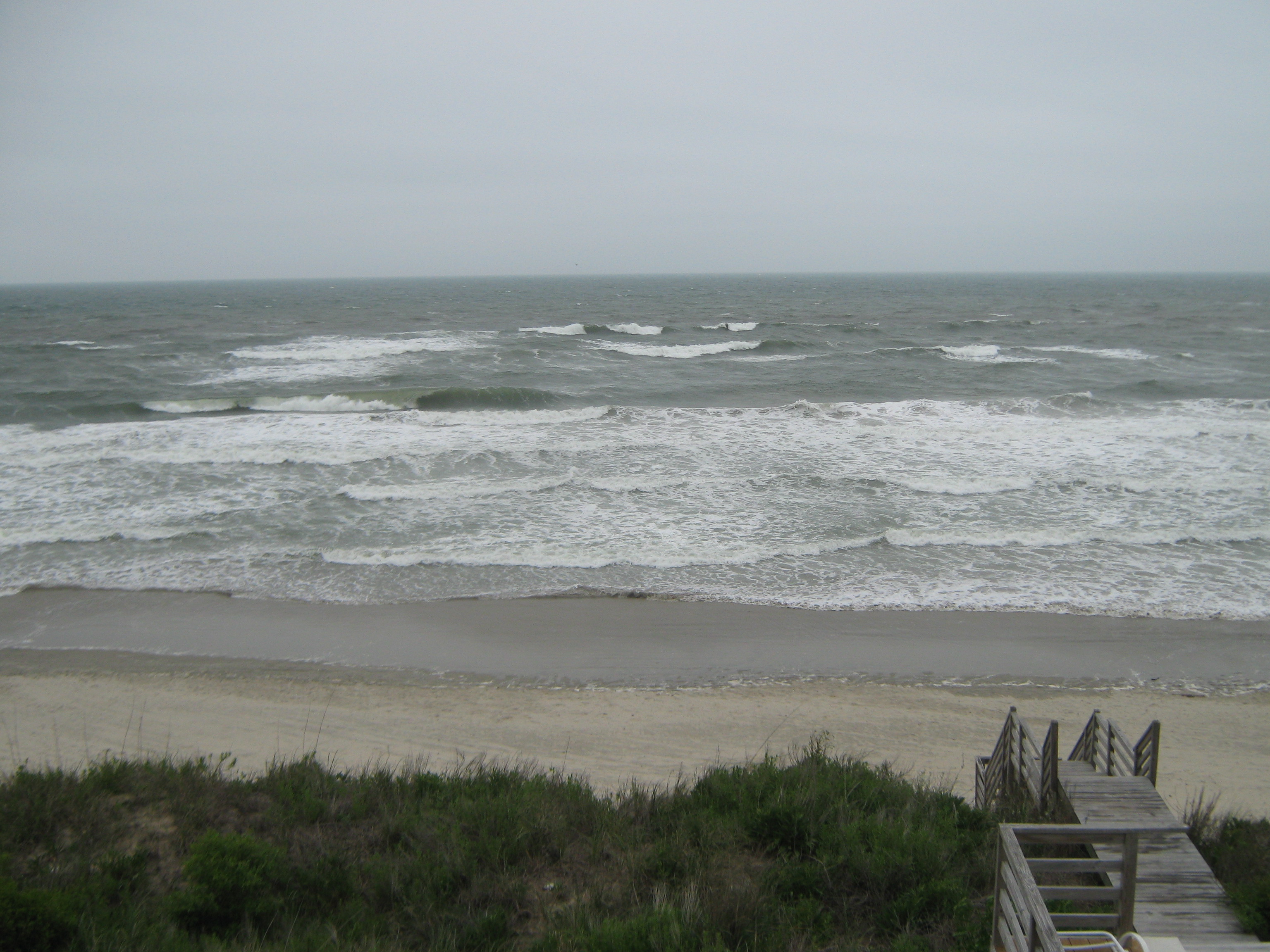
I wish you could hear the wind where I am right now. Then you might begin to understand with me that the old literary commonplace about the wind sounding like a human voice–moaning, screaming, calling–is more than just an old literary commonplace. It’s a blustery day at Whalehead Beach, the tide is freakishly high (at least it looks that way to landlubber eyes), and the ocean’s surface is frothy. The wind sounds like the voice of someone lost at sea (sorry, another cliche). A formation of large birds flies by, and I think of the Ancient Mariner’s albatross. I am also thinking about the climactic storm at Yarmouth in David Copperfield, and also about a Coldplay song, as you can tell by my title. I am so little acquainted with the ocean that apparently I am unable to think about it except in terms of books and music.
These pictures will make you think I’m exaggerating; I am too scared (and cold) to go down on the beach and get a better view. Anyway, you would need audio to really get a sense of what the sea is like right now.

Seeking unlikely hero who’s good with plants
I realize this morning’s post was probably a bit of a snooze for people who haven’t read The Rise of Silas Lapham (even though the novel itself is not a snooze–I’ve been flying through the last hundred pages this afternoon and evening), so this evening I decided to write something more fun, or something that at least nerds like me will consider fun.
I was thinking earlier about the two fictional characters I’m most in love with. One, Sam Gamgee, I’ve loved since I first read The Lord of the Rings at age 13; the other, Neville Longbottom, I’ve loved for a shorter time but no less fervently (I have a larger-than-life-sized representation of him in glossy cardboard). The similarities between the two are significant: both appear somewhat incompetent on first impression but turn out to be undeniably capable and even heroic, and both have a knack for botany (or Herbology, in Neville’s case). Also, now that I think of it, both are intimidated by angry wizards. But who wouldn’t be?
Based on these ideal figures, I’ve compiled a list for the reference of any guy who may, for whatever reason, want to impress me.
1. I would be really impressed if you could slay something, preferably something that urgently demands to be slain, such as a squadron of orcs or a snake that’s actually a Horcrux.
2. You need to be able to locate plants with magical properties in case I need them in an emergency. For example, if I am stabbed by a Morgul blade, I will need you to find me some athelas, also known as kingsfoil. Or, if I need to spend a prolonged period of time underwater (I was thinking about visiting the Titanic site with James Cameron), I will require gillyweed.
3. It would also be nice if you had some skill with regular, non-magical plants, particularly edible plants like po-ta-toes and strawberries (do you remember the taste of strawberries, Mr. Frodo?). Here Sam has a decided advantage over Neville. I guess it’s possible that Neville is cultivating a little kitchen garden next to his venomous tentacula plants, but we know for a fact that Sam cooks (unintentional 1960s popular music reference!). But if we’re talking about advantages and disadvantages, let’s be fair: Neville owns a pair of shoes. Also, Neville is human; technically, Sam is not. But this isn’t a competition.
4. If you have a domineering older person in your life, such as your old Gaffer or your Gran, you will always have someone whose good opinion you strive to live up to or whose poor opinion you strive to prove wrong. This will play a large part in your emerging heroism.
5. I don’t mind if you say lots of ridiculous things; in fact, I will probably find it endearing. But try to come up with at least one awesome line to deliver at a tense moment. For example, if someone asks you how your parents are, try saying, “Better, now they’re about to be avenged.” Or, here’s one that works in all kinds of different situations: “I can’t carry it for you, but I can carry you!”
Well, that should give you something to work with. If you think you could live up to my exacting standards, and especially if you’ve ever had your Remembrall stolen or gotten excited about seeing an oliphant, please inquire.
Dinner Party, 1885
I borrowed the title of this post from a short story I wrote several years ago. In my story, I attempted to convey the awkwardness, tension, and even suppressed heartbreak of a gathering where the participants are trying very hard to act as expected of them according to their positions in society. (In the original version of the story, the characters didn’t have names; they were called “the banker,” “the student,” “the epicure,” etc.) I’m proud of that story–maybe I’ll share it here sometime–but if you really want to get a sense of the pressure of playing to type, you can either go back to high school, or you can read a novel from the 19th century. I recommend the latter.
Before this past weekend, I would have recommended reading a Victorian novel, specifically. I probably would have made some generalization about how the English have always been so much more hung up on class than the Americans. While this may be broadly true, William Dean Howells’s 1885 novel The Rise of Silas Lapham, which I haven’t quite finished yet, provides a poignant and funny (and poignantly funny) illustration of a particular type of social conflict that is uniquely American: the brash yet self-conscious invasion of Boston’s artistic and intellectual aristocracy by a self-made industry hero and his well-meaning but culturally backward family. The eponymous mineral paint millionaire finds himself in a disorienting position: The popular newspapers valorize him for exemplifying the American spirit of independence and bootstrap-pulling-up (huh?), but the cultural elite smirk at him even as they find themselves obligated to pay homage to his money by socializing wih his family. It’s a very 19th-century story, but then again, it’s also depressingly familiar to 21st-century readers. Heads of corporations are still alternately fawned over, sneered at, praised and blamed for events they probably didn’t bring about. And America certainly still has an intellectual aristocracy–read The New Yorker.
The narrative voice of Howells’ novel reminds me of George Eliot’s, but without a lot of the philosophical interruptions that can make it hard to slog through parts of Middlemarch. The main similarity is that both narrators demand our sympathy for all of the characters, no matter how distasteful they’re acting. At first I was undecided as to whether I was supposed to sympathize with the Laphams, who sometimes come across as vulgar but have an endearing family relationship, or the Coreys, who are often snobbish but take a refreshingly clear and witty view of what’s going on. Then I came to the conclusion (which I realize could be altered by the ending) that I’m supposed to sympathize with everyone. This is all the more striking considering the fact that Howells, from what I gather from the editorial notes, hung out with people like the Coreys. He could have written a completely satirical portrayal of Silas Lapham, even a farce, but instead he wrote a novel of great sensitivity.
Lapham’s oldest daughter is named Penelope, so of course I have a special bond with her. She’s a particularly interesting character because she is, in a sense, caught between the two worlds. She reads more than anyone else in her family, and she has a sharp wit that almost, but not quite, would enable her to hold her own in the Coreys’ drawing rooms. Also, I think Tom Corey is in love with her, even though he’s supposed to be in love with the pretty younger sister, Irene. I fear no good can come of this, but I can’t wait to find out.
Another Penelope
After grading a student’s paper about Tennyson’s poem “Ulysses,” I thought it would be nice to give a shout-out to another great Penelope, she of the never-ending tapestry in Homer’s Odyssey.
I’ve never done any research on critical responses to the Odyssey, but I’m guessing that Penelope is not a favorite character among feminist theorists, since she’s gone down in history for nothing more than being faithful to her husband, who’s out there having adventures with the boys and spending time with gorgeous sea witches. But Penelope isn’t a brainwashed, bovinely loyal house-slave. She’s smart, for one thing–note the brilliant weaving idea. And her faithfulness to Odysseus is perfectly rational. After all, the men she’s trying to fend off are coarse-talking, booze-swilling idiots who can’t even string a bow, let alone shoot an arrow straight. I suppose she could give up men entirely and go off on adventures of her own, but she has a good reason for staying home: the man she’s waiting for is worthy of a brave, intelligent woman. Odysseus is clever (he came up with the Trojan horse plot), resourceful (having survived Circe, Calypso, Charibdys, the Cyclops, and other obstacles, not all of which begin with C), and pretty obviously in love with his wife. He’s clearly worth waiting for. So in Penelope’s case, faithfulness and personal fulfillment go hand in hand. They aren’t always mutually exclusive, something feminist theorists (at least of the knee-jerk variety) seem unwilling to understand.
Penelope is such a great character that Tennyson’s easily overlooked reference to her in “Ulysses” is insulting. Telemachus, the son, gets a couple of lines, but Penelope only gets three words: “an aged wife.” Come on, man! Not even her name? In general, I love Tennyson’s stirring and wistful interpretation of Odysseus’s last great speech, but the treatment of Penelope is disappointing. Better for her not to be mentioned at all than for her significance to be tossed aside in such a demeaning way.
Well, if Tennyson won’t give Penelope the respect she deserves, I will. Penelope Clearwater salutes you, Penelope of Ithaca.
“Heaven knows we need never be ashamed of our [f]ears.”
The title of this post is a modification of a Dickens quotation. In the original, the final word is “tears,” but when I look at the quote every morning on the cover of A Charles Dickens Devotional (previously reviewed), the t looks like an f, so I’ve gotten it into my head the wrong way. Anyway, I think both sentiments make sense.
I chose the title because last night I was thinking about my top three greatest fears, particularly my probably irrational fear of getting seriously ill or injured and consequently losing some brain function, leading me to become or appear less intelligent. Sometime I may write a full post about my biggest fears (I’m sure they look pretty silly when written down), but for now I simply want to give you a list of disconnected, but related, quotations and thoughts that have come to me while I’ve been worrying about the fear that I mentioned and pondering the subjects of humility, not holding too tightly to what I value, and not caring so much about what people think of me.
(This list is dedicated to all the Ravenclaws out there and to Hermione Granger, who should have been a Ravenclaw.)
- Wit beyond measure may be man’s greatest treasure, but God’s wisdom makes our wit look like foolishness.
- “Because the foolishness of God is wiser than men, and the weakness of God is stronger than men . . . God has chosen the foolish things of the world to put to shame the wise, and God has chosen the weak things of the world to put to shame the things which are mighty.” (I Corinthians 1:25, 27)
- “Take my intellect and use / Every power as you choose.” (Frances Ridley Havergal)
- “Though I speak with the tongues of men and of angels, but have not love, I have become sounding brass or a clanging cymbal. And though I have the gift of prophecy, and understand all mysteries and all knowledge, and though I have all faith, so that I could remove mountains, but have not love, I am nothing.” (I Corinthians 13:1-2) N.B., Ravenclaws: Luna Lovegood gets this.
Oh, P.S. Perce Shelley, Queen Mab, and I are doing fine now. I no longer want to shoot myself in the eye. Hope you enjoyed the Wordsworth anyway. 🙂
The Hunger Games and exploitation
Everybody already knows that The Hunger Games is, in part, a social commentary on a lot of things: surveillance, reality television, extreme body modification, poverty, governmental power, etc. The morning after I saw the movie (which is quite good), I tried to think of something new to say about it on my blog. This came to me while I was blow-drying my hair, an activity which seems to generate many good ideas for me:
The Hunger Games is a commentary on the entertainment industry and how you “break into” it. The Careers from Districts 1 and 2 are analogous to professional actors: They are, in most cases, born to privilege. They have trained to be performers their whole lives. They volunteer because they enjoy doing the kinds of things the Games require them to do.
I haven’t found a good analogy for the people in the middle districts–maybe they’re people who play bit parts in movies and television and don’t really get recognized–but those in the outer districts, 11 and 12, are parallel to those who get dragged into the entertainment industry by exploitative measures. These tend to be people who either need the little bit of money that temporary notoriety might bring them, or have a personal non-conformity that our society’s Gamemakers judge to be potentially good entertainment. (In the old days, this latter group would have been in circus freak shows.) I’m talking about the people who appear in shows as widely ranging in subject matter and in quality as The People’s Court, Hoarders, Extreme Makeover Home Edition, The Biggest Loser, and even the audition weeks of American Idol. To some extent, also, the casts of recent “redneck” reality shows such as Swamp People and Duck Dynasty are in this category, although they seem to be more self-aware and wry than those on the other shows I mentioned. I’m not saying that all of these shows are purely exploitative, but I am saying that the reasons many people watch these shows are the same reasons the Capital’s citizens watch The Hunger Games. The reasons are a complex web including identification, sympathy, curiosity, and the attraction of repulsion. Cruelty may be part of the web for some people, especially in the Capital, but certainly not everyone.
An example of curiosity about other lifestyles, a curiosity that can become exploitative, is the tradition of dressing the tributes in costumes that stereotypically represent their district’s industry. The Capital’s citizens can say, “Oh, isn’t that cute (or weird); they’re coal miners!” without really attempting to understand District’s 12’s culture or challenges. That’s why it’s so important that Cinna gives Peeta and especially Katniss a measure of dignity by designing costumes for them that are truly attractive and represent their district in a subtler way.
I may return to this rather undeveloped post later. Feel free to chime in.
Happy birthday, Charles Dickens!
Today is the bicentennial of Charles Dickens’s birth. I have been trying to decide how best to use my blog to commemorate the day, and I haven’t come to a satisfying conclusion. I think the problem is that there’s too much Charles Dickens. I can’t pick just one favorite character from his teeming world, where every time you turn a London street corner you’re likely to run into an old enemy, a dear school friend, or a long-lost relative. Or, maybe just a singular character whom you ran into on that same street corner ten years before. I can’t pick just one favorite line from the most verbose Englishman since Shakespeare (I’m not doing an accurate word count, here; I’m just referring to the exuberant flow of language that characterizes the work of both authors), who mastered both snark and sentiment, and can still make readers who have never seen the Thames feel a creeping London fog rolling in with the night over the river.
To my readers who don’t know what I’m talking about: for the characters, read David Copperfield. For the descriptions, read Bleak House. For something short to start off with, read A Christmas Carol. And let me know what you think!
Harry Potter humor
Despite its title, I’m trying to make sure this does not become a Harry Potter blog, and I intend for my next few posts, after this one, to have nothing to do with HP. (For example, I’m planning to review the final David Crowder Band album, Give Us Rest, which was released last week.) But I couldn’t resist sharing a thought I had the other day: What if every bestselling novel and series released since J.K. Rowling started writing Harry Potter was actually about Harry Potter? Here are some hypothetical synopses.
1. A Series of Unfortunate Events. The life of Neville Longbottom.
2. The Hunger Games. An account of the brawl that inevitably ensues when a meal is served at the Weasley home. First come, first served.
3. The Help. A socially conscious young woman named Hermione Granger meets two house-elves, Dobby and Winky, who will change her life forever.
4. The Shack. An allegorical story set in the ramshackle structure outside Hogsmeade where Remus Lupin (see Twilight below) can ride out his lycanthropic fits without hurting anyone.
5. Diary of a Wimpy Kid. Never mind, this is the one about Neville. (I love you, Neville.)
6. The Half-Giant Man with the Dragon Tattoo. Things you didn’t know about Hagrid.
7. Eragon. A spin-off series in which the tattooed half-giant’s dream comes true: he befriends a talking Norwegian Ridgeback named Norbert.
8. Percy Weasley and the Ministry Aides. Ambitious Hogwarts grads take on stacks of paperwork of Olympian proportions. Olympian.
9. Left Behind. What happens to Harry when he has to stay at school because he didn’t get his Hogsmeade permission slip signed.
10. Twilight. Nymphadora Tonks has to decide whether she wants to be with Remus Lupin or a nattily dressed vampire who looks like Cedric Diggory.
We have a winner!
Congratulations to Allison, the winner of a lovely hardcover copy of A Jane Austen Devotional. Allison, I have already sent your address to the PR representative who sponsored the contest, so you should be receiving your book in the mail soon. Here again is the Jane Austen quotation that Allison shared as her contest entry, along with her commentary:
In which Miss Elizabeth accepts an invitation to the Lakes and consoles herself over the loss of Mr. Wickham with admirable humo(u)r:
“‘Adieu to disappointment and spleen. What are young men to rocks and mountains? Oh! what hours of transport we shall spend! And when we do return, it shall not be like other travellers, without being able to give one accurate idea of anything. We will know where we have gone—we will recollect what we have seen.’”
Having now been to the Lakes, I have a new appreciation for the heart-healing power of rocks and mountains!
Honorable mention goes to Vickie, who, I hear, has already gone out and bought her own copy of the book at Lifeway. The Charles Dickens contest received no entries, sadly. I do realize that C.D. is not everyone’s cup of tea, but perhaps some of you should try him out and see what you’re missing!
 the Dr. Tess blog