A soft heart does not equal a soft head.

Today I want to acknowledge and dispel a common misconception about Hufflepuffs: You know, the one about this being the house for people who weren’t smart enough to get into the other houses. You can see where the stereotype comes from; after all, our common room is the only one that you don’t have to solve a riddle or even remember a password to get into. But when you look at some of our alumni, like Newt Scamander and Cedric Diggory, the suggestion that Hufflepuff is a house full of incompetents becomes ridiculous. Even badgers are traditionally thought of as canny. Perhaps it’s more accurate to say that instead of emphasizing the individual possession of intelligence, Hufflepuff focuses on the wisdom of groups (loyalty) and the application of one’s gifts (perseverance). Other qualities commonly associated with Hufflepuff, such as kindness and justice, make me think of a specific type of intelligence: emotional intelligence, which I’ve written about extensively on my blog (see this post and many others–just click on the “emotional intelligence” tag). Emotional intelligence, or EQ, involves understanding oneself and others and making wise decisions based on that understanding. And I hasten to add that EQ is not an exclusively Hufflepuff property; Ravenclaw Luna Lovegood is a wonderful exemplar of it.

Let’s look at an EQ principle that applies particularly to leadership*: A soft heart does not equal a soft head. Making decisions based on empathy is popularly associated with vague thinking. In fact, most people would probably consider the phrases “making an emotional decision” and “making an illogical decision” to be synonyms. But Hufflepuff leaders (and the many EQ theorists of the past several decades, beginning with Daniel Goleman) know that both rationality and emotion can be vehicles of wisdom. (Actually, much earlier thinkers knew this too–I have a quote taped to my laptop that’s attributed to Blaise Pascal, though I can’t vouch for the accuracy because I got it from the tag of a Celestial Seasonings teabag: “We know truth, not only by reason, but also by heart.”) We also know that having empathy for the people we lead does not mean having low standards or not caring what they do. After all, both mercy and justice are Hufflepuff qualities. Holding them in tension–leaning to one side or the other as the occasion demands, but striving to remain upright in the middle–is hard work (which Hufflepuffs aren’t afraid of, right?) that is well worth the effort. In fact, those of us who serve the God of the Bible will recognize justice and mercy as two of his attributes that are frequently associated in Scripture; e.g. Psalm 85:10: “Mercy and truth have met together; Righteousness and peace have kissed.”

So we can lead with love and still be savvy, have high standards, and hold people (and ourselves) to them.  I would love to hear stories about how you or a leader you know has done this!

*I should have made it clear earlier that I’m not using “leadership” as the businessy jargon term it’s often used as. For our purposes, leadership encompasses much more than being a CEO; it could mean being a mentor, a parent, or–as I often conceive of the role–a teacher.

guest post: “Slytherin will help you on your way to greatness”

Today, I’m pleased to be able to feature the work of our Slytherin correspondent, Andy Ford, who will be looking at the hallmark traits of the serpent house from a Christian perspective. Let him know what you think on Twitter: @Andy_Ford

Or perhaps in Slytherin,

You’ll make your real friends,

Those cunning folk use any means,

To achieve their ends.

Pride.

Ambition.

Cunning.

Can a person be both a believer in Christ and a Slytherin? Can a person balance Pride, Ambition, and Cunning with following Christ? I’m not sure. I’d like to think so. I’d like to be both, a Slytherin and a Christian. I’d like to be one unified person, rather than have two sides of myself warring with each other.

The first problem for the Christian Slytherin, at least on the surface, is that Pride, Ambition, and Cunning are all things to which the Christian must die. Pride is often condemned, Paul warns against selfish ambition and vain conceit, and the serpent in the Garden is described as cunning. The question, then, is: can a Christian exercise Pride, Ambition, and Cunning while maintaining his or her witness? To answer this question we must first define terms. For the purposes of this discussion, I will use the word “Pride” to mean the opposite of humility, I will use the word “Ambition” to mean “a strong desire to do something, typically requiring determination and hard work,” and I will use the word “Cunning” to mean “having or showing skills in achieving one’s ends by deceit or evasion.”

So first, Pride. Pride is and has long been considered sinful; ask Thomas Aquinas. But is there a difference between, for example, Lucifer’s pride in Ezekiel 28:17, and being a proud alumnus of Liberty University, or being proud of a child when he succeeds at something he cares about. Again, the Pride I am discussing is the opposite of humility. One of my Graduate School professors taught me that all sin is ultimately idolatry, and all idolatry is ultimately Pride. Which means that all sin is Pride and thus all Pride is sin. As believers, we are instructed to die to ourselves daily and that includes dying to our own Pride. However, for every command against in the Bible, there is a command to. In the case of Pride, we die to it to embrace what I would call holy confidence. We are told to approach the throne of Grace with confidence. Confidence that we will not be turned away. That confidence has nothing to do with our accomplishments but has everything to do with the character of God. Brennan Manning (who is always a Win) wrote that God’s fundamental attitude toward us is one of affection. This affection directly contradicts Pride, because it is not dependent upon our own actions. Regardless of how holy or unholy we think we are, God’s attitude does not change. There is nothing we can do to change God’s attitude toward us; we are loved. Period.

This raises the question of how a Christian can exhibit the Slytherin trait of Pride without contradicting his or her walk with God. The answer, I think, lies in the type of Pride discussed. A person can be proud to be part of Slytherin House without falling into the sin of Pride. This does not mean being ashamed of being a Slytherin, or making excuses for the Sorting Hat’s decision, but rather it means that one understands both the benefits and the weakness of the House.

Ambition raises a slightly different question, although one that still has its own complications. Ambition is frequently pointed to as the defining characteristic of dictators and tyrants, like the titular character in Shakespeare’s Julius Caesar, but the Apostle Paul writes that we should do nothing out of selfish ambition, which implies that there is another type of Ambition that is not selfish, and I think that’s the type of Ambition Slytherin House should emphasize. Salazar’s personal desire for greatness aside, being a Slytherin is not about being the greatest ever for the sake of being better than anyone else. That way leads to Voldemort’s obsession with becoming the Master of Death. Instead, I think true Slytherin Ambition is about becoming the best version of one’s self for the sake of being better than one was. Hemingway wrote, “There is nothing noble in being superior to your fellow man; true nobility is being superior to your former self,” and I think the same can be said for Ambition. True, Godly ambition is the desire to improve one’s self and the desire for continuous sanctification.

I’ll be honest, Cunning put me into a quandary. On the one hand, in the New King James Version of the Bible, the serpent in the Garden is described as Cunning. (The New International Version and the New American Standard Version both use “crafty,” while the King James Version uses “subtil.”) On the other hand, Jesus tells his disciples to be as wise as serpents and innocent as doves. As the symbol for Slytherin House is a serpent, I find this to be an interesting connection. So, which is it? Is Cunning evil or not? The problem is: Cunning implies deceit, deceit implies dishonesty, dishonesty implies lying, and lying is a sin. By telling his disciples to be as wise as serpents, is Jesus instructing his disciples to get what they want through deception? Obviously not. I think the proper, Godly use of cunning is in a sort of “it takes one to know one” sort of a way. The context of Jesus’ words is: he’s sending his disciples out into the world to spread his message, and he’s instructing them on how best to keep themselves safe. One of my all time favorite movies is Gone Baby Gone, and the film opens with the main character, Patrick Kenzie, discussing this exact question: “When I was young, I asked my priest how you could get to heaven and still protect yourself from all the evil in the world. He told me what God said to his children. ‘You were sheep among wolves. Be wise as serpents, yet innocent as doves.’” I think Jesus meant: you are about to enter a fallen world, be aware of how people will try to take advantage of you and do not let them. But, and this is the “innocent as doves” part, do not do anything that would compromise your witness. Do not be taken advantage of, but in your attempt to avoid being taken advantage of, do not take advantage of someone else.

Neither Pride, nor Ambition, nor Cunning is necessarily evil in its own right. They are simply traits, like having red hair or blue eyes. The question is: how will the person who possesses those traits make use of them? And that depends, in large part, on the character of the person. This is the important part. A person’s sorting says what traits they possess and says absolutely nothing else about the type of person sorted. The Sorting Hat makes no character pronouncements. There are evil Slytherins, absolutely. But there are also good Slytherins (not naming names; I’ve been in that fight before, and it’s not worth it). The point is: Slytherin is not necessarily “the Evil House of Evil.” It does seem to have a uniquely dangerous combination of virtues, especially when compared to the Integrity and Hard Work of Hufflepuff and the Intelligence and Creativity of Ravenclaw, but having traits that are perceived as negative is not the same thing as being evil. A person can balance all three while remaining a good person. The goal, I think, of being a member of any organization is to identify both the strengths and weaknesses of that organization and embrace both, making use of its strengths and avoiding its weaknesses. As Harry tells Albus Severus in the final scene of Deathly Hallows, it does not matter into which House a person is sorted as long as the person does their best and strives to be a good person. For a Christian, as long as he or she is open to the correction and guidance of the Holy Spirit, God will mold them into the type of person God wants them to be.

Hufflepuff Leadership: a bit more explanation

Based on the copious positive feedback I received on last week’s post, I plan to move forward with the Hufflepuff Leadership project, but as you can see, I haven’t taken any steps yet toward changing the look of the blog.  I did receive an offer of free design work that I’m definitely going to take up, and I have an idea about the cover illustration.  I thought it would be fun to find a picture of a badger (the Hufflepuff mascot) in a business suit, and of course, this made me think about Badger from The Wind in the Willows.  I’ll probably need to check copyright/fair use issues if I’m going to use the picture as part of my brand, but just for this post, I think it’s probably okay to show you this example that I found on someone’s Pinterest: Wind in the WillowsOkay, it’s not exactly a business suit he’s wearing, but Mr. Badger definitely appears to be in a leadership role in this picture, wouldn’t you say?
As I mentioned last week, I’m thinking of writing from the perspective of a Hufflepuff prefect.  It just so happens (I’m about to get weirdly confessional here) that I have invented what amounts to a Mary Sue character (a character in fan fiction who is essentially the author inserting him/herself into the story) named Rebecca (my middle name), or Becky, Weasley (she’s married to Charlie!), who is a Hufflepuff alum and former prefect.  I also made up a Weasley nephew named Patrick who is a current Hufflepuff prefect.  I don’t know if I’ll use these characters extensively because I’m a little embarrassed about disclosing the extent to which my unwritten fan fiction has gone, but now that I’ve introduced them to the world, I guess they’ll at least have to make occasional appearances.

I’ll probably kick off the new project with a series of posts about the basic principles of Hufflepuff leadership.  I’ve already thought of clever aphorisms to express a couple of these, such as “A soft heart does not equal a soft head.”  I’ll illustrate these principles with my own experience, research on emotional intelligence and other concepts from various fields, conversations with colleagues, and of course, Hufflepuff students and graduates from the Harry Potter canon.  Also, based on responses from last week, it sounds like I have a good team of writers who can give us the Griffyndor, Ravenclaw, and Slytherin perspectives on these issues as well.

I also mentioned last week that not all posts from here on out will necessarily be directly focused on the theme.  For example, this past weekend, I attended the Southeastern Writing Center Association conference, and I deliberately chose sessions on concepts that I could see myself writing about on this blog: vulnerability, burnout, mentoring–topics from the non-cognitive side of tutoring.  From time to time, I will report on events like these (as well as books I’m reading, movies I’ve seen, etc.) and may not necessarily use the language of Hufflepuff leadership, but I won’t stray far away from topics my regular readers will be interested in.

As always, let me know what you think!


Hufflepuff Leadership: a blog idea

I’m thinking of rebranding my blog. Before I explain why, I’ll briefly explain the blog’s history for those of you who haven’t been with me from the beginning.

I started penelopeclearwater.wordpress.com in December 2011 so that I could get two free books. A friend had told me about an opportunity to receive the books for free in exchange for reviewing them on my blog. I didn’t have a blog, but there’s a lot that I’d be willing to do for free books, so I started one. (I posted the book review in January 2012.) As you will see if you read my inaugural post, I had fairly high aspirations for the blog (I wanted it to be “a place where thoughtful inquiry and the magic of words can thrive”), but I never had a specific theme in mind. For the past 6+ years, I’ve kept that tradition alive, posting about whatever I felt like posting about. In that inaugural post, I also explained the reasoning behind the blog’s name–and its subtitle, which is the motto of Ravenclaw House–and while my original ideas about the title still apply, I’ve come to identify with Hufflepuff more than Ravenclaw (a journey I’ve documented well here on the blog, in a number of existential-crisis posts). In the beginning, I sometimes used “Penelope Clearwater” as a narrative persona; I rarely do so now.

Recently, some observations and conversations have gotten me rethinking the goal of the blog and how I want to represent that goal. Let me first make clear that I have no intention of quitting my day job in order to become a professional blogger. This is a hobby. Nevertheless, hobbies can be approached with purpose just like jobs can. One way I’ve been approaching my blog with greater purpose over the past year and a half is to post weekly, with few exceptions, generally on Mondays. I’ve also linked the blog to my Facebook and Twitter accounts, garnering a larger readership, even if it consists mostly of people I know personally.

I’ve also noticed that most other people’s blogs–at least the popular ones–have a specific theme. I’ve observed that when I categorize my posts with certain keywords–especially “travel”–I get more likes and follows from the WordPress community than when I use other keywords (and certainly more than before I started using categories and tags). This phenomenon was confirmed by a successful blogger I know. Another friend helped me to nuance this idea by noting that while the blogs she follows do tend to have a specific theme (cooking, design, books, etc.), some of her favorite posts are the ones in which the bloggers depart from their ostensible topics and show a slice of their lives and/or make observations outside their chosen fields. This reassured me that committing to a narrower focus may not be as restrictive as I had feared.

Also, when my dad’s guest post from this past Friday sparked immediate attention and elicited articulate comments from some of my Facebook friends, I again got the message that people are looking for ideas to engage with and not just the kooky ramblings of my mind.

All of this led me to the conclusion that it might be time to refocus and rebrand my blog.  But I didn’t know what to focus it on until one recent morning when I was thinking about some recent conversations I’d had with a work colleague. The idea came to me that someone should write a book (or a blog–or both) about how to lead like a Hufflepuff–a person who is probably not a natural or comfortable leader. I thought it would be fun to write in the persona of a Hufflepuff prefect and offer advice, from my own and others’ experience, about leading with the qualities valued by our house. And I realized that a number of my existing posts would fit into this theme with very little tweaking.

Next week, I’ll expand on this idea, but for now, what do you think? Would you read a blog about Hufflepuff leadership, keeping in mind that not every post would be explicitly on that theme?

blessed are les miserables (and other lessons from song lyrics)

As you may know, if you’ve been reading my blog for long, I tend to listen to a lot of music that doesn’t have lyrics, particularly my workday quadrivium of classic, ambient, post-rock, and movie scores.  So when I do listen to music with lyrics, I make sure they’re good lyrics.  Here are some observations I’ve made recently on some great song lyrics.

  1. 2009 was the year I fell in love with both the Harry Potter series and Coldplay’s album (which I still maintain is their greatest) Viva La Vida.  I got really invested in Snape during my first reading of the series, so I often thought of him–and still do–when I hear these lyrics from the last song on Viva La Vida: “No, I don’t wanna battle from beginning to end; I don’t want a cycle of recycled revenge; I don’t want to follow death and all of his friends.”  In those lyrics, I see Snape making the hard choice not to take revenge on James Potter’s child, and I see him turning his back on Voldemort and all of his Death-eaters.  Whatever you think about Snape, you have to admit those were brave things to do.
  2. Recently I’ve been listening to the song that goes “I’m no longer a slave to fear; I am a child of God.”  (Someone help me out here–is the artist I Am They or Bethel Music, or are those essentially the same thing?  I’m not hip enough to understand what’s going on with these “worship collectives” that are so popular these days.)  It’s the sort of song that I would generally say is a little too “on the nose.”  I admit it; I’m kind of a music snob, so I prefer subtlety in my lyrics.  But I’ve realized recently that sometimes a song that’s “on the nose” is exactly what I need.  Sometimes I just need someone to tell me that I’m a child of God.  I’m thankful for this song.
  3. And now, a thought for this Ash Wednesday from my favorite musical, Les Miserables.  I’ve been thinking about the title (which is also the title of Victor Hugo’s novel, the musical’s source text) and how we never translate it into English.  I think that’s because we don’t have a word in English that exactly captures the meaning.  “The Miserable (People”) isn’t quite right because we’re talking about a specific kind of misery.  There’s a phrase in one of the songs that captures the idea well: “the wretched of the earth.”  Les Miserables is mostly about the poor, prisoners, and prostitutes–the rejects of society.  But it gets really interesting if you think of every character in the story as les miserables, including the supposed antagonist, Javert, who is a tragic character because he can’t accept forgiveness or even his own life as a gift.  “Les miserables” are similar to the people Jesus was talking about when he said “blessed are the poor in spirit”–the people who don’t have it all together, to put it mildly.  These people are blessed if, like Jean Valjean, they acknowledge their poverty of spirit; they are doomed if, like Javert, they try to deny it.  And, if we’re honest, these people are all of us.  So take that thought into Lent with you.

things I dig right at this moment

Every so often (okay, pretty often) my brain is too scattered to produce a unified blog post, but I can still manage to make a list of disunified things I’m thinking about.  Here is one such list: Things I Dig Right at This Moment.

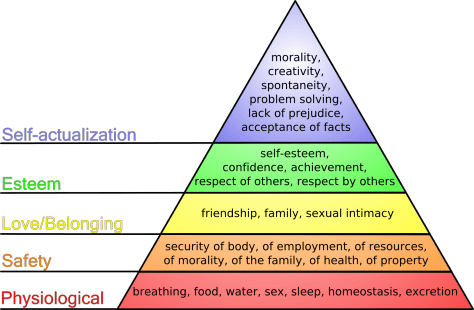
  1. Maslow’s Hierarchy of Needs. Maslow's_hierarchy_of_needs I showed this to my children’s lit students this morning, and I was reminded once again of how much sense this makes.  (Maslow’s basic argument is that the bottom levels of the hierarchy are necessary in order to achieve the higher levels.)  It applies to so many situations: the difficulty abused and neglected kids have in school, the poor work output of people who aren’t getting enough sleep, the writer’s block I get when I’m worried about other things (hey, didn’t I just mention that?).  It even explains the phenomenon of being hangry.  Sure, there are amazing stories about people who aren’t getting their foundational needs fulfilled (such as concentration camp victims) who nevertheless achieve the highest level of the pyramid by creating beautiful works of art or performing heroic acts of self-sacrifice, but what makes those stories so amazing is their rarity.  They are the exception that proves the rule.
  2. The emoji with no mouth. You’ve seen it: It’s a smiley face, minus the smile.  And yet it’s so eloquent.  I use it to mean “There are no words”–a phrase which, like Maslow’s hierarchy of needs, applies to so many situations.
  3. To Kill a MockingbirdI finished rereading this classic yesterday, and I was confirmed in my opinion that Scout Finch is one of the greatest narrators, and Atticus one of the greatest dads, of all time.  Very few books juxtapose humor and danger (recall that Scout is wearing a ham costume throughout the climactic scene), wisdom and innocence (Atticus’s words interpreted through the child Scout’s limited understanding and recalled from the adult Scout’s perspective) in such an effective way.  And the evocative descriptions—the humid warmth of a summer evening, the cracks in a sidewalk that has a tree root pushing through it—take me back to my own childhood, even though mine wasn’t spent in Alabama.
  4. The Grey Havens. My friend told me about this band Saturday morning, I impulse-bought their album Ghost of a King for $10 on iTunes without sampling it first, and I ended up listening to it over and over while driving that day.  Although their style is a little inconsistent (fluctuating from the folksy and dramatic sound of Mumford and Sons to a poppier but still substantial sound that reminds me of Imagine Dragons), I don’t mind that because I like both kinds of music, and their themes are consistent.  This is Christian music that doesn’t advertise itself as such.  On Ghost of a King, without using the names “God” or “Jesus,” they pretty much outline the whole history of the Bible, hitting the major points of creation, fall, and redemption.  My favorite song on that album is “Diamonds and Gold,” definitely on the pop/electronic end and very fun to dance to in the car (and probably out of the car, too).
  5. using flavored cream cheese as a dip for pretzels. Last night I used the Philadelphia brand roasted vegetable cream cheese as a comparatively “healthy” Super Bowl “dip.”  (Oh, my gosh.  Philadelphia.  I just made the connection.  I am the reason they won.)  Today, I polished off the rest of a tub of honey pecan cream cheese (also Philadelphia) as a lunch snack at work.  Seriously, this is good.  You should try it.

What are you digging right now?  Let me know in the comments.

the humility of Jesus

Yesterday morning, I wasn’t planning to go to church; I was going to donate platelets instead.  (My prioritization of church, or lack thereof, is a topic for another post.)  But my hemoglobin was a little too low to donate, so I ended up walking into the 11:00 church service about 15 minutes in, toward the end of the singing.  Normally I carry a big, black leather-bound ESV study Bible to church, as well as a hardcover journal for taking notes.  (Never mind that I take notes mostly in order to stay awake in my church’s soft-seated, dimly-lit sanctuary and rarely go back and look at my notes.  Having the journal makes me look serious.)  But yesterday, because I didn’t think I was going to church, I didn’t have my Bible and journal.  So I walked in late, with no Bible (in a church where most people still carry bound Bibles) and with a new short, somewhat asymmetrical haircut that could, I suppose, be interpreted as countercultural.  And, because I don’t know the words very well yet, I didn’t sing most of the song that had just started when I walked in.  Taking together all of these factors, I was worried that the people next to me were going to assume I was a visitor, probably an “unchurched” one.

When my pastor began preaching on Matthew 12:15-21 (at least I had the YouVersion Bible app on my phone and could follow along), I quickly realized how silly my worries were–even if the people next to me were actually thinking about me, which is unlikely.  In that passage, Jesus heals a lot of people and then forbids them to tell anyone.  My pastor pointed to this action as a demonstration of Jesus’ humility: Jesus’ goal on earth was to do his Father’s will, not to “make his own name famous” (a phrase that is popular today in some church circles but is inconsistent with Jesus’ whole way of operating).  It’s not that Jesus didn’t want people hearing his message; he just didn’t want fame, which is shallow and temporary.  We as Christians, my pastor said, spend too much time doing image control, worrying about whether we’re giving a good impression of Christianity.  Even when we say that we don’t care what people think, we’re showing that we care what people think.  My pastor said that all we are called to do is to live in obedience (which sometimes means proclaiming a message verbally–that’s not what is being forbidden here); it is not our job to control how we’re perceived.

It made me think of Shusaku Endo’s Silence (okay, I haven’t read the book, but the movie absolutely wrecked me), which is about a man who has an intensely personal faith in God of which he cannot speak, but which, we understand in retrospect, has driven his actions all through his life.  This character doesn’t have the luxury of branding himself as a Christian, as so many of us do in America today, but all that matters to him is that he knows that God knows of his faithfulness.

I ended up putting away my phone and just listening to the sermon.  My church follows the current trend of putting the words of Scripture on the screens at the front, so I didn’t really need to follow along in my app anyway (unless I wanted to look at the context, which using the screens can’t really replace).  I tried to think of myself not as an individual sticking out like a sore thumb, but as another member of Christ’s body, just like the people next to me.  It helped.  I listened.  I worshiped.  And, wonderfully, I didn’t fall asleep!


motif or obsession

This past weekend, I attended the Roanoke Regional Writers Conference, and during a session on monologue-writing, which ended up being more generally about principles of characterization, we were asked to write short descriptions of the people represented by faces that the presenter showed on the screen.  Then we had to pick our favorite, sketch a picture of them, and write a monologue using beginning, middle, and ending lines given to us by the presenter.

I drew this guy:

https://www.instagram.com/p/BeLsm5LjMpw/?taken-by=tessrs

I said he has one Hispanic parent and one white parent, he is approaching 30, and he is passively annoyed that everyone considers him a harmless teddy bear.  His name is Manny, but as I was writing his monologue, in which he gets defensive about the fact that he illustrates comic books for a living and hardly ever leaves his apartment, I realized that he was basically a biracial version, with a somewhat different childhood trauma, of the character I’m always writing about–usually named Sam.

When I started writing about this character, I was in high school, and so was he.  He was called Sparky Melloy back then, but his real name was Samuel.  Then, as now, he was blond-haired, chubby, quiet, self-effacing, and sometimes funny.  Back then, he was obsessed with Dr. Pepper and often wore baseball caps backward.  Now, he prefers Coke (his tastes have matured) and only occasionally wears a baseball cap, forward.

There was a period a few years ago during which I departed a bit from this general profile.  The guy I wrote about during this time shared many of Sparky/Sam’s features, but he was a musician with dark curly hair–he was Jewish, sometimes–who was both older (because I was older too) and angrier than his previous manifestations.  Sometimes he had a fraternal twin brother.  This guy was different enough from Sparky Melloy that I gave him a different name, Adrian.  But the basic character was still there.

At some point, I got rid of the fraternal twin brother, who was a jerk anyway, but I gave Sam (for that is now his permanent name) a best friend, a curly-haired, easily annoyed musician named Adrian.  But this Adrian is a skinny redhead, and I totally jettisoned the Jewish part, mainly because I have no idea how to write from a Jewish perspective.

Here’s what I know about Sam: He writes and illustrates comic books for a living and is quite successful.  He’s single and thinks he probably always will be, mainly because he doesn’t think any woman will ever be attracted to a “fat mental patient” like him.  (He spent one night in a psych ward, 10 years ago, after he attempted suicide and Adrian saved his life.)  He grew up with a severely depressed mother, a father who couldn’t talk about emotions, and no siblings.  Sam himself is on medication for depression, but he’s not a depressing person to be around.  He’s creative, kind, sometimes surprisingly witty, and usually a calming influence on people around him.  Life is hard for him, but he doesn’t want to die anymore.  And, in the story I’m writing right now, he’s surviving the zombie apocalypse.

Generally, when we see a character, theme, or symbol recurring again and again in an author’s writing, we call it a motif.  I think Sam may be an obsession.  I don’t know if he represents me, the person I want to be, or the person I don’t want to be–maybe all of the above.  I kind of have a crush on him.  I know, it’s weird.  But those of you who are writers–or who at least make up stories in your head–do you know what I mean?  Please share.

half-bloodedness in Harry Potter

This Wednesday, I am giving an informal talk about the concept of half-bloodedness in the Harry Potter series (not to be confused with the Percy Jackson series, in which being a half-blood means one of your parents is special.  In Harry Potter, it means one of your parents is NOT special–a perspectival difference only, but a crucial one).  My talk will be based on a paper I contributed to a collection a number of years ago, but since it’s been a while since I really engaged with that paper, I thought I’d use this post as a vehicle for updating my thoughts.

First things first: When I wrote that paper, I committed a major oversight.  I said that there are three characters in the series who we know to be true half-bloods (i.e. having one wizard/witch and one fully Muggle parent): Seamus Finnegan, Severus Snape, and Tom Riddle.  The character I forgot is, ironically, Penelope Clearwater.  One could argue that Penelope is not a major character–after all, she didn’t even make it into the movies–and that she never discusses her parents or her blood status, but it’s assumed that she was a deliberate object of a basilisk attack in Chamber of Secrets because of that very blood status, so I could have used her character to reinforce my point that wizarding world racism extends not only to the completely Other but also to those whose origins are less obvious.  I will probably put in a Penelope plug on Wednesday night.

I was just talking with a student today about how the fact that Harry Potter is a fantasy makes it a safe space to discuss “mature themes”–child abuse and neglect, slavery, political corruption, you name it–in the classroom.  The issues are no less real because they are present in a fantasy, but the fictional context provides a layer of detachment, allowing the difficult conversations to be less charged.  The concept of half-bloodedness creates a forum for discussing issues such as racism, racial performativity, and biracial identity, but it does so with a situation that’s not exactly like any situation in the real world.

In the paper, I use Seamus Finnegan to introduce the concept in a relatively light-hearted way (just like the books do), but my main argument contrasts Tom Riddle, whose attempt to erase his diverse racial history backfires, leading to a fragmented personality and a literally shattered soul, with Severus Snape, who, though he keeps his half-blood status largely private (like so much about himself), never denies that he is a half-blood, and therefore achieves an integrated identity and a character of integrity.  A lot of big words, but I’m basically arguing that Snape remains true to himself (even when his mission requires him to present a false front), whereas Riddle/Voldemort destroys himself through his own self-directed racism and denial.

If I were to rewrite the paper today, I would probably say more about my current Harry Potter interest, which has to do with the effect of the home and family of origin on how characters turn out.  Both Snape and Riddle grew up in loveless homes, but they were different kinds of loveless homes, and I think the differences in their situations contributed to the differences in how they handled their half-blood status.  I will think about this idea, try it out on Wednesday night, and perhaps blog about it next week.

the fandom panel! (updated with more cool links!)

In May, I told you about a panel discussion on fandom that I had just begun, along with a committee, to plan.  This morning, all the planning came to fruition, and we had a wonderful event that was collegial, fun, scholarly, and well-attended by enthusiastic fans (not of us, but of a wide range of fandoms), many of whom were wearing t-shirts representing their chosen texts.

In the spirit of “remix culture” (which we could have discussed this morning if we’d had more time), I’m not going to give you a traditional, single-authored recap of the event; instead, I’m going to give you some cool links that will inspire you to join the conversation!

  • One of our panelists captured an iPhone audio recording of the discussion that turned out surprisingly well.  Here it is on YouTube.  The image you’ll see is the fantastic event poster created by Ms. Mariannette Oyola–also mentioned in the next point.
  • We had two fabulous vendors selling their fannish wares.  One has an Etsy shop, GeekOutsidetheBox; the other posts her work on her Instagram site, @misssoyola_art.  I bought something from both, and there was a lot more I had to restrain myself from buying.  Check them out.
  • During the discussion, I mentioned Confessions of an Aca-Fan, the blog of Henry Jenkins, who was one of the first media scholars to study fandom in a positive light when he published his book Textual Poachers in 1992, and who is still going strong today.  If Jenkins and/or his blog sounds familiar to you, it’s probably because I’ve mentioned him several times on my blog.
  • I’m going to pull a Gilderoy Lockhart and tell you to see my published works for further details.  My doctoral dissertation is about, among other things, fans.  In it, I mention the intriguing (if I do say so myself) idea that some authors, like J. K. Rowling and Charles Dickens, are fans of their own work.  I don’t mean that they’re arrogant; I mean something more positive and productive.  Read more here.  (I am not sure if this link requires a log-in.  If it does and you can’t get in, let me know–I’d be happy to send you a PDF.)
  • Panelist Marybeth Davis Baggett referred to her Christ and Pop Culture article on Kurt Vonnegut, of whom she is a devoted fan.  Read the piece here.
  • All of our panelists are active (and saying really smart things) on some blog or social media platform, but I didn’t ask which is each person’s preferred platform.  I’ll check with them and post their handles here so you can follow them.  (And if you’re a panelist and you happen to be reading this, go ahead and comment with all your info.)

Let’s keep the conversation going.  Share some cool links that you think would be relevant!