things that made me happy this week

I couldn’t settle on a single topic for this post, so I’m just going to make a list of things that brought me a bit of delight over the past week, in hopes that it may be interesting and useful to others as well.  I guess you could call this my T(t)hanksgiving post, since next week you better believe I’ll be blogging about Fantastic Beasts and Where to Find Them.

  1. Finding the soundtrack to Fantastic Beasts on Spotify today–there’s nothing like listening to the score to get you excited about a movie (not that I needed it in this case)
  2. The full trailer for Beauty and the Beast, released yesterday.  Besides the fact that this is a remake of one of my very favorite Disney movies, I also love that the anticipation is giving me a way to bond with other fans, including my children’s lit students and some of the women in my family.
  3. Speaking of my students (in all of my classes), they’ve been making me happy all semester.  These groups of students are fun and smart, they seem to like me (teachers, let’s not act like that doesn’t make a huge difference in our personal morale), and they seem to actually be interested in what we’re reading.  And those things aren’t necessarily true every semester.
  4. Finding three Christmas tree ornaments over the weekend: a wooden “Peace on Earth” ornament from The Funky Junk Shop in Forest, VA (where I also found a cozy and flattering shirt that I’m now in love with) and a felt baby chick and a vintage Shiny Brite brand bulb with the solar system on it, from The White Brick House, also in Forest (where I also found a vintage Virginia state bird and state flower glass to replace one from my set that I had broken).
  5. Cooking and baking, for myself and for others.  For myself, I’ve been making some chard-based recipes featured in the December Better Homes and Gardens, and they’ve been delicious so far.  Last night I baked an apple pie for a Thanksgiving dinner being hosted by a friend’s local ministry (and the crust actually looked presentable, which is definitely something to be thankful for), and tonight I’ll be making some treacle fudge for the International Candy Tasting at work tomorrow.  And I’m already looking forward to making sweet potato souffle this weekend for my friends and next week for my family.  (I also made some last week just for me–I’d like to keep up this “one sweet potato souffle a week” trend as long as I can stand it.)
  6. The cardio funk class I attended last night at the YMCA.  When people think of my good qualities, rhythm is not normally near the top of the list (or on it at all), but I think that’s part of the reason why I enjoyed this class so much–I knew I wasn’t going to get the moves exactly right, so I just focused more on the cardio than on the funk and had fun laughing at myself.  Tonight…Zumba.
  7. Volunteering with Safe Families for Children, an organization I’m excited to be involved with as it gets off the ground in Central Virginia.  Saturday morning I got to help with registration for a conference for foster and adoptive families where SFFC had a big presence, and it was so much fun to see all these hospitable, compassionate people showing up eager to learn and be encouraged.  Yesterday and today, I’ve provided transportation for some young single moms, and I’ve enjoyed talking with them and playing with their cute kids.  I know they say that helping other people is a big mood-booster, but more than that, I love getting to know all the many different people that I encounter through these opportunities (and this is coming from an introvert).
  8. The beauty right outside my house as winter approaches.  This week, highlights have included a flock of blue jays in the backyard; a huge and colorful woodpecker that landed on my feeder a few days ago, looked bewildered, and then flew away; the incredibly bright supermoon on Sunday and Monday nights, and the hard frost Saturday night/Sunday morning (the coolest part was in the morning when the sun started melting the frost where there weren’t any shadows–my lawn was half white and half green).

I could keep going, but it’s time to go make a chard stir-fry.  You should seriously consider taking half an hour to write down things that have made you happy this week.  It isn’t hard at all.

the Harry Potter list

Sometimes there’s so much Harry Potter stuff going on, I have to make a list to keep it all straight.

  1. The illustrated edition of Chamber of Secrets was released very recently, but I just finally got around to reading the illustrated Sorcerer’s Stone.  Jim Kay’s illustrations are gorgeous, highly detailed (you can stare at the Hogwarts interiors for hours), sometimes surprising (Hagrid dresses like a biker–which makes sense since we first see him on a motorcycle, but I never thought of it!), and occasionally even startling (Snape’s creepy eyes!).  I’m looking forward to seeing how he approaches memorable book 2 characters like Gilderoy Lockhart and the basilisk, and I’m really curious as to whether the ratio of pictures to text will continue to be similar as the books get massive.
  2. Tomorrow is the first day of November, which is release month for Fantastic Beasts and Where to Find Them!  I realize that Harry Potter is not going to be in this movie, nor any of our beloved characters (I hear Dumbledore is namedropped, but I think that’s about the extent of it), but I’m really excited about getting back into the Wizarding world.  This is the first movie for which J. K. Rowling has actually written the screenplay, which means, if nothing else, that it’s going to be lush with detail.  It also helps that Eddie Redmayne is beautiful.  But the element of this film I may be looking forward to the most is the fact that there’s a major character who’s non-magical.  What will it mean for HP fandom that people like us are now part of the story?  I will be blogging about this, no doubt.
  3. With all the publishing action happening this year, Harry Potter festivals seem to be back on the rise.  I attended one this past Saturday in Scottsville, a very small town in central Virginia that for three years running has transformed its (also very small) downtown business district into Hogsmeade.  Lines were long at places like Honeydukes (normally a bookstore and coffee shop) and Ollivander’s (normally a tattoo and massage parlor), but in other establishments, it was easy to duck inside, take in the fabulously creative displays (I loved the hand-lettered envelopes at the owl post location) and perhaps contribute to the local economy by making a purchase (I bought two beeswax taper candles at the owl post place, which in its Muggle life is a beekeeping supply shop).  Perhaps the most fun part of the festival (other than getting a signed photo of Gilderoy Lockhart at Flourish and Blotts–that guy was fabulous) was the people-watching.  I saw some fantastic costumes (Moaning Myrtle, the painting of Sirius Black’s mother, a trio of house-elves) and a lot of fairly obscure fan t-shirts–the kind you can’t just impulsively buy at Target.  I hope to return to this festival next year, and I also hope the weather will be more seasonally appropriate.  It was about 80 degrees on Saturday, and I was dressed as Professor Trelawney.  There was a lot of fabric draped over and around me.
  4. Today is Halloween.  That means that it’s the anniversary of Lily and James Potter’s tragic death (I saw their gravestone in Scottsville, too–there was a lovely old church with the Godric’s Hollow graveyard recreated outside), as well as of the baby Harry Potter’s amazing, unlikely defeat of Voldemort.  Halloween is also a good day to have a huge feast with live bats swooping overhead (that always seems unsanitary to me)…and a good day for…wait for it…a TROLL IN THE DUNGEON!  Thought you ought to know.

the thankfulness book

This is the next in my series of posts on crafting a rule of life.  Those of you who have been following this series will be interested (and maybe a little sad) to know that I am probably going to wrap it up after next week’s post.  However, I’ll continue to add to my rule of life and will probably blog about it from time to time in the future.

Two weeks ago I wrote about the three hours I spent in solitude, meditating on my struggle with anger and how, with God’s help, I can implement practices into my life that will help me to become less angry and more gentle.  One of the action steps that came from that session was to begin writing daily in the thankfulness journal that I started last summer during a Bible study on Ann Vosskamp’s One Thousand Gifts, a book I heartily recommend.  Like thousands of other Christian women who have read the book, I chose a beautiful journal (mine is a handcrafted one from Nepal, with a colorful woven cover and soft, fibrous pages) and started making a list of things I’m thankful for, with the eventual goal of reaching one thousand.  Like thousands of other Christian women, I faithfully wrote 2-3 items daily for a few weeks and then petered out, starting and stopping again sporadically throughout the year whenever I happened to notice the journal under a pile of other books.

As I mentioned in my solitude post, the authors of Taking Your Soul to Work connect anger (the sin) and gentleness (the fruit of the spirit) with surrendered contentment (the outcome).  After I recognized this unexpected connection, I decided that picking my thankfulness journal back up and making it a habit this time could be an effective strategy for becoming more content with the gifts I have and thereby feeling less compelled toward anger about what I don’t have and/or can’t control.  Too, writing about those seemingly out-of-nowhere gifts that come to me more often than I usually notice (e.g., a good conversation with a friend whom I “happened” to walk by when leaving a blood drive early after an unsuccessful attempt to donate) may help me see how good it is that I’m not in control of every minute of my day.

Keeping a thankfulness list isn’t just for angry people, or for women, or for people who have been inspired by Ann Vosskamp.  It’s for anyone who wants to rewire their brain circuitry to look for good things.  (There’s real science that says you can actually do this; maybe I’ll write a post about it sometime.)  And it only takes a minute or less to jot down a few items every day.  This practice can also be done with other people.  My family has a now-threadbare journal that we’ve pulled out every Thanksgiving since 1991 to record what we’ve been most thankful for during the previous year.  Reading our entries aloud together has led to much laughter, many happy tears, and deep fellowship with each other and with God.

If you think it sounds cheesy, have you actually tried it?  It won’t change you into a different person overnight, but it will gradually train your brain–and your heart, and all the rest of you–to see gifts where you didn’t before.

If you have experience with keeping a thankfulness list, or if you have ideas about how you might incorporate this simple discipline into your life, let me know in the comments!

Remembering the Sabbath Day

This is the first of my posts describing specific items that will become part of my “rule of life”–see July 15’s post for an introduction.

The spiritual practice that most caught my attention during the class, as both something I’m not currently doing (at least not very well) and something I’d really like to do, was a weekly observance of the Sabbath.  I’m not just talking about going to church on Sunday–I already do that–or about not going into the office on weekends.  Observing the Sabbath means choosing one day per week (it probably will be Sunday for me, but it doesn’t have to be for everyone) to rest in a deliberate manner.

I know; “rest in a deliberate manner” sounds like a contradiction in terms.  But my point is that Sabbath rest is planned and zealously guarded.  It’s not the same as crashing in front of the TV at the end of the day because you’re so tired from work.  Sabbath rest will look very different for different people, but the common factors are that it happens every week (ideally on the same day every week, though I understand that this may not work for people with unpredictable work schedules), it lasts for an entire day (following the Jewish model, it could actually start on the previous evening), and it doesn’t get shoved to the side when life gets busy.  An exceptionally busy person is in exceptionally great need of a Sabbath rest.

The idea of observing Sabbath comes from two biblical passages: the creation in Genesis 1-2, in which God works for six days and then rests on the seventh, and the Ten Commandments in Exodus 20, in which God commands his people to keep the seventh day “holy” (i.e., set apart; special).  This command is elaborated on elsewhere in the Jewish law and clarified (never abolished) in the Christian New Testament.  Even people who don’t accept Scripture as authoritative in their lives often understand from experience that a weekly day of rest is physically and mentally restorative–and not merely a luxury, but a necessity to function at full capacity.

As I mentioned before, the actual observance of the Sabbath will look different for different people.  This is the “Sabbath policy” (subject to revision) I plan to put into effect for myself beginning next Sunday:

  1. No checking email
  2. No job-related* work of any kind, including grading (This may motivate me to work more efficiently during the week!)
  3. Perform a short ceremony to mark the beginning and end of the Sabbath.  This will usually be as simple as lighting a candle on Saturday evening and again on Sunday before I go to bed.
  4. Include other people in my Sabbath celebration whenever feasible.  (Note: Solitude is a separate practice, which I’ll write about in a later post.  I included this item because my tendency is to be a hermit on Sundays, but since I’m now treating Sunday as a little holiday, it makes sense to be with other people.)
  5. Increase the quality and (probably) quantity of the time I spend at church.  (Important note: Some people have no need to do the second part of this and should probably spend less time at church–I’m talking about those people who get burned out serving in every ministry.  But I’m not always mentally and spiritually “present” when I’m in church, and I tend to escape as soon as the service is over, so I’m challenging myself to enjoy my church–by that I primarily mean its people.)

I’m looking forward to implementing this first part of my rule of life.  What about you?  Let me know how you observe, or plan to start observing, a weekly Sabbath rest!

*For me, I think it’s okay to do work that has nothing to do with my career, like mowing my lawn or grocery shopping, although I’ll probably try to do those things on Saturday.

Crafting a rule of life

This week I audited a course at Regent College in Vancouver, called Taking Your Soul to Work.  (I really enjoyed this week of professional development and vacation, and I’m already thinking about doing it again next year.)  Going into the course, I was excited to learn about a theology of work, but I didn’t realize how much of the content would be drawn from historical Christian traditions such as desert monasticism, the Benedictine Rule, and Ignatian spirituality.

The main action item I gave myself based on the course is to craft my own rule of life, which is a new concept for me. A rule of life is a slate of spiritual disciplines, developed on one’s own and/or with the input of trusted advisors, to be incorporated into one’s life at set intervals: daily, weekly, annually, etc. Despite the rigid connotations of the word “rule,” the term in this context implies a “life-giving rhythm” (to quote Eugene Peterson’s paraphrase of Matthew 11:28-30 in The Message).  Rather than more items on a to-do list, the disciplines are a way to become aware of God’s presence amidst the “secular” activities of one’s life.  (Another idea we discussed in this class: There’s no such thing as a secular activity.)

A rule of life can include, among many others, such practices as observing a weekly Sabbath rest, reading Scripture daily, praying the examen prayer (more on this is a later post), and taking a semi-annual silent retreat.  My initial instinct is to sit down for an hour and quickly knock out a rule for my life, but I think it will be wiser to process what I’ve learned this week and craft my rule one item at a time.  My plan is to blog about this process along the way.  Want to join me?

encore: Easter and The Walking Dead

Now I understand why people become professional bloggers. It’s a lot easier to remember to blog when it’s your job.

It’s not my job, but I do plan to get back into posting semi-regularly. Meanwhile, here’s a post I wrote three years ago around this time of year.

This will be a quick post in which I don’t intend to say anything new or profound, except in the sense that the gospel is always profound. I just think the co-occurrence of The Walking Dead‘s season finale with Easter Sunday is too good an opportunity to pass up. If you’re a TWD fan, you’ve probably already noticed this conjuncture and have been tweeting little jokes about it all week. While I can appreciate this subcategory of morbidly irreverent humor, I want to remind us all of a few basic yet important truths.

We often forget that Christ’s resurrection means our resurrection too. Do a search on occurrences of the term “first-fruits” in the Bible–in the Old Testament, you’ll get instructions about bringing your produce to the temple, but in the New Testament, you’ll find all kinds of good doctrine, most if not all from Paul, about how Christ’s resurrection was only the first in a series of resurrections. There will indeed be a day when “all who are in the graves will hear his voice and come forth” (John 5:28-29). It sounds a lot like a Romero-esque scenario in which “the dead will walk the earth,” EXCEPT THAT THEY WON’T BE DEAD. The difference between reanimation–when corpses become mobile–and resurrection–when formerly dead people live again–couldn’t be more pronounced.

So when you watch The Walking Dead tomorrow night and you see all those rotting bodies stumbling around outside the gate of the prison where our friends are holed up, don’t think for a minute that this is what the Bible means when it talks about the defeat of death. There won’t be anything creepy about the resurrection, just like there isn’t anything creepy about having an Easter sunrise service in a cemetery (I saw a sign for one of those while driving past Alta Vista, VA, yesterday). And when you attend a church service tomorrow morning, as I hope you do (whether it’s at sunrise or not), don’t think for a minute that Christ’s resurrection was just a past event that’s nice to remember but that has no effect on the present or future.

“Therefore, my beloved brethren, be steadfast, immovable, always abounding in the work of the Lord, knowing that your labor is not in vain in the Lord.” I Corinthians 15:58

Happy Christmas from my tree

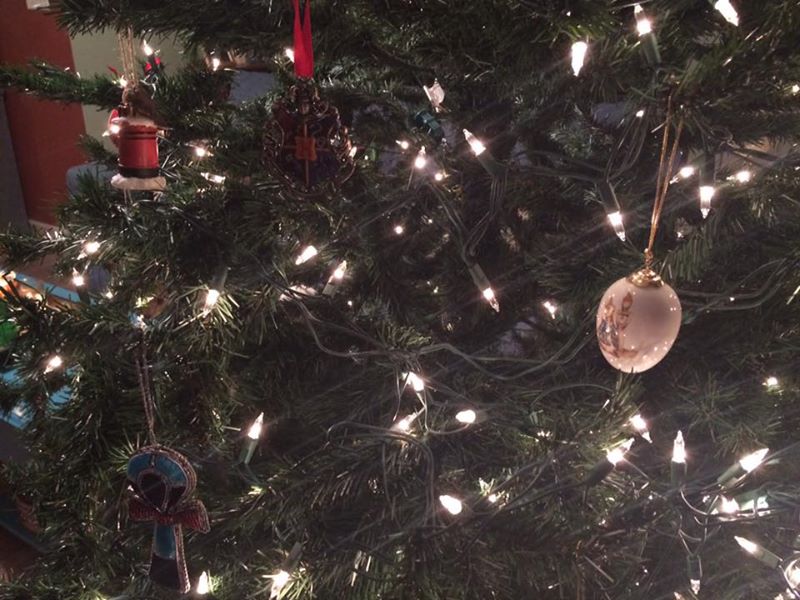
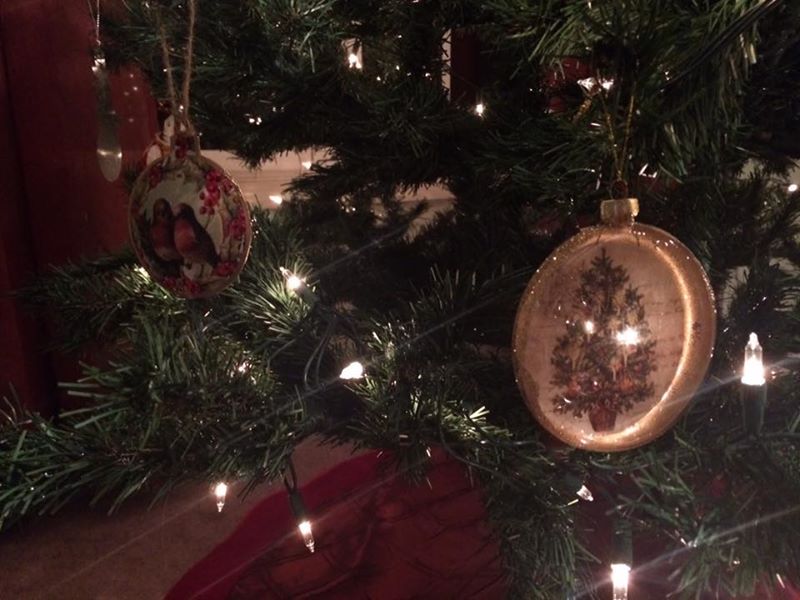
For my Christmas post this year, I thought I’d show you pictures of many of the 16 ornaments I bought while traveling in England (London and the Lake District) a few weeks ago.  I don’t have anything clever or profound to say this time–just that I hope you have a magical and blessed Christmas!

bird with carols written on its wings (from the British library) and bird on a post box (from Westminster Abbey)

bird with carols written on its wings (from the British library) and bird on a post box (from Westminster Abbey)

ornaments 2

Celtic cross from the British museum (bottom left), Hogwarts crest from the Harry Potter studio tour (top), Peter Rabbit painted on an egg from The World of Beatrix Potter (right)

ornaments 3

two Victorianesque ornaments: robins from Charles Dickens’s house and a Christmas tree from the British Library

ornaments 4

Here’s the postbox robin again, along with my other ornaments from Westminster Abbey. (That’s Queen Victoria.)

ornaments 5

These are from Harrod’s. I could have spent a fortune on ornaments there.

I forgot to take pictures of my Christmas pudding ornament, the heart-shaped ornament with Shakespeare’s face, and a few others.  But I hope these give you a taste of England at Christmastime!

Easter every day

This morning, it was my turn to lead our weekly devotions at work, and I tried (through my scratchy allergy voice) to talk to about how Christ’s resurrection is not only a crucial historical event that means a great deal for the believer’s future, but that it also impacts the believer’s everyday life in the present.  This same theme came up later on as I was praying with a student over the phone and I said something about how we live in Christ’s resurrection power.  So you can imagine my delight this evening when I was reading Brennan Manning’s Abba’s Child and I came across chapter six, “Present Risenness.”  Manning says everything I was trying to say today, and more.  I hope you’ll forgive me for quoting at length from the chapter.

Standing on a London street corner, G. K. Chesterton was approached by a newspaper reporter.  “Sir, I understand that you recently became a Christian.  May I ask you one question?”

“Certainly,” replied Chesterton.

“If the risen Christ suddenly appeared at this very moment and stood behind you, what would you do?”

Chesterton looked the reporter squarely in the eye and said, “He is.”

Is this a mere figure of speech, wishful thinking, a piece of pious rhetoric?  No, this truth is the most real fact about our life; it is our life.  The Jesus who walked the roads of Judea and Galilee is the One who stands beside us.  The Christ of history is the Christ of faith.

Biblical theology’s preoccupation with the resurrection is not simply apologetic–i.e., it is no longer viewed as the proof par excellence of the truth of Christianity.  Faith means receiving the gospel message as dynamis, reshaping us in the image and likeness of God.  The gospel reshapes the hearer through the power of Jesus’ victory over death.  The gospel proclaims a hidden power in the world–the living presence of the risen Christ.  It liberates men and women from the slavery that obscures in them the image and likeness of God.

What gives the teaching of Jesus its power?  What distinguishes it from the Koran, the teachings of Buddha, the wisdom of Confucius?  The risen Christ does.  For example, if Jesus did not rise we can safely praise the Sermon on the Mount as a magnificent ethic.  If He did, praise doesn’t matter.  The sermon becomes a portrait of our ultimate destiny.  The transforming force of the Word resides in the risen Lord who stands by it and thereby gives it final and present meaning.

I will say it again: The dynamic power of the gospel flows from the resurrection.  The New Testament writers repeated this: “All I want is to know Christ and the power of his resurrection” (Philippians 3:10).

When through faith we fully accept that Jesus is who He claims to be, we experience the risen Christ. . . .

. . . In other words, the resurrection needs to be experienced as present risenness.  If we take seriously the word of the risen Christ, “Know that I am with you always; yes, to the end of time” (Matthew 28:20), we should expect that He will be actively present in our lives.  If our faith is alive and luminous, we will be alert to moments, events, and occasions when the power of resurrection is brought to bear on our lives.  Self-absorbed and inattentive, we fail to notice the subtle ways in which Jesus is snagging our attention.

I’ll stop here, but you should really read the whole book.  It can be hard for a Christian writer or speaker to convey a message that is kind, tender, and joyful without sliding off into doctrinal squishiness or compromise.  Brennan Manning walks that middle road with great care and wonderful effect.

Charles Dickens on Christmas (no, not THAT story)

Good evening, readers, whom I have been sadly neglecting this year.  And merry Christmas.  I am probably losing some of you due to the fact that every time I have posted recently, my post has been about Charles Dickens.  It’s just that I love him, and you know how it is when you’re in love.  I actually bought a Charles Dickens finger puppet/refrigerator magnet the other day.  Yes, I did.

I promise that after this post, I’ll take a break from Charles Dickens.  But I want to quote him in this, my annual Christmas post.  (For previous years’ posts, click the “holidays” category in the menu on the left.  There’s an Easter post and a Thanksgiving post in there, but other than that, they’re all about Christmas.  Most years I’ve written more than one annual Christmas post.)  Every year, whether I write something funny or something profound, or a little of each, my goal is to get you to think about Jesus.  Christmas is his day, after all, even beyond the sense in which every day is his day.

Last night I read a few stories from a massive volume entitled The Selected Illustrated Works of Charles Dickens, purchased in the same transaction as the puppet/magnet.  I came across a piece I’d never read before, “The Seven Travellers,” composed of three short stories.  The piece ends with a description of the narrator’s walk home on a cold, quiet Christmas morning, during which everything reminds him of Jesus.  As soon as I read these few paragraphs, I knew I’d be letting Charles write my annual Christmas post for me.  Please enjoy this excerpt, and may the Founder of Christmas bless you richly.  [Note: A couple of the biblical references are a little obscure–a good reason to read, or re-read, the gospels!]

When I came to the stile and footpath by which I was to diverge from the main road, I bade farewell to my last remaining Poor Traveller, and pursued my way alone.  And now the mists began to rise in the most beautiful manner, and the sun to shine; and as I went on through the bracing air, seeing the hoarfrost sparkle everywhere, I felt as if all nature shared in the joy of the great Birthday.

Going through the woods, the softness of my tread upon the mossy ground and among the brown leaves enhanced the Christmas sacredness by which I felt surrounded.  As the whitened stems environed me, I thought how the Founder of the time had never raised his benignant hand, save to bless and heal, except in the case of one unconscious tree.  By Cobham Hall, I came to the village, and the churchyard where the dead had been quietly buried, “in the sure and certain hope” which Christmas time inspired.  What children could I see at play, and not be loving of, recalling who had loved them!  No garden that I passed was out of unison with the day, for I remembered that the tomb was in a garden, and that “she supposing him to be the gardener,” had said, “Sir, if thou have borne him hence, tell me where thou hast laid him, and I will take him away.”  In time, the distant river with the ships came full in view, and with it pictures of the poor fishermen, mending their nets, who arose and followed him–of the teaching of the people from a ship pushed off a little way from shore, by reason of the multitude–of a majestic figure walking on the water, in the loneliness of night.  My very shadow on the ground was eloquent of Christmas; for did not the people lay their sick where the mere shadows of the men who had heard and seen him might fall as they passed along?

Thus Christmas begirt me, far and near, until I had come to Blackheath, and had walked down the long vista of gnarled old trees in Greenwich Park, and was being steam-rattled through the mists now closing in once more, towards the lights of London.  Brightly they shone, but not so brightly as my own fire, and the bright faces around it, when we came together to celebrate the day.


my continuing Dickens obsession

I have an ongoing love for Charles Dickens, but my devotion sometimes hits these especially high peaks, and I’ve been on one of them for the past couple of weeks.  I finished reading A Tale of Two Cities last weekend (see my last post for an earlier observation), and I read A Christmas Carol yesterday and today.  (Of course, this wasn’t my first time through either book.)  I can’t wait to lead a discussion of Carol at the Liberty University Bookstore on December 2.  In the meantime, I’ve engaged in two particularly nerdy expressions of my love for Charles.  Please enjoy.

1. The story of Jerricho Cotchery.  I’ll try to make the frame narrative short: I’m eating out with two of my work colleagues, and there’s a Thursday night football game on TV.  One of us mentions McSweeney’s delightful piece called “NFL Players Whose Names Sound Vaguely Dickensian.”  Later I look up at the game and notice Jerricho Cotchery, who catches my eye because he’s a former Steeler (current Panther).  I realize that if Jerricho Cotchery were in a Dickens novel, he would definitely be a Methodist minister.  He would have a lean and starved appearance, and his ears would stick out from his head at exaggerated angles.  When he preached, his voice would take on a ranting cadence.  Then my co-worker/friend Kristen and I rapidly concoct a plot in which Dickens attempts, unusually for him, to sympathize with a Methodist minister.  I wish I’d written down some notes from this impromptu creative session, but I do remember that Jerricho Cotchery is in love with a happy, useful, and modest young parishioner named Evangeline, and that in the past he did some undefined injustice to Oliver Twist, for which he now feels horribly remorseful.  I hope to return to this story at some point, so if you have any good ideas for Jerricho, let me know in the comments.

2. The Sydney Carton playlist.  I’m really obsessed with A Tale of Two Cities right now.  I went so far as to make a Spotify playlist for Sydney Carton, and it’s a far, far better playlist than I have ever made.  (Actually, it’s my first Spotify playlist.)  You should be able to find it by searching “Sydney Carton.”  If you find a 10-song playlist by Tess Stockslager, you’ve got it.  Here’s your guide to the songs: The first four are anthems for a wasted/purposeless life, with a particular emphasis on songs about drinking, because–let’s face it, friends–Sydney is an alcoholic.  The next three songs are about unrequited love and/or heartbreak; I think it’s pretty clear why those are on there.  (As Lucie says at one point, “He has a heart he very, very seldom reveals, and . . . there are deep wounds in it. . . . I have seen it bleeding.”)  The next two are about people deciding they don’t want to waste their lives anymore; this corresponds to that point in ATOTC when Sydney starts hanging out with the Darnays in the evening instead of with his stupid boss/”friend”/enabler Stryver.  And the last song is about what Sydney wants to do, and finally succeeds in doing, for Lucie and her family.

So, put on the playlist, and get ready to dance, then cry, then dance again, then cry again.  Or, put on the playlist and read A Tale of Two Cities.  And while you’re at it, don’t forget about Jerricho Cotchery.