Children’s Literature Conference!

I’m here at Shenandoah University’s 33rd Annual Children’s Literature Conference in Winchester, VA. Specifically, I’m here in the dorm room (complete with inconveniently tall beds) that I’m sharing with my friend and conference veteran Allison Scoles (look for her picture book blog starting later this year!). Now that we’re three days into the conference, I want to give you a recap of what I’ve heard so far.

Monday: First, there was a power outage, and everybody freaked out, but the show went on. (Someone actually quoted P.T. Barnum, with proper attribution.) Our first presenter, Laurie Ann Thompson, author of books for young activists such as Emmanuel’s Dream and Be a Changemaker, bravely gave her presentation in a dark, stuffy auditorium. Her description of her middle school experience was what stood out to me most. I wish I’d written it down, but basically she said that she’d tried to be as unremarkable as she could–invisible, if possible–in order to avoid unwanted attention. I can understand that desire, and I think many people can. She also spoke of her career in software engineering prior to becoming a writer; this became a theme of at least the first couple of days of the conference: very few people follow a simple trajectory from childhood dreams to school to being a famous writer.

The power came back on right as Matthew Holm, the illustrator of the Babymouse and Squish books (his sister, Jennifer L. Holm, writes the text), was about to speak. This was a good thing, because he did a bit of sketching during his presentation. Confession: On Tuesday, I noticed that his sketch (of Squish the amoeba looking a little bit like Harry Potter) was still on the easel, so I sneaked up to the platform at the end of the day and took it. Why? Because it’s original artwork, because I love Harry Potter (“Really? You love Harry Potter?”), and because I think I have a little bit of a crush on Matthew Holm. I mean, he’s an adorable nerd with an infectious laugh who draws comics for a living, and who’s happy doing that even though he knows he’s probably never going to win a Caldecott. Also, during his roundtable session, he gamely answered a whole string of questions I asked about how a comic book illustrator would behave during the zombie apocalypse. I asked these for research purposes. (Seriously, the main character of my zombie story is a comics creator.)

After lunch, we heard from Ryan Higgins, author and illustrator of Mother Bruce, its sequels, and other picture books that draw from the comic tradition. He mostly told embarrassing stories from his life in a sheepish voice, but he also gave us what appeared to be a very detailed (though he claimed it was rushed) demonstration of how he uses an app called Procreate (snicker snicker) to draw Bruce, the cranky bear. I enjoyed seeing some of his juvenilia (including an illustrated joke book–I think I made one of those as a child too, or at least a page of one) and learning about his influences–from Calvin and Hobbes to his grumpy yet nurturing grandpa.

The last presenter on Monday was John Schumacher, or Mr. Schu, a former school librarian, now blogger, professor, and Scholastic ambassador, whose enthusiasm and energy make me feel exhausted just watching him. He referred to himself as the “Oprah of books” because he kept giving away books to people just because they waved their hands in the air. I guess he likes to see his enthusiasm mirrored! He mostly told stories about kids’ responses to books, some of which were quite emotional. It was an inspiring conclusion to the first day, but I felt like I needed to take a nap afterward.

Okay, I’ve done it again–my post is already long, and I’ve only done one day. On day two, we heard from some heavy hitters (three Newbery winners and someone who’s probably going to win a Caldecott one day), so I’ll save them, along with the equally awesome day three, for a later post. I suppose I should give you a “takeaway” from the conference thus far. Well, it’s been more reinforcing than revelatory for me. The presenters have been speaking about how children need to see themselves represented in books, to learn empathy through books, and to choose books they want to read. I already knew all that. But hearing each of the presenters explain these concepts in their own way and illustrate them through their own lives has been endlessly fascinating. I’m ready for day four (well, after a good night’s sleep in my weirdly tall dorm bed).
activities that are surprisingly fulfilling to do alone

You won’t believe #3! (just kidding–that was me making fun of clickbait)

  1. Hiking. I have recently become fond of solo hiking. This past Saturday morning, I hiked Sharp Top, a popular local peak, as my quarterly three-hour “solitude retreat.” I enjoyed the experience very much, partly because it was early in the morning (I got to the summit at 8:00 and stayed up there for about half an hour), which meant that there was still mist hovering below the nearby ridges and a cool breeze blowing. But a large part of my enjoyment consisted in being alone, except for the few people I saw along the way. When I hike alone, I can set my own pace, and I’m more aware of my surroundings, which is good not only for practical reasons (I can pay attention to where I’m setting my feet) but also for more esoteric ones (I can hear the different bird calls in the woods). I can also stay at the summit for as long or short a time as I want, without having to take the obligatory group photos. Don’t get me wrong; I love hiking in pairs and groups, but if you’ve never thought of hiking as a solo activity, perhaps it’s time to consider it. Two words of caution: 1. Choose a hike where you won’t get lost (Sharp Top is pretty foolproof, though I did accidentally take the bus shelter path instead of the main hiking trail the first time I hiked it alone–duh), and 2. MAKE SURE SOMEBODY KNOWS WHERE YOU ARE GOING. If you don’t think that second piece of advice is important, watch 127 Hours.
  2. And that’s a great segue into my second item: Going to the movies. Think about it: You’re not going to be chatting during the movie anyway, at least I certainly hope not. So why not go alone? That way, you don’t have to feel obligated to share your Sno-Caps or Cherry Coke. And it’s dark, so nobody is going to be looking at you thinking, “Look at that sad person who couldn’t find anybody to go to the movies with.” And even if it weren’t dark, nobody would be thinking that anyway. The only bummer about going to the movies alone is that you don’t have anyone to rehash the film with afterward, but if it’s something you’re pretty sure only you will enjoy, it’s better to go by yourself than to go with someone negative. And if it’s a movie you know others in your circle will be watching eventually, seeing it alone gives you some time to contemplate it before discussing it– a bonus for introverts.
  3. Eating out. Okay, this is one I’m still dipping my feet into. I have not yet eaten at a full-service restaurant (i.e. with a waiter) by myself. If you have, I’d love to hear about your experience. Also, I haven’t gotten to the point of being able to just sit there and enjoy the food without reading a book or looking busy on my phone. But I’m sure there’s value in giving my full attention to what I’m eating, just as there’s value in giving my full attention to my surroundings while hiking. Normally I’m a big advocate for sharing food with other people, and I know that solo eating often has negative causes (e.g. loneliness) and negative effects (e.g. overeating), but I think it can be a good thing if done mindfully. Even in public!

Let me know if you’ve had experience with any of these solo experiences and/or if there are other activities you enjoy doing alone!

Puffs!

A week ago, I went to see Puffs, an off-Broadway homage to Harry Potter (but totally unofficial) that was filmed and shown on two nights in selected movie theaters. I am not a theater critic, and I’m certainly not a critic of plays that are filmed and then shown in movie theaters (though this does seem to be an art form–some creative camera work was involved in this one), so I’ll make my remarks from the perspective of a fan.

First, it was amusing to see how the writers bent over backward to avoid using copyrighted names, such as Hogwarts, which they referred to as an unnamed “School of Female Magic and Male Magic,” and Dumbledore, whom they always referred to simply as the headmaster. Other characters, like Cedric Diggory, were called by first name or last name, never both together. In many cases, it was clear that the writers were having fun exploiting the limitations–and, perhaps, gently ridiculing the idea of placing such restrictions on such household names.

The four houses were called Brave, Smart, Snake, and Puff, and the story focused on the Puffs, the house that has the least interaction with Mr. Potter in the canonical story, which meant that this house was the perfect vehicle for exploring the experience of a non-famous, non-chosen student who’s just trying to get through school with decent grades. The protagonist was Wayne, an American kid who ends up at the school by a series of unlikely events, probably fulfilling a fantasy of the writers themselves. I should point out here that the actors were all adults, which says a lot about the intended audience. I think the goals of this play were to make long-time Harry Potter nerds squeal with recognition at the inside jokes, to aim a little irreverence at a sacred cow (without becoming cynical or nasty, although some of the jokes were definitely for a “mature audience”), and to provide a bit of vindication for the Hufflepuffs. The childlike wonder of magic was not really a focus.

The play was only about 90 minutes long, and the seven books provided its organizational structure, so in this sense, it reminded me of a parodic play called Potted Potter that I saw a few years ago. (A lot of the humor came from the forced brevity, kind of like in the popular Complete Works of William Shakespeare Abridged.) The plot stuck to events that happen in the books, except in one (ultimately rather anticlimactic) plotline involving the Death-Eater mother of Wayne’s friend Megan. The play is best enjoyed as sketch comedy rather than as a full narrative arc, although it does have a climax: the Battle of Hogwarts, as seen from the Puff perspective. I don’t want to give away spoilers here in case the filmed version ever comes out on DVD, but I will say that the until-now underrated contribution of the Hufflepuffs in this battle, recently pointed out by J. K. Rowling (wait–am I allowed to say her name?), was given its due here. I thought there were some tonal infelicities in this last segment of the play (i.e. some stuff that was played for laughs that I didn’t think should have been), but the writers redeemed themselves with a heartwarming scene between Wayne and the headmaster, which in itself was a vindication (since in the books, it’s only Harry who gets to process things one-on-one with Dumbledore).

As a Hufflepuff, I enjoyed Puffs; I think I would have enjoyed it even if I were a Brave, a Smart, or a Snake. I also realized that I switched between past and present tense in this post. I hope you didn’t notice.

Monday miscellany

Here are some quick takes for your reading pleasure. Consider it professional development (after all, this is a leadership blog, right?).

  1. You know you have a serious problem when you start sorting the Corleone family into Hogwarts houses. I started thinking about this a couple of weeks ago when I was considering how to pitch a Hufflepuff leadership book idea to someone who seemed unfamiliar with Harry Potter but had used a Godfather analogy in his presentation. Then I went down a rabbit hole. I sorted Vito and his three sons (his blood sons; sorry, Tom Hagen–I think you’re a Muggle), and, conveniently, there’s one for each house. Michael, I knew immediately, is a Slytherin; he’s quiet and sneaky and always assumes his way is the right way. His dad, Vito, is also very intelligent but, generally speaking, using his genius for good; he’s a Ravenclaw. Sonny is a Gryffindor because he has a good heart but mistakenly believes he can solve everything with his fists. And I put Fredo in Hufflepuff because he just wants everybody to be happy. Obviously, I’m dealing in broad strokes here; I’m just making a fun comparison, not trying to say anything profound about either universe, so please don’t pick a fight with me about the oversimplified way I defined the houses.
  2. If you want a more perceptive analysis of what the houses mean, check out this post that our Slytherin correspondent shared with me over the weekend. Lots to think about here.
  3. I watched the first two Lord of the Rings movies over the weekend (extended version, of course), so I want to take a couple of minutes to wax eloquent about one of my favorite honorary Hufflepuffs, Samwise Gamgee. Yes, I guess Gryffindor could make an argument to claim him too (he’s brave and a little impulsive), but a Gryffindor’s not writing this post. 😉 And besides, Sam is the quintessence of loyalty. You really see it in The Two Towers when Sam and Frodo are following Gollum through the wilderness. About 95% percent of the time, Sam thinks Frodo is making bad choices (and Sam is right, I would add). And he says so. But he never leaves, and that’s not only or primarily because he agrees with the abstract cause of Frodo’s overall quest, but because he cares about Frodo. A truly loyal friend doesn’t stop being your friend because you’re making bad decisions; a truly loyal friend realizes that when you’re making bad decisions, you need a friend more than at any other time. Sam also functions as Frodo’s connection to reality. Even fairly early in the quest, Frodo needs Sam to tell him to do basic things like eating and sleeping. And as the journey goes on and the Ring’s increasing pull causes Frodo to fade out of the physical world and nearly become pure spirit, it’s almost as if Sam becomes Frodo’s body, fighting off Shelob and the orcs, and, in the end, carrying Frodo when he is powerless even to move. I’ve said it before, and I’ll say it again: I’ll know my life has truly been fulfilled if I can say that I’ve had and that I’ve been a friend like Samwise Gamgee.

Well, there you have it. Consider your professional development for this week done.

things I dig right at this moment

Every so often (okay, pretty often) my brain is too scattered to produce a unified blog post, but I can still manage to make a list of disunified things I’m thinking about.  Here is one such list: Things I Dig Right at This Moment.

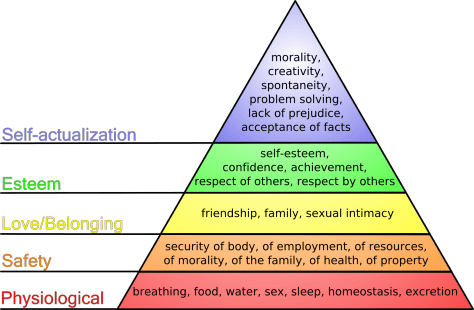
  1. Maslow’s Hierarchy of Needs. Maslow's_hierarchy_of_needs I showed this to my children’s lit students this morning, and I was reminded once again of how much sense this makes.  (Maslow’s basic argument is that the bottom levels of the hierarchy are necessary in order to achieve the higher levels.)  It applies to so many situations: the difficulty abused and neglected kids have in school, the poor work output of people who aren’t getting enough sleep, the writer’s block I get when I’m worried about other things (hey, didn’t I just mention that?).  It even explains the phenomenon of being hangry.  Sure, there are amazing stories about people who aren’t getting their foundational needs fulfilled (such as concentration camp victims) who nevertheless achieve the highest level of the pyramid by creating beautiful works of art or performing heroic acts of self-sacrifice, but what makes those stories so amazing is their rarity.  They are the exception that proves the rule.
  2. The emoji with no mouth. You’ve seen it: It’s a smiley face, minus the smile.  And yet it’s so eloquent.  I use it to mean “There are no words”–a phrase which, like Maslow’s hierarchy of needs, applies to so many situations.
  3. To Kill a MockingbirdI finished rereading this classic yesterday, and I was confirmed in my opinion that Scout Finch is one of the greatest narrators, and Atticus one of the greatest dads, of all time.  Very few books juxtapose humor and danger (recall that Scout is wearing a ham costume throughout the climactic scene), wisdom and innocence (Atticus’s words interpreted through the child Scout’s limited understanding and recalled from the adult Scout’s perspective) in such an effective way.  And the evocative descriptions—the humid warmth of a summer evening, the cracks in a sidewalk that has a tree root pushing through it—take me back to my own childhood, even though mine wasn’t spent in Alabama.
  4. The Grey Havens. My friend told me about this band Saturday morning, I impulse-bought their album Ghost of a King for $10 on iTunes without sampling it first, and I ended up listening to it over and over while driving that day.  Although their style is a little inconsistent (fluctuating from the folksy and dramatic sound of Mumford and Sons to a poppier but still substantial sound that reminds me of Imagine Dragons), I don’t mind that because I like both kinds of music, and their themes are consistent.  This is Christian music that doesn’t advertise itself as such.  On Ghost of a King, without using the names “God” or “Jesus,” they pretty much outline the whole history of the Bible, hitting the major points of creation, fall, and redemption.  My favorite song on that album is “Diamonds and Gold,” definitely on the pop/electronic end and very fun to dance to in the car (and probably out of the car, too).
  5. using flavored cream cheese as a dip for pretzels. Last night I used the Philadelphia brand roasted vegetable cream cheese as a comparatively “healthy” Super Bowl “dip.”  (Oh, my gosh.  Philadelphia.  I just made the connection.  I am the reason they won.)  Today, I polished off the rest of a tub of honey pecan cream cheese (also Philadelphia) as a lunch snack at work.  Seriously, this is good.  You should try it.

What are you digging right now?  Let me know in the comments.

your New Year’s inspiration

I hope you had a wonderful Christmas (although, as we learned in my last post, we are still in the Christmas season and will be until next Saturday, which is Epiphany) and didn’t miss me too much during my unannounced hiatus last week.  Today, I have a story to inspire you toward whatever goals you may be pursuing in the new year.

Last week, we were staying in a hotel while visiting family in Ohio.  One morning, I was in the fitness center doing a walking incline workout on the treadmill, when a little old lady–I use the term quite literally, with no disrespect intended–came into the room and hoisted herself up onto the elliptical.  My initial reaction was “Bless her heart,” but as the minutes went by, I could see in my peripheral vision that she was holding her own pretty well.

When I got off the treadmill, she was still going at it, and she wished me a good day, a merry Christmas, and a happy new year.  (At least I think she did–I had my music up loud.)  I thanked her and asked if she wanted the TV remote, which had been sitting unused on my machine, but she couldn’t hear me very well either (she didn’t have her hearing aids in, as she told me a few minutes later), so she got off her elliptical to find out what I was talking about.  I felt bad that she had to interrupt her workout, but it quickly became apparent that she wanted to talk.  We had one of those polite little strangers-in-public exchanges, but this wouldn’t be an interesting story at all (sorry about the long set-up) if not for what she asked me while I was on my way out the door.

“Have you ever run a marathon?” she asked.  I popped out one of my earbuds and answered, “No, I’ve run a half-marathon, but not a full marathon.”

“Oh, you have to run a marathon,” she said.  “I’m training for my 13th marathon.  I didn’t run my first one until I was 61.”

[From here on, I’m not going to continue with this dialogue thing–just imagine me saying variations of “Wow, amazing!”]

She began speaking as if me signing up for a marathon were a done deal.  “Just have fun,” she said.  “You can alternate between walking and running, at least on your first two marathons.”  (Now she was assuming I was going to run two.)  “Don’t worry about keeping up with the Kenyans.”  Here I laughed knowingly; my heart always sinks when the first Kenyan runner passes by on the return leg of the Virginia Ten-Miler when I’ve barely gotten started.

The conversation was short, and it ended with an exchange of first names (hers: Connie) and with Connie telling me she would pray for me and my family (this is not really a surprise in Central Ohio, Bible Belt North).  I walked away from the fitness center with a lot to think about, most of which can be summed up in various cliches such as “Don’t judge a book by its cover” and “It’s never too late to try something new.”  So I won’t belabor the point.  I’ll let you draw your own conclusions, and I hope Connie’s example won’t discourage you (“I’m not her, so I won’t try”) but inspire you.  Your thing may not be running marathons (though apparently mine is), but you do have a thing–go do it.

Thor: Ragnarok (another good review)

I’m sure I’ve said before on this blog that the Thor films are my favorite Avenger movies–not just because of their central character (who’s gorgeous, funny, sensitive, and smarter than people give him credit for) but because of the whole mythology-infused world of the stories and the painfully realistic (though sometimes hilarious) family drama that lies at their heart.  Anyone who knows me in real life is aware that I have a special love for Loki, but I’ve never been one of those fans who advocate for him to get a solo film.  Loki needs Thor, and both need Asgard.  And as we learned in Thor: Ragnarok, Asgard is a people, not a place (and certainly not just a throne).  Read on if you’re not worried about spoilers.

When trailers for Ragnarok started appeared several months ago, I was worried that the movie, with its neon colors, comedy, and rock-and-roll soundtrack was basically going to be Guardians of the Galaxy 3.  (Though I was pleased to see “Immigrant Song” finally associated with a Thor movie.  And not that there’s anything wrong with Guardians–I just wanted Thor to be Thor.)  And certainly, there are elements of Ragnarok that would fit comfortably in the Guardians universe, like the trippy trash planet Sakkar (which also reminds me of Mad Max and those weird landfill people from the last season of The Walking Dead) and the new character Korg, a humanoid pile of rocks with a Kiwi accent and a deadpan delivery, who shares certain qualities with Guardians characters Drax and Groot.

Yet, despite the fact that we’ve departed far from the Shakespearean line delivery of Kenneth Branagh’s Thor (and of the old comics) and the high seriousness of much of Thor: The Dark WorldRagnarok still feels like a Thor movie.  Maybe it’s the callbacks to the previous films–lingering interior and exterior shots of Asgard on the verge of destruction and appearances (however brief) of Thor’s old comrades.  (I wanted to cheer when Heimdall finally showed up!)  But I think the main reason Ragnarok feels like a Thor movie is that even though I spent most of the film laughing, I still felt the gravity of what was at stake.  And I felt that Old Norse sense of the dignity of dying alongside one’s companions (even though, happily, most of our favorite characters didn’t die).

One key death in the film, of course, is Odin’s, and I loved this beautiful, understated scene.  It was fitting that Odin, now humble but never humiliated, should spend his last moments not detailing his exploits but calling attention to the wild cliffs of the Norwegian coast.  Most importantly, he tells both of his sons that he loves them, and I think this explains not only the surprising (yet really not surprising, when you think about it) new power Thor attains at the end of the movie (I loved this) but also the subtle difference in Loki throughout the rest of the film.  Not that he suddenly converts to a thorough-going good guy, but he seems to have softened just slightly.  I really believed he was going to cry when Thor was talking about how it would be good for Loki to stay on Sakkar.  (Darn you, Tom Hiddleston, and your beautiful eyes.)

And that scene takes place just before the first occurrence of the recurring “Get Help” bit, which has been making me giggle out loud every time I recall it.  There’s a lot about the Thor movies, as a series, that’s really good, but I maintain that the best thing about them is the chemistry between Thor and Loki.  Whether they’re physically fighting or verbally bantering (or Thor is throwing Loki at unassuming guards), they act like real brothers, and I’ll never get tired of watching.  Here’s hoping their Sakaarian spacecraft leads them to more adventures that we’ll get to see.

what I would say if I were on Talking Dead

Sometimes I think about what I would say if for some reason I became famous enough to sit on the celebrity couch in Chris Hardwick’s fake studio apartment.  Lately, the guests (and Chris) have been doing fairly well at focusing on The Walking Dead instead of promoting their own work and making dirty jokes.  But there are some topics nobody has broached that I think need to be addressed.

  1. Negan is not a good role model or even a cool guy.  I made this quite clear in my post from a year ago entitled why I hate Negan, so I won’t belabor the point now.  At the time, I said he was an engaging character, but now I find his swagger contrived (which it is, of course–it’s a post-apocalyptic persona) and his relentless unkindness, even to his own terrified followers, almost unbearable to watch.  Yet convention attendees are still dressing their little kids up in Negan costumes.  It’s troubling, to say the least.  I wish Rick (or anyone, really) would kill him ASAP–next Sunday, preferably–but I’m sure he won’t die until the end of this season, if even then, because he seems to have surpassed Darryl as the darling of ratings.
  2. The most interesting characters are the people who seem to have nothing to offer–the ones considered dead weight or even liabilities according to the masculine contribution-value paradigm I wrote about in another post.  Sure, we need people like Rick who have gun skills and leadership abilities, and people like Carol whose past traumas have made them tough, but we also need people like Father Gabriel, who had to go through a serious worldview shift in order to even comprehend what was happening, and people like Eugene, who concocted the (end of the) world’s biggest lie because he was so afraid of being cast out or killed by people he knew were more capable and prepared.  People like these latter two, perhaps my favorite characters right now, provide a necessary non-majority perspective and are able to empathize with others who aren’t brave or bad-ass and yet have worth just by being human.  (Well, Father Gabriel is able to empathize.  Eugene’s not great at people skills, but he’s improving.)  I often think back to Dale in Seasons 1 and 2 and that bewildered look he would get, which I affectionately refer to as The Dale Face.  Dale clearly was having trouble reconciling his understanding of the world with the horror he was seeing around him.  I would have the same trouble, and I’m glad to think I would.  The people who aren’t troubled by the zombie apocalypse are the people who scare me.  And even some of our most confident and capable characters have had to go through periods of retreat and reflection–Morgan, most notably, but also Rick when he went through his gardening phase.  (By the way, I was annoyed with all the fans who mocked “Farmer Rick.”  Besides processing his own grief, he was also creating a sustainable food source for his community.  Since when is that a bad thing?)
  3. King Ezekiel, his tiger, and his kingdom have turned this show into a bizarre mashup of a gritty, hyper-realistic road story set in the near future and a faux-medieval high fantasy, Lord of the Rings style, and I love it.  He’s the best thing that’s happened to this show in a while.
  4. Please, someone, wash and cut Carl’s and Darryl’s hair.  I can hardly stand to look at them.

Let’s talk about the zombie apocalypse.

Classes started at my university today, and even though I’m not even teaching on Mondays, right about now I’m really relating to that song in Fight Club, “Where Is My Mind?”  (See my post from the beginning of the spring semester, “This is my brain on the first day of classes.”)  So in honor of not having a functioning brain—but also because I’ve been working on this particular project lately—let’s talk a little bit about my zombie apocalypse story.  I’ve been going to a creative writing group and getting some awesome feedback, but I’d love to hear your thoughts as well on a key issue: the title.  My working title for the story, which I eventually want to turn into a screenplay, is “Sam and Adrian in the zombie apocalypse.”  That’s nice for helping me find my Word document, but that’s about the extent of its usefulness.  Here are some other titles I’ve considered:

  • “Jungleland,” as in the Bruce Springsteen song.  It evokes the proper sense of chaos, but that song is very much about a city, and my story takes place mostly on rural roads and in a small town, so the title may be misleading.
  • “The Pursuit of Happiness,” an ironic reference to the central plot device: a man is running out of his antidepressant medication and is searching for more in a world where there are no doctors and most pharmacies have been depleted by looters.  But this title could also be confusing; I can just see audience members grumbling, “I thought this was the movie where Will Smith solves the Rubix cube!”
  • “The Road to Hibbing” because roughly the last half of the story takes place in Hibbing, Minnesota, the hometown of Bob Dylan and also of one of my protagonists.  (The first half is about getting there.)  The title accurately describes what happens, but I think it sounds a bit too whimsical.  It also makes me feel like Irish ballads should be playing during the movie trailer.  That’s not really the musical tone I’m going for.
  • “Life Is Hard,” which is going to be a recurring line in the story.  (It also gives a very subtle nod to a line from a Bob Dylan song: “Life is sad, life is a bust.”)  Effective, but a bit heavy-handed, perhaps?
  • “Sam’s Town,” as in the Killers album.  The name of my character who grew up in Hibbing and returns to his hometown is Sam, so again, an accurate description.  However, this title might lead to more disgruntled viewers—this time, people who were expecting to see a Killers tribute (though I do like the idea of using one or two Killers songs on the soundtrack, along with Dylan and Springsteen).  A similar option would be “Sam’s Home”; I like this one because it can be interpreted two different ways.  I think of this story/screenplay as, among other things, a supernatural twist on the “30-ish guy moving back in with his parents” plot, and “Sam’s Home” riffs on that a bit.

Titles are important, so I’ll probably be thinking about this for a while.  I’d love your feedback on these suggestions, along with other title ideas you may have.

what I’m reading

This is the second in the trilogy of posts on what I’m watching, reading, and listening to.  I may make this a regular, periodic feature.  

I teach a college-level children’s literature course, so I read a lot of children’s books, and I have no reason to be ashamed of that.  Most of the below list of books I’ve finished or started within the past week are children’s or YA (young adult, technically a subcategory of children’s lit).

  1. Salt to the Sea by Ruta Sepetys.  I mentioned this YA novel in my recent post about World War 2 stories.  It’s about the sinking of the Wilhelm Gustlav (an overcrowded ship that was evacuating civilians, many of whom were not ethnic Germans, from nearly-defeated Germany in 1945), the largest maritime disaster of the 20th century.  I think being informed about this little-known event is important, but I was disappointed with the book.  Sepetys was too ambitious in trying to write in the voices of four very different adolescents, some of which voices succeed more than others.  In particular, I became increasingly annoyed over the course of the book with the voice of Emilia, a character with whom readers are clearly meant to sympathize.  I think part of the problem was the too-precious voice of the audiobook narrator, but beyond that, the character was overly dreamy and seemed strangely unmoved by the horrors that had occurred in her young life.  Several of her overwrought similes made me cringe.  In contrast, the most successful voice belonged to Alfred, the probably sociopathic young Nazi sailor.  I occasionally felt sorry for him in his delusions, but I mostly felt disgusted–as the author wanted me to feel–by his racism and cowardice.  But the most effective scenes in the book were the minimalist, objective descriptions of the human and inanimate flotsam that floated by the protagonists during the long, freezing night after the sinking.  These scenes were actually more powerful than similar scenes in Titanic (to the extent that you can compare a book with a movie), but the rest of the book was a disappointment–to me, anyway.  Apparently not to people on Goodreads.
  2. And now for a book with a wonderful narrative voice: Bud, Not Buddy by Christopher Paul Curtis.  I reread this book over the weekend because I’ll be teaching it this fall, and I chose it because the protagonist, who tells the story in first person, is an absolute delight.  He reminds me of Huckleberry Finn in that he’s an at-risk youth in pretty dire circumstances, yet he shows his resilience by finding the humor in everything.  I laughed out loud at several of his flights of imagination, like when he tries to drive a car (he can’t) to escape a man he suspects of being a vampire, or when he pretends his mop is the submarine in “20,000 Leaks under the Sea”–“10,000 leaks stopped, only 10,000 more to go!”  The hilarious, genuine voice of Bud–along with the fact that readers are learning unobtrusive lessons about the Great Depression, labor unions, and the Jim Crow era–is probably why this book won the Newbery Medal.
  3. A Ring of Endless Light by Madeline L’Engle.  I’ll probably finish this one tonight.  I read An Austin Family Christmas every Christmas as a child, so I’m enjoying reading about Vicky and her family (and Mr. Rochester the Great Dane) now that they are all a little older.  It took me a little while to get used to the dialogue–it seemed stilted at first, but I eventually realized that these are just really thoughtful and articulate people.  This isn’t a fantasy in the sense of A Wrinkle in Time, but Vicky’s dolphin communication project hovers at the line between science and magic (to quote a Thor movie).  The rest of the novel, though, is firmly realistic.  It’s about death, family, growing up, dating–it’s pretty weighty.  But Vicky’s subtle faith and strong support system make it a hopeful story.
  4. Extremely Loud and Incredibly Close by Jonathan Safran Foer.  This is a book that breaks textual convention (it includes blank pages, photos, cross-hatching, etc.) in an attempt to articulate the inarticulable–death and, more specifically, the deaths of thousands of people (represented by one man) on September 11, 2001.  In keeping with this theme, I won’t say a lot about this book, but I will say that it’s a great example of the principle that having a child narrator (even a successfully authentic one like Oskar in this book) does not make a book a children’s book.

Let me know if you have opinions about any of these books.  Next week, I’ll be back with music I’m listening to.