for your New Year’s resolution to read more children’s lit

Because if that isn’t one of your New Year’s resolutions, it should be.

When I was grading my children’s lit students’ response papers on contemporary realism, for which at least five of them chose to write about Louis Sachar’s Holes, I realized that I had never read this novel, though I had seen the 2003 movie (which is excellent, and which I’ll address shortly).  So during my Christmas break, I decided to spend an afternoon reading it.  Now, I’m pretty sure I’ll use it as an assigned text if I teach the course again next fall.  Let me tell you why Holes is so good.

In slightly over 200 pages, Sachar weaves a five-generation family saga together with a hundred-year-old mystery and the story of a teenage boy’s developing self-esteem and moral consciousness.  In the process, he meaningfully addresses the penal system, homelessness, and race relations in America.  Yet there’s nothing pretentious or alienating about this novel.  It’s exciting, it’s funny, and it’s perfectly pitched toward that elusive reading demographic, elementary to middle school-aged boys.

When I get around to teaching Holes, I’ll have to comb through it to find all the symbolism, parallelism, and other literary devices that Sachar uses in such a not heavy-handed way.  For now, here’s one example: the situational irony.  I love the little detail at the end of the novel that tells us that Camp Green Lake ends up turning into a Girl Scout camp, a wonderful conclusion to all Mr. Sir’s lame jokes about how it isn’t a Girl Scout camp.  As ironic reversals go, this ranks right up there with Haman’s nasty shock in the book of Esther, my current go-to example of situational irony.

I’ll also have to find time in the course to show the movie, which is one of the most faithful page-to-screen adaptations I’ve ever seen (not that I valorize faithfulness; I understand that books and films are two totally different media), probably because Sachar himself wrote the screenplay.  (He also appears in a brief cameo–he’s the balding guy that Sam the Onion Man tells to rub onion juice on his scalp.)  One thing I appreciate about the film is that all the characters from the book are in it; none of them are collapsed together for simplicity’s sake, as so often happens in adaptations.  I also think it’s important that each of the actors who portrays one of the boys in D Tent is the same race as the character in the book, since race is such a major (though relatively subtle) theme in this novel.

The one place where the movie diverges significantly from the book is also one of its areas of strength: the casting of the protagonist, Stanley Yelnats.  Shia LaBeouf plays this role with great sensitivity and humor (whatever he may be now, Shia used to be a really good actor), but he doesn’t fit the novel’s description of Stanley as a very overweight kid.  Stanley’s weight is important to the themes and even the plot of the novel, and it adds painful overtones to scenes that are already emotionally fraught (like when ZigZag tries to force Stanley to eat his cookie).  I wonder if some young fans of the novel were disappointed that the movie didn’t address this element–especially, perhaps, some kids who identified with Stanley.  I was a little disappointed myself, but it’s my only complaint about the film.

In conclusion, you should read Holes, watch the movie, and let me know what you think.  And get working on that New Year’s resolution.
some random questions for Christmas

In which I interview myself.

If you could design a Christmas t-shirt, what would it say?  Bob Cratchit: Straight Outta Camden.

If you could spend Christmas with any fictional family, what family would you choose?  I borrowed this question from another blog I looked at over the weekend, but it’s something I’ve thought about before–not that I had to think very hard.  The only correct answer to this question (and a total no-brainer if you’ve been reading my blog over the years) is “the Weasleys.”  However, I did see Fantastic Beasts again today, and I have to say that if for some reason I couldn’t Apparate across the Atlantic for Christmas, it would also be fun to spend Christmas with Tina and Queenie Goldstein–if Newt and Jacob could also be there, and if we could have pie and strudel.

What holiday season song bothers you the most?  Please indulge me in a rant on this one.  I am deeply troubled by the song “Baby, It’s Cold Outside.”  It used to bother me because although it gets classified as a Christmas song, it’s merely a cold weather song.  People in Australia could sing it in August.  But then someone pointed out to me that this song appears to describe a man keeping a woman in his home against her will.  You can call it an attempt at date rape or a hostage situation–either way, there’s nothing cute or clever about it, and it really annoys me that singers who think they are cute and clever are still covering it.  You can try to explain the lyrics away as the product of a simpler time, but what are you going to do with the line, “Say, what’s in this drink?”?  Slipping drugs into a person’s beverage was never okay.

Let me contrast this song with another one that presents a similar scenario: “Let It Snow.”  In this song, the two characters appear to be mutually consenting adults who actually like each other, unlike in “Baby It’s Cold Outside,” and they face a far more challenging weather prognosis (cold is only dangerous if you have to spend the whole night outside, whereas snow can cause decreased visibility and hazardous road conditions).  Yet, after a nice evening enjoying popcorn in front of the fire, one of them is mature enough to say, “I’ve had a lovely time, but I am now going to get in my four-wheel drive vehicle and safely drive home before this snow gets worse.  How about you give me a big kiss and a hug to keep me warm on my way?”  Yes, the line “The fire is slowly dying, and my dear, we’re still goodbye-ing” may indicate a reluctance to part, but again, this reluctance seems to be mutual.  There is no coercion here, nor any guilt-tripping.  (Contrast this with the part in “Cold” when the man says, “Think of my lifelong sorrow.”  Gag me.)

(takes a deep breath) Okay, we can move on to the next question.

What charming Christmas comedy have you discovered in recent years?

How did you know I’d recently discovered a charming Christmas comedy?  Well, last year I came across Nativity! in which Martin Freeman plays a put-upon grade-school teacher directing a nativity play that gets way out of hand.  Martin Freeman is delightful as always (I think I’ve used that exact same adjective to describe him at least once before on this blog), and the kids, who seem to be “real” people rather than actors, are hilarious.  So is Mr. Poppy, the teacher’s aide who is basically a child himself.  Check this one out.


Advent week 3: Christmas rituals

Last week, actual tears came to my eyes while I was writing my blog post, and I don’t feel like going through that emotional wringer again (plus I can’t think of anything profound to say this week), so I’m going to write about something more fun.  But first, I have to tell you about a book I checked out of my church library.  It’s called Simply SenseSational Christmas.  The title, interestingly enough, isn’t the cheesiest thing about the book.  Let’s just say that it savors strongly of the 1990s, when it was published.  But although the hip DIY bloggers of 2016 might sneer at much of this book’s aesthetic, its central points are perhaps more relevant than ever: 1. Christmas is about the time when God was born in a stable, so stop stressing yourself out trying to have the perfect showplace home, and 2. Appealing to all five physical senses is possibly the best way to create a memorable, delightful, and even worshipful experience for yourself and your loved ones at Christmas.  The book goes on to offer simple strategies like scattering a handful of cloves around candles so that they give off a spicy, festive scent when they get warm.  This might not be life-changing stuff–then again, it might.

This book has got me thinking about some of the rituals, most if not all of them involving the physical senses, that I enjoy in my own home each Christmas.  This is the second Christmas I’ve spent in my house.  Before that, I was renting an apartment, and while I enjoyed some Christmas rituals there too, there’s something special about celebrating in one’s very own home.  (I also enjoy a number of Christmas rituals in my parents’ house, where I always spend the actual day of Christmas and usually the week or so before and after it, but those aren’t the subject of this post.)  Here are some of them.

  1. I have a number of Christmas albums in my iTunes library, including some that I’ve been listening to with my family since childhood (The New Young Messiah) and some that I’ve acquired in recent years (Christmas at the Renaissance Fair by Moat Jumper–exactly what it sounds like).  I start listening to these while I’m decorating on December 1, and I usually get through the whole collection about three times during the Christmas season.  I also have some individual Christmasy tracks from other albums that I include in the rotation, such as Ralph Vaughan Williams’ “Fantasia on Greensleeves” and John Williams’s “Christmas at Hogwarts” from the Harry Potter and the Sorcerer’s Stone soundtrack.  I also like to listen to the Nutcracker suite on record #12 of the Festival of Light Classical Music record collection I bought at Goodwill last year for $2.50.
  2. I light candles like a pyromaniac all year, but at Christmas, it really gets out of hand.  I go through tealights like my family goes through toilet paper at a large gathering.  The last year I lived in the apartment, my neighbor made me a lovely set of candleholders created from upside-down stemware decorated to look like Santa Claus, a snowman, and other festive characters.  I also have a balsam-and-cedar scented large Yankee jar candle that almost compensates for the fact that my 1.5 trees (I have a big one in the living room and a little one in my home office) are artificial.  My Pier One Holiday Forest room spray, a gift from a friend last year, also helps.
  3. I love mail.  I check my mailbox obsessively on Saturdays when I’m home to check it, and I actually have a real honest-to-goodness pen pal.  So it’s no surprise that I enjoy sending Christmas cards.  I love writing in them (even if it’s just a simple “Love, Tess”), sticking Christmas seals on the envelopes, and putting a big fat stack of them out in the mailbox.  In turn, when I receive Christmas cards, I hang them with tiny clothespins on twine in the corner of my entryway.  It’s an easy and beautiful decoration, especially when I get cards with gold on the front, which catch the light from my many candles and my tree lights.

I could go on–I haven’t said a word about food–but I think you get the idea.  These rituals are so common as to sound almost banal, but they’re meaningful to me.  I’m sure you have some that are meaningful to you.  Feel free to share in the comments!

things that made me happy this week

I couldn’t settle on a single topic for this post, so I’m just going to make a list of things that brought me a bit of delight over the past week, in hopes that it may be interesting and useful to others as well.  I guess you could call this my T(t)hanksgiving post, since next week you better believe I’ll be blogging about Fantastic Beasts and Where to Find Them.

  1. Finding the soundtrack to Fantastic Beasts on Spotify today–there’s nothing like listening to the score to get you excited about a movie (not that I needed it in this case)
  2. The full trailer for Beauty and the Beast, released yesterday.  Besides the fact that this is a remake of one of my very favorite Disney movies, I also love that the anticipation is giving me a way to bond with other fans, including my children’s lit students and some of the women in my family.
  3. Speaking of my students (in all of my classes), they’ve been making me happy all semester.  These groups of students are fun and smart, they seem to like me (teachers, let’s not act like that doesn’t make a huge difference in our personal morale), and they seem to actually be interested in what we’re reading.  And those things aren’t necessarily true every semester.
  4. Finding three Christmas tree ornaments over the weekend: a wooden “Peace on Earth” ornament from The Funky Junk Shop in Forest, VA (where I also found a cozy and flattering shirt that I’m now in love with) and a felt baby chick and a vintage Shiny Brite brand bulb with the solar system on it, from The White Brick House, also in Forest (where I also found a vintage Virginia state bird and state flower glass to replace one from my set that I had broken).
  5. Cooking and baking, for myself and for others.  For myself, I’ve been making some chard-based recipes featured in the December Better Homes and Gardens, and they’ve been delicious so far.  Last night I baked an apple pie for a Thanksgiving dinner being hosted by a friend’s local ministry (and the crust actually looked presentable, which is definitely something to be thankful for), and tonight I’ll be making some treacle fudge for the International Candy Tasting at work tomorrow.  And I’m already looking forward to making sweet potato souffle this weekend for my friends and next week for my family.  (I also made some last week just for me–I’d like to keep up this “one sweet potato souffle a week” trend as long as I can stand it.)
  6. The cardio funk class I attended last night at the YMCA.  When people think of my good qualities, rhythm is not normally near the top of the list (or on it at all), but I think that’s part of the reason why I enjoyed this class so much–I knew I wasn’t going to get the moves exactly right, so I just focused more on the cardio than on the funk and had fun laughing at myself.  Tonight…Zumba.
  7. Volunteering with Safe Families for Children, an organization I’m excited to be involved with as it gets off the ground in Central Virginia.  Saturday morning I got to help with registration for a conference for foster and adoptive families where SFFC had a big presence, and it was so much fun to see all these hospitable, compassionate people showing up eager to learn and be encouraged.  Yesterday and today, I’ve provided transportation for some young single moms, and I’ve enjoyed talking with them and playing with their cute kids.  I know they say that helping other people is a big mood-booster, but more than that, I love getting to know all the many different people that I encounter through these opportunities (and this is coming from an introvert).
  8. The beauty right outside my house as winter approaches.  This week, highlights have included a flock of blue jays in the backyard; a huge and colorful woodpecker that landed on my feeder a few days ago, looked bewildered, and then flew away; the incredibly bright supermoon on Sunday and Monday nights, and the hard frost Saturday night/Sunday morning (the coolest part was in the morning when the sun started melting the frost where there weren’t any shadows–my lawn was half white and half green).

I could keep going, but it’s time to go make a chard stir-fry.  You should seriously consider taking half an hour to write down things that have made you happy this week.  It isn’t hard at all.

a gallery of picture books

I am teaching a college class about children’s literature, and today our topic was picture books.  Truly, we could spend a whole semester on these beautiful works that are not merely cute stories (I challenged my students not to use the word “cute” in any of their papers for the rest of the semester) or fond memories from childhood.  Picture books represent an astonishing variety of artistic styles and mediums; they tell stories that may incorporate irony and sensitive characterization, and–yes–they sometimes teach lessons ranging from basic counting to eating in moderation (both of which are found in The Very Hungry Caterpillar by Eric Carle, a simple and delightful book that doesn’t feel like it’s teaching any lessons).

During the 75-minute class period, I had time to read seven entire picture books to the class, while pausing to point out important details in the text and illustrations.  Here are the books we read, along with a few observations about each.

  1. Mr. Rabbit and the Lovely Present, words by Charlotte Zolotow and pictures by Maurice Sendak.  This book draws from two very grown-up artistic traditions.  Magical realism, a literary tradition in which bizarre events happen to normal people and are treated as no big deal, is evident in the protagonist’s conversation with a rabbit who is taller than she is and from whom she has no problem taking advice.  Meanwhile, the pictures in the story, with their pastoral setting, pastel colors, and blurred brushstrokes, seem to fit into the school of impressionism.
  2. The Story of Ferdinand, words by Munro Leaf and pictures by Robert Lawson.  The text, about a bull who would rather smell flowers than fight, is laugh-out-loud funny (I say that because I actually laughed out loud while reading it), and the black-and-white line drawings are amazingly detailed and delightful.  We don’t expect to find irony in pictures books, but the whole impact of this story comes from an ironic reversal involving the key word “mad”: Everyone wants to make Ferdinand mad so he’ll fight, but he ends up making everyone else mad when he sits down to smell the flowers.
  3. Tuesday, words and pictures by David Wiesner.  This almost-wordless book, in which frogs launch off on lily pads and begin to fly through an average neighborhood, is illustrated in a style that our textbook calls surrealism, and I have to agree.  I bet Salvador Dali wishes he thought of painting a picture of a guy eating a sandwich in his kitchen while frogs are flying past the window.  Another wonderful thing about this book is that the ending isn’t really an ending–there’s an indication that more magic is going to happen next Tuesday.
  4. The Very Hungry Caterpillar–I’ve already mentioned this one, and it’s so well-known that there’s not much more that I can say about it.  For a very short book, there’s an awful lot going on, and it’s brilliant.
  5. Come Away from the Water, Shirley, words and pictures by John Burningham.  This is a very funny book about a little girl having an adventure with pirates while her clueless mother keeps admonishing her not to get tar on her shoes or to pick up any smelly seaweed.  There is huge irony in the layout of the book; the parents’ boring day at the beach is illustrated in washed-out colors on the left-hand side of each page spread, while Shirley’s simultaneous adventure is depicted in bold colors on the right.  The deliberately naive drawing style reminds me of Charles Schultz’s Peanuts.  (Shirley’s head is perfectly round, like Charlie Brown’s.)
  6. Make Way for Ducklings, words and pictures by Robert McCloskey.  This one might be my favorite of the ones we read today.  The sepia pencil drawings aren’t necessarily eye-catching at first, but they grow on you as the story continues, taking you flying above real locations in Boston (this book has a strong sense of place).  I love how the police officer, Michael, is so serious about helping these ducks get through the city safely that he gets practically the entire Boston PD involved.  This books has it all: onomatopoeia, repetition, and even a quest narrative.
  7. Where the Wild Things Are, words and pictures by Maurice Sendak.  Speaking of books that have it all: this one is also a quest narrative, with a chiastic structure, internal rhyme, and a plot that make psychoanalytical theorists go crazy.  But it’s also a story about a boy who feels wild and out of place, learning that he belongs right where he is, where his mother loves him and keeps his dinner waiting for him, still hot.  Now that’s a good story.

Picture books aren’t just for children or people with children.  Read some this week!

Am I not smart anymore?

Here’s what I’m a little bummed about right now: I haven’t written what I consider a real blog post (primarily text, longer than a few lines, and not recycled) since “My month with Kenneth,” published on November 10.  When I think about writing an articulate, coherent post that has a meaningful message, I feel really tired.

For example, you need to have transitions in good writing.  Transitions are really hard to write!  (Maybe I need to lay off on my English 102 students.)  I don’t know how to transition into my next paragraph, so I’m just going to jump topics, if that’s okay with you.

There’s a difference between having ideas for writing and actually writing.  I experience the former all the time.  I have so many screenplay ideas in my head, I would probably have a good statistical probability of winning an Oscar if I actually wrote all of them and saw them made into movies.  Examples: Best Adapted Screenplay: Dickens’s A Tale of Two Cities, starring Tom Hiddleston and J. J. Feild (because the screenwriter gets to do the casting, obviously); Best Original Screenplay: Sam’s Home (there’s a pun in that title), a bittersweet comedy about a 30-ish guy with depression who’s had some setbacks and is now back living with his parents and working in the same Italian restaurant he worked at in high school (it sounds like it’s been done before, but I have fresh angles).

See, that paragraph was easy to write!  Because I didn’t have to put sentences together logically; I just used a lot of parentheses.

I used to be able to write really brilliant stuff.  The other day I was thinking about some of my best work: my master’s thesis about eating and bodies in George Eliot’s novels, the short story about Cain and Esau in a diner that I wrote in 2009, the paper I wrote on Moneyball and masculinity in a doctoral film class.  I’ve even written some blog posts that I’m pretty proud of.  (See my archives, at left.)  But now, this is the kind of writing I do every day: “Hey guys, we need to have a meeting about Topic X and Topic Y.  How does June 15 sound?”  After a day of writing that kind of stuff, I’m too mentally tired to write a blog post, or to actually start penning one of those screenplays (although I did read a couple of books on screenplay last summer), or (are you kidding me?) write something scholarly.

Does this mean that my creativity is sapped, that my argumentation skills have significantly waned, that my vocabulary has shrunk, or–as my title sadly suggests–that I’m just not smart anymore?

Or, is one of these three more optimistic things true (I know; “things” is a weak noun)?

  1. I just have to set aside time for writing, as Daniel Silvia has told me in How to Write a Lot.  Perhaps I was lucky in the past and was frequently struck with inspiration, but I shouldn’t expect that to be par for the course (ugh, cliche!).  Maybe if I actually sat down and said, “I’m going to write now,” I would come up with something brilliant.
  2. I can still write pretty decent prose–I mean, I’m writing this post!
  3. The “Hey guys” emails, the comments I write on my students’ papers, the Instagram photo captions–maybe those are actually just as brilliant as those old papers and stories I’m really proud of.  They’re just different kinds of brilliance for different contexts.  Maybe?

#FakeSummerBlockbusters


I was going to tweet these, but since I haven’t posted here in a while, and I think people are just as likely to look at my blog as my Twitter, here are some movies that aren’t actually coming out this summer.

From Christopher Nolan, a football movie that rips the very fabric of time and space: InterCeption.

Which Zombie Is Eating Gilbert Grape? –starring the kid from Fear the Walking Dead who looks like young Johnny Depp.

A boring superhero who wears blue and always does the right thing vs. a rich guy who doesn’t have superpowers but wears a cool suit.

Oh, wait, this movie already has come out this year.  Twice. #justkidding #LuvUCapAmerica

#hobbitlife

Several times on this blog, I’ve stated or hinted that I feel I have quite a bit in common with a hobbit.  (See, for example, I am not fast” and my comments on “Another schizophrenic post.”) Yesterday, I formulated my most thorough, yet succinct, statement of this resemblance to date.  I wrote it for a different venue, but I thought I’d share it here.  Enjoy.

If you want to understand me pretty well, you really just need to think of Bilbo Baggins. Like Bilbo, I love my house, and I’m quite proud of keeping it tidy and homey. I like my routine, my alone time, and my square meals. But if you show up at my door and ask me to go on an adventure–well, I might need a little prodding, and I might freak out about forgetting my pocket handkerchiefs, but once you get me on the road, you’ll find me a dependable traveling companion, and I might even pleasantly surprise you with my resourcefulness and (occasionally) courage.

Just as a clarification, I don’t have big ears or hairy feet.

My Month with Kenneth

Kenneth Branagh, that is.  See what I did with the title, there?

I’ve loved Kenneth Branagh and his art ever since my mom made me read Much Ado about Nothing and watch his exuberant 1993 adaptation when I was in middle school.  I love his non-Shakespeare stuff too; in Harry Potter and the Chamber of Secrets, he makes the cringe-worthy Gilderoy Lockhart funny and even likeable.

A few weeks ago, I watched Branagh’s 1994 film Mary Shelley’s Frankenstein twice within the space of four days.  I wanted to show it to the book club I’m faculty advisor for, but first I wanted to watch it (it had been quite a few years since I’d seen it) to make sure I could show it to the students in good conscience, considering that it’s rated R.  I decided that I could, but I prefaced our group viewing with a warning about why it’s an R-rated movie (mostly what the MPAA calls “thematic elements”–it is, after all, about a guy who sews and splices dead human body parts together).  Then I gave them another warning: There’s nothing subtle about this movie.  There’s weeping!  Screaming!  A huge house fire!  A bombastic soundtrack!  Dramatic gestures and facial expressions!  I told the students that I think part of the reason for this lack of subtlety is that it’s an adaptation of a novel from the Romantic period, a novel full of heightened language and unabashed displays of emotion.  (If I had a dollar for every time in the book that Victor Frankenstein flings himself into or out of a conveyance, or his eyes gush with tears…)  The dialogue in the 1994 adaptation is actually pretty understated, but the Romantic emotionalism appears elsewhere in the cinematic elements I mentioned above.

But I don’t think that’s the only reason for the heightened–well, the heightened everything of Mary Shelley’s Frankenstein, because the same over-the-top qualities appear in other Kenneth Branagh films.  I think the reason is that Branagh, like many film actors and directors from the UK, was first a stage actor and is still actively involved in live theater.  (More on this later.)  But unlike many others, Branagh has continued to bring that stage sensibility to the films with which he’s involved.  Everything is bigger on the stage because there’s no camera or audio equipment to swoop in and catch the flicker of an eyelash or a quiet sigh.  Over the years, the film industry has taught us to valorize intimacy and subtlety, and to view “stagey” as a derogatory term.  Kenneth Branagh’s films often challenge those conventions.  Just watch his wild and colorful Much Ado about Nothing, with its triumphant Patrick Doyle score, and compare it with Joss Whedon’s snarky black and white 2012 adaptation, with its smooth jazz score.

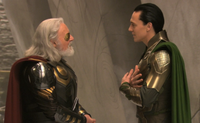
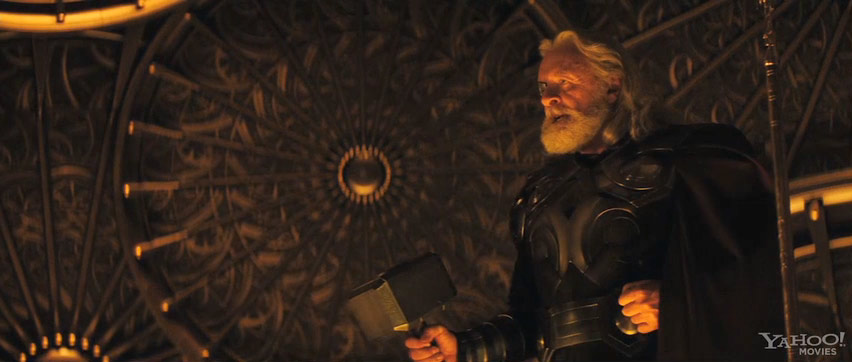
I thought about this more last night when I re-watched Thor (2011), which Kenneth Branagh shocked Hollywood by choosing to direct.  (The one that really shocked me was Jack Ryan: Shadow Recruit–I’m still not sure what Kenneth was doing there.)  Because I’m preparing to write an essay about the Thor movies (I’m sure I’ll say more about this in future blog posts), I was taking notes and paying particular attention to the Shakespearean allusions and the stage conventions that appear in this first film.  I noticed that the dialogue, at least in the Asgard scenes, is very different from the snappy, jokey language typical in superhero movies.  This is a Shakespearean family inheritance drama.  Stakes are high, voices are raised, accusations are flung, tears are shed.  I think that may partially explain why some die-hard Marvel fans didn’t care for this movie–it didn’t fit their expectations.

GET OUT OF MY HOUSE, UNGRATEFUL PUNK!!!!

GET OUT OF MY HOUSE, UNGRATEFUL PUNK!!!!

FINE!!  AND I'M NEVER COMING BACK!

FINE!! AND I’M NEVER COMING BACK!

"WHY DIDN'T YOU TELL ME I WAS ADOPTED???!!!" "BECAUSE I KNEW YOU'D FREAK OUT LIKE THIS!!!!"

“WHY DIDN’T YOU TELL ME I WAS ADOPTED???!!!”
“BECAUSE I KNEW YOU’D FREAK OUT LIKE THIS!!!!”

Anyways.  I’m not very good at creating memes.  My point is that there are some fantastic actors in this movie, so we can’t attribute all that yelling, nor those facial expressions (!), to bad acting.  In fact, several of them are also stage actors, and my guess is that they were totally on board with Branagh’s unconventional choice to make a superhero movie look a lot like a live production of Henry V.  (I chose that particular Shakespeare play for a reason, since Branagh on numerous occasions has compared the two stories.  See this fascinating article for details.)

I’ll close this post by saying that next Monday night, my parents are going to see Kenneth Branagh in Harlequinade, a very meta comedy about a troupe putting on A Winter’s Tale, at the Garrick Theatre in London.  (You know that part in the Bible that says, “Thou shalt not covet thy parents’ theater tickets”?)  If this rambling post has been accurate, they will be watching Kenneth Branagh do on stage what he has been doing on film (and directing others to do) for years now in defiance of Hollywood convention.  Stick it to ’em, Kenneth.

I am not fast.

A brief explanation to the people I’ve been road-running with (that is, in the wake of) recently.

My running style can best be understood if you keep in mind that I am basically a hobbit.  I’m about 5’2″ and (this is a nice and fairly accurate way of putting it) solidly built.  I like to walk barefoot and can be quiet and light on my feet, but never graceful like an elf.  I enjoy and am quite good at hiking long distances, like to the Old Forest on the borders of the Shire.  I can carry my dearest (emaciated) friend up the side of Mount Doom, no problem.  But if you expect me to be fast, there we encounter a problem, unless you intend to give me a piggyback ride as Boromir did for Merry and Pippin.

Speed is not my skill.  Endurance is.  I’m well aware that endurance is not glamorous.  It is hard to depict in literature or film, and boring to read or watch.  For me, though, it’s something to be quietly proud of.  I take pride in the fact that during the Virginia Ten-Miler, I keep running steadily up Farm Basket Hill when most of the runners around me, some of them generally faster than I, are slowing down to walk.

Apparently I also have endurance in other areas of my life.  My chiropractor says I have a high pain tolerance, which is kind of an ugly cousin to endurance.  The first time I had a phone conversation with my dissertation chair, whom I’d never met in person, he said he thought I had grit, another close relative of endurance.  I’d like to believe it was the steely note of determination in my voice, but I think he was probably just bluffing.  Still, he must have been right, because I finished my dissertation (relatively quickly, I think, considering some of the logistical difficulties I encountered), and anyone who completes a doctoral dissertation must have grit.

I composed this post in my head during a recent run when I was feeling really bad about the fact that the second-slowest runner was so far ahead I couldn’t even see him.  I’ve framed it as an explanation to my fellow runners, but I think it’s actually just validation for me.  And I’m sharing it on my blog because there may be some other hobbits out there who need to look at their boring endurance trait from a new perspective.  Keep trudging, my friends.