I don’t like me when I’m angry.

People don’t believe me when I say this, because I’m usually quite good-natured, but I get a bit violent when I’m angry.  My bursts of anger are quite brief–I don’t hold grudges–but my blood pressure shoots up dramatically, and I tend to react physically (or at least to want to react physically).  In other words, I turn into Little Hulk.  I say “Little” because I am about five foot two or three and not very strong.  That’s why people tend to think it’s funny or cute when I yell or punch a desk or jump on my sister (I did that several times when we were roommates).  I agree that it makes an amusing story, but ultimately it’s not very cute or funny, and here’s why.

1. Someday, I will probably have people in my life who are smaller than I am and whom I could actually hurt–i.e., children.

2. Anger gives me a temporarily useful adrenaline rush (I packed up my entire office in about an hour this morning when I was mad about a dumb thing, which I am now over), but I’m pretty sure it has negative physiological effects in the long term.  See, for example, my comment above about blood pressure.  I think people can also get ulcers from being angry too much.

3. Although, as Jesus demonstrated, righteous anger is…well, righteous, 99.9% of the time my anger has no such just cause.  Usually I’m angry because things aren’t going according to my selfish, carefully-constructed plan.  And that kind of anger has bad spiritual and relational effects on me and everyone around me.

So, although they asked me if I wanted to replace Mark Ruffalo in the next Avengers movie, I turned down the offer in order to preserve my holistic well-being.  Hey, don’t laugh; I think I’d be pretty believable.  It’s all CGI anyway, right?

two good guys and a real woman

There’s apparently something about April that makes me want to write short stories.  (Check out last April’s creations, another brother story and a cousin story.)  This one is a best friend story, but it also has male protagonists.  For some reason I find it easier to write about men, but sometimes I need actual men to let me know if my characters are acting like men.  So feel free to critique.  I’m also aware that the non-male of my three main characters, Ramona, isn’t as compelling as the other two.  Since they clearly think she’s something special, I need to do a better job of showing why.  And I do know that the legal stuff the characters discuss about copyright and fan fiction is a bit murky.  I need to do more research on that, although this ultimately isn’t a very important part of the story. 

Please enjoy this as-yet untitled piece.  Warning: It is fairly long.

Back in college, they used to get pizza wasted.  This doesn’t mean that they ordered pizza while wasted.  This means that they ate so much pizza, they got stupid.  There was one three-week period when they watched Psycho every night, at least that’s how they remembered it later.  Every night they quoted the same lines.  “You’re going to put me in the fruit cellar.  Think I’m fruity, do you?”  After destroying three large stuffed crust Pizza Hut pizzas, they could barely breathe, far less think.  Adrian was skinny in college, even more than now.  Sam was, as now, bless-his-heart fat.  This made little difference.  They both demolished about a pizza and a half each.

Adrian was not exactly wishing, just now, that he was pizza wasted.  But he was thinking, with a twinge of nostalgia, about what a different setting he and Sam were in on this particular evening.  Instead of a B.O.-funky dorm room, they were in a vast hall with crystal chandeliers, which hurt Adrian’s eyes, and thick, somnolent carpets.  Sam was sitting at the front table, wearing a suit and looking flushed and sweaty but radiantly happy.  Adrian was sitting at one of the indistinguishable round tables with Ramona, who was falling asleep.  He saw that she had her phone in her lap and knew it was set to vibrate, so he texted her, “Wake up!”  Her eyes flew open, and she looked at Adrian sheepishly.  He texted again, “My little flower.  You wilt when there’s no natural light. :)”  She texted back, “Shut up and pay attention!,” but she was smiling.

Adrian looked up at the podium and tried to pay attention.  A middle-aged woman, who clearly didn’t read Sigyn: Intra-Yggdrasil Negotiator, was talking about Sam.  Sam wrote and illustrated comic books for a living.  He routinely referred to this as “the ultimate loser job,” but Adrian called it what it really was: living the dream.  Sam had pulled Sigyn out of a footnote in Norse mythology and turned her into the heroine of his hugely cult-popular series.  A national feminist organization had noticed that Sigyn was a “real” woman and now was honoring Sam for his work to advance realistic and positive portrayals of women in the comic book genre.  As far as Adrian, Sam, and Ramona had been able to tell, “real” meant that Sigyn didn’t take crap from people, and it also had something to do with the size of her hips.

Sam had been floored by this honor.  “I wasn’t trying to say anything,” he’d said last night while freaking out over his acceptance speech.  “I mean, she’s just a great character, and I think she’s hot.”  “I don’t think you should mention that last part,” Adrian had warned him.  “No, I don’t think the feminists would like that,” Ramona had agreed.  “Even if it is true.”  The laugh in her voice when she said this had made Adrian stare at her for a few moments, trying to see if he could find some hidden message.  Adrian had long suspected that Sam was modeling Sigyn’s appearance, and some of her mannerisms, after Ramona’s.  It was just little things, like her hair color and her fondness for wearing green.  Since Sam was clearly infatuated with his fictional creation, the possible connection between Sigyn and Ramona was one that Adrian was afraid to pursue.  He hoped he was just being paranoid.

Adrian snapped out of his reverie and realized that he was staring at Ramona, who was looking at Sam, who was now at the podium speaking.  Sam pushed a damp clump of hair off his forehead and took a sip of water.  “I’m so grateful for the love you’ve all shown Sigyn.  I was just trying to create a character who was smart and strong and happy and . . . you know . . . healthy, mentally and emotionally and . . . physically.”

Adrian and Ramona exchanged a glance.  So far Sam hadn’t said anything to get the feminists indignant.  Sam continued, “I think Sigyn’s greatest quality is that she brings peace with her wherever she goes.  She’s able to get these crazy, selfish, combative kings and demigods to stop fighting, and she can do that because she’s . . . like I said, smart, and emp–empathetic.”  He took a bigger swallow of water.  “So, I’m glad you love her too, and thanks for this . . . honor.”  Sam gave a tentative little wave and started to go back to his chair but stopped at a signal from the middle-aged woman who didn’t read Sigyn.  “Oh!” he exclaimed, sounding out of breath.  “Um, questions?”

A younger woman sitting in the press section raised her hand.  “There’s a lot of speculation on the message boards that Sigyn is having an affair with Balder.  What would you say in response?”

“STUPID QUESTION,” Ramona texted Adrian.

“Oh, that’s ridiculous,” Sam said, the hesitation gone from his voice.  “Balder’s not that kind of guy; he’s just a good guy, you know?”

Adrian texted back, “Seriously, what does she think this is, Inside Edition?”

“And besides,” Sam continued, “as weird as it sounds, the whole series is based on the premise that Sigyn actually loves Loki.  And in his limited, narcissistic way, he loves her too.”

The fact that Sigyn, true to the original mythology, was married to Loki was one of the reasons Adrian suspected that she was modeled from Ramona.  Unlike most normal women, Ramona wasn’t particularly attracted to Thor; it was the pale, dark troublemaker who caught her fancy, and for some reason this made Adrian extra jealous.  “Do you have to have a picture of Tom Hiddleston on your desktop?” he’d asked the other day, knowing he sounded petulant and ridiculous.  “Do you have to drool every time a preview with Jessica Chastain comes on TV?” she had rejoined, with a smile that said she didn’t take this nearly as seriously as he did.

Adrian wondered if he was becoming unreasonable, or worse, pathetic.  It wasn’t that he didn’t trust Ramona.  It was just that he sometimes, increasingly often, had the self-esteem of a 14-year-old girl.  There was no other reason for him to feel threatened by mythical gods and unattainable British actors, and by–well, by Sam, who now, it seemed, was finished answering questions.  The middle-aged woman was now making closing-type remarks while Sam stood at a deferential distance from the podium, his cheeks bright pink and his blonde hair turning dark at the ends from perspiration.

“Sam looks miserable,” Ramona texted.

“He’s fine,” Adrian typed at first, but backspaced this and wrote instead, “Those lights up there look really bright.”  What he wanted to write was, “Hey, I’m feeling kind of miserable myself over here, you notice?”  But that would really be pathetic.


Later, in the cab, Sam was happy again now that he’d taken off his jacket and tie and unbuttoned his collar.  “Man, I haven’t worn a suit since you two got married.”

“Yeah, but that time it was a tuxedo.  So this isn’t that bad,” Adrian pointed out.  Sam had been a groomsman in their wedding–not the best man, a distinction that had belonged to Adrian’s brother.  Sam didn’t have any siblings, nor did he have any other close friends, and his parents didn’t like to travel, which was why Adrian and Ramona had been his guests for the banquet.  (Of course, there was also the distinct possibility that Ramona was the inspiration for the character whom all the fuss was about, but nobody talked about that.)  After a brief, awkward spat, Adrian and Ramona had agreed to let Sam pay for their plane tickets and hotel room.  “I’m still shocked that I’ve made any money from writing comics,” Sam had said.  “And what better way to spend my money than to spend it on my best friends?”  Sam had a way of saying embarrassingly sincere things like that.

Now, in the cab back to the hotel, Sam punched Adrian in the arm.  Adrian cringed, which he knew was stupid, because it didn’t hurt and he normally didn’t mind being punched in the arm.  “Hey,” said Sam.  “Have you thought about it?  Are you gonna be Percy?”  Sam wanted to start a new series called Percy Weasley and the Ministry Aides, and he’d asked for Adrian’s permission to let him model the title character’s appearance after his own, which corresponded superficially to J. K. Rowling’s description of Percy.  Adrian found this annoying.  There was nothing particularly special about having red hair and horn-rimmed glasses.  Besides, all this was clearly just a formality, since Sam hadn’t asked for permission to model his other title character after Ramona.  Unless he had, and nobody had ever told Adrian.  But this was too enormous to be considered.

“Can’t you rest on your laurels for a while before starting your next project?” Adrian asked.

“But this one is going to be awesome!” Sam said.  “I’ve got it all planned out.  I think Percy is going to be kind of a hipster.”

“Why?” Adrian asked with an edge to his voice.  He certainly wasn’t hip enough to be a hipster.

“I don’t know; that’s just how I picture him.  I think it’s the glasses.  I’m thinking Cornelius Fudge can send Percy down to the local pub to get him a beer, and Percy comes back with this obscure craft brew called, like, Goblin Hoard.”

Ramona laughed.  She was the biggest Harry Potter fan of them all.  “Is Percy going to get reconnected with Penelope Clearwater?”

“Of course!” Sam exclaimed.  “I haven’t quite figured out how, though.  I think she’s working for the Daily Prophet.  Oh!  And I’ve already got the Christmas issue planned out.  Percy is going to get a card from his mom that just says, ‘Come home.’  And he isn’t going to come home, because this is before all the Battle of Hogwarts stuff, but he’s going to have this whole Christmas meltdown thing.  Great stuff.  I can’t wait.”

“Percy has always broken my heart,” Ramona said.

“J. K. Rowling is probably going to sue you,” Adrian said, even though Ramona had sounded like she was going to say more.  He was looking straight out the windshield; Sam and Ramona were leaning across him to talk to each other.  He felt a little sick.

“No, she isn’t,” Sam said.  “Has Marvel ever tried to sue me for using Loki and Thor and Odin?  I’m not famous enough to be a threat.”

“Yeah, but you might have to be more careful now that you’re a noted feminist artist,” Ramona said in a wink-wink voice.

Sam chuckled, always a fan of Ramona’s humor.  “Naah, this is the 21st century.  The whole concept of copyright is changing.  And I’m basically just writing fan fiction.  I’ve done my research; I won’t get in trouble for the stuff I do.”

“Please don’t go to jail, Sam!” said Ramona in an exaggeratedly worried tone and a proper British accent.  Ramona enjoyed doing British accents, especially when the context didn’t call for it.

“We’re at the hotel,” Adrian said, before the cab had even reached the breezeway.  He was angry at everyone in the backseat, especially himself, and he wanted to go to bed.

After Sam paid the driver, he hustled to catch up with Adrian and Ramona, who were already in the lobby.  “Hey,” he said.  “It’s probably just me, but–are you guys still hungry?”

“Actually, yeah,” said Ramona.  “I thought it was just me.”

“Kind of,” Adrian conceded.  “The food at that banquet was . . .”

“Not great,” Sam said apologetically, as if he felt bad for taking his friends to a lousy banquet.  “And there wasn’t much of it.  And I was so nervous, I couldn’t eat.”  He paused for a beat.  “Just kidding!”

Adrian never knew how to respond when Sam made fat jokes about himself, which this seemed to be.  “Earlier I saw a pizza place at the end of this block,” Adrian said.  “I’ll go get some pizzas.”

“We could just get delivery,” Ramona suggested.

“No, I want to walk,” said Adrian.

“I’ll go with you.  You’ll have a lot to carry.  And I want to pay,” said Sam.

“But you have your jacket and tie . . .”

“I’ll take them upstairs,” said Ramona.  “I have some grading to do, so I’ll wait up there for you guys.”

Adrian sighed.  He wanted to be alone, but at least this way Sam and Ramona wouldn’t be alone in adjoining hotel rooms.  “Okay, come on, Sam.”

It was a balmy night.  In spite of himself, Adrian was starting to feel calmer.  Sam seemed a little high from the evening’s events.  “Adrian,” he said.  “I want to tell you something.  I think you already know, but I want to say it out loud.”

“Don’t say anything you’ll regret,” Adrian said dryly, looking down at a pebble he was kicking along the sidewalk.

“Well, like I said, I think you know, but . . . I really . . . I mean I’ve always . . . I love your wife.”

Adrian nearly tripped mid-kick.  “What?”  He stopped and turned to look at Sam, whose face was redder than it had been all evening.  “Why would you tell me that?”

Most people would’ve had the decency to look away, Adrian thought, but Sam just looked at him with those big blue eyes that made him seem desperate even at the best of times.  “Come on, Adrian, I’ve loved Ramona pretty much ever since you two started dating–”

“Stop saying love!” Adrian shouted.  He was shouting, on a street that wasn’t entirely deserted, but he didn’t care.  “You don’t even know what that is!”

Now Sam turned away.  Adrian immediately realized what he’d said.  “I’m sorry, that was . . .” It was cruel, but that word sounded overly dramatic.  “Does she know?  Have you said anything to Ramona?”

Sam shook his head emphatically, still not looking at Adrian.  “Of course not.  You know me.  I would never act on this.”

“Because you’re a good guy,” said Adrian, in a dull voice now.  “And you know that as weird as it sounds, Ramona loves me, and I love her, in my limited, narcissistic way.”

Sam looked at Adrian now.  “What?  Did you think I was saying that about you?  That was just some literary crap that sounded good when I was on the spot.  It was about Loki, and you’re definitely not him.”

“Believe me, I know that!” Adrian turned and started walking briskly toward the pizza parlor.  Sam was shorter and practically had to jog to keep up with Adrian’s stride.  Adrian turned to speak again, as if Sam had kept the conversation going.  “Listen, I know this makes me sound like a douche bag, but it’s true.  You don’t know what it’s like to be married to a woman who’s whole leagues better than you, and to always be baffled about what she sees in you, and to constantly be paranoid about pretty much all the other men in the world, even if they’re fictional characters or . . . or really good guys.”

Sam stopped walking, forcing Adrian to stop too, and indicated his whole person in a sweeping gesture.  “Have you seen me, Adrian?  I’m a fat nerd.”

Adrian flung his arms out too, which he normally only did when he was teaching and making a very important point.  “Sam, did you sleepwalk through that banquet tonight?  Did you hear what those people were saying about you?  You’re like the Stan Lee of our generation.”  Sam snorted.  “Okay, maybe not yet, but you will be!  You spend all day, every day writing incredible stories that people all over the world love.  So don’t tell me–”

“I’m lonely, Adrian,” Sam cut in, not loudly.  It took Adrian a moment to realize what he’d said.  “I’m so lonely.  It’s worse than ever.  If I’d had to go to this thing by myself, I don’t think I could’ve gone.”  He paused to take a breath.  “Do you forget what that’s like?”

Adrian ran his fingers through his hair and straightened his jacket and his glasses, as if he’d been physically hit.  “Geez, Sam.”

They were at the pizza place.  Sam held the door open.  “How much pizza do you think we should get?”

Adrian shook his head.  “I don’t know.  Whatever.  All of it.”  He felt sick again.  “You decide.  I need to sit down.”  He went over to a far corner booth, sat down, took off his Percy glasses, and sat there with his face in his hands, while Sam placed what sounded like a very long pizza order.

Sam came over and slid into the opposite seat.  He let out a long sigh.  “It’s supposed to be ready in 15 minutes.”

Adrian put his glasses back on.  “You know what I was thinking about tonight?  Remember in college, how we used to get pizza wasted?”

Sam briefly chuckled.  “Oh, man.  Remember when we watched Psycho like 21 nights in a row?”

Adrian nodded.  “That’s exactly what I was thinking about.”  He paused, a moment of silence for their former selves.  “How did we pay for all that pizza?”

Sam shrugged.  “Student loans, I guess.”

“But . . . why did we do it?”

“I don’t know.” Sam shook his head.  “Actually, that’s not entirely true.  I know why did it.  I was especially miserable that year, and I was trying to numb it, I guess.  Kind of the story of my life.”

Adrian cringed again.  “Geez, Sam.”

“Sorry.”

“No, don’t be sorry.”  There was a long, comfortable silence, the kind men can generally pull of much better than women.

Finally, Adrian said, “Look.  I know I suck as a friend.”

“No, you don’t,” Sam insisted, with an are-you-crazy face.

“Yes, I do.  I’ve said some awful things to you tonight.  And just so you know, I was totally zoned out during at least half of the speaking part of the banquet.”

“So was I,” Sam laughed.

“Dude, the whole banquet was for you.”  Now Adrian had the are-you-crazy face.

Sam shrugged.  “I know.”

“Well, then we both suck as human beings.  But listen.  I’ll be Percy if you answer me one question.”

“What’s that?” Sam asked slowly, probably thinking that he’d spilled enough guts for one evening.

Adrian took a deep breath.  He thought he already knew the answer, but he was scared to hear it aloud.  “Is Ramona–when you draw Sigyn, are you really drawing Ramona?”

“Yes.”

Adrian let out the breath.  “I knew it.”

“But not on purpose, at least not from the beginning.” Sam closed his eyes for a second, the way people do when they’re trying to look into the past.  “I was just drawing a woman who was all those things I said in the speech earlier, strong, and–you know . . .”

“Smart, and happy, and healthy, and all that.”

“Yeah.  And then one day I was like, ‘Sigyn looks really familiar,’ and it wasn’t just because I’d gotten to know my character, although that was true; it was because I was drawing Ramona.”

Adrian look at Sam and realized he didn’t feel angry.  He then looked down at the table and realized he’d been tearing a straw wrapper to bits.  He brushed the pieces into a little pile.  “Well.  I think you should tell Ramona that she’s Sigyn.”

“What, really?”  Sam had been looking out the window, but he snapped back to look at Adrian when he heard this.  “But if I tell her, won’t she know–”

“Ramona is smarter than the two of us put together,” Adrian interrupted.  “She’s probably known about all this stuff–I mean all of it–for, like, ever.  And besides,” he added, “people like to hear nice things about themselves.”  For once in his life, Adrian wasn’t fishing for a compliment when he said this.  Which was good, because Sam didn’t give him one.

Instead, Sam just said, “Wow, okay.”  And then, after a pause, “Oh, hey.  Do you still like pizza without any tomato sauce?  Because I got you a whole one like that.”

“Sam,” said Adrian.  “I should start calling you Samwise, because you are, without a doubt, the world’s greatest friend.”  After a second of introspection, Adrian was pleased to find that he was perfectly sincere.

Be Our Guest

As you know if you read my May post entitled Disney Memories, Beauty and the Beast is one of my favorite Disney animated movies. In that post, I wrote about what an excellent role model I think Belle is. (I don’t agree with the assessment that she’s a victim of Stockholm syndrome; I think she makes an independent and well-considered decision to pursue a relationship with the Beast.) But there’s one thing that bothers me about the portrayal of Belle, and that is that during the classic song “Be Our Guest,” practically a hymn to fine dining, she doesn’t actually eat anything. Sure, she takes a little sample of the grey stuff (and apparently finds it, as advertised, delicious), but after all the song’s fanfare about how she’s going to be sated with food as well as with music, she walks away from the table having eaten essentially nothing.
This post is not going to be a diatribe about the unspoken assumption that a Disney princess couldn’t possibly have a physical body that needs to eat, drink, rest, etc., although I think it’s important to discuss that assumption. Instead, I’m going to tell you about a recent way in which Disney has gone some way toward correcting the missed opportunity for somebody to actually eat all that food that Lumiere and co. prepared with such gusto.
Earlier this year, Walt Disney World added a new section to Fantasyland in the Magic Kingdom. Aside from the fun roller-coaster called the Seven Dwarfs Mine Train, a throwback to the first Disney movie, the new section pays homage to two animated features from the early 1990s, now a nostalgic time for people in their 20s and 30s: The Little Mermaid and Beauty and the Beast. The visual focal point of the area is the Beast’s castle, which, unlike the iconic Cinderella’s Castle, is merely a cluster of decorative turrets on top of a huge faux rock formation, giving the impression of a large castle viewed from a distance.
Inside the “rocks” is where the culinary magic happens at Be Our Guest, a full-service restaurant with a French-inflected menu and majestic decor that should please young (and older) princesses looking to step inside their favorite movie, as well as adults who prefer a grown-up atmosphere. Guests can eat in the West Wing, an authentic (if better-lit) re-creation of the Beast’s gloomy Byronic bachelor pad, the Rose Gallery, where the centerpiece is a larger-than-life music box featuring a dancing Belle and Beast, or–where my family was seated–the Ballroom, with a breathtaking high ceiling and tall windows looking out on a dim “French countryside,” where it’s perpetually snowing. Guests are allowed to tour all of the dining rooms, as well as the vestibule with its beautiful tapestries and stained-glass depictions of scenes from the movie. Periodically, the Beast (announced by a striking selection from the film’s musical score) sweeps through the dining room and enters his study, where (as a commanding voice from above informs us) he will be receiving guests.

I ordered hot tea because I often do in restaurants and because I had a cold (alas) and thought it would feel good on my throat. I wasn’t thinking about Mrs. Potts and Chip, but I was delighted when my little teapot and cup arrived (plain white, no faces) and my sister reminded me of the connection. Everything on the menu looked good; I chose the braised pork, coq a vin style, served with creamed cauliflower and asparagus. It was excellent, and I can only imagine how much more excellent it would have been if all my senses had been working properly. Others in my party ordered ratatouille, sautéed shrimp and lobster in a pastry crust, and lamb with a side of buttered celery root, and everyone really enjoyed their meal.
For dessert, we were invited to try the grey stuff (a dessert featuring grey frosting atop a chocolate shell), and everyone else in my family did, but I chose, mainly on the basis of visual appeal (we were shown the desserts table side), a beautiful triple chocolate cupcake topped with a raspberry and a chocolate square embossed with the restaurant name. It also happened to be delicious.
Although we didn’t end up going into the study to meet our host, we felt royally welcomed and thoroughly enjoyed our meal. I tried to enjoy it for Belle, too.

my literary crushes

First of all, you’ll all be glad to know that I’ve completed the first draft of the body of my dissertation.  Still to go: revisions, introduction and conclusion, and defense.

I thought I’d write a quick post to address something I’ve been saying a good bit lately.  I’ve been telling people that I “have a crush” on several different fictional characters.  What makes this notable is that I’m not talking about characters in movies, who have the benefit of being played by a cute actor.  I’m talking about characters from books.  Some of them have been portrayed in movies, but not in a way that impressed me in the particular way that I’m talking about.  I’m just going to address three here–two classics and a newcomer–but I’m sure I could come up with more if I thought about it.

1. Hamlet.  I hate it when people reduce Hamlet to the adjectives dark, brooding, and indecisive.  (I don’t think that last one is fair, anyway.  He’s trying to make up his mind about things like whether to believe a ghost and whether to kill his uncle.  These are not decisions to be made quickly.)  He’s also very funny in a reckless sort of way, a devoted son with conflicted but deep feelings about his dead father and his living mother, and a pretty deft swordsman.  He’s got a razor-sharp intellect, but that’s not his defining characteristic.

By the way, the main reason I’m thinking about Hamlet right now is that a friend and I tried to figure out his Myers-Briggs type today.  We settled on INFP.  I would date that.

2. The Deathless Man from Tiger’s Wife by Téa Obreht.  My book club recently read this 2011 magical realist novel.  The deathless man is this guy who shows up from time to time and basically fulfills the function of Brad Pitt’s character in Meet Joe Black, without the social awkwardness.  I fell in love with him early in the novel, when he was described as having large eyes, a feature I find very attractive.  (For a visual, look up a picture of JJ Feild RIGHT NOW.)  He continued to win me with his polite, calm, and occasionally gently sardonic manner, and then he totally stole my heart near the end when he ordered this fantastically sumptuous meal at a hotel in order to make a dying waiter happy, but clearly enjoyed it for what it was, not just for the good deed angle.  I like a man who likes to eat good food.

3. Sydney Carton from A Tale of Two Cities.  I guess it’s a cliché to fall in love with the guy who says, “It is a far, far better thing that I do than I have ever done.”  If so, I’m happy to be a cliché.  This is our current book club selection, and I’m about 100 pages in and remembering how much I love this man who sacrifices himself (in so many ways throughout the novel, not just at the end) without being an insufferable martyr, who is bitter without being cruel, and who loves long and hopelessly without being a sentimental sap.*  I’ve long noticed a similarity in stories between Sydney Carton and Severus Snape, but Carton is a more pleasant character because he doesn’t take himself so seriously.  (Note that this is a theme for me.)

While we’re on this topic: There hasn’t been a good Tale of Two Cities movie in a long time, so I’m taking suggestions for two actors who look similar enough to play Sydney Carton and Charles Darnay.  You can’t have the same actor play them, because then you’d have this weird fantasy doppelganger thing, which would take the focus off what’s really going on.  Please leave me your suggestions, along with your own literary crushes, in the comments.

*Which he could have easily become if Dickens hadn’t restrained himself.  I love Charles Dickens very much, but I’m willing to admit that he sometimes warms my heart so much I want to throw up.

world’s quickest interview, with Penelope Clearwater

Anonymous Interviewer: So, Penelope, are you ever going to post on your blog again?

Penelope Clearwater: Yes.

AI: Ok, good.  Like, when you watch another good movie, or…?

PC: When I finish my dissertation.

AI: Oh!  And how much of that do you still need to write?

PC: In the body proper, about 17 pages.

AI: Cool!  I’ll let you get back to that.


Penelope Clearwater will return in An Epic Celebration.


Things you need to know before watching War Horse

Over the past month or so I’ve watched several long movies. (I consider a long movie to be about 2 1/2 hours. Anything longer than that is a Peter Jackson movie.) These require a major time commitment, so I’ve been rating them on a scale according to how good of a return on my investment I feel I’ve received. They’ve ranged from “OMG I need to call somebody right now and talk about this and then watch it again as soon as possible!” (Prisoners) to “I could have done something much better with those 2 1/2 hours (or with those actors, actually)” (Cloud Atlas).  Gone Baby Gone fell somewhere in the middle.  It was very good, but it didn’t quite suck me in the way Prisoners did, which is probably a good thing for my mental health.

This past week I watched a long movie that I gradually came to realize was really good.  I think I would have realized this about War Horse (2011) earlier (like, before I was over halfway into the movie) if someone had told me what to expect.  So I’m going to tell you some things you need to know about War Horse, and then you should watch it and tell me what you think.

1. The two main characters of this movie are in the title: the war (World War One, or the Great War) and the horse (Joey, a beautiful thoroughbred that even I, by no means a horse connoisseur, could appreciate).  Beyond these two, there is little character development, although you do get to know the central lad (I call him this because he’s somewhere between a boy and a man) and his parents fairly well.  Do not allow yourself to get attached to the other characters.  People die in wars.  And in this movie, even if they don’t die, the flow of the story will steal them away from you.  (See #2 below.)  

Another way of putting this: Don’t watch the movie for the actors.  Benedict Cumberbatch fans, he makes one big speech, gets berated by a German officer, and then is outta here.  David Thewlis fans, don’t expect Remus Lupin.  In this movie, he’s mean and sarcastic and wears ugly tweed suits.  This is not any particular person’s movie, except maybe Steven Spielberg’s.  It’s very telling that there are no opening credits.

 photo-cheval-de-guerre-war-horse-war-horse-424287259

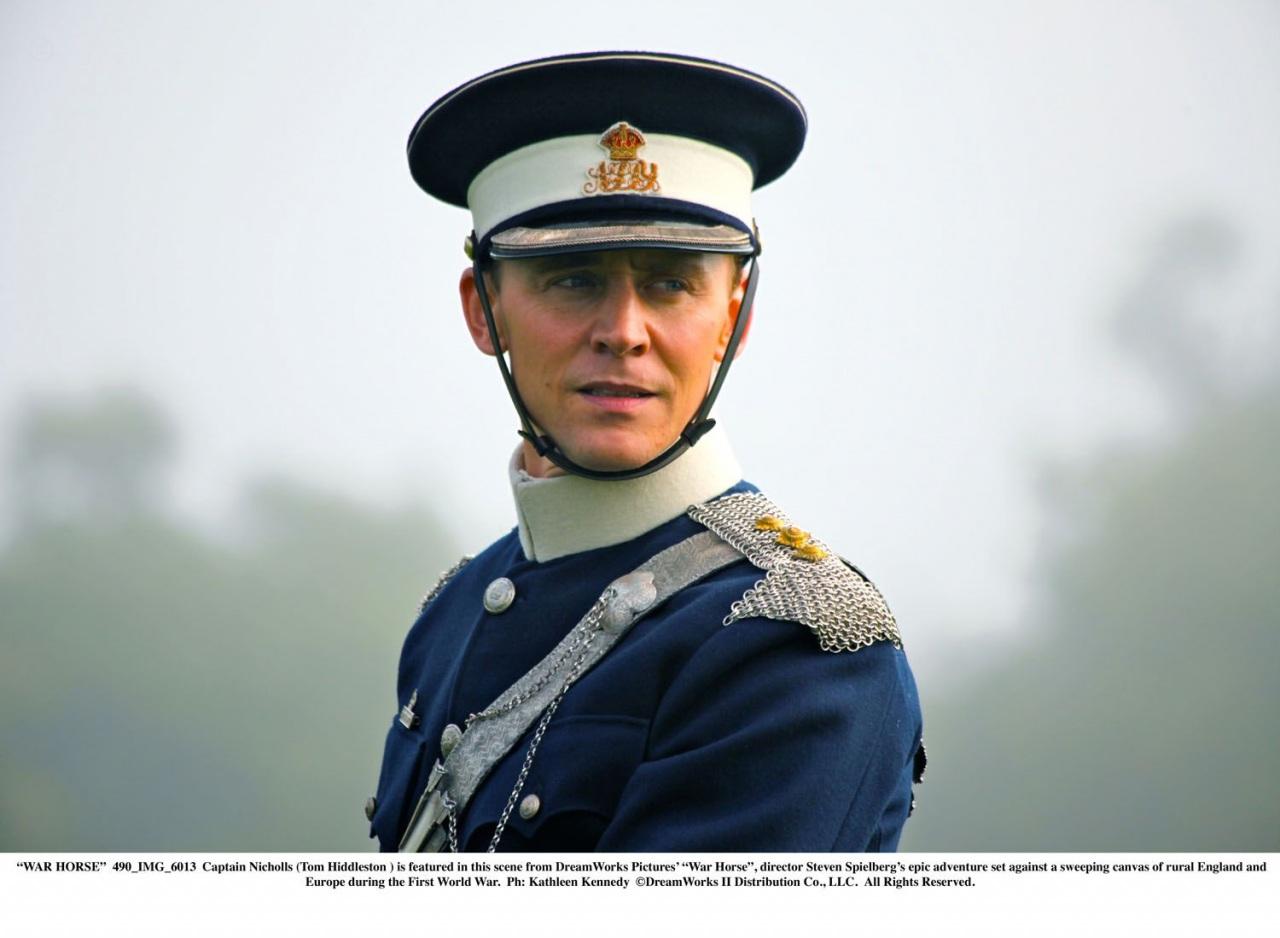
Don’t get attached to Tom Hiddleston’s beautiful face.  You won’t be seeing it for long.

2. This movie is episodic.  It does have one overarching plot (Will there be a reunion between the horse and his boy?), but within that it’s composed of short vignettes tied together by Joey.  This is really cool because you get to see the war from a variety of perspectives, but it is jarring if you’re not expecting it, since we’re so little used to narratives told this way today.  Now that I look back on the movie, I think the episodic nature helped me to enjoy it, because it made the movie feel shorter than 2 1/2 hours.  Be warned, though: the first half-hour, before the war and the vignette-hopping start, is a little boring.  BUT see #4 below.

3. There is very little fanfare in this movie, and I think that’s healthy in a war picture.  This is especially the case with the dialogue.  There is exactly one inspiring speech, and its function is to show you that inspiring speeches (like drawn-sword cavalry charges) have no place in modern warfare.  The dialogue in general is very simple, almost to the point of banality.  But that’s how real people talk, so I much preferred this to the cheesy, overblown banter and speech-making that you often get in war movies.  Just don’t expect to be trading War Horse quotes with your friends after you watch this.  It’s not a quotable movie.

4. Although I said that the first half-hour is a little boring, I must qualify this by saying that the Devon (England) countryside is a feast for the eyes: green pastures, blue skies, gray stone cottages.  But it feels real.  (There’s a lot of brown mud too.)  Also, the very last scene of the movie has this spectacular orange sunset that throws the human figures into these breathtaking silhouettes.  Seriously, even if you hate the whole movie (but you won’t), you have to keep watching for this scene.  And while we’re on the subject of beauty, the score, always an important factor for me, is John Williams doing his best Ralph Vaughan Williams impression–which is not a dig at John.  I just mean that nobody will ever be Ralph Vaughan Williams again, but this score, with its strong English folk song influences, comes respectably close.

Ok, I think you’re now prepared to watch War Horse.  If you do, please comment below and tell me what you think!


Disney memories

Last night while trying to fall asleep, I chose my five favorite animated Disney movies (not counting Pixar) and figured out why I like them so much.  They can be categorized into two I loved when I was a kid (1 and 2), one I liked as a very small child and later rediscovered for different reasons (3), and two that are my favorites now and probably always will be (4 and 5).

1. Sleeping Beauty.  I think it’s accurate to say that this movie inspired my first experiences with cosplay.  As a little girl I used to put on a blue dress and pretend to be–no, not Princess Aurora, but Merryweather, the chubby fairy who doesn’t speak but always seems to be indignant about something she can’t articulate.  I was an odd little girl.  I haven’t seen the movie in years, but I still think it’s beautiful and effectively scary.  Am I excited about the Maleficent movie coming out next week?  Not really, though I’ll probably go see it.  I have a hard time with Angelina Jolie.

Merryweather

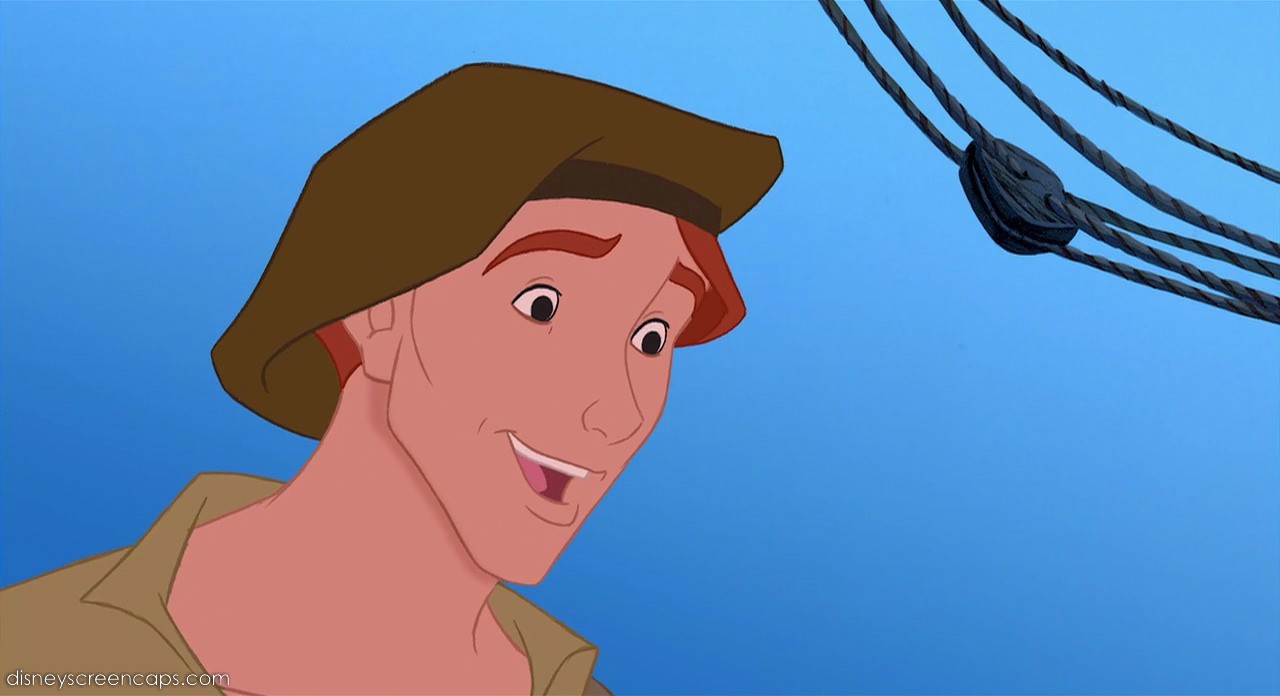
2. Pocahontas.  This movie came out when I was 11, and I was really into it.  I had a lot of Pocahontas merch–I remember a nightshirt, when nightshirts were a big thing, and a necklace that I took apart so that I could string the beads onto other necklaces.  I was an odd tween.  I knew all the lyrics to “Colors of the Wind,” and of course I still do, because you don’t forget songs you learn in childhood (which is why I still know the lyrics to most of The Eagles’ greatest hits–another story).  Pocahontas also gave me my first crush, at least the first I remember.  And no, it wasn’t on John Smith, but on Thomas, the naive and timid redheaded sailor (voiced by Christian Bale) who accidentally shoots Pocahontas’s boyfriend Kocoum.  Some things don’t change.  Again, I still think this is a beautiful movie.  I know people complain about the historiography, but it was never intended as a documentary.

Image

Thomas

3. Bambi.  As a child, I had a Bambi stuffed animal, and I liked Thumper (I remember quoting, “If you can’t say somethin’ nice, don’t say nothin’ at all,” still good advice for most contexts) and Flower, the really cute androgynous skunk.  Then I guess I got “too old” for Bambi and kind of forgot about the movie until one family trip to Disney World; I believe it was the one shortly after I graduated from college.  We were at Disney Studios watching one of those compilation films about the magic of animation or whatever, and suddenly the frantic pace of the clips slowed down and they showed that scene in which Bambi steps out into the clearing and asks, “Mother?” and the stag–Bambi’s father, though Bambi doesn’t know it–approaches and says, “Your mother won’t be with you anymore, Bambi.”  Standing in a room full of tourists, I started weeping.  It was embarrassing, but cathartic.  I still think that’s a brilliant scene–no music for emotional manipulation, just the stark colors of the deer against the snow and that spare, heartbreaking dialogue.  (Ok, I’m tearing up while writing this.)  Bambi is like that in general–a very simple story, no flashy songs and a small cast of (non-wisecracking) characters.  The animation is beautiful.  I am not ashamed to say that I own a Bambi t-shirt.

4. Beauty and the Beast.  I liked this movie when I was a kid, but didn’t truly appreciate it until I grew up.  I’ve always identified with Belle because she likes to read, but now I see that there’s much more to her.  She’s a lot like Jane Eyre in that she has just the right combination of strong will and empathy to be able to transformatively love a selfish and deeply wounded man while still retaining her own identity and protecting herself emotionally.  This, too, is a beautiful movie.  Of course the songs are great, but so is the score.  The settings are so atmospheric: the gloomy castle perfectly matches the Beast’s mood, and the forest outside it is truly desolate.  And I love the way the prologue uses animated “stained glass” to tell the Beast’s back-story.

5. Peter Pan.  This is one of my favorite stories, period.  (It’s Victorian, and it’s magic.  Therefore, I love it.)  The Disney movie isn’t a perfect adaptation, but there’s no such thing.  Certain things about it are perfect, at least to me, like the iconic image of the children flying over the nighttime silhouette of London, something no previous adaptation was able to capture and no subsequent one has attempted to try.  The songs are very good, especially “You Can Fly.”  I also love the way the musical sequences add to the character development in subtle ways.  (For example, the song “Following the Leader” seems like nothing more than a fun romp, but it illustrates the idea, which is barely latent in the J.M. Barrie story but makes perfect sense, that John Darling would see Peter Pan as a rival.)  I know most people think of Tinkerbell when they think of this movie, but I could take her or leave her.  For me, it’s about Peter, who is one of my favorite trickster figures, and the Darling children, who react to being essentially abducted from their home in fascinatingly different ways.  I also like the Lost Boys.  And the Peter Pan ride at Magic Kingdom is wonderful.  Yes, it’s a really short ride with a really long line, but it’s totally worth it.

Second star to the right and straight on ’til morning!

My belated Oscar wrap-up

It’s been nearly two months since the Academy Awards aired, but I’ve been mentally reliving the event a bit recently, not only because I’ve finally gotten around to watching several of the Best Picture nominees, but also because I read a brief “news” article yesterday in which Jared Leto said that his Oscar statue is all sticky and gross because his apparently grubby friends have been playing with it. And these are the people we admire and aspire to be like. Anyway, in place of a traditional recap, which would be pointless by now, here is a stream-of-consciousness presentation of some of my thoughts during and after the ceremony.

As I look into Jared Leto’s beautiful yet strangely vacant eyes, I wonder if he’s shown up to the Academy Awards as stoned as the character he won his Oscar for portraying (a person called Rayon, frequently stoned, and appearing for much of Dallas Buyer’s Club in a covetably comfy-looking pink cable-knit bathrobe).  But no, surely not, since he’s accompanied by his mom.  And his acceptance speech is lucid–not brilliant, but lucid, a high compliment indeed on this night.  I mean, the literal kind of “high.”

Thinking about Best Supporting Actor nominees accompanied by their moms turns my thoughts toward Jonah Hill, and I think to myself that someday he is going to be a real contender for this category and not just a person that the presenters make gratuitous comments toward because they feel charitable toward him because he is less sexy than they are.  And he is going to win, and he is going to throw his Oscar in their stupid condescending faces.

Then I wonder why I am throwing so much imaginative energy into my Jonah Hill revenge fantasy, and I realize that it’s because I’m bored, because essentially none of my favorite actors are here.  This has a lot to do with the fact that most of my favorite actors are British and obviously couldn’t make the long trip to Los Angeles.  Or, more likely, they weren’t invited.  If you are an actor from the UK and you want to be made much of at the Oscars, you have to either 1) be Colin Firth, although even that doesn’t work every year, 2) be old enough to be an institution, or just not dye your hair, so that people think you’re old (that’s you, Helen Mirren), 3) always play Americans, like Christian Bale or last year’s Best Actor Daniel Day-Lewis, or 4) find your way into a small role in pretty much all of the Best Picture nominees, like Benedict Cumberbatch did this year (okay, I think he was in two of them).

*Long mental digression while I calculate the odds of Martin Freeman ever being an Oscar nominee*

My guests are gasping, and I gradually realize it’s because they think Ellen Degeneres is being “mean.”  And I’m thinking, did you ever see Ricky Gervais host the Golden Globes?  This is like Mr. Rogers’ Neighborhood in comparison.

Which brings me to the pizza interlude.  There is a lot of debate about how spontaneous, hence “authentic,” this actually was, but that’s not the question that captivates me.  My question is: Do these people actually eat pizza?  On paper plates, no less?  The possibility boggles the mind.  One of the actors we saw ostensibly preparing to eat pizza was Brad Pitt.  It’s true that Brad Pitt is seen constantly eating food in many of his movies (e.g., Meet Joe Black, in which he develops an obsession with peanut butter), but I guess I just assumed he spit it out after the take.  Did Angelina make him spit his pizza out during the commercial break?

These, thank goodness, are not questions that keep me up at night.  However, this is: What in the world was Matthew McConaughey talking about?


corporate stultification and the strange world of male aggression

What do the movies Fight Club, The Matrix, and Office Space have in common?  Two things, actually: They all came out in 1999, and they all offer possible responses to what many people perceived as the soul-killing materialism of 1990s corporate culture.  I watched Fight Club for the first time tonight, and the other two movies quickly popped into my mind.  They all start out with an easily recognizable Average Guy who is slowly–or quickly–dying on the inside as a result of his meaningless job in a company where everybody wears ugly ties and works in a cubicle.  Then comes the inciting incident, widely differing though it may be in each of these movies, and then a spiraling series of chaotic events that bring into vivid life that Goo Goo Dolls line (written in 1998) that says “you bleed just to know you’re alive.”  In Fight Club, the blood is quite literal, whereas The Matrix is strangely bloodless for an action movie, and in Office Space the violence is displaced onto a copy machine.  (The most violent scene of that movie is also the funniest.)  But they’re all about angry men trying to figure out what they’re angry at.

I used the word “men” deliberately.  Women are mostly peripheral in all three of these films, even though each has a token female “main” character.  They are all three about men admiring, envying, conspiring with, competing with, and beating the crap out of other men…and The Man.  I find it a bit troubling that women seem so extraneous and expendable in these worlds, but then again, I’m not sure if I, as a woman, would want to be part of them.  I’m content to be a fascinated and sometimes repelled onlooker.

Of the three movies, The Matrix is easily my least favorite, not only because, as I mentioned above, the violence is unconvincing (not that I’m a fan of violence for its own sake, but if you’re going to put it in a movie, it should look and feel real), but also because humor is important to me, and The Matrix takes itself way too seriously.  Still, I think you need all three of these films to get a comprehensive picture of how male filmmakers tried to respond to the 90s at the end of the 90s.

Now it’s your turn to chime in: Have I been inaccurate in my recollections of The Matrix or Office Space?  (It’s been about a year since I saw either of them.)  Can you think of any other parallels among the three movies?  Am I missing any movies that could fit into this paradigm?  Let me know what you’re thinking.


My annual Oscar rant

Right on cue, here is my yearly collection of thoughts on the Academy Awards.

  • Gravity is clearly going to win a lot of awards.  One that it seems nearly guaranteed to win is Achievement in Directing for Alfonso Cuarón.  When people like me think of Alfonso Cuarón, we think of his darkly whimsical interpretation of Harry Potter and the Prisoner of Azkaban.  Do you think he could find a way to work an Azkaban shout-out into his acceptance speech?
  • I was excited when I saw that my favorite movie music composer, Thomas Newman, was nominated for his beautiful score to Saving Mr. Banks.  But I was annoyed when I did my predication research this evening and saw that he isn’t even being mentioned as a possibility to win.  All I can say is that the Academy is going to owe Thomas Newman one massive Lifetime Achievement Award segment.
  • I never thought I’d see the day when a movie called Jackass Presents: Bad Grandpa was nominated for an Oscar.  I realize that the category is Achievement in Makeup, and I’m willing to concede that the nominee, Stephen Prouty, did a pretty good job on that guy’s face.  But I’ve vowed never to watch the Oscars again if this movie wins.
  • I have a plan.  The Academy should create some new award categories: Best Actor, Actress, Supporting Actor, and Supporting Actress in a Genre Film.  That way, the people who do excellent acting work in films that aren’t “literary” (to borrow a term from the book publishing world)–e.g., science fiction, fantasy, and superhero movies; romantic comedies; “children’s” movies that aren’t animated–can be honored.  Because, let’s face it, they’re not going to be nominated in the traditional acting categories, except in very unusual cases like those of Johnny Depp in the first Pirates of the Caribbean (and there was no way he was going to win) or Heath Ledger in The Dark Knight–an extremely unusual case indeed, since he did win.  The only potential problem here is that creating such a category could further marginalize these types of movies and prevent genre-transcending films like The Dark Knight from getting the recognition that the Academy was actually prepared to give them.

So I’m curious: Who would you nominate if we had the Acting in Genre Films categories this year?  And what are your two cents, in general, on the 2014 Oscars?  Do share.