
Jesus was homeless

This morning while washing my face and putting on makeup and blow-drying my hair, I was trying to keep tears from streaming down my face. Let me briefly tell you why.

I was listening to the Trans-Siberian Orchestra song “Good King Joy,” which combines the tunes of “Joy to the World” and “Good King Wenceslas” (the moderately obscure carol about the king who feeds, warms, and clothes a poor man) but also contains a blues-gospel vocal riff on the journey of the wise men to bring gifts to Jesus. My first thought was “It’s odd that they would conflate those two stories.” My next thought was “Duh. They’re not conflating anything; those two stories are absolutely connected.” Jesus said that whatever we do for “the least of these”–like the poor man that King W. saw–we have done for him. And that’s why we sing about King W. at Christmas (well, we at least hear the song occasionally–I’m not sure if I’ve ever actually sung it) and why so many people give their time and money at Christmas. Charitable giving at Christmas is not something Charles Dickens came up with in the 1840s; Dickens was drawing from a very old tradition that stretches all the way back to the wise men and even further back to the innkeeper who did, after all, let Mary and Joseph stay in the stable. We give to the poor at Christmas because on the first Christmas, God became poor. He didn’t just become a baby unable to help himself; he became a baby born to a couple who didn’t have much in terms of worldly possessions and who, on the night Jesus was born, didn’t even have a place to stay.

This seems so obvious now that I’m typing it out, and it’s not like I didn’t know all this before. It just hit me this morning in a way that it never has before. This advent season, I want to pay attention to the people around me who are economically poor as well as poor in spirit, because in doing so I am paying attention to Jesus.
the dig list

It’s time for one of my periodic lists of stuff I dig right now.

  1. Music with close vocal harmonies. Throughout the past week, I have been listening to two bands whose music showcases the capabilities of the male voice in harmony with others. One is Queen. Have you ever noticed–well, I’m sure you have; I’m stating the obvious here–that if you stripped away the wailing guitars, many of their songs would make wonderful barbershop quartet numbers? The other band is Lord Huron, whose moody music conjures the lowering darkness of an overcast autumn day–specifically, of clouds gathering over a lake, probably Lake Huron. (Some of their songs reference lakes too.) Their harmonies are tiiiiiight (in two senses of the word).
  2. The Pickwick Papers. I decided that while I’m reading Michael Slater’s biography of Charles Dickens, I’m going to watch, in order of novel publication, my collection of BBC Dickens adaptations. Saturday and Sunday, I watched the 1985 Pickwick Papers miniseries. I can’t put my finger on what’s so delightful about watching rotund middle-aged men act like adult children and get into the same tight spots (figuratively and sometimes literally) over and over again, but maybe it’s that in this novel and only this novel within Dickens’ repertoire, everyone is so genuinely good-hearted. Even the blood-sucking lawyers Dodson and Fogg are ultimately harmless. Pickwick and his friends triumph because they choose to believe the best about everyone. Maybe that’s not the way the world really works, but it’s something to strive for. Watching this mini-series is kind of like watching Parks and Recreation, which manages to be hilarious even while being refreshingly un-cynical. All the duels, lawsuits, and other confrontations in Pickwick are funny in the same way that it’s funny when the other characters make fun of Jerry on Parks and Rec. They’re like little kids trying to be mean but succeeding only in being cute.
  3. Fazoli’s. Okay, look. It may not be “authentic Italian food,” though I’m not sure that phrase really means much in America, where we’ve adopted Italian cuisine as one of our own and enacted tons of bizarrely creative, often successful variations on it. (I mean, just look at pizza.) But I ordered a Caesar side salad, baked ziti, breadsticks, and a blood orange Italian ice online, picked it up, and was back home within half an hour. It was faster than flying to Sicily. And it was good.
  4. Peer review day. One of my favorite things to do as a teacher is to walk around the classroom and briefly engage with pairs of students as they read and constructively critique each other’s papers. My short attention span appreciates the short interactions, and instead of standing in front of a classroom babbling until my throat hurts, I get to swoop in, answer questions and sound very knowledgeable, and move on to the next group. All kidding aside (not kidding about that stuff, though), peer review can be a great instructional strategy, teaching students the important life skills of reflection and of giving feedback without being vague or unkind. Fortunately, I’m teaching two writing classes and have lots of peer review days to look forward to this semester.

What are you digging right now? Let me know if the comments.

back to school

Today was the first day of classes at my new institution. Last time I wrote about the first day of classes, I wrote about being so scatterbrained that I could barely organize my thoughts for a blog post. While I wasn’t exactly a chilled-out guru sitting on a mountaintop in mountain pose with a cup of green tea today, I was considerably more focused and less stressed because now teaching is my entire job, not something I try to fit in around meetings and administrative tasks.

It’s an unusually hot day in western Michigan, and this morning it was raining, so my office has been a little damp all day. But at least it has air conditioning, unlike the room where I taught this afternoon. (There were fans blowing, but only the students who sat in the back of the room got to benefit from those, I realized when I went over to talk to one of them after class.) I like to wear a cardigan while teaching because of the pockets, so there was sweat actually dripping down my back and my legs after about an hour of class. On the positive side, my classroom has windows, and it also has an upright piano, which I doubt we’ll ever use, but it looks cool to have in the background. Actually, maybe I’ll see if any of my students can bang out a rendition of “A Mighty Fortress Is Our God” on October 31, when we have the Reformation/All Saints Day party that I really did schedule on the syllabus. (It may end up being a Halloween party as well, but I wanted to get a sense of who my students are before I start foisting pagan celebrations upon them.)

All classes here are 90 minutes long, and I was worried about filling that much time on intro day, but I neatly rounded out the first hour by taking attendance and rambling about myself, the syllabus, and the textbooks (I am a champion rambler), and then I had my students write a literacy narrative during the remaining half-hour. I’d read about literacy narratives in composition journals–apparently they are rather passe now–but I had never assigned one myself. My off-the-cuff version of the assignment probably didn’t exactly conform to the standards of the genre, but not only did it use up a good chunk of class time; reading the results also taught me quite a bit about my students as writers and readers (e.g. several of them are Harry Potter fans; some lack confidence about writing, and all of them have decent handwriting)–and my students got a 10-point completion grade. Win, win, win.

Eleven of my twelve students are women, so I promised the token male student I would not single him out in class. All but two are brand new freshmen, though a couple of them have parents who work at the university and/or took pre-term classes, which means they probably know more about this school than I do. Still, they all looked sincere and eager to learn, many of them were taking notes during my course introduction (and I didn’t penalize them for doing so, like Snape did to Harry Potter), and one of them asked approximately ten questions during the syllabus review. She apologized for having so many questions, but I thanked her and told her that others probably had the same questions. The best student feedback I received today, though, probably wasn’t meant for my ears. Before class, I heard one of the students saying to the person next to her, “I’m so excited about this class.” I don’t think I’ve ever heard a student say that about a freshman writing class. I wonder if she still felt the same way after class.

I wrote a brief note on each student’s literacy narrative, and in many of them, I asked the student to talk with me about something–not incorrect grammar or ineffective transitions, but Harry Potter, creative writing, or some other such enjoyable topic. I hope they will come see me, even the ones who are shy about their writing or terrified about starting college. Especially those ones.

I don’t have any classes tomorrow, so I’ll have time to prepare for my Wednesday classes, which I think are in a room with air conditioning. Every time I walk into a class for the first time, I’m nervous that I’ll be met with faces that are judgmental, sarcastic, or completely checked out, and occasionally that happens, but most of my students really want to be in college. I just hope that after sitting through my class on day 1, they want to stay.

sad songs playlist

I sometimes half-jokingly refer to one of my favorite genres of music as “sad folk.” It’s the kind of music that inevitably comes to dominate my Avett Brothers artist station on Pandora if I listen to it long enough. (The Avetts themselves are always painfully sincere and can be quite sad–have you heard “Murder in the City”?) The voices of this genre tend to be soft and introspective, and the music sounds like a rainy fall day: think Bon Iver or Alexi Murdoch. And yes, sometimes the lyrics can be rather devastating (the question is whether you can actually hear them). I tend to like sad songs in general, even if they don’t fit under the “folk” designation (which has recently gotten so broad as to not be very helpful). Here are some of my favorites.

  1. “She Loves You” by The Gaslight Anthem. No, this isn’t a Beatles cover, though I wouldn’t be surprised to find out that the title is a deliberate allusion; TGA does love naming their influences. This was a bonus track on American Slang, and I feel bad for all the people who got the regular album and didn’t find out about this song. Brian Fallon’s voice can make any song sound sad, even Katy Perry’s “Teenage Dream,” which he covered with side project The Horrible Crowes. The lyrics to “She Loves You” aren’t necessarily sad, though, just wistful. Like West Side Story and that Dire Straits song about Romeo and Juliet, this song places everyone’s favorite Shakespearean young lovers in an urban setting, which means that like most good Gaslight Anthem songs, this one has a strong sense of place. The tune is wonderfully singable and sounds like it’s been around for a long time (you know what kind of tune I mean?), which evokes another sense of the word “folk” even though this song fits more into the rock genre.
  2. “The Stable Song” by Gregory Alan Isakov. You’ve probably heard this singer’s beautiful, pained voice even if you’ve never heard his name; one of his songs was in a Subaru commercial recently. (One of the many reasons why hipsters buy Subarus, I guess.) I’ll be honest; I’m not 100% sure what “The Stable Song” is about, though I get hints of deep regret over a series of foolish decisions. (It’s definitely not about the stable where Jesus was born, though it did come up on a Christmas station I was listening to once!) What I love about this song, aside from its heartbreaking tune, is that it seems to have an Appalachian setting: it mentions the Ohio River, and one of its loveliest metaphors is “turn these diamonds straight back into coal.” Listen to the album version, but also check out the movie-score-worthy version featuring the Colorado Symphony Orchestra.
  3. “Rivers and Roads” by The Head and the Heart. Despite the creepy cover, which shows a man with a sheep’s head, I own and really enjoy The Head and the Heart’s first album. (I just have to hide it behind my other records.) I’ve loved this song for a long time, but just in the past week, as I’ve been thinking about moving away from the place I’ve lived for 15 years and, in fact, entirely out of the Appalachian region (see above), where I’ve lived pretty much my whole life, I’ve started to listen to it in a new way. This song, like most of the album, is about coming and going and wanting to return. My favorite line, which in its matter-of-fact profundity sounds like a line The Avett Brothers would write, says, “My family lives in a different state/And if you don’t know what to make of this, then we cannot relate.”
  4. “A Little Bit of Everything” by Dawes. I posted a link to this song on Facebook the other day on National Chicken Wing Day because while there are probably lots of songs that rep chicken wings (mostly country songs, I bet), this is the only one I’m actually aware of. I included a warning that this is NOT some light-hearted novelty song, despite the chicken wing reference, so you should not listen to it unless you are prepared to weep. Dawes has written some of the most perfect rock lyrics since the classic rock era, and many of them are on display in this song. The verses are about, respectively, a would-be suicide who can’t nail down one reason why he’s about to jump off the Golden Gate Bridge (“it’s a little bit of everything”), a beaten-down-by-life older man experiencing decision paralysis in a buffet line, who reviews his bittersweet life and then decides to eat everything!! (this is the chicken wing part), and an engaged couple contemplating the life they’re about to embark on (this is the happy verse, though it still mentions the bride-to-be loving “the way you ache”). It’s a sad song, but it also communicates a defiant, white-knuckled determination to hold onto the good parts of life.

Maybe don’t listen to all four of these songs right in a row. Or maybe do. And while you’re at it, let me know what your favorite sad songs are.

Unite my heart

Yesterday, I was looking at some notes from a solitude retreat I took last August. At the time, I was feeling overcommitted and distracted, and I was trying to decide which of the good things in my life were helping me to glorify God by living a fulfilled life and which were not. So during the retreat (which took the form of a solo hike), I spent some time praying for focus and looking at scripture about having an undivided heart. Let me quote a few of the notes I took at the top of the mountain:

Today’s theme: asking God for focus. I feel like my mind is scattered among tasks and passions and I’m not giving my best to any of it (or truly enjoying any of it). I’ve often said that God’s promise of wisdom in James 1 is one of the only places in Scripture where God promises something without any qualification (e.g. You must be an Israelite). But that isn’t true–the qualification is that you must ask without doubting–“because he who doubts is like a wave of the sea, blown and tossed by the wind. That man should not think he will receive anything from the Lord; he is a double-minded man, unstable in all he does” (Jas. 1:6-8). (I didn’t do a very good job clarifying this in my original notes, but the key word there for my purposes is “double-minded.” God’s gift of wisdom comes to those who are single-minded.)

“Be thou my vision” = Be thou my focus?

This mountain is a good place to be thinking about perspective. The birds are flying below where I’m sitting right now.

Ps. 86:11–“Teach me your way, O LORD, and I will walk in your truth; give me an undivided heart, that I may fear your name.” (KJV–“Unite my heart to fear thy name.”)

Then follows a discussion of things I was going to quit and other things I was going to commit to instead (almost none of which really happened) and a list of things I needed wisdom about, most of which are no longer relevant (which I guess is an answer to prayer?).

This deep desire to be single-minded and united in heart, to be able to focus on one thing and stop my mind from racing down crossroads, is one reason–perhaps the greatest reason–why I decided to “quit everything” (the title, incidentally, of a Dawes song I’ve been thinking about a lot) and move to a new state where my only commitment, so far, is to my job (which is only three days a week this fall!). I’ve been describing this move as “hitting reboot on my life”–a cheesy metaphor, I know, but it’s what this feels like to me.

We’ve been talking about this united heart thing for a long time in Christian circles. I remember I used to feel so guilty when we would sing that song that goes “Give me one pure and holy passion, give me one magnificent obsession”–until I realized that the song is a prayer, not a declaration that we already have one pure and holy passion (“Hey, God. Check this out.”). But I think the secular world is also beginning to articulate the deep discomfort we feel when we are distracted, inattentive, and trying to justify our place in the world by showing all the different ways in which we can contribute. Lately, we have been seeing data about how multitasking is bad for productivity, studies about “flow” (the phenomenon, named by psychologist Mihaly Csikszentmihalyi, of getting caught up in a fulfilling task), and radical suggestions for strategies like putting our phones away during face-to-face conversations. As is so often the case, the Bible gave us a really good idea thousands of years ago, and we’re just starting to get it.

I know that having a heart singly focused on God is not the same thing as eliminating distractions and getting in the zone while completing a fulfilling task. But the two confirm the same truth: We were created to serve one master, to do one thing really well, to have one ruling passion under which all of our other passions are ordered. We were created to have a united heart.

blessed are les miserables (and other lessons from song lyrics)

As you may know, if you’ve been reading my blog for long, I tend to listen to a lot of music that doesn’t have lyrics, particularly my workday quadrivium of classic, ambient, post-rock, and movie scores.  So when I do listen to music with lyrics, I make sure they’re good lyrics.  Here are some observations I’ve made recently on some great song lyrics.

  1. 2009 was the year I fell in love with both the Harry Potter series and Coldplay’s album (which I still maintain is their greatest) Viva La Vida.  I got really invested in Snape during my first reading of the series, so I often thought of him–and still do–when I hear these lyrics from the last song on Viva La Vida: “No, I don’t wanna battle from beginning to end; I don’t want a cycle of recycled revenge; I don’t want to follow death and all of his friends.”  In those lyrics, I see Snape making the hard choice not to take revenge on James Potter’s child, and I see him turning his back on Voldemort and all of his Death-eaters.  Whatever you think about Snape, you have to admit those were brave things to do.
  2. Recently I’ve been listening to the song that goes “I’m no longer a slave to fear; I am a child of God.”  (Someone help me out here–is the artist I Am They or Bethel Music, or are those essentially the same thing?  I’m not hip enough to understand what’s going on with these “worship collectives” that are so popular these days.)  It’s the sort of song that I would generally say is a little too “on the nose.”  I admit it; I’m kind of a music snob, so I prefer subtlety in my lyrics.  But I’ve realized recently that sometimes a song that’s “on the nose” is exactly what I need.  Sometimes I just need someone to tell me that I’m a child of God.  I’m thankful for this song.
  3. And now, a thought for this Ash Wednesday from my favorite musical, Les Miserables.  I’ve been thinking about the title (which is also the title of Victor Hugo’s novel, the musical’s source text) and how we never translate it into English.  I think that’s because we don’t have a word in English that exactly captures the meaning.  “The Miserable (People”) isn’t quite right because we’re talking about a specific kind of misery.  There’s a phrase in one of the songs that captures the idea well: “the wretched of the earth.”  Les Miserables is mostly about the poor, prisoners, and prostitutes–the rejects of society.  But it gets really interesting if you think of every character in the story as les miserables, including the supposed antagonist, Javert, who is a tragic character because he can’t accept forgiveness or even his own life as a gift.  “Les miserables” are similar to the people Jesus was talking about when he said “blessed are the poor in spirit”–the people who don’t have it all together, to put it mildly.  These people are blessed if, like Jean Valjean, they acknowledge their poverty of spirit; they are doomed if, like Javert, they try to deny it.  And, if we’re honest, these people are all of us.  So take that thought into Lent with you.

things I dig right at this moment

Every so often (okay, pretty often) my brain is too scattered to produce a unified blog post, but I can still manage to make a list of disunified things I’m thinking about.  Here is one such list: Things I Dig Right at This Moment.

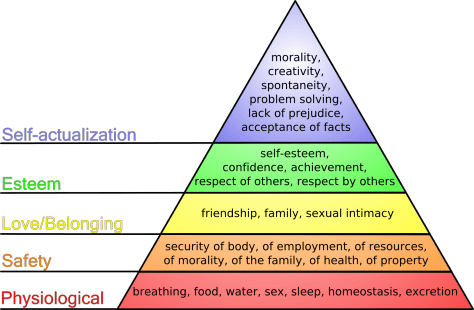
  1. Maslow’s Hierarchy of Needs. Maslow's_hierarchy_of_needs I showed this to my children’s lit students this morning, and I was reminded once again of how much sense this makes.  (Maslow’s basic argument is that the bottom levels of the hierarchy are necessary in order to achieve the higher levels.)  It applies to so many situations: the difficulty abused and neglected kids have in school, the poor work output of people who aren’t getting enough sleep, the writer’s block I get when I’m worried about other things (hey, didn’t I just mention that?).  It even explains the phenomenon of being hangry.  Sure, there are amazing stories about people who aren’t getting their foundational needs fulfilled (such as concentration camp victims) who nevertheless achieve the highest level of the pyramid by creating beautiful works of art or performing heroic acts of self-sacrifice, but what makes those stories so amazing is their rarity.  They are the exception that proves the rule.
  2. The emoji with no mouth. You’ve seen it: It’s a smiley face, minus the smile.  And yet it’s so eloquent.  I use it to mean “There are no words”–a phrase which, like Maslow’s hierarchy of needs, applies to so many situations.
  3. To Kill a MockingbirdI finished rereading this classic yesterday, and I was confirmed in my opinion that Scout Finch is one of the greatest narrators, and Atticus one of the greatest dads, of all time.  Very few books juxtapose humor and danger (recall that Scout is wearing a ham costume throughout the climactic scene), wisdom and innocence (Atticus’s words interpreted through the child Scout’s limited understanding and recalled from the adult Scout’s perspective) in such an effective way.  And the evocative descriptions—the humid warmth of a summer evening, the cracks in a sidewalk that has a tree root pushing through it—take me back to my own childhood, even though mine wasn’t spent in Alabama.
  4. The Grey Havens. My friend told me about this band Saturday morning, I impulse-bought their album Ghost of a King for $10 on iTunes without sampling it first, and I ended up listening to it over and over while driving that day.  Although their style is a little inconsistent (fluctuating from the folksy and dramatic sound of Mumford and Sons to a poppier but still substantial sound that reminds me of Imagine Dragons), I don’t mind that because I like both kinds of music, and their themes are consistent.  This is Christian music that doesn’t advertise itself as such.  On Ghost of a King, without using the names “God” or “Jesus,” they pretty much outline the whole history of the Bible, hitting the major points of creation, fall, and redemption.  My favorite song on that album is “Diamonds and Gold,” definitely on the pop/electronic end and very fun to dance to in the car (and probably out of the car, too).
  5. using flavored cream cheese as a dip for pretzels. Last night I used the Philadelphia brand roasted vegetable cream cheese as a comparatively “healthy” Super Bowl “dip.”  (Oh, my gosh.  Philadelphia.  I just made the connection.  I am the reason they won.)  Today, I polished off the rest of a tub of honey pecan cream cheese (also Philadelphia) as a lunch snack at work.  Seriously, this is good.  You should try it.

What are you digging right now?  Let me know in the comments.

motif or obsession

This past weekend, I attended the Roanoke Regional Writers Conference, and during a session on monologue-writing, which ended up being more generally about principles of characterization, we were asked to write short descriptions of the people represented by faces that the presenter showed on the screen.  Then we had to pick our favorite, sketch a picture of them, and write a monologue using beginning, middle, and ending lines given to us by the presenter.

I drew this guy:

https://www.instagram.com/p/BeLsm5LjMpw/?taken-by=tessrs

I said he has one Hispanic parent and one white parent, he is approaching 30, and he is passively annoyed that everyone considers him a harmless teddy bear.  His name is Manny, but as I was writing his monologue, in which he gets defensive about the fact that he illustrates comic books for a living and hardly ever leaves his apartment, I realized that he was basically a biracial version, with a somewhat different childhood trauma, of the character I’m always writing about–usually named Sam.

When I started writing about this character, I was in high school, and so was he.  He was called Sparky Melloy back then, but his real name was Samuel.  Then, as now, he was blond-haired, chubby, quiet, self-effacing, and sometimes funny.  Back then, he was obsessed with Dr. Pepper and often wore baseball caps backward.  Now, he prefers Coke (his tastes have matured) and only occasionally wears a baseball cap, forward.

There was a period a few years ago during which I departed a bit from this general profile.  The guy I wrote about during this time shared many of Sparky/Sam’s features, but he was a musician with dark curly hair–he was Jewish, sometimes–who was both older (because I was older too) and angrier than his previous manifestations.  Sometimes he had a fraternal twin brother.  This guy was different enough from Sparky Melloy that I gave him a different name, Adrian.  But the basic character was still there.

At some point, I got rid of the fraternal twin brother, who was a jerk anyway, but I gave Sam (for that is now his permanent name) a best friend, a curly-haired, easily annoyed musician named Adrian.  But this Adrian is a skinny redhead, and I totally jettisoned the Jewish part, mainly because I have no idea how to write from a Jewish perspective.

Here’s what I know about Sam: He writes and illustrates comic books for a living and is quite successful.  He’s single and thinks he probably always will be, mainly because he doesn’t think any woman will ever be attracted to a “fat mental patient” like him.  (He spent one night in a psych ward, 10 years ago, after he attempted suicide and Adrian saved his life.)  He grew up with a severely depressed mother, a father who couldn’t talk about emotions, and no siblings.  Sam himself is on medication for depression, but he’s not a depressing person to be around.  He’s creative, kind, sometimes surprisingly witty, and usually a calming influence on people around him.  Life is hard for him, but he doesn’t want to die anymore.  And, in the story I’m writing right now, he’s surviving the zombie apocalypse.

Generally, when we see a character, theme, or symbol recurring again and again in an author’s writing, we call it a motif.  I think Sam may be an obsession.  I don’t know if he represents me, the person I want to be, or the person I don’t want to be–maybe all of the above.  I kind of have a crush on him.  I know, it’s weird.  But those of you who are writers–or who at least make up stories in your head–do you know what I mean?  Please share.

the greatest showmen

In the week leading up to Christmas, I used my MoviePass (a small investment that pays off hugely even if you don’t go to the movies as often as I do) to see three films: The Man Who Invented ChristmasStar Wars: The Last Jedi, and The Greatest Showman.  I am a casual Star Wars fan at most, so I am both unqualified and a little frightened at the prospect of jumping into the debates surrounding the latest installment, so I won’t.  I’ll simply say that I found the story satisfying and the visual experience awesome (especially in IMAX) and that I am MAD SHIPPING Rey and Kylo Ren (as are the filmmakers, I think, in a subtle way that I really like).

The other two films I saw are about larger-than-life nineteenth century entertainers: Charles Dickens (in The Man Who Invented Christmas) and P.T. Barnum (in The Greatest Showman).  Yes, I called Dickens an entertainer, because that’s how he saw himself (he always wanted to be an actor, and he found his headiest enjoyment in the dramatic and comic public readings he gave toward the end of his life), and I don’t think calling him that diminishes the literary merit of his work at all.  Barnum, of course, can’t really be called anything but an entertainer.  In the remainder of my post, I’ll say a few words about each movie and then explain the similarities I see between these two wild, frustrating, delightful, troubled (and troubling) men.

The Man Who Invented Christmas is the story of Dickens’ composition of A Christmas Carol.  While indulging in some magical realism, it remains remarkably faithful to the biographical facts and psychological truths of Dickens’ life.  As a Dickens fan and scholar, I found virtually nothing to quibble about; it was emotionally and intellectually on point.  The performances were excellent, especially Dan Stevens’ portrayal of the young, dandyish, and rather pretty Dickens.  (Okay, he was kind of gorgeous–I mean both Stevens and the real Dickens.)  I wish this movie had received wider release.

The Greatest Showman has received wider release and much more hype.  I suppose one would call it a bio-musical.  The music is effective, inspiring, and catchy.  The message is simple: Love yourself; follow your dreams.  But this message is, of course, complicated by the historical facts: P.T. Barnum built his business on deception, and–regardless of how well he may have treated his employees–he was still charging money for them to be viewed as curiosities–that is, freaks.  The musical format makes it easy to forget that people weren’t going to Barnum’s circus to see talented singers and dancers.  They weren’t going to see a fantastic female singer who happened to have a beard.  They were going to see a bearded lady, period.

For me, the most interesting thing about The Greatest Showman was the similarities I saw between Barnum (at least the way he was portrayed in this movie–I haven’t done any research on him) and Dickens.  Both grew up as working, lower-class boys who then spent their entire adult lives trying to get respect from the wealthy who would never see them as anything but vulgar entertainers.  Both were amazingly creative and audacious, if not always prudent.  Even Barnum’s weird obsession with promoting the renowned singer Jenny Lind (who didn’t really need a promoter) reminded me of the series of bad decisions Dickens made during his mid-life crisis.  It’s also interesting to note that Dickens had a lifelong enjoyment of the circus.  I wonder if he ever got to see Barnum’s show on one of his visits to America.  I’d have to check and see if the dates line up.

I may pursue this theme later, but I’ll close for now by recommended all of the films I’ve just mentioned.  Even the troubling Greatest Showman is enjoyable, well-executed, and deserving of any honors it may receive during this award season.


People, look East!

Did you know that, for the first time in 14 years, there are four Sundays in Advent this year?  I learned this yesterday when I attended St. Paul’s Episcopal Church in Lynchburg, VA, as a change of pace from my home church.  I have no intention of switching churches anytime soon, but as I explained to several people, I enjoy attending liturgical services around holidays, especially Christmas.  My boyfriend was a good enough sport (maybe because he got to have breakfast at Market at Main first) to go along with me to this service involving a lot of standing, kneeling, and even walking up to the altar rail for Holy Communion.  (He said he was watching me and doing whatever I did.  I didn’t know what I was doing either; I was watching the person in front of me.)

We were also reminded in the sermon that right now, we are not technically in the Christmas season.  We are in Advent, and we will be until December 24, that rare fourth Sunday.  Christmas begins that night and goes until January 6, variously called Epiphany, Twelfth Night, and Three Kings Day.  Of course, as my evangelical friends will rightly remind me, we can celebrate Christmas all year, and the dates matter less than the substance of what actually happened and what it means for us.  But the significance of Advent is that it’s all about hope, expectation, and waiting.  These are not only essential disciplines for the Christian life but also just good general life habits.  Advent and Christmas, if we see them in their true Christian light, teach us that what we await far exceeds even the weeks of excitement and preparation.  The days after December 25 are not a letdown, as we often think of them, but a continued celebration of the long-expected Christ who has finally come.

Yesterday’s service closed out with a beautiful hymn by Eleanor Farjeon that I had never heard before.  I loved it so much (especially the bird verse, of course) that I wanted to share it with you.  Please enjoy it, and think about it this week when you start to wonder if Christmas is really worth all the fuss.  It is, and far more!  Think about it later this winter when you feel exhausted from walking around in the dark and shivering all the time.  Spring is coming!  And think about it throughout your life when you are tired of waiting for a break, waiting to see the fruits of your labor, waiting for your prayers to be answered in a way that you can see and understand.  Love is on the way.

(Note: I added the exclamation points because I felt they fit the tone of the song better than the periods that were printed in the bulletin.)

1. People, look East!  The time is near of the crowning of the year.

Make your house fair as you are able, trim the hearth and set the table.

People, look East and sing today: Love the guest is on the way.

2. Furrows, be glad!  Though earth is bare, one more seed is planted there:

Give up your strength the seed to nourish, that in course the flow’r may flourish.

People, look East and sing today: Love the rose is on the way.

3. Birds, though you long have ceased to build, guard the nest that must be filled.

Even the hour when wings are frozen, God for fledging time has chosen.

People, look East and sing today: Love the bird is on the way.

4. Stars, keep the watch! When night is dim, one more light the bowl shall brim,

Shining beyond the frosty weather, bright as sun and moon together.

People, look East and sing today: Love the star is on the way.

5. Angels, announce with shouts of mirth Christ who brings new life to earth!

Set every peak and valley humming with the word the Lord is coming.

People look East and sing today: Love the Lord is on the way.