my leadership role model

Today’s post is about a person who appears in the Old Testament books of 1 and 2 Samuel, so to start us off I thought I’d share something fun I discovered this morning. I am reading the Bible chronologically, and this morning my reading was 1 Samuel 4-8. Did you know that the names of two famous characters from 19th-century fiction appear in these chapters? They are Ichabod (as in Ichabod Crane, from Washington Irving’s “The Legend of Sleepy Hollow”) and Ebenezer (as in Ebenezer Scrooge, from Charles Dickens’s A Christmas Carol). I think these characters’ creators chose the names because they sound funny and quaint to modern English-speakers and may invoke a harsh brand of Protestantism, not, or not primarily, because of their Hebrew meanings: Ichabod means “inglorious” and was the name of a baby (poor little guy!) born just after the Ark of the Covenant was stolen by the Philistines, and Ebenezer means “thus far has the LORD helped us” and was the name of a memorial stone set up to commemorate a victory against the Philistines.  (I have written a post about Ebenezer Scrooge’s association with memorial stones–I’m not sure if this was deliberate or unconscious on Dickens’s part.) Anyway, there’s your fun fact for the day.

Later in 1 Samuel, we meet the young man who will become Israel’s greatest king, David. Many of the people who appear in the pages of the Old Testament are roughly sketched and hard to relate to, but David is what we would call in literature a well-developed character. Not only from the historical accounts but also from the many psalms he wrote, we learn about David’s bold frankness, his concern for those under his care (first his father’s sheep, then the rebels who fought under him during his outlaw years, then finally his subjects and his many children), and his ardent love for God. David’s emotions are always near the surface in these accounts–he has a warm heart and, often, a hot head. As an F (feeling) on the Myers-Briggs scale, I can relate to David.

David made many mistakes, some ugly and inexcusable (murder by proxy, adultery, bad parenting). But the reason he’s my leadership role model is that, throughout his life, David remained teachable and open to correction. A prophet named Nathan keeps showing up in the accounts of David’s kingship, and nearly every time we see him, he’s calling out David for some sin. The fact that David not only tolerates but welcomes Nathan’s correction is amazing considering what David’s descendants, the increasingly bad kings, will do to prophets who tell them the truth (e.g. throw them in a pit, kill them). David could say, “I’m the king; I can do whatever I want!” Instead, he responds to Nathan’s truth-telling, not with a political “Hmm, I’ll consider that,” but with repentance, confessing his sin against God and immediately doing what he can to restore fellowship with God and the people he has wronged.

One of my greatest leadership fears is becoming the person who is too imperious or even just too sensitive to be corrected–the person everyone else is reluctant to confront. I don’t enjoy confrontation, but I’m thankful that I work with people who kindly tell me about things I need to do better, and I hope I will always have people like this.

Another thing I love about David is that once he’s confessed his sin, he doesn’t wallow in it. Once fellowship has been restored with God (see Psalm 51, a painful and beautiful expression of this process), David is able to move on with joy and confidence that he’s been forgiven. Of course, his actions have consequences, and he recognizes this and grieves the harm he’s done to others. But this is another necessary leadership quality: the ability to walk forward.

I’d love to hear about your leadership role models!

safer and friendlier schools

At the end of my last post, I mentioned that my fan-fictional Hufflepuff prefect, Patrick Weasley, wants to go into the Ministry of Magic and work toward making school a safer and friendlier place for students. I didn’t get to clarify what I meant by “safer and friendlier,” so I want to take a moment to do that now. I fear that when some people read that phrase, their immediate reaction may be to grumble about how we make things so easy for kids these days and how we should be teaching them to grow up instead of coddling them. I’m glad these hypothetical curmudgeons brought this up because teaching kids to grow up and to thrive–i.e. teaching them resilience–is exactly what I’m concerned about too. 🙂

Before we can even have a conversation about resilience, we first need to understand that it’s necessary and acknowledge that childhood is hard. I wrote a post about this last fall, so I won’t repeat myself here. Suffice it to say that childhood is hard for everyone–you’re figuring out who you are and who everybody else is and how the world works–but it’s especially difficult for children who experience major forms of trauma. I just watched an excellent webinar by Dr. Allison Jackson and sponsored by Emote, and I’ve been given permission to share it, which I’ll do as soon as the recording is available. It’s the first in a series on identifying and addressing trauma for educators and anyone who works with children; for me, it’s relevant to both my children’s literature teaching and my volunteer work as a Court Appointed Special Advocate for abused and neglected children. Normally the word “webinar” doesn’t suggest engaging viewing, but I had tears in my eyes at one point during this one, and they weren’t tears of boredom.

When I talk about making schools safer and friendlier for kids, I’m not talking about making everything cheerful; I’m not talking about making everything easy–those things are impossible. I’m talking about letting kids know that they’re acceptable, even if they don’t have designer clothes and fancy lunches, even if they are a different size/shape/skin color from everyone else in the class. And then I’m talking about teaching them that they have the responsibility and the power to be kind to others. I will say more about this in future posts–or maybe Patrick will!

Becky and Patrick, our Hufflepuff correspondants

When I first pitched the idea of a Hufflepuff leadership blog to you, I mentioned that I would sometimes refer to two characters I had created: Becky Weasley, a Hufflepuff alum, and her nephew Patrick Weasley, a seventh-year student and Hufflepuff prefect. I haven’t ended up using this device much, but I have given these characters a great deal of thought, so today I’m going to tell you more about them. I would love your feedback about these characters and whether you think they would be useful and likable guides on your leadership journey.

Rebecca, or Becky, Weasley was Rebecca Durbyfield before she married Charlie. (“Rebecca Durbyfield” is sort of a pun on my own name: Rebecca is my middle name, and Durbyfield is the last name of Tess in Thomas Hardy’s novel.) She has one American parent and lived in the United States until she was old enough to go to Hogwarts, where she had always dreamed of attending. On her American side, she is the granddaughter of Queenie and Jacob from Fantastic Beasts, and the fact that her grandfather was a very famous baker gives her a lot of cred with her mother-in-law, Molly Weasley. At Hogwarts, Becky was in Hufflepuff but was best friends with Penelope Clearwater; they were part of a glorified study group called the Tri-House Transfiguration League that also included people you may have heard of such as Cedric Diggory, Oliver Wood (before he got kicked out of the club because he focused too much on Quidditch–not Becky’s idea), and Percy Weasley, another good friend of Becky’s. Becky always had a crush on Percy’s older brother Bill; she barely thought of the sporty second brother Charlie until years later when she met him at a wedding, realized he was a really great guy, and eventually married him. Now Charlie is the Hogwarts gamekeeper and Care of Magical Creatures professor, and Becky teaches Muggle Studies, which she knows a lot about from her grandpa Jacob. The Professor Weasleys’ cottage is a welcoming place for students who want to get away from the noise and drama of the castle and have a nice homecooked meal.

One such student is their nephew, Patrick, who is the only child of Percy and Penelope. (Of COURSE they ended up together, though I also have a whole story about their ugly seventh-year breakup and post-Hogwarts estrangement.) Patrick was a shy child who was overwhelmed by all his cousins and confused by his parents, who tried very hard to be good parents but couldn’t help being a little overbearing. When he got sorted into Hufflepuff, everyone was surprised (since he was the first Weasley in that house) but agreed it was for the best, since Percy and Penelope would never have stopped arguing if he’d been sorted into either Gryffindor or Ravenclaw. His own experiences during his first few years at school with homesickness and bullying made him want to help younger students, and his academic achievements helped him become confident, so he was happy to take on the role of prefect in his fifth year. Today, he is one of the most popular prefects in recent Hogwarts history, due no doubt to his empathetic approach. One tradition that Patrick and his prefectural partners have initiated is the weekly “Hufflepuff History” discussions, in which students learn about notable people from their house and begin to see themselves as part of this legacy. (Patrick’s Aunt Becky has helped to lead some of these discussions.) Patrick also likes to cook and is particularly good at making piecrusts, but his career goal is to work in the education department of the Ministry of Magic, with the platform of making school a safer and friendlier place for students.

Monday miscellany

Here are some quick takes for your reading pleasure. Consider it professional development (after all, this is a leadership blog, right?).

  1. You know you have a serious problem when you start sorting the Corleone family into Hogwarts houses. I started thinking about this a couple of weeks ago when I was considering how to pitch a Hufflepuff leadership book idea to someone who seemed unfamiliar with Harry Potter but had used a Godfather analogy in his presentation. Then I went down a rabbit hole. I sorted Vito and his three sons (his blood sons; sorry, Tom Hagen–I think you’re a Muggle), and, conveniently, there’s one for each house. Michael, I knew immediately, is a Slytherin; he’s quiet and sneaky and always assumes his way is the right way. His dad, Vito, is also very intelligent but, generally speaking, using his genius for good; he’s a Ravenclaw. Sonny is a Gryffindor because he has a good heart but mistakenly believes he can solve everything with his fists. And I put Fredo in Hufflepuff because he just wants everybody to be happy. Obviously, I’m dealing in broad strokes here; I’m just making a fun comparison, not trying to say anything profound about either universe, so please don’t pick a fight with me about the oversimplified way I defined the houses.
  2. If you want a more perceptive analysis of what the houses mean, check out this post that our Slytherin correspondent shared with me over the weekend. Lots to think about here.
  3. I watched the first two Lord of the Rings movies over the weekend (extended version, of course), so I want to take a couple of minutes to wax eloquent about one of my favorite honorary Hufflepuffs, Samwise Gamgee. Yes, I guess Gryffindor could make an argument to claim him too (he’s brave and a little impulsive), but a Gryffindor’s not writing this post. 😉 And besides, Sam is the quintessence of loyalty. You really see it in The Two Towers when Sam and Frodo are following Gollum through the wilderness. About 95% percent of the time, Sam thinks Frodo is making bad choices (and Sam is right, I would add). And he says so. But he never leaves, and that’s not only or primarily because he agrees with the abstract cause of Frodo’s overall quest, but because he cares about Frodo. A truly loyal friend doesn’t stop being your friend because you’re making bad decisions; a truly loyal friend realizes that when you’re making bad decisions, you need a friend more than at any other time. Sam also functions as Frodo’s connection to reality. Even fairly early in the quest, Frodo needs Sam to tell him to do basic things like eating and sleeping. And as the journey goes on and the Ring’s increasing pull causes Frodo to fade out of the physical world and nearly become pure spirit, it’s almost as if Sam becomes Frodo’s body, fighting off Shelob and the orcs, and, in the end, carrying Frodo when he is powerless even to move. I’ve said it before, and I’ll say it again: I’ll know my life has truly been fulfilled if I can say that I’ve had and that I’ve been a friend like Samwise Gamgee.

Well, there you have it. Consider your professional development for this week done.

A soft heart does not equal a soft head.

Today I want to acknowledge and dispel a common misconception about Hufflepuffs: You know, the one about this being the house for people who weren’t smart enough to get into the other houses. You can see where the stereotype comes from; after all, our common room is the only one that you don’t have to solve a riddle or even remember a password to get into. But when you look at some of our alumni, like Newt Scamander and Cedric Diggory, the suggestion that Hufflepuff is a house full of incompetents becomes ridiculous. Even badgers are traditionally thought of as canny. Perhaps it’s more accurate to say that instead of emphasizing the individual possession of intelligence, Hufflepuff focuses on the wisdom of groups (loyalty) and the application of one’s gifts (perseverance). Other qualities commonly associated with Hufflepuff, such as kindness and justice, make me think of a specific type of intelligence: emotional intelligence, which I’ve written about extensively on my blog (see this post and many others–just click on the “emotional intelligence” tag). Emotional intelligence, or EQ, involves understanding oneself and others and making wise decisions based on that understanding. And I hasten to add that EQ is not an exclusively Hufflepuff property; Ravenclaw Luna Lovegood is a wonderful exemplar of it.

Let’s look at an EQ principle that applies particularly to leadership*: A soft heart does not equal a soft head. Making decisions based on empathy is popularly associated with vague thinking. In fact, most people would probably consider the phrases “making an emotional decision” and “making an illogical decision” to be synonyms. But Hufflepuff leaders (and the many EQ theorists of the past several decades, beginning with Daniel Goleman) know that both rationality and emotion can be vehicles of wisdom. (Actually, much earlier thinkers knew this too–I have a quote taped to my laptop that’s attributed to Blaise Pascal, though I can’t vouch for the accuracy because I got it from the tag of a Celestial Seasonings teabag: “We know truth, not only by reason, but also by heart.”) We also know that having empathy for the people we lead does not mean having low standards or not caring what they do. After all, both mercy and justice are Hufflepuff qualities. Holding them in tension–leaning to one side or the other as the occasion demands, but striving to remain upright in the middle–is hard work (which Hufflepuffs aren’t afraid of, right?) that is well worth the effort. In fact, those of us who serve the God of the Bible will recognize justice and mercy as two of his attributes that are frequently associated in Scripture; e.g. Psalm 85:10: “Mercy and truth have met together; Righteousness and peace have kissed.”

So we can lead with love and still be savvy, have high standards, and hold people (and ourselves) to them.  I would love to hear stories about how you or a leader you know has done this!

*I should have made it clear earlier that I’m not using “leadership” as the businessy jargon term it’s often used as. For our purposes, leadership encompasses much more than being a CEO; it could mean being a mentor, a parent, or–as I often conceive of the role–a teacher.

Hufflepuff human resources

Last night, some friends and I had a lengthy discussion about human resources departments.  (Yes, we’re a barrel of laughs.) And then, on The Walking Dead, Negan–a character who is the opposite of a Hufflepuff leader, ruling by intimidation and derision (click here for a post on how I feel about him)–once again referred to people as resources, one of his favorite expressions. And then, this afternoon, the author of a newsletter article I was reading mentioned treating people as resources and assets as if this were a good thing. So, I thought, there’s the theme for this week’s post.

I think the newsletter article author was referring to valuing our people’s expertise and perspectives and trusting them to do good work rather than falling into the “I can do it better myself” trap. These are good things. Where the “people as resources” trope becomes dangerous is the point at which we begin to value people only for what they can contribute. I have blogged about this before, but I want to revisit the idea in a Hufflepuff leadership context (with some examples from The Walking Dead). When we start valuing people only by their contributions–an attitude I see in a lot of the rhetoric surrounding zombie apocalypse narratives, as well as (I hate to say it, but it’s true) in some of my Hogwarts compatriots from the other three houses–we ignore two crucial truths. Briefly, I want to remind us of those truths:

  1. All people have value because of who they are, not what they’ve done. As a Christian, I believe that all people have value because they are created in the image of God. If you’re not prepared to go that far, at least I hope you can accept that people have value because they’re human. That includes people who are judged as too disabled, too reticent, too selfish, too [fill in the blank] to contribute anything noticeable to the world. On The Walking Dead, as I’ve mentioned before, this means that even people who are self-admitted cowards, who freeze in the face of danger, are valuable. (Are you reading this, Gryffindors?)
  2. We all can contribute something valuable to the world, but that something might not look valuable in an obvious or accepted way. My favorite example from The Walking Dead is Father Gabriel, who isn’t a good fighter, planner, or leader; isn’t athletic, and has now become visually impaired. But he provides spiritual guidance and a calm, non-judgmental spirit that many characters have benefitted from (including Negan!). I always go back to the example, as well, of Rick Grimes, who got blasted by fans several seasons ago when he devoted some time to growing vegetables instead of killing zombies or fighting enemies. He was trying to help create a sustainable community–literally, to feed people–but because his actions weren’t the expected ones of a leader in this type of narrative, he was derided and undervalued–wrongly, as I will never stop arguing! I’ll give one more example: one of my favorite Hufflepuff predecessors, Newt Scamander. In Fantastic Beasts and Where to Find Them, he is awkward around people, to the point of social paralysis, but calm and confident around animals. At the end of the movie, he applies that “gentling” ability to a human who is becoming something other, and he prevents that person from doing further damage to himself or others. So Newt, the guy who could barely carry on a conversation, ends up pulling off a fantastic feat of diplomacy.

So today’s leadership principle is this: People are much more than resources.

National Day of Unplugging (i.e. hiding in the Forbidden Forest)

This week’s Hufflepuff leadership topic is what to do when you need to get away from people–either because you need to work on stuff or because you’re an introvert and being around people (even though you love them) exhausts you.  When asked how they create alone time and space, my two contacts at Hogwarts* had similar answers.  Muggle studies teacher and Hufflepuff alumna Becky Weasley said, “Well, it helps that I’m married to the Hogwarts gamekeeper.  Charlie and I have our own cabin a little ways away from the castle.  When I have a lot of grading to do, I work on it at home instead of in my office.  But when I really need to get away, I pack a picnic and conveniently get lost in the Forbidden Forest.  Charlie will always come find me eventually.”  Her nephew, Patrick, a seventh-year student and Hufflepuff prefect, said, “I like to be available to the first- and second-years when they have questions about school or are just homesick, but sometimes I have to get my own work done, you know?  So a lot of times, I’ll go next door to the kitchens and ask the house-elves not to tell anyone I’m there.  They usually give me some of whatever they’re cooking.  And in return, I help them clean up.  Or I’ll go visit my Aunt Becky and Uncle Charlie.  They usually feed me too.”  So, common themes seem to be 1) food and 2) hiding (like a badger in a burrow?).

But Muggle/No-Maj society presents an additional challenge that our Hogwarts friends don’t have to face: technology.  You can hide if you want, but if you have a phone, people can still find you.  (Unless you’re in the Forbidden Forest, where I hear that reception is really bad.)  Much ink (which here is a metaphor for digital text) has been spilled over the effects that smartphones have had on the American and European work week.  Now, our bosses, colleagues, and employees can find us anytime.  Some people, like me, avoid using their phones for email, but there’s still texting.  One curious consequence of this constant connectivity is a comparison game over who’s the busiest.  I’ve heard people in my organization brag about how many emails they get over the weekend.  “My boss starts emailing me Sunday night around sundown, and I can’t wait until Monday morning to respond to them [implied: because I’m too important to the company].”  I’m not saying this is any one person’s fault.  What we have not only in my organization but in our society at large is a culture of busyness.  And it’s not healthy.

Some Hufflepuff leaders (okay, I just made an assumption there) at an organization called Reboot have started an annual event called National Day of Unplugging.  I participated last year, and I’ve been looking forward to the 2018 event for months.  It’s simple: From sundown this Friday to sundown this Saturday, you keep your phone and other digital devices off.  (The resemblance to Sabbath is not an accident–Reboot is a Jewish organization.)  Of course, that’s if you want to be extreme (which I do).  Maybe for you, unplugging simply means you don’t check email or Instagram for that 24-hour period.  But in any case, you’re engaging in an act of radical freedom and humility–declaring that the digital world (which is not the whole world) can survive without you for 24 hours.

What does this have to do with leadership?  First, obviously, leaders themselves need a break.  But secondly, unplugging has a trickle-down effect.  When I step away from work for a day, I’m letting my employees and students know that it’s okay for them to do the same.

Will you be participating in the National Day of Unplugging?  Do you have other suggestions on this topic?  Let me know in the comments!

*These characters are both my own creations–see last week’s post.

Hufflepuff Leadership: a bit more explanation

Based on the copious positive feedback I received on last week’s post, I plan to move forward with the Hufflepuff Leadership project, but as you can see, I haven’t taken any steps yet toward changing the look of the blog.  I did receive an offer of free design work that I’m definitely going to take up, and I have an idea about the cover illustration.  I thought it would be fun to find a picture of a badger (the Hufflepuff mascot) in a business suit, and of course, this made me think about Badger from The Wind in the Willows.  I’ll probably need to check copyright/fair use issues if I’m going to use the picture as part of my brand, but just for this post, I think it’s probably okay to show you this example that I found on someone’s Pinterest: Wind in the WillowsOkay, it’s not exactly a business suit he’s wearing, but Mr. Badger definitely appears to be in a leadership role in this picture, wouldn’t you say?
As I mentioned last week, I’m thinking of writing from the perspective of a Hufflepuff prefect.  It just so happens (I’m about to get weirdly confessional here) that I have invented what amounts to a Mary Sue character (a character in fan fiction who is essentially the author inserting him/herself into the story) named Rebecca (my middle name), or Becky, Weasley (she’s married to Charlie!), who is a Hufflepuff alum and former prefect.  I also made up a Weasley nephew named Patrick who is a current Hufflepuff prefect.  I don’t know if I’ll use these characters extensively because I’m a little embarrassed about disclosing the extent to which my unwritten fan fiction has gone, but now that I’ve introduced them to the world, I guess they’ll at least have to make occasional appearances.

I’ll probably kick off the new project with a series of posts about the basic principles of Hufflepuff leadership.  I’ve already thought of clever aphorisms to express a couple of these, such as “A soft heart does not equal a soft head.”  I’ll illustrate these principles with my own experience, research on emotional intelligence and other concepts from various fields, conversations with colleagues, and of course, Hufflepuff students and graduates from the Harry Potter canon.  Also, based on responses from last week, it sounds like I have a good team of writers who can give us the Griffyndor, Ravenclaw, and Slytherin perspectives on these issues as well.

I also mentioned last week that not all posts from here on out will necessarily be directly focused on the theme.  For example, this past weekend, I attended the Southeastern Writing Center Association conference, and I deliberately chose sessions on concepts that I could see myself writing about on this blog: vulnerability, burnout, mentoring–topics from the non-cognitive side of tutoring.  From time to time, I will report on events like these (as well as books I’m reading, movies I’ve seen, etc.) and may not necessarily use the language of Hufflepuff leadership, but I won’t stray far away from topics my regular readers will be interested in.

As always, let me know what you think!


Hufflepuff Leadership: a blog idea

I’m thinking of rebranding my blog. Before I explain why, I’ll briefly explain the blog’s history for those of you who haven’t been with me from the beginning.

I started penelopeclearwater.wordpress.com in December 2011 so that I could get two free books. A friend had told me about an opportunity to receive the books for free in exchange for reviewing them on my blog. I didn’t have a blog, but there’s a lot that I’d be willing to do for free books, so I started one. (I posted the book review in January 2012.) As you will see if you read my inaugural post, I had fairly high aspirations for the blog (I wanted it to be “a place where thoughtful inquiry and the magic of words can thrive”), but I never had a specific theme in mind. For the past 6+ years, I’ve kept that tradition alive, posting about whatever I felt like posting about. In that inaugural post, I also explained the reasoning behind the blog’s name–and its subtitle, which is the motto of Ravenclaw House–and while my original ideas about the title still apply, I’ve come to identify with Hufflepuff more than Ravenclaw (a journey I’ve documented well here on the blog, in a number of existential-crisis posts). In the beginning, I sometimes used “Penelope Clearwater” as a narrative persona; I rarely do so now.

Recently, some observations and conversations have gotten me rethinking the goal of the blog and how I want to represent that goal. Let me first make clear that I have no intention of quitting my day job in order to become a professional blogger. This is a hobby. Nevertheless, hobbies can be approached with purpose just like jobs can. One way I’ve been approaching my blog with greater purpose over the past year and a half is to post weekly, with few exceptions, generally on Mondays. I’ve also linked the blog to my Facebook and Twitter accounts, garnering a larger readership, even if it consists mostly of people I know personally.

I’ve also noticed that most other people’s blogs–at least the popular ones–have a specific theme. I’ve observed that when I categorize my posts with certain keywords–especially “travel”–I get more likes and follows from the WordPress community than when I use other keywords (and certainly more than before I started using categories and tags). This phenomenon was confirmed by a successful blogger I know. Another friend helped me to nuance this idea by noting that while the blogs she follows do tend to have a specific theme (cooking, design, books, etc.), some of her favorite posts are the ones in which the bloggers depart from their ostensible topics and show a slice of their lives and/or make observations outside their chosen fields. This reassured me that committing to a narrower focus may not be as restrictive as I had feared.

Also, when my dad’s guest post from this past Friday sparked immediate attention and elicited articulate comments from some of my Facebook friends, I again got the message that people are looking for ideas to engage with and not just the kooky ramblings of my mind.

All of this led me to the conclusion that it might be time to refocus and rebrand my blog.  But I didn’t know what to focus it on until one recent morning when I was thinking about some recent conversations I’d had with a work colleague. The idea came to me that someone should write a book (or a blog–or both) about how to lead like a Hufflepuff–a person who is probably not a natural or comfortable leader. I thought it would be fun to write in the persona of a Hufflepuff prefect and offer advice, from my own and others’ experience, about leading with the qualities valued by our house. And I realized that a number of my existing posts would fit into this theme with very little tweaking.

Next week, I’ll expand on this idea, but for now, what do you think? Would you read a blog about Hufflepuff leadership, keeping in mind that not every post would be explicitly on that theme?

things I dig right at this moment

Every so often (okay, pretty often) my brain is too scattered to produce a unified blog post, but I can still manage to make a list of disunified things I’m thinking about.  Here is one such list: Things I Dig Right at This Moment.

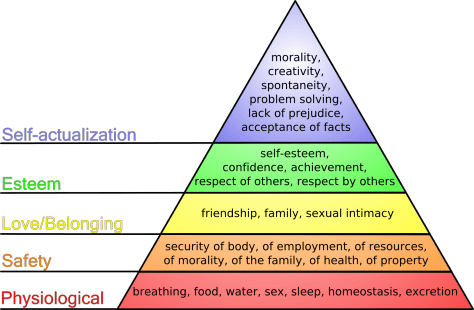
  1. Maslow’s Hierarchy of Needs. Maslow's_hierarchy_of_needs I showed this to my children’s lit students this morning, and I was reminded once again of how much sense this makes.  (Maslow’s basic argument is that the bottom levels of the hierarchy are necessary in order to achieve the higher levels.)  It applies to so many situations: the difficulty abused and neglected kids have in school, the poor work output of people who aren’t getting enough sleep, the writer’s block I get when I’m worried about other things (hey, didn’t I just mention that?).  It even explains the phenomenon of being hangry.  Sure, there are amazing stories about people who aren’t getting their foundational needs fulfilled (such as concentration camp victims) who nevertheless achieve the highest level of the pyramid by creating beautiful works of art or performing heroic acts of self-sacrifice, but what makes those stories so amazing is their rarity.  They are the exception that proves the rule.
  2. The emoji with no mouth. You’ve seen it: It’s a smiley face, minus the smile.  And yet it’s so eloquent.  I use it to mean “There are no words”–a phrase which, like Maslow’s hierarchy of needs, applies to so many situations.
  3. To Kill a MockingbirdI finished rereading this classic yesterday, and I was confirmed in my opinion that Scout Finch is one of the greatest narrators, and Atticus one of the greatest dads, of all time.  Very few books juxtapose humor and danger (recall that Scout is wearing a ham costume throughout the climactic scene), wisdom and innocence (Atticus’s words interpreted through the child Scout’s limited understanding and recalled from the adult Scout’s perspective) in such an effective way.  And the evocative descriptions—the humid warmth of a summer evening, the cracks in a sidewalk that has a tree root pushing through it—take me back to my own childhood, even though mine wasn’t spent in Alabama.
  4. The Grey Havens. My friend told me about this band Saturday morning, I impulse-bought their album Ghost of a King for $10 on iTunes without sampling it first, and I ended up listening to it over and over while driving that day.  Although their style is a little inconsistent (fluctuating from the folksy and dramatic sound of Mumford and Sons to a poppier but still substantial sound that reminds me of Imagine Dragons), I don’t mind that because I like both kinds of music, and their themes are consistent.  This is Christian music that doesn’t advertise itself as such.  On Ghost of a King, without using the names “God” or “Jesus,” they pretty much outline the whole history of the Bible, hitting the major points of creation, fall, and redemption.  My favorite song on that album is “Diamonds and Gold,” definitely on the pop/electronic end and very fun to dance to in the car (and probably out of the car, too).
  5. using flavored cream cheese as a dip for pretzels. Last night I used the Philadelphia brand roasted vegetable cream cheese as a comparatively “healthy” Super Bowl “dip.”  (Oh, my gosh.  Philadelphia.  I just made the connection.  I am the reason they won.)  Today, I polished off the rest of a tub of honey pecan cream cheese (also Philadelphia) as a lunch snack at work.  Seriously, this is good.  You should try it.

What are you digging right now?  Let me know in the comments.