Hufflepuff Leadership: a blog idea

I’m thinking of rebranding my blog. Before I explain why, I’ll briefly explain the blog’s history for those of you who haven’t been with me from the beginning.

I started penelopeclearwater.wordpress.com in December 2011 so that I could get two free books. A friend had told me about an opportunity to receive the books for free in exchange for reviewing them on my blog. I didn’t have a blog, but there’s a lot that I’d be willing to do for free books, so I started one. (I posted the book review in January 2012.) As you will see if you read my inaugural post, I had fairly high aspirations for the blog (I wanted it to be “a place where thoughtful inquiry and the magic of words can thrive”), but I never had a specific theme in mind. For the past 6+ years, I’ve kept that tradition alive, posting about whatever I felt like posting about. In that inaugural post, I also explained the reasoning behind the blog’s name–and its subtitle, which is the motto of Ravenclaw House–and while my original ideas about the title still apply, I’ve come to identify with Hufflepuff more than Ravenclaw (a journey I’ve documented well here on the blog, in a number of existential-crisis posts). In the beginning, I sometimes used “Penelope Clearwater” as a narrative persona; I rarely do so now.

Recently, some observations and conversations have gotten me rethinking the goal of the blog and how I want to represent that goal. Let me first make clear that I have no intention of quitting my day job in order to become a professional blogger. This is a hobby. Nevertheless, hobbies can be approached with purpose just like jobs can. One way I’ve been approaching my blog with greater purpose over the past year and a half is to post weekly, with few exceptions, generally on Mondays. I’ve also linked the blog to my Facebook and Twitter accounts, garnering a larger readership, even if it consists mostly of people I know personally.

I’ve also noticed that most other people’s blogs–at least the popular ones–have a specific theme. I’ve observed that when I categorize my posts with certain keywords–especially “travel”–I get more likes and follows from the WordPress community than when I use other keywords (and certainly more than before I started using categories and tags). This phenomenon was confirmed by a successful blogger I know. Another friend helped me to nuance this idea by noting that while the blogs she follows do tend to have a specific theme (cooking, design, books, etc.), some of her favorite posts are the ones in which the bloggers depart from their ostensible topics and show a slice of their lives and/or make observations outside their chosen fields. This reassured me that committing to a narrower focus may not be as restrictive as I had feared.

Also, when my dad’s guest post from this past Friday sparked immediate attention and elicited articulate comments from some of my Facebook friends, I again got the message that people are looking for ideas to engage with and not just the kooky ramblings of my mind.

All of this led me to the conclusion that it might be time to refocus and rebrand my blog.  But I didn’t know what to focus it on until one recent morning when I was thinking about some recent conversations I’d had with a work colleague. The idea came to me that someone should write a book (or a blog–or both) about how to lead like a Hufflepuff–a person who is probably not a natural or comfortable leader. I thought it would be fun to write in the persona of a Hufflepuff prefect and offer advice, from my own and others’ experience, about leading with the qualities valued by our house. And I realized that a number of my existing posts would fit into this theme with very little tweaking.

Next week, I’ll expand on this idea, but for now, what do you think? Would you read a blog about Hufflepuff leadership, keeping in mind that not every post would be explicitly on that theme?

I finally caught up with the rest of the world and watched Stranger Things 2.

*SPOILER ALERT*

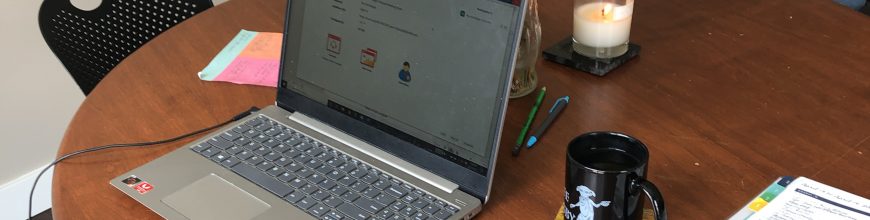
I watched the series on my laptop, which has a line down the middle of the screen (which sometimes created an amusing split-screen effect), but even with the small screen and display glitch, I feel like I got the full experience.  Because Stranger Things isn’t ultimately about a cosmic battle—it’s about the intimate emotions of the people in the Party fighting that battle.

Maybe it’s because I watched the final episode last night, so it’s fresh in my mind, but for me the moment in this season that encapsulates that emotional core is when Nancy comes over to those clunky, retractable, wooden get-a-splinter-in-your-butt bleachers (one of the countless nostalgic references in the show) and asks Dustin to dance, and we see that Dustin has been crying.  Not like a baby or like a drama queen, but like a seriously let-down 13-year-old boy.  I love that this vulnerable moment is shown but not belabored for all its sentimental worth.  That’s what this show does: It pierces your heart, but it doesn’t let you wallow—because there is, after all, a cosmic battle to be fought.  And like my favorite fictional cosmic battle (to save the Wizarding world, obviously), this one is fought using very non-fictional weapons: honesty (friends don’t lie), loyalty, courage, and love.

Let’s talk about courage for a minute.  I haven’t read anything on the internet yet about Stranger Things 2, but I’m guessing I’m not the only one who fell into unexpected love with Bob Newby, superhero.  I mean, I expected to enjoy Sean Astin’s performance, but for the first few episodes, the show seemed to be sending Bob down a “mom’s dorky boyfriend who doesn’t get it” story trajectory.  But of course, when Bob is invited into the Party (the larger Party that encompasses everyone–kid and adult alike–who gets pulled into the orbit of this conflict) and given room to use his dorky yet awesome skills, he becomes a hero.  And yet he doesn’t suddenly turn into a fearless guy who always knows what to do.  I appreciate the shots of Bob hiding in the closet from the…demodogs, I guess we’re calling them? (thanks, Dustin) because we see that he’s sweating, he’s almost hyperventilating—he’s terrified.  But he does what is necessary.  In a conversation, I said that Bob is not a brave person, but he does brave things.  Those are the kinds of characters that I love.

One more character who really wrung out my heart this season: Hopper.  He told Eleven/Jane/Kid that he feels like a black hole, an entity that sucks people in and then destroys them, but I think the better metaphor (analogy?) is of an emotional punching bag.  I think of that horribly sad shouting match with Eleven about halfway through the season, where she was doing most of the shouting (and telekinesis) and he was mostly just absorbing it, taking in the hurt.  And then I think of Mike screaming at Hopper in the last episode because he didn’t understand, wouldn’t understand that Hopper did what he did because he loved Eleven just as much as Mike did.  No wonder the guy keeps breaking all his health resolutions—a man who takes all those hits has to do something to cope!

I’ll probably write more about Stranger Things 2 next week because I’ve got more to say, including about this season’s most delightful surprise, a brand-new Steve: babysitter, mentor, and unlikely big brother.  Meanwhile, tell me your thoughts.  Or go watch the show, if you need to do that first.

what I would say if I were on Talking Dead

Sometimes I think about what I would say if for some reason I became famous enough to sit on the celebrity couch in Chris Hardwick’s fake studio apartment.  Lately, the guests (and Chris) have been doing fairly well at focusing on The Walking Dead instead of promoting their own work and making dirty jokes.  But there are some topics nobody has broached that I think need to be addressed.

  1. Negan is not a good role model or even a cool guy.  I made this quite clear in my post from a year ago entitled why I hate Negan, so I won’t belabor the point now.  At the time, I said he was an engaging character, but now I find his swagger contrived (which it is, of course–it’s a post-apocalyptic persona) and his relentless unkindness, even to his own terrified followers, almost unbearable to watch.  Yet convention attendees are still dressing their little kids up in Negan costumes.  It’s troubling, to say the least.  I wish Rick (or anyone, really) would kill him ASAP–next Sunday, preferably–but I’m sure he won’t die until the end of this season, if even then, because he seems to have surpassed Darryl as the darling of ratings.
  2. The most interesting characters are the people who seem to have nothing to offer–the ones considered dead weight or even liabilities according to the masculine contribution-value paradigm I wrote about in another post.  Sure, we need people like Rick who have gun skills and leadership abilities, and people like Carol whose past traumas have made them tough, but we also need people like Father Gabriel, who had to go through a serious worldview shift in order to even comprehend what was happening, and people like Eugene, who concocted the (end of the) world’s biggest lie because he was so afraid of being cast out or killed by people he knew were more capable and prepared.  People like these latter two, perhaps my favorite characters right now, provide a necessary non-majority perspective and are able to empathize with others who aren’t brave or bad-ass and yet have worth just by being human.  (Well, Father Gabriel is able to empathize.  Eugene’s not great at people skills, but he’s improving.)  I often think back to Dale in Seasons 1 and 2 and that bewildered look he would get, which I affectionately refer to as The Dale Face.  Dale clearly was having trouble reconciling his understanding of the world with the horror he was seeing around him.  I would have the same trouble, and I’m glad to think I would.  The people who aren’t troubled by the zombie apocalypse are the people who scare me.  And even some of our most confident and capable characters have had to go through periods of retreat and reflection–Morgan, most notably, but also Rick when he went through his gardening phase.  (By the way, I was annoyed with all the fans who mocked “Farmer Rick.”  Besides processing his own grief, he was also creating a sustainable food source for his community.  Since when is that a bad thing?)
  3. King Ezekiel, his tiger, and his kingdom have turned this show into a bizarre mashup of a gritty, hyper-realistic road story set in the near future and a faux-medieval high fantasy, Lord of the Rings style, and I love it.  He’s the best thing that’s happened to this show in a while.
  4. Please, someone, wash and cut Carl’s and Darryl’s hair.  I can hardly stand to look at them.

Fantastic EQ and How to Have It

Well, I couldn’t wait until next week.

I know there are some people who read my blog who love J. K. Rowling’s wizarding world as much as I do, but there are also some readers who aren’t great fans of that world but are interested in the psychology/personal growth topics I often write about.  This post is for all of you.

Last night as I was leaving the theater after seeing Fantastic Beasts and Where I Find Them, I ran into several friends and acquaintances, and as we briefly exchanged expressions of love for the movie, I noticed that I kept putting my hand over my heart, as if I needed to keep it inside my chest.  That’s how the movie made me feel.  I felt like my heart was overflowing.

Another way of saying the same thing: Sharp-eyed viewers (and people who have been on Pottermore recently) will notice that the protagonist, Newt Scamander (whom I loved just as much as I hoped I would), has a Hufflepuff scarf.  I remarked to one friend that even though Newt is the only Hogwarts graduate in the movie, all the inner-circle characters seem like Hufflepuffs to me.  Despite their different personalities, they are all kind, awkward, earnest, and almost painfully empathetic.  And I think that’s why I loved the movie.

Emotional intelligence (EQ), of which empathy is a big part, is a topic that fascinates me, so I can’t help noticing when fictional characters show that they have it–or don’t.  In Fantastic Beasts, I saw the main story as a piece of Newt Scamander’s EQ development journey.  At the beginning of the movie, he doesn’t make eye contact with people (he does with animals, though), he behaves bizarrely in social situations, and–most importantly–he’s very, very guarded about his personal life.  By the end, he hasn’t become a different person, but he’s learned to trust a few people who have earned it, he makes the (for him) difficult admission that a human being is actually his friend, and he seem to take the first tiny steps toward falling in love.

But yes, this is a fantasy, not an introspective drama.  Yet I think the splashier plot, the one involving dark magic and wand duels, also hinges on emotional intelligence.  At the end of the movie, empathy saves New York City.  (How’s that for a superhero movie title?)  Seriously.  Unfortunately, it comes too late to save the lost soul whose personal conflict has been spilling over and wreaking havoc on the city.  As in the Harry Potter series, we see that children who don’t receive love usually (unless they’re special, like Harry) have no love to give others.

There’s also a beautiful metaphor for empathy in this movie.  One character that I didn’t except to love (I forgot that Rowling can write really great female characters, unlike so many authors) was Queenie, who is a Legilimens (for you non-fans, that means she can read minds).  Mind-reading tends to be portrayed as a sinister skill, but in Queenie’s case, it’s a literalized form of empathy: I actually do know what you’re thinking and how you’re feeling, but instead of using that against you, I’m going to help you if I can, and just accept you if there’s nothing else I can do.  I think my favorite line in the whole movie was when Queenie said to Newt, talking about a girl that Newt used to be close to, “She’s a taker.  You need a giver.”  Right at that moment, Tina (Queenie’s sister and Newt’s–I think–love interest, and the one whose empathy, along with Newt’s, saves NYC) walked onto the scene, as if on cue.  The next second, so did Jacob, Newt’s new friend–a guy who’s so giving that he wants to open up a bakery and spend the rest of his life feeding people (insert emoji with heart-shaped eyes).  So it was just a whole room full of real and honorary Hufflepuffs–people whom you really, really want to be your friend.

Maybe I’ll write more about Fantastic Beasts next week.  (I haven’t even said anything about the fantastic beasts yet!)  But I just wanted to explain why I’m not just being sappy and fangirlish when I say that I had to rein my heart in after watching this movie.