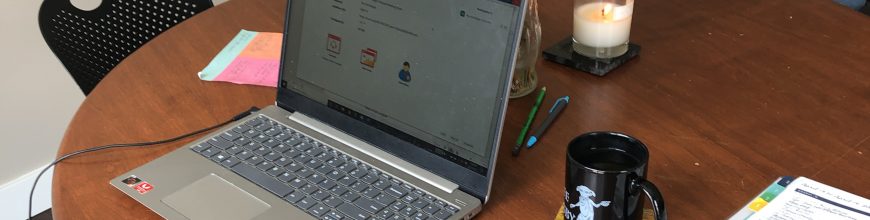
What online instructors want from their students

I’ve been thinking a lot lately about the misconceptions–or complete mystification–some online students have about what their professors are looking for. In an asynchronous online class, there’s no regular meeting time when students can ask questions and professors can pointedly emphasize certain desired behaviors. I don’t want my students to have to guess what my expectations are for them–nobody likes that game. While every instructor will have expectations specific to each of their courses, there are some that, at least in my opinion, transcend contexts. In this post, I’m going to list and briefly explain several of these close-to-universal expectations.

  1. We want you to write like a real person, not a robot. I’ve been saying this for years, but the recent revolution in accessible generative AI tools has made this advice particularly urgent and very literal! An essay written by ChatGPT and an essay written by a student in a stilted, impersonal academic-ese, while ethically different, are both really boring to read. I want to get to know you through your writing, especially in an online class where writing is about the only thing we have to build a relationship on. Let your own voice come through!
  2. We want you to communicate with us. Often, students who email me will preface their message by saying something like “I’m so sorry to bother you.” I always reassure these students that answering their questions is what I’m paid to do and that my best teaching often happens through email. Again, since you’re not sitting in a classroom with me, I don’t have that weekly or daily time to check that you’re understanding the material and doing okay in life in general. If you’re turning in assignments, at least I know you’re alive, but I’ve found that the students who do best in online classes are those who communicate with me outside of assignments–asking questions, running ideas by me, letting me know what you think of the course materials, etc. And this might go without saying, but if you’re not turning in assignments and you’re not emailing me, then I have no choice but to assume that you’ve fallen off the face of the earth! I would much rather receive an email explaining that it’s been a hard week and asking for an extension than receive no communication at all. Talk to me!
  3. We want you to read our feedback. This one may sound like a pet peeve rant (“I spent all that time writing feedback and they didn’t even read what I wrote!”), but there’s more to it than that. I guess I can’t speak for all instructors here, but I try to grade with the goal of helping my students on future assignments, both in my class and later classes. I don’t make as many grading corrections as I used to (I was trained in the bleeding red pen school), but the comments I do leave are substantial and, I sincerely hope, constructive. If you don’t read my feedback, you’re missing out on a big part of what you’re paying for in my class. If an assignment has a rubric (and I think rubrics are used pretty much across the board in online education today), find out how to open and read the filled-out rubric–otherwise, you don’t know why you lost the points you did, and you’re left to assume the professor just doesn’t like you. I can’t promise that I like all my students (that’s a different topic for a different post!), but I never deduct points just because–the rubric always makes it clear!

I’ll stop there for now, because those are by far the three biggest expectations I have for my online students. Of course, students also have a right to know what they can expect from their professors, so look for a future post on that!

What if I started a podcast?

I do a lot of writing in my work life (emails, course announcements, more emails, course revisions, more emails) and my regular human being life (planner, Bible study notes, text messages, social media posts, and the occasional non-work email). When I am writing, I constantly, reflexively revise, which both slows down the process and makes it more mentally taxing than it would be if I could manage to do the kind of one-shot, pristinely untouched writing that proponents of “silencing your inner editor” seem to be envisioning. I enjoy writing, I think writing is important, and I will never stop writing. But I’ve noticed lately that writing can burn me out in a way that talking usually doesn’t (the exception is teaching in front of a classroom, which, though I love it, can be draining for me).

So lately, I’ve been finding ways to substitute talking for writing–sending a Marco Polo to a friend when a text would be too long and complicated, video-recording grading feedback for online students so they can hear and see me and know that I’m not mad at them, etc. This has got me wondering what it would be like if I started a podcast.

So I’m thinking about it. I have a topic (it would be essentially the same as that of this blog, maybe a little wider-ranging) and a name (keeping it secret to increase the hype–actually, the truth is that I’m not sure if I like it yet) and am working on a logo. Beyond that, I got nothin’, except a mug I prematurely bought that says, “Proud to be a one-woman show,” with a little microphone on it. (I figure it can apply in a broad, metaphorical sense even if I don’t start the podcast.)

I should make clear that the podcast would not replace this blog. I’ve maintained this blog for 10 years as of this past December (most of those years it was called Penelope Clearwater), and I see no reason to fold it now. I would probably alternate blog posts and podcast episodes, or do what the influencers do and create coordinating sets of posts and episodes (and Instagram stories–I need to learn how to make those).

I’d like to ask for your help. Would you answer the few questions below to help me figure out how a podcast could best serve you, my readers? (And if the answer is by not existing, that’s okay!) I appreciate your help. You can also feel free to make non-anonymous suggestions in the comments down below.

our teaching and learning preferences

The idea for this post came from a confluence of three factors: 1. I noticed that several of my new students started following my blog after I shared the link (welcome!). 2. I had a Twitter conversation last night with a former student about the conditions for a good discussion in an English class. 3. I am working on my goals for 2021 and have been thinking about ways to be more available and approachable to my students.

So I’ve decided to open up a discussion, in which I hope you will join me, about your teaching preferences (if you’re a teacher) and your learning preferences (if you’re a human being, because we all learn). I’ll start with a few observations; then I’ll ask some questions and give my own answers to begin the conversation.

Observation 1: The idea that there are three learning styles–visual, auditory, and kinesthetic–seems to have been largely debunked, or at least marked with a large asterisk noting that the concept pigeonholes students, is overly simplistic, and isn’t research-based. Anyone can learn in any of those three ways, and the dominant style may have more to do with the world we live in than with an inborn disposition. (For example, I meet few people today who call themselves auditory learners, but if we take this concept anachronistically into the past, I bet there were a lot more auditory learners back in the 19th century when people where accustomed to listening to long political debates.) When folks in the education field talk about how students learn today, they look at a whole constellation of factors that may include cultural and language background, classroom environment, sensory processing modes, past learning experiences, personality factors that may influence when and under what conditions a student will speak up in class, etc. But the best methods for finding out how a student learns are still pretty old-school: observation (which is harder in an online classroom, but not impossible) and asking the students themselves.

Observation 2: Teachers tend to choose their teaching methods based on their own learning preferences. For example, I usually enjoyed the wide-ranging, open-ended discussions we had in the literature classes I took in college, so I often attempted to conduct these types of discussions in the classes I taught. This isn’t a bad starting place, but good teachers are willing to try different methods when they see that the ones that worked for them as students, or even the ones that have worked with previous classes, aren’t working with a particular group of students. (Of course, this doesn’t mean giving up the first time a method is met with dead silence or confused looks–the students might need time to figure it out and warm up to it.) Also, a technique that works for most of the students in a class may leave out a few students who, for various reasons, can’t get into it. Teachers often talk about “teaching to the middle,” and sometimes that’s what you have to do in a live classroom setting, but that doesn’t mean neglecting the students who fall outside that average clump.

So, here are my questions: How do you prefer to learn? What classroom conditions (online or in-person) make you most likely not only to meet the learning goals of the class but also to enjoy yourself while doing that? What do you want teachers to do to help you learn and enjoy learning? (The answer could be “just leave me alone, thanks”–that’s a legitimate learning style.)

If you’re a teacher (and this could include a Sunday school teacher, a tutor, someone who gives private lessons, a parent, etc.), what are some of your favorite ways of delivering content and connecting with students? Why do you think they’re your favorite?

I realize this post is getting long (I say that a lot, don’t I?), so I’ll just give two quick examples for myself. First, as a learner, I find it hard to concentrate when I’m doing nothing but sitting and listening. I prefer to be doing something with my hands or feet (taking notes, washing dishes, walking) while I’m learning. I think I’ve always been like this, because I have this embarrassing memory from fifth grade: One time I was doodling during class; I don’t remember what we were learning about, but I’m positive it wasn’t a music class. And I raised my hand and asked my teacher if he could show me how to draw a treble clef. And bless his heart, he stopped what he was doing and drew one for me on the board.

As a teacher, I’ve had to adjust my methods since I’ve moved to teaching fully online, but my favorite part about teaching is still connecting with students one-on-one or in small groups. (I used to be a writing tutor, and I loved that because it involved some of my favorite aspects of teaching and none of my least favorite–grading.) I love it when students reach out to me by email or phone, whether they have a question or just want to chat. I’ve said this before: in the online learning environment, it can be really difficult for students and teachers to think of each other as real people, not just writing machines. So I seize on any opportunity to make sure my students know I’m a real person and to learn about them as real people.

Okay, it’s your turn. Go back to those questions in bold and tell me what you think!