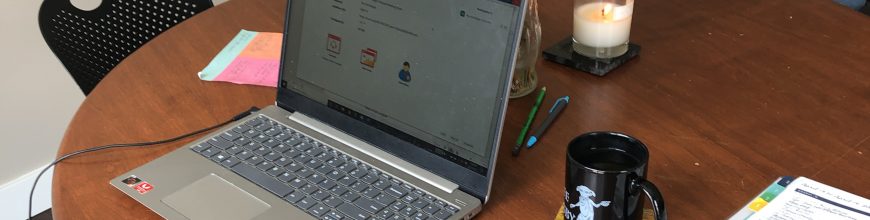
home: the new co-working space

Yesterday afternoon, I took a break from folding laundry and replying to students’ discussion board posts to make myself a cup of tea. I looked outside and saw a chickadee in our birdfeeder. Chickadees are harbingers of colder weather and new birds to look at, and besides, ever since a small stand of trees near our backyard was cut down a few months ago, we haven’t seen any birds at our feeder besides the occasional mourning dove that plants itself there for hours and doesn’t do anything but poop. (Sorry, mourning doves. At least you have a pretty voice!) So, the arrival of the chickadee was an exciting event, and I hollered to my husband, Jordan, who was working in his home office, to come out and look. As if they had been waiting for his arrival, a flurry of birds suddenly appeared, including more chickadees, some cute little brown guys (look, I never said I was a real birder), and even a couple of Eastern bluebirds—my favorite songbird but one that I rarely see. For about fifteen minutes, they flew around the backyard, alighting now and then on our feeder, the neighbors’ fence, and the scrubby bushes on our property line, even daring to get as close as our patio picnic table. Then, shortly after Jordan went back to his office, they were gone, and they haven’t been back (though I’ll be on the lookout around 2:30 this afternoon).

I shared this story because moments like this are among the blessings of working from home, especially with someone you love. This year, millions of people around the world started doing what fully-online professors (and those in an increasing number of job sectors) have been doing for years: working in the space where they also sleep, eat, do chores, and spend time with those they love. Working from home comes with its share of challenges (e.g., distractions, guilt over unfinished tasks, the difficulty of establishing a quitting time), and those challenges are compounded for those with children at home. I don’t want to minimize those challenges, but in this post I am focusing on the joys of working from home, as well as a few of the practical considerations.

Jordan, an engineer, started working from home in March, like many people did. He already had a home office with a pretty sweet computer set-up (powerful processor, big monitor, headset, etc.) because he’s an avid gamer. With a few adjustments (purchasing a second monitor, downloading the primary software he uses for work), he was able to set himself up to work basically the same way he did at the office, with one major difference: his co-workers aren’t here.

Sure, he can and does email, call, and ping them on Microsoft Teams. But if he wants to get up and stretch his legs and decompress after a stressful meeting, the only person in his physical space is me, and I’m not much use in a conversation about solenoids. (They’re little magnetic parts that open and close things. I’ve learned that much.) But then again, maybe that’s a good thing. Maybe what Jordan needs in that moment is both a cup of tea from a real teakettle (which I know he can’t get at the office) and a conversation with someone who’s doing something totally different, like grading English papers.

I think we all know that siloing is a major problem with the way our culture treats work, especially in the higher education sector. We specialize in one thing, starting with our undergraduate majors and getting increasingly narrower as we move through the levels of education and professional development, and while there’s certainly nothing wrong with getting really good at one thing (like making solenoids), I fear we are neglecting skills and character qualities that transfer from one situation, context, or career to another. Perhaps we are losing the ability to have meaningful intellectual conversations with those in other fields.

That just got really philosophical. But I went there because I’ve been thinking about the relatively recent phenomenon of co-working spaces. You’ve probably heard of them: they’re buildings (or floors) where anyone who needs a space to work—freelancers, private practitioners, telecommuters looking for a change of scene or some peace and quiet—can rent a room or cubicle alongside others who are doing the same thing. Though I’ve never worked in one of these spaces myself, I can imagine that one of the benefits—besides having someone to split a lunch order with—is that you get to have conversations with (and possibly eavesdrop on) people who are doing very different work than you are. Maybe you learn something from them, and maybe you even come up with ways you can partner with your cross-disciplinary co-workers. I wonder how many new businesses and community services have been hatched out of these almost accidental partnerships.

During this year’s pandemic, many couples, families, and roommates found themselves in a co-working situation with people they already knew and loved, but had never worked alongside. For Jordan and me, who just got married this year, this has been basically an unadulterated blessing. It has allowed us to spend almost all day, every day together during the formative early months of our marriage. It has allowed us to become familiar with each other’s work habits and given me a peek into Jordan’s relationships with his co-workers, who I know are very important to him. We have been taking an hour-long lunch break together, which gives us time to prepare and eat healthier meals. (And as a side benefit, we’ve gotten through all the seasons of Friends and most of Avatar: The Last Airbender during our lunches.) And sometimes, we get to share special moments like the bird-stravaganza of yesterday afternoon.

The only thing we’re still trying to figure out with regard to working from home is where my space will be. This was Jordan’s house before we got married, so I didn’t already have a workspace of my own as he did. I started out working on the dining room table, which had its benefits (good lighting, plenty of space, good view of birds), but I felt like I had to clean up my stuff at the end of every workday, and I wanted a more permanent area. So lately, I’ve been working in the bedroom. Next to one of the windows, I’ve set up a small, brown and green vintage metal table that I bought at an antique shop a few years ago. My laptop sits there all the time, along with my planner and a few other items. A chair doesn’t quite fit underneath the table, so when it’s time to work, I pull over a vintage wooden chair reupholstered in a bird print (another antiquing find) that usually sits in another part of the room. So far, this setup is working pretty well, but I’d also like to try setting up a little work corner in our living room. Jordan and I have talked about sharing the home office, but we don’t think this would work very well for meetings, and I’m happy to let that be his space since my work is more mobile than his.

I’m still figuring out my space, but trying out different spots is more fun than inconvenience. I’m thankful that I get to work from home, and even more thankful that I get to do it alongside my favorite co-worker.

What does your workspace look like? Who are your co-workers, in both senses of the word? What are some of the challenges and benefits of your work setup? I’d love to hear from you!

Imposter syndrome: You probably have it.

Today I’m writing to you about something that’s so central to my experience of being a teacher and an academic that I considered calling this The Imposter Blog. (I decided that might be confusing.) Imposter syndrome has become a widely documented phenomenon in the fields of psychology and education. It simply means feeling like everyone else in your group (whether that’s a class, a doctoral cohort, a department at work, or even a group of gaming friends) belongs there, but that you’re an unqualified, inexperienced imposter–a poser, as people my age used to say when we were teens. If you’re a teacher, have you ever though as you approached your students (whether online or in front of a classroom), “I don’t know enough about this topic to be teaching other people about it?” If so, you’ve experienced imposter system. (If not, are you lying?)

One of the strongest triggers of imposter syndrome in my life has been joining the faculty of the university where I earned my first two degrees, coming to teach alongside professors who once taught me. Besides the perpetually awkward conundrum of what to call them (there are some whose first names I’ll never be able to bring myself to use), I have a really hard time shaking the feeling that I’m just the annoying kid who tags along with the adults. Although it’s been a few years and I’ve started coming into my own as a colleague, there are still situations that send me straight back to being a shy nineteen-year-old sitting in my first British lit class. These include having to express disagreement with one of my former professors, serving on a thesis committee with them (especially if I’m the chair), and being asked to share my expertise on something (gut reaction: what expertise?).

Instead of giving you my five steps to overcoming imposter syndrome (as a matter of fact, I don’t have those), I’d like to ask you to share your expertise, or at least your stories. In what situations, if any, have you felt imposter syndrome? Is there anything you can do that helps? Is there anything your colleagues or administrators have done that helps, or that you wish they would do?

Thanks for being part of this community! Next time, I won’t make you wait so long for a new post.

on “putting oneself out there” and how it feels to fail

I thought I’d start this blog on a positive note with a post about rejection and failure.

That’s a joke; you can laugh. I’m not trying to make a profound statement about the value of failure. I believe it can be valuable, but that’s not what this post is about. Today, I want to start a conversation about how rejection and failure—and the fear thereof—feel in the moment you are experiencing them, before you start looking for life lessons and recalling all the inspiration quotes you’ve read about Thomas Edison and people like that. Let’s talk about what makes us feel these feelings and what we do to deal with them.

Academics are always at risk of rejection and failure. I am reading a book by Helen Sword called Air and Light and Time and Space: How Successful Academics Write (and really enjoying it! Perhaps I’ll review it here when I finish), and I found it delightfully ironic but not surprising that she included a chapter on failure in a book about successful people. The book consists largely of quotations from Sword’s extensive interviews with prolific and well-regarded (but not necessarily celebrity-level) scholars from across the disciplines, and in this chapter, they speak of rejection letters, bad reviews, discouraging colleagues and “mentors” (I put this in scare quotes because a discouraging mentor should be an impossibility), and the all too familiar fear of sharing one’s words and ideas with an audience of any size.

Sword’s book is addressed to professors who publish academically on a regular basis, which means I’m a little bit outside her target demographic. Perhaps some of you, like me, are in a position in which your primary duty is to teach and there is little or no expectation for you to publish. But that doesn’t mean you don’t consistently face rejection and failure too. For one thing, if you have a blog, a social media platform, or even a regular-person social media profile that your colleagues and students can find, your ideas (and your photos of sunrises and pumpkin spice lattes—I’m talking about myself here) have a larger audience than you might feel entirely comfortable with. If you are an online faculty member with creative control over your own course, your students are reading your words, hearing your voice, perhaps seeing your face each time they log into the course, and there’s always a risk that the students will find your mannerisms awkward or your teaching style overbearing, or that an activity or reading you assign will fall flat. Even if you see yourself as merely a facilitator of a course that someone else designed, you are still the breathing, human face of the course for your students, and every time you post grading feedback or send an email clarifying an instruction, there’s a chance your students will misunderstand or be offended or ignore you.

Why do we keep setting ourselves up for potential rejection or failure? Well, think about the alternatives—you could just not reply to your emails, or you could never try anything new in your course, or you could wear a paper bag over your head in your course videos (as just a few examples). I hope you agree with me that, while these alternatives may be enticing, they are not desirable options. The very same conditions that set you up for failure and rejection are also the conditions that allow you to teach, to encourage, to model, and—possibly—to change lives. But now I’m getting too inspirational. Let’s back up for a minute.

I want to talk about the specific scenarios that trigger those fears of rejection and failure. Please share in the comments below—what, in your teaching career, has made or regularly makes you want to hide under your desk? For me, one of the worst triggers is reading course evaluations. I think a big reason why these are so consistently scary for me is that my first full-time college-level instructional job was teaching a required, zero-credit course that many students regarded as remedial (which it was, even though we didn’t use that word) and as a punishment for not passing the placement test. Some students welcomed the opportunity, some begrudgingly came to admit that the course wasn’t a complete waste of their time, but others bore a semester-long grudge toward the course and took it out in the course evaluation. And of course, I read all the negative comments in the evaluations as if they were about me, as a person, even though many of them weren’t. So even though I’m now teaching courses that students tend to enjoy or at least find valuable, my heart rate still goes up and my palms get sweaty when I open those evaluations. I rush through them, seeking out negative comments so I can get them over with, which causes me to skim over and not fully appreciate the positive, sometimes even glowing, comments that now typically outnumber the bad ones. Course evaluations are supposed to be a tool to help faculty know how to improve their courses, but for me, they’re too tied up with ugly emotions to really be helpful. Like other things in academia that are supposed to be useful, they have become an ordeal instead (perhaps another post for another time?).

Here are some other scenarios that might trigger a fear of rejection or failure:

  • Presenting an idea in a committee meeting or email discussion
  • Asking for something (a pay increase, time off, the opportunity to teach a desired course)
  • Meeting with a new student who thinks you’re cool and wondering the whole time if her illusions about your awesomeness are being shattered (Does this sound oddly specific? It’s happened to me. By the way, this scenario involves imposter syndrome, a subcategory of today’s topic that I plan to write a whole post about soon.)

What are some of your scenarios? Why do you think they are triggers for you? Do they cause physiological symptoms like the ones I mentioned above? (The raised heart rate and sweaty palms are not just metaphors!) Is there anything you have learned to do to deal with these fears or at least mitigate their symptoms? (For example, in my welcome post, I mentioned that I might have my husband hold my hand while I read course evaluations.)

I’m excited about the community we are forming here, and I look forward to reading your thoughts on this topic. If you found this post helpful or mildly entertaining, tell a colleague or friend!

a quick guide to being a great teacher

Like my title? Yeah, that’s clickbait. (And if you’re a teacher, you should know that.) But it also fits the story I want to tell you today.

Since 2016, when I designed the main online college course I teach right now, I have been requiring students to create a “research quick guide” in one of the last modules. The assignment is supposed to get them to reflect on what they know about how to do research in their field (“field” can be academic or professional, or in the case of my creative writing students, genre) and come up with a succinct way to share that knowledge with others. The important thing is the content, but somewhere along the line, I’ve gotten a little hung up on the design element of the assignment. I often find myself deducting points when a student’s guide is “hard to visually scan” or “more of an essay than a quick guide.” The problem is that there’s not a general consensus across contexts as to what a “quick guide” actually is. I’m committing that terrible teacher sin of asking my students to read my mind.

I should also point out that it’s pretty ironic that I’m judging other people’s design skills, as may be evident from the fact that I’m still using this template from when I started this blog in 2011. I mean, I know basic principles like “don’t use Comic Sans in a work email” and “don’t put too many words on a PowerPoint slide (and then turn your back to the audience and read straight from said wordy slide),” but that’s about the extent of my knowledge. So not only am I asking students to read my mind, but I’m also asking them to do something I don’t really know how to do myself.

Now, as part of a larger update of the course, I’ve set out to create a quick guide for my students. My initial motivation for this project was not to create a quick guide as such; instead, I wanted to respond to a suggestion a student made last fall. (I’ve been carrying around the now-grubby no-longer-sticky note in my planner ever since then.) It turned out that some of the off-hand tips I gave her in emails were actually quite revelatory for her as a first-time online graduate student who hadn’t written an academic paper in years, and she thought that other students might also benefit from the advice. She suggested some categories, like “how to check grades and feedback,” “what is an annotated bibliography?,” and “getting to know your professor.”

Meanwhile, many students have asked for an example quick guide, so I decided to combine these two endeavors. I would create a quick guide to being an English 602 student (very meta, if you ask me). I hoped to be able to send this out to current and future students and tell them, “Hey, I’m not a designer, but I made this in Word and it wasn’t that hard and didn’t take me that long. You can do it too!”

I finally started on the document yesterday. For visual interest, I decided to use a variety of Word’s prefabricated text boxes and sidebars. I also used some relevant clip art icons to create a short border between two of the sections, and I inserted a photo from my computer. Nothing fancy, but I think it looks pretty good (though I still need to do the second page).

Here’s the problem: It wasn’t easy. Once I got some of the text boxes on the page, dragging them around to accommodate new elements was frustratingly difficult. Inserting and resizing the picture was a stab in the dark–I wasn’t sure what those numbers meant or why most of the photo had disappeared off the bottom of the page. I had to get my husband to help me, and even he, who’s all-around better at this stuff than I am, admitted that he didn’t know how to do everything I wanted to do.

So I don’t feel honest telling my students that creating a document like this will be easy. I sometimes have students who have design backgrounds or who use Publisher regularly in their work, and they turn in beautiful, readable, user-friendly quick guides. But for students who are having trouble centering their title or inserting a paragraph break in a basic essay, what I’m asking them to do in this assignment could be panic-inducing.

I’m going to finish the quick guide and send it to my students with the message I had planned to give them, minus “it wasn’t that easy and didn’t take me that long.” I am also going to add that their quick guide doesn’t need to look as good as mine; even some bullet points or a numbered list will show me that they’re thinking about how not to overwhelm their readers. I am going to continue assigning the quick guide, because I think it’s useful for students to work on problem-solving skills in a class about workplace writing–who knows what their bosses may ask them to create someday? But now that I’ve gone through the process of creating a quick guide myself, I’ve learned what’s most important about this assignment, and I’ve developed some empathy for my students. And I’ll be able to answer questions better in the future.

Lesson learned: Don’t ask your students to do something you’ve never done yourself. That may not be a quick guide to becoming a great teacher, but it might be a small step to becoming at least a good one.

app recommendation: Forest

I’m writing to you today at the end of a productive and surprisingly relaxing day of grading Week 7 assignments (the big, culminating projects on which I try to give students their money’s worth in grading comments) for my online classes. I graded six assignments today (on track with the schedule I made yesterday), plus I did this week’s laundry, had lunch and watched a Friends episode with my husband, and even took a yoga break. I attribute my success and Zen-like calm partly to the fact that my classes are fairly small this term, but also to one of my favorite apps, Forest, which I’d like to recommend to you.

Several years ago, I learned about the Pomodoro method, a popular productivity technique that simply involves working for a period of time (usually 25 minutes) and then taking a short break (usually five minutes). There are plenty of apps for this, let alone the fact that you could easily replicate it with any timer or clock, but my favorite one is Forest, which I’ve been using for about a year. I believe it was my good friend Allison who introduced it to me, and I think I happened to be in England when she texted me about it. I actually did a fair bit of grading during my vacation in the village of Knutsford last summer—I was there visiting my dad, who was on a work project, and during the weekdays, he went to work, and I sat in the flat and graded, punctuating my work sessions with little breaks in the charmingly walkable streets of the village. I remember choosing my first Forest tree style while I was waiting for my takeaway sandwich at a delightful cheese shop/cafe.

So, about those trees: Forest is simple—if you succeed in focusing on your task for your selected span of time (I usually do 25 minutes but have also done 30 with equal success), a little virtual tree (or mushroom, grass tuft, bush…you get to pick) grows in your little virtual forest. If you use the app in Deep Focus mode, which I always do, your tree will die if you do anything else on your phone for more than about five seconds, and that’s a devastating enough consequence to keep me on task. There are gamified aspects to Forest—you can earn coins to unlock fancier tree styles, and you can even choose to have a real tree planted in your honor if you earn a large enough number of coins. But for me, the basic functionality is enough (though I have leveled up my trees a few times). It’s simple and charming (like Knutsford!), and it’s been making grading less dreadful for me since June 2019. Find it in the app store and let me know what you think!

in praise of my students

I am currently teaching six classes, three in online programs and three that started out as on-campus classes and have moved to the weird jerry-rigged sort-of online hybrid-ish format that many colleges and universities have implemented in recent weeks. I just want to write a quick post in praise of my students. I am so proud of the resilience they are all showing, from the online student I talked with on the phone yesterday who’s behind in her work because she’s been working ten days straight in a healthcare facility, to the on-campus students who had to quickly move out of their dorms this past weekend. They are all still writing thoughtful, thorough, intellectually curious discussion board posts. They are taking the time to encourage each other and me. I should probably be telling them this instead of writing it in a blog post–perhaps I’ll send this to them tomorrow. But for now, I would like to encourage you to join me in telling someone that you’ve noticed how wonderful they are. If you want, shout those people out in the comments below!

what I’m doing this week: making risotto, being student-centered, and still planning a wedding

This post should not be read as me tooting my own horn (“you should be just like me”) but rather as me sharing some things that I’m doing that may or may not work for you–after all, you may have even better ideas. Also, it’s an aspirational post for me, too; I mean, this is only Monday, and even in a normal week, my best-laid plans can turn into a mess of arrows bumping tasks down to later in the week on my planner page (some of which tasks will fall off the page entirely). So, with all that in mind, here are three things that (you are free to do as you like) am planning to do this week.

  1. Making risotto. This morning, I bought ingredients to make one of my favorite dishes, risotto. I know that not everyone loves cooking, but for me, it’s relaxing and a way for me to use totally different skills than the ones I use in my work. Also, there’s sometimes a temptation, when we are housebound or just generally in stressful situations, to throw basic nutrition guidelines out the window, but I think it’s important for us to continue to be at least mindful of what we’re eating and feeding those we love. I’m not saying risotto is the pinnacle of healthy eating, but it certainly is filling and nourishing, and I’m adding peas and shrimp to mine (thanks for the idea, Betty Crocker) for some green and protein. So, again, I’m not telling you what to do, but perhaps you’d like to use some of your time at home to prepare something special in the kitchen–even if it’s just toast with your favorite nut butter.
  2. Being student-centered. My university, like most, has moved on-campus classes online for the next three weeks. There’s been a lot of talk in higher ed circles about the best way to ensure students are still getting both the rigor and the support of a traditional classroom setting. I’ve chosen to make things relatively easy for myself by using the same format–loosely based on a typical asynchronous* online course–for all three of my on-campus classes. But the really important thing, I think, is that I’m trying to be present for and supportive of my students–answering their emails promptly and encouragingly, commenting on their discussion boards here and there, etc. For me, one of the most crucial (and enjoyable) parts of teaching has always been letting my students know I’m a real person (hence the many times I “accidentally” display my desktop, which features a cute picture of me and my fiance, on the screen in the front of the classroom) and letting them know that I care about them as real people. This can be harder in an online environment, but it’s worth the effort, especially in times when students are facing even more anxiety than usual. So, if you’re looking for takeaways (again, it’s okay if you’re not), here are two: a. Keep doing your best work, even if it looks different than it did last week, and b. Make sure the people you care about know that you care.
  3. Still planning a wedding. So, speaking of my cute fiance…we are planning to get married on May 24. As of now, that’s far enough in the future that we may as well keep planning as if everything’s going forward as normal. When we get closer to the date, we may have to make some difficult decisions, just like couples with March wedding dates are having to make right now. (My heart goes out to them.) But today, I’m working on booking a salon so my bridesmaids and I can get our hair done, because right now, I’m still fully intending to have a wedding on May 24. The takeaway here is that we can’t know what the future is going to look like. We never can; this virus has simply highlighted that truth for us in a particularly poignant way. Not knowing the future is frightening, but acting like we know it usually only leads to despair. As Gandalf once said, “Even the very wise cannot see all ends…and that is an encouraging thought.”

*a fancy word that means “not conducted in real time”

emerging from a tunnel

I’m in one of those seasons (and I mean that in the currently trendy in “inspirational” women’s writing sense, though I’m going to talk about the revolution of the earth around the sun sense later in this post)…Let me start over. I’m in one of those seasons in which I’m having a hard time coming up with wise or even coherent things to say on my blog. (You may have noticed that I didn’t post last week.) I promise I’m having smart ideas right now; I’m just wasting them all on my students. (Just kidding about the “wasting” part, students!) I’m having a ball teaching three literature classes this semester: children’s, dystopian, and my usual intro to lit with a little bit of composition thrown in. The fun part about teaching multiple back-to-back classes in a day is that a topic from an earlier class might lead to an apt illustration coming to my mind in a later class. Yesterday, the sinking of the Titanic came up in both of my classes, both times as an oddball illustration that nevertheless seemed to resonate with my students. And I’m pretty sure I’ve talked about World War One in all three of my classes. And I haven’t even seen 1917 yet!

Oh, that reminds me–I was going to say something about the Oscars. I’m mad at 1917, actually, because I picked it to win Best Picture, and it let me down. I’m not ignorant of the historical significance of Parasite‘s win, and I’m mostly pleased that it did, except that it busted my bracket, to borrow a March Madness metaphor. I believe I would have won my family’s prediction competition had I gotten this category correct; as it was, I came in third out of seven (not bad, I guess. *eye-roll*).

Unlike last year, when I very deliberately watched all of the Best Picture nominees before the Oscars, I had only seen one of them this year, Little Women (which I greatly enjoyed, except that I was a bit troubled by the implication that the whole Jo/Bhaer romance was a fabrication added to please the publisher. Did anyone else notice that?). So I’m going to confine myself to making two comments.

  1. I have to say something about my fave category, Best Original Score. Although I would have liked to see my guy Thomas Newman win, I was happy to see the award go to another young composer (and a woman at that), Hildur Gudnadottir, who composed the haunting (yes, I looked it up on Spotify and listened to it in full, along with all the other nominees) score to Joker. I say “another” because last year’s Oscar went to Ludwig Goransson, another member of what I see as the upcoming generation of composers, for his epic and experimental Black Panther score. By the way, if you haven’t seen The Mandalorian yet, Goransson’s very cool score is one reason to check it out.
  2. I have a crush on Adam Driver. I mention this because he was sitting in the front row and they kept showing him. But you know what? I have an even bigger crush on my fiance, Jordan Martinus. And do you know what Adam and Jordan have in common? They have both lived in Mishawaka, Indiana. True story!

Okay, now that I’ve exhausted most of your patience on preliminary stuff, here is what I actually sat down to write. I went for a walk in the park this morning, and although there was snow everywhere and I didn’t see or hear a single bird, I started to have that feeling I get this time of year when spring is juuuuuuust visible on the horizon. It’s like emerging from a tunnel. Some of my usual reliable signs of winter’s approaching end have occurred: the Super Bowl and the Oscars are over (though the Oscars were early this year–did anyone else notice that?); The Walking Dead is coming back soon; it’s still light outside when I sit down at my computer to work for an hour at 5:00 pm. In a month, my students and I will already be back from spring break, and I’ll probably start making more sense in class because I find my brain is generally clearer in the spring. Oh, and there are just over 100 days left until I marry a guy from Mishawaka. (Jordan, in case you were wondering.) Next time I write to you, we’ll be a little closer to the tunnel’s edge.


stuff in my life right now

I looked back through my blog archives and realized that it’s been a while since I did one of those themeless list posts. Since people tend to enjoy those, and since I’m not sure if I can generate a coherent argument today, here is a list, in no particular order, of things I have going on right now.

  1. I just put my electric blanket on my bed and tucked it in at the end so that it has officially become part of my bedding for the duration of the winter. This will no doubt enhance my quality of life.
  2. I’m in a Peter Pan season. I went to see the strange and delightful play Peter and the Starcatcher Friday night at the South Bend Civic Theater. (By the way, did you know that the novel on which the play is loosely based is called Peter and the Starcatchers? Play–singular; novel–plural.) This week in my children’s lit class, we are reading Peter Pan, and as part of our discussion of Peter Pan as culture-text (a fancy term for the whole conversation surrounding the text–sources, adaptations, connotations, etc.), I plan to show the student clips from the 1953 Disney Peter Pan and Finding Neverland, read them part of Piers Dudgeon’s The Real Peter Pan, and show-and-tell them my Peter Pan Funko Pop. Maybe I’ll even wear my new  Neverland jacket. In summary, I’m way too engrossed this week in a flying, narcissistic, magical boy.
  3. Jordan and I are doing the Whole30.* I am putting an asterisk next to this statement because we are aware that we cannot truly say we have done the Whole30 if we take a break in the middle, which we did last weekend for a very good reason: our wedding reception tasting, which we weren’t about to delegate to anyone else. Also, you’re not supposed to eat sugar-cured bacon or sausage on the Whole30, but it’s dang hard to find non-sugar-cured versions, and I’m not stressing out about it. So we’re doing the Whole30.* Maybe we’ll do it for real later this year. In the meantime, I’ve learned that you can make a really good barbecue sauce using dates as the sweetener. Who knew?
  4. I am doing Yoga With Adriene’s 30-day yoga “journey” entitled Home. (Look her up on YouTube; she’s a phenomenon.) Instead of doing my daily practice in the morning as I typically have in the past, I am waiting until 4:00 or 4:30 pm. This not only frees up my early mornings for other types of exercise but also gives me a delicious (yummy, as Adriene would say) break after the workday. It’s been fun trying to wrap everything up in order to make sure I can get started at the time I’ve written in my planner. (See last week’s post on why I’m giving non-meeting, non-appointment activities like yoga a specific time in my planner.)
  5. I received six goodly-sized jar candles for Christmas. That sounds like a lot, but I love having a bit of fire in my home, and since I don’t have a fireplace, this works almost as well (and smells better). I did have all six out in various places, but today, in an effort to be seasonally appropriate (something I typically don’t care about), I put away Peach Flambe and Ocean Currant for later. I’m amazed by my restraint.

And now, I must go because it’s almost 4:30 and time to do yoga. Let me know what you’re into right now!

getting my act together

Most people who know me well know that I enjoy routine. I like to wake up, exercise, eat my meals, drink my tea, and go to bed at roughly the same time every day. (I prefer exactly the same time, but I’ve matured at least enough to know that that isn’t always feasible.) Every so often, I have to replace a routine that is no longer serving me. And sometimes, I hang onto routines even though I am fully aware they are no longer serving me. But in general, I think my routines do more good than harm.

I was delighted to receive for Christmas from my future in-laws the 2020 weekly edition of The Simplified Planner by Emily Ley. Aside from the fact that it’s pretty and sturdy, has a large format (which means more room for writing), comes with a list of small suggestions for simplifying one’s life, and is part of a lifestyle and paper products brand with an undeniably supportive and cheery vibe, it’s a fairly standard planner. By this, I mean that there aren’t prescripted categories for what to write each day; most of the pages consist simply of dates and blank lines. I know from watching one of Ley’s supportive and cheery videos that this is intentional: She wanted to create a planner that could become what the user needs it to be. And for me, at this season of my life, I’ve discovered that I need to write down and carry around with me a hyperspecific list of what I must do every day and–this is key–what I want to do every day.

I realized that for a long time now–probably years–I’ve been spending my unstructured time wandering around my house feeling the anxiety of all the things I need to do but unsure of what I should do next. This habit has been exacerbated by my current freeform work schedule (I have to be on campus for classes, office hours, and meetings, and that’s it). So even though I believe that part of being a functioning adult is knowing how to use one’s time without having to be told what to do, I have recently felt that I might actually need someone to tell me what to do, at least for a while. And I decided that that person ought to be me.

So I’m filling out every line of my planner. And as I mentioned, these are big pages. I’m not just writing down classes and appointments; I’m also writing down specific times for things like “prayer while making tea,” “have my first coffee,” “talk to Jordan,” “blog,” and “yoga”–things that I say are important (and that I typically enjoy) but that I apparently have never considered important enough to set a time for on my schedule. (This includes those routine items that I mentioned in the first paragraph–yes, I’m writing “wake up” and “go to bed” in my planner.) The level of specificity might seem ridiculous, but judging by these first few weeks of the year, it seems like it’s helping. The true test, of course, will be once my classes really get going and I have grading to do, but I already have a plan for that: one of my to-do items this week is “Count # of students & divide by # of weekdays to schedule grading.” If it’s important, I’m writing it down.

One good thing about this system is that my to-do list is finite and specific to each day, rather than vague and unending, so I’m getting the added benefit of a major list-crossing-off endorphin rush each day. There were one or two days last week when my to-do list was too ambitious, but I was able to move the items to another day or even the following week after re-assessing their urgency.

I should also mention the weekly routine I’ve added that, so far, is incredibly helpful: taking an hour each Sunday night to plan my week. (I am grateful to life coach Cindy Sielawa for this suggestion.) I create a calm environment by lighting all the candles I got for Christmas (it’s a lot–guys, I like fire) and doing a facemask (the skincare kind, not the football kind), and then I fill out all those blanks in my planner. And my routine-loving heart is happy.

And you can make it even happier by telling me some of your favorite daily routines and planning habits! Please share in the comments!