Searching into the Inimitable: A Guide to Research on Charles Dickens

Charles Dickens sometimes referred to himself in correspondence as “The Inimitable,” and while it’s unclear whether this was meant to be straightforwardly hubristic or cheekily self-deprecating (knowing Dickens, it was probably both), the phrase has proven to be prescient. Dickens was an astonishingly prolific writer of journalism, fiction, letters, and plays; a mesmerizing performer of his own work; a passionate social critic, and the creator of some of the most memorable characters in the English language. So perhaps it goes without saying that the field open to the Dickens-focused researcher is deep and broad. Here is a guide to get you started.

Primary sources: Dickens wrote fourteen full-length novels (plus a good portion of an unfinished fifteenth, The Mystery of Edwin Drood, which has spawned a cottage industry of potential endings), five Christmas novellas, many short stories and journalistic pieces (some comical, some melodramatic, some addressing social issues of his day), several theatrical works written for himself and his circle of friends to perform (Dickens was a talented actor who almost pursued a career on stage), and countless letters (including manuscript critiques from his time as a journal editor). Some of Dickens’ working journals, in which he outlined his novels and jotted down queries to ponder, also survive, along with extensive reworkings of his novels and stories that he created for his public readings. To borrow a line from Hamilton, Dickens wrote like he was running out of time. No Dickens researcher should feel obligated to read every word he wrote, but neither should any Dickens researcher attempt to write about him without making acquaintance with his work.

Other people’s reactions to Dickens are an important category of primary sources as well, including contemporary reviews of his works and accounts of his (literally?) mesmerizing performances at his public readings. You can find many of these quoted in secondary sources, but also check out historical periodicals databases, such as ProQuest’s British Periodicals Collection.

Contextual sources: Dickens undoubtedly helped to shape the Victorian period (the era spanning Queen Victoria’s reign, 1837-1903), but it also shaped him. Perhaps even more so, Dickens was marked by his childhood in the late Georgian period, which still contained elements of a pre-industrial “old England.” While Dickens’ works and especially his characters are often called “timeless,” he was a man of his time, and no serious Dickens researcher should ignore the historical and cultural contexts of his work. One of the best places on the internet to begin learning about 19th-century England is the Victorian Web (victorianweb.org), a massive, well-maintained site that combines contributions from scholars and readers around the world. (It also contains some articles about the pre-Victorian context of Dickens’ early years.) It’s also a good idea to read writings by and about Dickens’ contemporaries, some of whom were his close comrades and collaborators (Wilkie Collins) and others who were at times closer to frenemies (William Thackeray).

Scholarly works: Though in his own day, Dickens was sometimes dismissed as merely a popular entertainer, it didn’t take long for scholarly literary criticism to latch onto him. You can find scholarly monographs on Dickens through the lens of crime, the theater, the city of London, and many other topics. There are also many good biographies of Dickens, and while all will give you the same basic facts, each of the best ones has its own angle that makes it worth reading. (As one example, take Peter Ackroyd’s Dickens, which includes a number of interludes that imagine Dickens as a character in his own novels.) Dickens scholarship is regularly published in journals such as Victorian Studies and Dickens Quarterly, the official publication of the Dickens Society.

Fan productions: Not everyone who is a devoted reader and careful observer of Dickens is a scholar with a PhD and access to channels of peer-reviewed publication, and thus researchers should not ignore the productions of fans. While the word “fan” itself might be anachronistic in the context of Dickens, the phenomenon of fandom is not; Dickens’ serial novels had people lining up outside booksellers eager to get their hands on the next installment, and his public appearances (especially during his 1842 American tour and his famous readings later in life) filled auditoriums with people desperate to get a glimpse of him. Dickens’ fans range from prominent 20th-century writers such as G. K. Chesterton (who also wrote some “legitimate” scholarly work on Dickens) to the contributors on the Charles Dickens thread on fanfiction.net (there are quite a few). While the world of fan-produced writing is a bit of a Wild West, requiring the researcher to apply non-traditional methods of assessing credibility, research in this realm can yield exciting results.

Adaptations: Dickens may be the most adapted writer of all time. People were adapting his work even before he finished writing his first novel—the loose (indeed, almost non-existent) copyright laws of the time, and the fact that Dickens published his novels in serial, allowed unscrupulous publishers and low-brow theater impresarios (not that Dickens had anything against low-brow theater as such) to come out with speculative endings to his works before Dickens himself had a chance to finish the stories. The tradition of adapting Dickens’ work for the page (see recent novels such as Drood and Death and Mr. Pickwick), the stage, and eventually the screen has continued, and the various interpretations of his characters and stories can provide the researcher with nuanced insights. Besides that, many of them are purely fun to read or watch. Dickens’ works, with their visually abundant settings and the exaggerated mannerisms of many of the characters, lend themselves particularly well to theater and film.

This brief guide has barely begun to plumb the depths of knowledge available to the Dickens researcher. May it introduce you to a lifelong friend.
book recommendation: Mariner

I’ve just finished what will probably turn out to be my favorite book read in 2024. (I think it’s safe to make that prediction in mid-November.) I chose Malcolm Guite’s Mariner: A Voyage with Samuel Taylor Coleridge as a possible book club option for the arts-focused life group we’re starting at church. I was excited about both the author and the subject matter. Malcolm Guite is a poet, scholar, rock band member, and Anglican priest. I’ve heard him read his own poetry in person and speak on some podcasts, and I like what he has to say (and his gravelly British voice) a lot. And of course, Samuel Taylor Coleridge was one of the leaders of the English Romantic movement, both a brilliant Christian philosopher and a renowned poet, known especially for the haunting ballad The Rime of the Ancient Mariner.

Guite’s book is both literary criticism and biography–an insightful analysis of the Rime and its famous gloss (explanatory notes Coleridge added later in his life), and a careful demonstration of how the text interweaves with the narrative of Coleridge’s own life, especially his tragic descent into opium addiction and eventual recovery. Even if you aren’t a poetry fan or don’t know anything about the English Romantics, you will enjoy this book if you believe nature speaks to us about God, if you like ghost stories and/or seafaring tales, or if you appreciate a great redemption story. You will be captivated both by Guite’s clear, beautiful prose and by Coleridge’s scintillating verse (quoted amply throughout the book–you don’t need to know it ahead of time) and fascinating letters and journals. It’s rare that I read a nonfiction book that I wished wouldn’t end, but this was one of them.

a poem to share

Last week I received a beautiful, thick volume of Victorian poetry, published as a textbook in the 1960s, with excellent editorial notes and a fantastic breadth of coverage. My only complaint about the book is that it inexplicably omits one of my favorite poems by one of my favorite poets, Gerard Manley Hopkins. I’ve always been under the impression that this was one of his best-known poems, so all I can guess is that either its omission was a mistake or the editor was tired of hearing it. I’m not tired of hearing it, so I’m going to share it with you here. This poem is in the public domain, and I obtained this text from the ever-helpful poets.org. (The accented syllables are meant to receive emphasis. Try reading this poem aloud; it’s even better that way!)

As kingfishers catch fire, dragonflies draw flame

As kingfishers catch fire, dragonflies dráw fláme;	
As tumbled over rim in roundy wells	
Stones ring; like each tucked string tells, each hung bell's	
Bow swung finds tongue to fling out broad its name;	
Each mortal thing does one thing and the same:	        
Deals out that being indoors each one dwells;	
Selves—goes itself; myself it speaks and spells,	
Crying Whát I do is me: for that I came.	
 
Í say móre: the just man justices;	
Kéeps gráce: thát keeps all his goings graces;	        
Acts in God's eye what in God’s eye he is—	
Chríst—for Christ plays in ten thousand places,	
Lovely in limbs, and lovely in eyes not his	
To the Father through the features of men’s faces.

work/life rhythm and the weirdness of online education

I just wrote an email to my graduate students that turned out to be more eloquent than I had originally intended, and since it deals with topics I write about frequently on this blog, I thought I’d share it here, with a few adjustments for confidentiality. As you might be able to tell, this course is at a Christian college.

Dear students, 

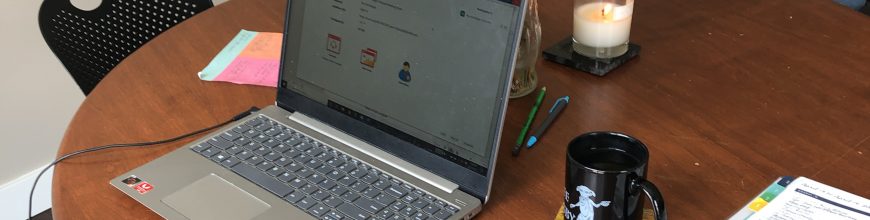
I normally like to make weekly videos for my [this course] students, but here we are, almost halfway into the course, and I haven’t shared one since my introductory video. I won’t be making one this week because my husband and I are on vacation at a family cabin in the woods of western Maryland. There’s no Wi-Fi here, and while my iPhone hotspot worked well enough for me to grade your Module 2 assignments this afternoon, I don’t think I’m going to try uploading a video. So you can picture me sitting at the table in our outdoor kitchen area, with my husband across the table playing a solo board game and the surrounding tall oak and locust trees sighing in the wind. I’m about to close up my laptop and spend the rest of the afternoon reading a good book.

I’m sharing this with you because I want to remind you that I’m a real person, not just a machine who grades your work, and you are too. Online education is weird because we don’t have a designated time and place in which to do it. We take it with us. Perhaps you’ve written a discussion post on your phone while you were in a waiting room. Perhaps, like me, you’ve fit in a bit of schoolwork while enjoying God’s creation in a beautiful place away from where you normally live.

Of course, this is a blessing and a curse. The other side of the coin of flexibility is the absence of any clear boundaries between our schoolwork and the rest of our lives. That’s not necessarily bad if it means that we’re learning to think biblically and intellectually about everything that crosses our paths. Our scholarly pursuits should affect our lives by shaping how we think. But our scholarly pursuits should not dominate our lives, leaving no room for family, community, or rest. So right now, as you start your graduate career, start thinking about how you will create boundaries–or rhythms, if that makes more sense to you–of work and rest, knowing that your classes constitute only one of your responsibilities and only a small part of who you are in God’s eyes.

If my iPhone hotspot holds up, I’ll pop into the discussions later this week. Thank you both for your thought-provoking responses to the prompts and for carrying on the conversation in this tiny class. If there’s anything I can do for you, please don’t hesitate to ask. I am praying for you!

Sincerely,

Dr. Tess

what my online students can expect from me, part 3: constructive challenge

This is the last post in a series on expectations in online education. You can read the previous post here.

You can expect me to gently challenge your thinking. I struggled with whether to share this one because it sounds more lofty than it actually is. I am not Mr. Keating from Dead Poet’s Society; I don’t spend much time exhorting students to seize the day and question the conventional assumptions on which they’ve based their lives. But I do often find myself writing comments along the lines of “I encourage you to keep an open mind as you research this topic” (to students who already know what their thesis is going to be before they start their research) or “Maybe challenge yourself by writing in a genre you’re not used to writing in” or simply (to students who make a confident assertion without proof) “I am not sure this is true.” Sometimes it’s hard for me to challenge students’ thinking because I want them to like me, and I’m afraid that if I appear to disagree with them, they won’t listen to anything I have to say. But most of the time, if I receive feedback from students who have gotten these kinds of comments from me, they are appreciative.

“Critical thinking” is one of those things we all know we’re supposed to integrate into our teaching, but I would venture to say that many of us don’t have a clear idea of what this would actually look like in our own disciplines. I don’t think teaching students to think critically means we have to wield like weapons the Latin names of all the classical logical fallacies. Maybe it just means asking good questions and encouraging students to think about why they’re making the choices they’re making. And sometimes, I find out that what I thought was an error was actually a deliberate choice on a student’s part, and I was the one misunderstanding their meaning. So this is an expectation that can work both ways!

what my online students can expect from me, part 2: appropriate grading feedback

This is the latest post in a series about expectations in online education. You can read the previous post here.

You can expect me to give you grading feedback in an amount and kind appropriate to the assignment. I use the word “appropriate” instead of “substantial,” a term greatly emphasized at one of my institutions in relation to grading feedback, because I don’t think all assignments require substantial feedback. For example, when I am grading students’ participation in a peer review discussion, it’s probably enough for me to say, “Thank you for your participation.” When I’m grading a topic proposal, I might record a three-minute video giving the student guidance on narrowing down the topic and starting to look for sources, but I probably won’t launch into a nitpicky critique of their APA format. However, when I’m grading a final/summative paper, I will give feedback on all areas of the assignment–content, organization, research, mechanics, and documentation–and my comments will likely consist of several sentences each. But still, there will be issues I overlook (intentionally or not), because my goal is to give students useful suggestions for improving their writing, not to discourage them by making the paper illegible with overlapping marginal comments on every sentence (the digital equivalent of a paper bled through with a red pen). I know from personal experience how discouraging this can be!

I hasten to admit that I’m not perfect at this. I often worry about whether I’m giving enough grading feedback, whether my comments make sense, and whether I got the tone right. And there are definitely times, usually when I’m on vacation or just really not feeling like grading, when I give a completion grade on an assignment that I probably should have taken the time to carefully assess using the rubric. But I think I largely succeed at my goal of making the overall message of my grading not “Here’s what you did wrong” (though I realize some students will still read it that way) but “Here are some things you can consider doing differently next time.”

what my online students can expect from me, part 1: collegial communication

Last week, I wrote about the top three expectations I have for my online students. Now, I’m going to write a few posts focused on things my students can expect from me. I’m choosing to write these posts exclusively in the first person because I think it’s more difficult to make safe generalizations in this area as compared to the area of my last post. But I’d love to hear from other online faculty members–are your expectations similar?

You can expect me to reply to your communication and not be annoyed about it. First, I want to clarify what this does not mean. It does not mean I’ll reply to your emails, text messages, or voicemails (I do sometimes get those!) immediately. I go to bed pretty early, and I put my phone in sleep mode when I do. Another rather countercultural practice I have, which I believe has done wonders for my mental health, is that I do not receive email notifications on my phone. I sit down to check email, usually on my computer, at designated times when I’m ready to focus on email. So this may mean that, especially on weekends, a student may go 24 hours, or slightly more, without receiving a reply from me. But here’s what this expectation does mean: When I respond to your message, I’m going to read it carefully and give you a substantial answer. (And yes, I may occasionally say, “Go look at p. 24 in the APA guide” or something similar, but I won’t be snarky about it.) I’m not going to be annoyed at you because, as I explained in my post last week, email and other personal communication forums are where I do some of my best work. In fact, right now I have a student who’s been sending me some fairly lengthy emails a couple times a week–sometimes to ask questions, other times to say she appreciated something I said in a video, etc.–but I’m not irritated at her, because our email exchange is allowing us to build a collegial relationship. Also, it helps that when she doesn’t expect a reply to one of her messages, she will actually say that in the subject line.

I’m always baffled when students are profusely grateful that I responded to their emails, when to me this seems like a bare minimum expectation. Apparently, some professors aren’t doing this, or they’re giving their students the impression they’d rather not. I’m thankful for this simple practice that allows me to tailor my instruction to individual students, build relationships, and get good course evaluations in the process. 😉

    What online instructors want from their students

    I’ve been thinking a lot lately about the misconceptions–or complete mystification–some online students have about what their professors are looking for. In an asynchronous online class, there’s no regular meeting time when students can ask questions and professors can pointedly emphasize certain desired behaviors. I don’t want my students to have to guess what my expectations are for them–nobody likes that game. While every instructor will have expectations specific to each of their courses, there are some that, at least in my opinion, transcend contexts. In this post, I’m going to list and briefly explain several of these close-to-universal expectations.

    1. We want you to write like a real person, not a robot. I’ve been saying this for years, but the recent revolution in accessible generative AI tools has made this advice particularly urgent and very literal! An essay written by ChatGPT and an essay written by a student in a stilted, impersonal academic-ese, while ethically different, are both really boring to read. I want to get to know you through your writing, especially in an online class where writing is about the only thing we have to build a relationship on. Let your own voice come through!
    2. We want you to communicate with us. Often, students who email me will preface their message by saying something like “I’m so sorry to bother you.” I always reassure these students that answering their questions is what I’m paid to do and that my best teaching often happens through email. Again, since you’re not sitting in a classroom with me, I don’t have that weekly or daily time to check that you’re understanding the material and doing okay in life in general. If you’re turning in assignments, at least I know you’re alive, but I’ve found that the students who do best in online classes are those who communicate with me outside of assignments–asking questions, running ideas by me, letting me know what you think of the course materials, etc. And this might go without saying, but if you’re not turning in assignments and you’re not emailing me, then I have no choice but to assume that you’ve fallen off the face of the earth! I would much rather receive an email explaining that it’s been a hard week and asking for an extension than receive no communication at all. Talk to me!
    3. We want you to read our feedback. This one may sound like a pet peeve rant (“I spent all that time writing feedback and they didn’t even read what I wrote!”), but there’s more to it than that. I guess I can’t speak for all instructors here, but I try to grade with the goal of helping my students on future assignments, both in my class and later classes. I don’t make as many grading corrections as I used to (I was trained in the bleeding red pen school), but the comments I do leave are substantial and, I sincerely hope, constructive. If you don’t read my feedback, you’re missing out on a big part of what you’re paying for in my class. If an assignment has a rubric (and I think rubrics are used pretty much across the board in online education today), find out how to open and read the filled-out rubric–otherwise, you don’t know why you lost the points you did, and you’re left to assume the professor just doesn’t like you. I can’t promise that I like all my students (that’s a different topic for a different post!), but I never deduct points just because–the rubric always makes it clear!

    I’ll stop there for now, because those are by far the three biggest expectations I have for my online students. Of course, students also have a right to know what they can expect from their professors, so look for a future post on that!

    revisiting the idea of home as a co-working space

    Since I’m sharing our home today with three dogs (we’re dog-sitting for my in-laws), my husband (who is doing an all-day virtual professional development training in his home office), and our friend who just moved here and is staying with us until her apartment is ready, I thought I’d share a post from nearly four years ago about home as a co-working space. Though things have changed (Jordan is back at his worksite most days; I have a permanent workspace in the corner of our living room; we regularly get a wide variety of birds at our feeder, and I’m learning their names pretty well), I think the ideas explored in this post are still worth considering.