world’s quickest interview, with Penelope Clearwater

Anonymous Interviewer: So, Penelope, are you ever going to post on your blog again?

Penelope Clearwater: Yes.

AI: Ok, good.  Like, when you watch another good movie, or…?

PC: When I finish my dissertation.

AI: Oh!  And how much of that do you still need to write?

PC: In the body proper, about 17 pages.

AI: Cool!  I’ll let you get back to that.


Penelope Clearwater will return in An Epic Celebration.


Things you need to know before watching War Horse

Over the past month or so I’ve watched several long movies. (I consider a long movie to be about 2 1/2 hours. Anything longer than that is a Peter Jackson movie.) These require a major time commitment, so I’ve been rating them on a scale according to how good of a return on my investment I feel I’ve received. They’ve ranged from “OMG I need to call somebody right now and talk about this and then watch it again as soon as possible!” (Prisoners) to “I could have done something much better with those 2 1/2 hours (or with those actors, actually)” (Cloud Atlas).  Gone Baby Gone fell somewhere in the middle.  It was very good, but it didn’t quite suck me in the way Prisoners did, which is probably a good thing for my mental health.

This past week I watched a long movie that I gradually came to realize was really good.  I think I would have realized this about War Horse (2011) earlier (like, before I was over halfway into the movie) if someone had told me what to expect.  So I’m going to tell you some things you need to know about War Horse, and then you should watch it and tell me what you think.

1. The two main characters of this movie are in the title: the war (World War One, or the Great War) and the horse (Joey, a beautiful thoroughbred that even I, by no means a horse connoisseur, could appreciate).  Beyond these two, there is little character development, although you do get to know the central lad (I call him this because he’s somewhere between a boy and a man) and his parents fairly well.  Do not allow yourself to get attached to the other characters.  People die in wars.  And in this movie, even if they don’t die, the flow of the story will steal them away from you.  (See #2 below.)  

Another way of putting this: Don’t watch the movie for the actors.  Benedict Cumberbatch fans, he makes one big speech, gets berated by a German officer, and then is outta here.  David Thewlis fans, don’t expect Remus Lupin.  In this movie, he’s mean and sarcastic and wears ugly tweed suits.  This is not any particular person’s movie, except maybe Steven Spielberg’s.  It’s very telling that there are no opening credits.

 photo-cheval-de-guerre-war-horse-war-horse-424287259

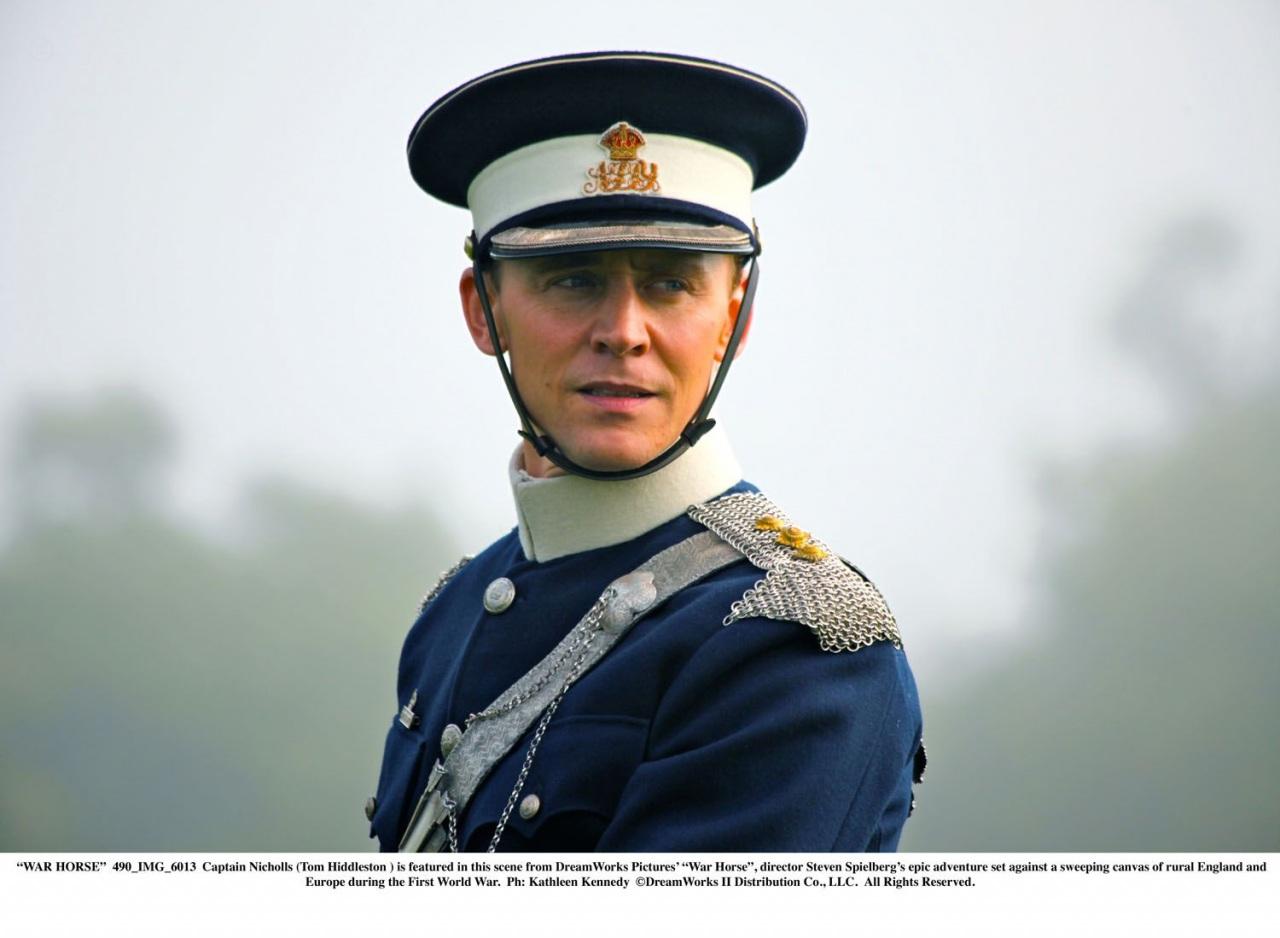
Don’t get attached to Tom Hiddleston’s beautiful face.  You won’t be seeing it for long.

2. This movie is episodic.  It does have one overarching plot (Will there be a reunion between the horse and his boy?), but within that it’s composed of short vignettes tied together by Joey.  This is really cool because you get to see the war from a variety of perspectives, but it is jarring if you’re not expecting it, since we’re so little used to narratives told this way today.  Now that I look back on the movie, I think the episodic nature helped me to enjoy it, because it made the movie feel shorter than 2 1/2 hours.  Be warned, though: the first half-hour, before the war and the vignette-hopping start, is a little boring.  BUT see #4 below.

3. There is very little fanfare in this movie, and I think that’s healthy in a war picture.  This is especially the case with the dialogue.  There is exactly one inspiring speech, and its function is to show you that inspiring speeches (like drawn-sword cavalry charges) have no place in modern warfare.  The dialogue in general is very simple, almost to the point of banality.  But that’s how real people talk, so I much preferred this to the cheesy, overblown banter and speech-making that you often get in war movies.  Just don’t expect to be trading War Horse quotes with your friends after you watch this.  It’s not a quotable movie.

4. Although I said that the first half-hour is a little boring, I must qualify this by saying that the Devon (England) countryside is a feast for the eyes: green pastures, blue skies, gray stone cottages.  But it feels real.  (There’s a lot of brown mud too.)  Also, the very last scene of the movie has this spectacular orange sunset that throws the human figures into these breathtaking silhouettes.  Seriously, even if you hate the whole movie (but you won’t), you have to keep watching for this scene.  And while we’re on the subject of beauty, the score, always an important factor for me, is John Williams doing his best Ralph Vaughan Williams impression–which is not a dig at John.  I just mean that nobody will ever be Ralph Vaughan Williams again, but this score, with its strong English folk song influences, comes respectably close.

Ok, I think you’re now prepared to watch War Horse.  If you do, please comment below and tell me what you think!


Sometimes humility must come through humiliation

Luke 15:17-24 But when [the younger son] come to himself, he said, “How many of my father’s hired servants have bread enough and to spare, and I perish with hunger!  I will arise and go to my father, and will say to him, ‘Father, I have sinned against heaven and before you, and I am no longer worthy to be called your son.  Make me like one of your hired servants.'”  And he arose and came to his father. But when he was still a great way off, his father saw him and had compassion, and ran and fell on his neck and kissed him.  And the son said to him, “Father, I have sinned against haven and in your sight, and am no longer worthy to be called your son.”  But the father said to his servants, “Bring out the best robe and put it on him, and put a ring on his hand and sandals on his feet.  And bring the fatted calf here and kill it, and let us eat and be merry; for this my son was dead and is alive again; he was lost and is found.”  And they began to be merry.

The Voyage of the Dawn Treader, C. S. Lewis, chapter 7 (Eustace’s story about turning from a dragon back into a boy)*: “Then the lion said” – but I don’t know if it spoke – “You will have to let me undress you.” I was afraid of his claws, I can tell you, but I was pretty nearly desperate now. So I just lay flat down on my back to let him do it.

“The very first tear he made was so deep that I thought it had gone right into my heart. And when he began pulling the skin off, it hurt worse than anything I’ve ever felt. The only thing that made me able to bear it was just the pleasure of feeling the stuff peel off. You know – if you’ve ever picked the scab off a sore place. It hurts like billy-oh but it is such fun to see it coming away.”

“I know exactly what you mean,” said Edmund.

“Well, he peeled the beastly stuff right off – just as I thought I’d done it myself the other three times, only they hadn’t hurt – and there it was lying on the grass: only ever so much thicker, and darker, and more knobbly-looking than the others had been. And there was I as smooth and soft as a peeled switch and smaller than I had been. Then he caught hold of me – I didn’t like that much for I was very tender underneath now that I’d no skin on – and threw me into the water. It smarted like anything but only for a moment. After that it became perfectly delicious and as soon as I started swimming and splashing I found that all the pain had gone from my arm. And then I saw why. I’d turned into a boy again. You’d think me simply phoney if I told you how I felt about my own arms. I know they’ve no muscle and are pretty mouldy compared with Caspian’s, but I was so glad to see them.

“After a bit the lion took me out and dressed me – ”

“Dressed you. With his paws?”

“Well, I don’t exactly remember that bit. But he did somehow or other: in new clothes – the same I’ve got on now, as a matter of fact. And then suddenly I was back here. Which is what makes me think it must have been a dream.”

“No. It wasn’t a dream,” said Edmund.

“Why not?”

“Well, there are the clothes, for one thing. And you have been – well, un-dragoned, for another.”

“What do you think it was, then?” asked Eustace.

“I think you’ve seen Aslan,” said Edmund.

“Aslan!” said Eustace. “I’ve heard that name mentioned several times since we joined the Dawn Treader. And I felt – I don’t know what – I hated it. But I was hating everything then. And by the way, I’d like to apologize. I’m afraid I’ve been pretty beastly.”

“That’s all right,” said Edmund. “Between ourselves, you haven’t been as bad as I was on my first trip to Narnia. You were only an ass, but I was a traitor.”

“Well, don’t tell me about it, then,” said Eustace. “But who is Aslan? Do you know him?”

“Well – he knows me,” said Edmund. “He is the great Lion, the son of the Emperor-beyond-the-Sea, who saved me and saved Narnia. We’ve all seen him. Lucy sees him most often. And it may be Aslan’s country we are sailing to.”

Harry Potter and the Deathly Hallows, J. K. Rowling, chapter 30 There was a scuffling and a great thump: Someone else had clambered out of the tunnel, overbalanced slightly, and fallen.  He pulled himself up on the nearest chair, looked around through lopsided horn-rimmed classes, and said, “Am I too late?  Has it started?  I only just found out, so I–I–”

Percy spluttered into silence.  Evidently he had not expected to run into most of his family.  There was a long moment of astonishment, broken by Fleur turning to Lupin and saying, in a wildly transparent attempt to break the tension, “So–‘ow eez leetle Teddy?”

Lupin blinked at her, startled.  The silence between the Weasleys seemed to be solidifying, like ice.

“I–oh yes–he’s fine!” Lupin said loudly.  “Yes, Tonks is with him–at her mother’s–”

Percy and the other Weasleys were still staring at one another, frozen.

“Here, I’ve got a picture!” Lupin shouted, pulling a photograph from inside his jacket and showing it to Fleur and Harry . . .

“I was a fool!” Percy roared, so loudly that Lupin nearly dropped his photograph.  “I was an idiot, I was a pompous part, I was a– a–”

“Ministry-loving, family-disowning, power-hungry moron,” said Fred.

Percy swallowed.

“Yes, I was!”

“Well, you can’t say fairer than that,” said Fred, holding out his hand to Percy.

Mrs. Weasley burst into tears.  She ran forward, pushed Fred aside, and pulled Percy into a strangling hug, while he patted her on the back, his eyes on his father.

“I’m sorry, Dad,” Percy said.

Mr. Weasley blinked rather rapidly, then he too hurried to hug his son.


*The selection I really would have liked to include here is a passage from The Lion, the Witch, and the Wardrobe that doesn’t actually exist: the talk that Aslan has with Edmund after rescuing him from the White Witch.  That talk takes place off-stage, and afterward Aslan simply says to the other children, “Here is your brother . . . and – there is no need to talk to him about what is past.”  The passage I’ve posted here isn’t quite what I wanted, but I thought of it because my sister posted a link on Facebook to a song by the Oh Hellos called “The Lament of Eustace Scrubb.”  And I do like this passage, because it features both of Narnia’s repentant sinners comparing notes about Aslan.

Disney memories

Last night while trying to fall asleep, I chose my five favorite animated Disney movies (not counting Pixar) and figured out why I like them so much.  They can be categorized into two I loved when I was a kid (1 and 2), one I liked as a very small child and later rediscovered for different reasons (3), and two that are my favorites now and probably always will be (4 and 5).

1. Sleeping Beauty.  I think it’s accurate to say that this movie inspired my first experiences with cosplay.  As a little girl I used to put on a blue dress and pretend to be–no, not Princess Aurora, but Merryweather, the chubby fairy who doesn’t speak but always seems to be indignant about something she can’t articulate.  I was an odd little girl.  I haven’t seen the movie in years, but I still think it’s beautiful and effectively scary.  Am I excited about the Maleficent movie coming out next week?  Not really, though I’ll probably go see it.  I have a hard time with Angelina Jolie.

Merryweather

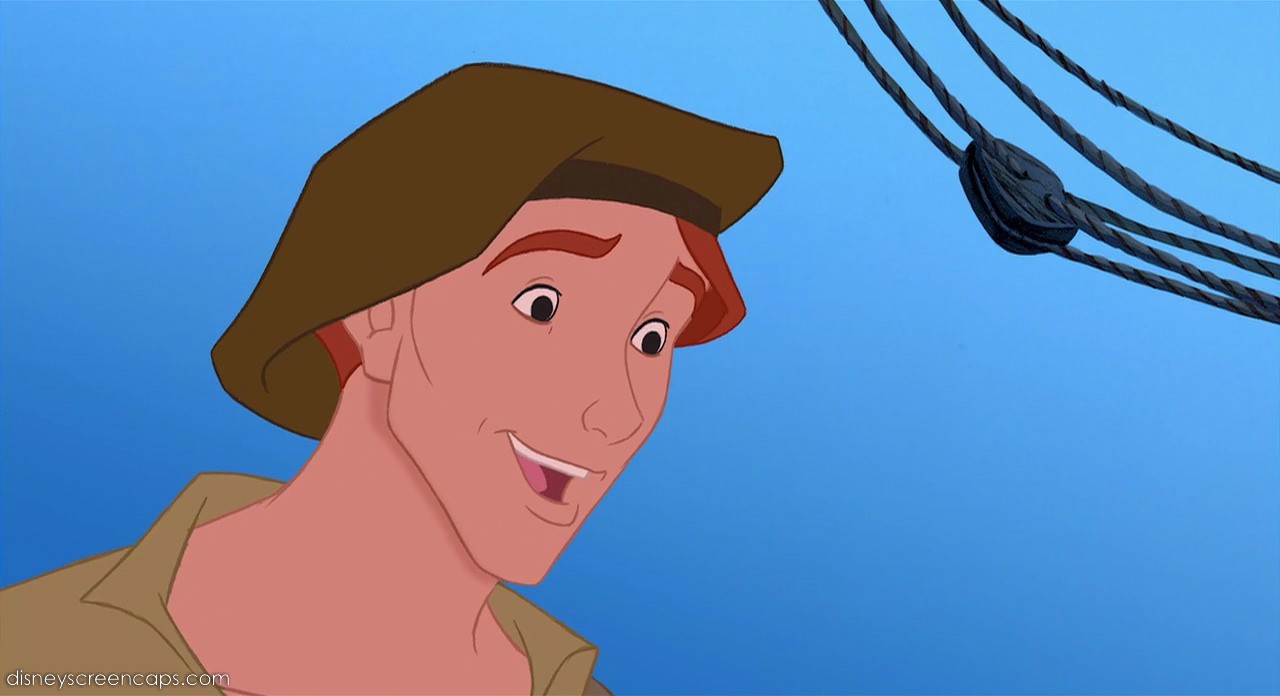
2. Pocahontas.  This movie came out when I was 11, and I was really into it.  I had a lot of Pocahontas merch–I remember a nightshirt, when nightshirts were a big thing, and a necklace that I took apart so that I could string the beads onto other necklaces.  I was an odd tween.  I knew all the lyrics to “Colors of the Wind,” and of course I still do, because you don’t forget songs you learn in childhood (which is why I still know the lyrics to most of The Eagles’ greatest hits–another story).  Pocahontas also gave me my first crush, at least the first I remember.  And no, it wasn’t on John Smith, but on Thomas, the naive and timid redheaded sailor (voiced by Christian Bale) who accidentally shoots Pocahontas’s boyfriend Kocoum.  Some things don’t change.  Again, I still think this is a beautiful movie.  I know people complain about the historiography, but it was never intended as a documentary.

Image

Thomas

3. Bambi.  As a child, I had a Bambi stuffed animal, and I liked Thumper (I remember quoting, “If you can’t say somethin’ nice, don’t say nothin’ at all,” still good advice for most contexts) and Flower, the really cute androgynous skunk.  Then I guess I got “too old” for Bambi and kind of forgot about the movie until one family trip to Disney World; I believe it was the one shortly after I graduated from college.  We were at Disney Studios watching one of those compilation films about the magic of animation or whatever, and suddenly the frantic pace of the clips slowed down and they showed that scene in which Bambi steps out into the clearing and asks, “Mother?” and the stag–Bambi’s father, though Bambi doesn’t know it–approaches and says, “Your mother won’t be with you anymore, Bambi.”  Standing in a room full of tourists, I started weeping.  It was embarrassing, but cathartic.  I still think that’s a brilliant scene–no music for emotional manipulation, just the stark colors of the deer against the snow and that spare, heartbreaking dialogue.  (Ok, I’m tearing up while writing this.)  Bambi is like that in general–a very simple story, no flashy songs and a small cast of (non-wisecracking) characters.  The animation is beautiful.  I am not ashamed to say that I own a Bambi t-shirt.

4. Beauty and the Beast.  I liked this movie when I was a kid, but didn’t truly appreciate it until I grew up.  I’ve always identified with Belle because she likes to read, but now I see that there’s much more to her.  She’s a lot like Jane Eyre in that she has just the right combination of strong will and empathy to be able to transformatively love a selfish and deeply wounded man while still retaining her own identity and protecting herself emotionally.  This, too, is a beautiful movie.  Of course the songs are great, but so is the score.  The settings are so atmospheric: the gloomy castle perfectly matches the Beast’s mood, and the forest outside it is truly desolate.  And I love the way the prologue uses animated “stained glass” to tell the Beast’s back-story.

5. Peter Pan.  This is one of my favorite stories, period.  (It’s Victorian, and it’s magic.  Therefore, I love it.)  The Disney movie isn’t a perfect adaptation, but there’s no such thing.  Certain things about it are perfect, at least to me, like the iconic image of the children flying over the nighttime silhouette of London, something no previous adaptation was able to capture and no subsequent one has attempted to try.  The songs are very good, especially “You Can Fly.”  I also love the way the musical sequences add to the character development in subtle ways.  (For example, the song “Following the Leader” seems like nothing more than a fun romp, but it illustrates the idea, which is barely latent in the J.M. Barrie story but makes perfect sense, that John Darling would see Peter Pan as a rival.)  I know most people think of Tinkerbell when they think of this movie, but I could take her or leave her.  For me, it’s about Peter, who is one of my favorite trickster figures, and the Darling children, who react to being essentially abducted from their home in fascinatingly different ways.  I also like the Lost Boys.  And the Peter Pan ride at Magic Kingdom is wonderful.  Yes, it’s a really short ride with a really long line, but it’s totally worth it.

Second star to the right and straight on ’til morning!

The Author Who Loved

The title of this post is a pun on “The Author Who Lived,” the title of the doctoral dissertation I’m working right now, which in turn is a pun on Harry Potter’s famous nickname “The Boy Who Lived.”  (My dissertation is about Charles Dickens’s and J. K. Rowling’s unusual relationships with their audiences; you can read a piece of the proposal here.)  All I want to do right now is to share with you a quote I was delighted to come across in my Dickens research.  It was written late in Dickens’s career/life by the respected critic Charles Eliot Norton.  The first sentence could be interpreted as a snide back-handed compliment, but keep reading; it isn’t.  I know there are writers who would disagree with me, but I think Norton in this statement gives Dickens the greatest praise anyone could give a writer.  And perhaps the second-to-last sentence will remind you of someone else.

No one thinks first of Mr Dickens as a writer.  He is at once, through his books, a friend.  He belongs among the intimates of every pleasant-tempered and large-hearted person.  He is not so much the guest as the inmate of our homes.  He keeps holidays with us, he helps us to celebrate Christmas with heartier cheer, he shares at every New Year in our good wishes: for, indeed, it is not in his purely literary character that he has done most for us, it is as a man of the largest humanity, who has simply used literature as the means by which to bring himself into relation with his fellow-men, and to inspire them with something of his own sweetness, kindness, charity, and good-will.  He is the great magician of our time.  His wand is a book, but his power is in his own heart.  It is a rare piece of good fortune for us that we are the contemporaries of this benevolent genius.

My belated Oscar wrap-up

It’s been nearly two months since the Academy Awards aired, but I’ve been mentally reliving the event a bit recently, not only because I’ve finally gotten around to watching several of the Best Picture nominees, but also because I read a brief “news” article yesterday in which Jared Leto said that his Oscar statue is all sticky and gross because his apparently grubby friends have been playing with it. And these are the people we admire and aspire to be like. Anyway, in place of a traditional recap, which would be pointless by now, here is a stream-of-consciousness presentation of some of my thoughts during and after the ceremony.

As I look into Jared Leto’s beautiful yet strangely vacant eyes, I wonder if he’s shown up to the Academy Awards as stoned as the character he won his Oscar for portraying (a person called Rayon, frequently stoned, and appearing for much of Dallas Buyer’s Club in a covetably comfy-looking pink cable-knit bathrobe).  But no, surely not, since he’s accompanied by his mom.  And his acceptance speech is lucid–not brilliant, but lucid, a high compliment indeed on this night.  I mean, the literal kind of “high.”

Thinking about Best Supporting Actor nominees accompanied by their moms turns my thoughts toward Jonah Hill, and I think to myself that someday he is going to be a real contender for this category and not just a person that the presenters make gratuitous comments toward because they feel charitable toward him because he is less sexy than they are.  And he is going to win, and he is going to throw his Oscar in their stupid condescending faces.

Then I wonder why I am throwing so much imaginative energy into my Jonah Hill revenge fantasy, and I realize that it’s because I’m bored, because essentially none of my favorite actors are here.  This has a lot to do with the fact that most of my favorite actors are British and obviously couldn’t make the long trip to Los Angeles.  Or, more likely, they weren’t invited.  If you are an actor from the UK and you want to be made much of at the Oscars, you have to either 1) be Colin Firth, although even that doesn’t work every year, 2) be old enough to be an institution, or just not dye your hair, so that people think you’re old (that’s you, Helen Mirren), 3) always play Americans, like Christian Bale or last year’s Best Actor Daniel Day-Lewis, or 4) find your way into a small role in pretty much all of the Best Picture nominees, like Benedict Cumberbatch did this year (okay, I think he was in two of them).

*Long mental digression while I calculate the odds of Martin Freeman ever being an Oscar nominee*

My guests are gasping, and I gradually realize it’s because they think Ellen Degeneres is being “mean.”  And I’m thinking, did you ever see Ricky Gervais host the Golden Globes?  This is like Mr. Rogers’ Neighborhood in comparison.

Which brings me to the pizza interlude.  There is a lot of debate about how spontaneous, hence “authentic,” this actually was, but that’s not the question that captivates me.  My question is: Do these people actually eat pizza?  On paper plates, no less?  The possibility boggles the mind.  One of the actors we saw ostensibly preparing to eat pizza was Brad Pitt.  It’s true that Brad Pitt is seen constantly eating food in many of his movies (e.g., Meet Joe Black, in which he develops an obsession with peanut butter), but I guess I just assumed he spit it out after the take.  Did Angelina make him spit his pizza out during the commercial break?

These, thank goodness, are not questions that keep me up at night.  However, this is: What in the world was Matthew McConaughey talking about?


a cousin story

On a roll, I wrote another scene for the piece I mentioned in my last post.  I’m calling the overall piece Cousin PercyAfter reading this scene, you will have met all the cousins except for Peter, the one who’s still in college.  I intend for quiet, self-effacing Peter to be the one who unexpectedly breaks through to the frustratingly uncommunicative Percy, but I haven’t quite developed that idea yet.  In this scene, you’ll see just how frustratingly uncommunicative Percy is.  You need to know that Percy doesn’t yet know that Harry was once married and has a rather sad back story.  He thinks he’s got Harry all figured out.  This scene is shorter and, I think, funnier than the last one I posted, but you should still be able to feel the underlying tension.  By the way, I promise that my next post will be on another topic.

Three nights before Christmas, Harry Sinclair sat in a dim, deeply-recessed booth in the corner of the pub nearest the door, nursing a bottle of cream soda and watching the acoustic band intently.  During a particularly loud moment in one of the American folk songs the band was valiantly plowing through, his cousin Percy, whom Harry had known for exactly four days, approached the booth, carrying a pint and wearing the leather jacket that, Harry had already decided, made him look like a Liverpool dockworker circa 1959.

“This is the only empty seat in the place,” said Percy by way of explanation.

“Well, sit down!” said Harry in an unnecessarily expansive voice that sounded, to both men, a bit false.  “What brings you here on this cold evening?”

“Why does anybody come to a pub?” Percy replied flatly as he sat.  “Having an ale.  What are you doing here?”

“Why does anybody come to a pub?”  Harry paused before continuing, “I’m spying on my employee.”

Percy grunted into his pint, possibly indicating interest.

Harry took the indication and ran with it.  “He’s the one on the stool at the front of the band, playing the guitar.”

“The fat kid?”

Harry rolled his eyes.  “Totally unnecessary, but yes.  He’s the portly chap who’s singing right now.  That’s Sam.  He helps me out at the shop.”  Harry made a slight confidential lean toward his cousin; Percy made no response of any kind.  “So I’ll say to him at the end of the day, ‘What are you doing tonight, Sam?’  Just making conversation.  And he’ll always say something like, ‘Oh, I guess I’ll just go home and watch TV.'”  Harry said this in an exaggeratedly glum voice.  “Only he’s a Scotsman, but I can’t do his accent right.”

Percy cleared his throat, which Harry took as another sign of engagement.  “So the other night, I’m leaving the shop, and I see him sneaking in here with a guitar case like he’s about to do a drug deal.  So I said to myself, I can be sneaky too, and the past few nights I’ve been hiding in this booth, thinking, hey, this kid has got some talent.  But the next day, not a word about it from either of us.  So tell me, why do you think he’s trying to hide this from me?”

Percy took a swig of ale and said nothing.  Harry sighed.  “Did you hear anything I just said?”

The cousins stared at the band for a few minutes before Percy looked down and asked, incredulously, “What are you, having a cream soda?”

“Yes, I’m having a cream soda,” Harry replied, glad his cousin was making an effort at conversation.

“Don’t you drink, or what?”

“No, I don’t drink anymore.”

“What were you, a wino or something?”

“I wasn’t a wino,” Harry retorted, beginning to think the uncomfortable silence was preferable.  “I just don’t like myself when I drink.  I’m sarcastic–and obnoxious.”

Percy snorted.  “Only when you drink.”

Harry turned in his seat, trying to force his cousin to make eye contact.  “Well, I think that’s a pretty rude thing to say considering you hardly know me.”

“Oh, I know you,” Percy said into his glass, not looking at Harry.

Harry clenched his hands under the table, determined to remain civil.  “Well, I’m afraid I can’t say the same about you.  Why don’t you ever tell us anything about yourself?  We’re family and all.”

Percy shrugged.  “There’s nothing to tell.”

Harry gave a short, humorless laugh.  “I know you know that I know that that’s bullshit.”

Percy made no sign that this assessment fazed him.  The cousins lapsed back into silence.  The band was playing a twangy song about Raleigh, North Carolina.  Harry tried again.  “I don’t get the fascination these lads have with playing all this American local color stuff.  I mean, half the people in this town have never been more than two hours away.  What do they know about Raleigh?”

“How do you know where they’ve been?” Percy asked, still looking straight ahead.

Harry shrugged.  “I fix their cars; they talk to me.”

The band had moved on to a plaintive song about the Blue Ridge Mountains.  “Have you ever been to the States?” Harry asked.

“Yeah.  Lived there for a while.”

“Oh!” exclaimed Harry, pleasantly taken aback by this rush of self-disclosure.  “Where did you live, exactly?”

“New York City.”  Percy was not equally excited by the conversation.

“Ah, indeed,” said Harry, like someone who knew.  “Where else?”

Percy paused in lifting his pint and gave his cousin a sidelong glance.  “What’s that supposed to mean?”

Harry didn’t actually know what he had meant.  “I just thought…New York City was a sort of melting pot,” he replied lamely.

Percy sniffed–laughed, possibly–and finished taking that drink.

“So, was it a nice place to live?” Harry asked, determined to press on.

“No.”

Harry nodded, hoping for but not really expecting more.  “And…are you going to tell me about it?”

“No.”  Percy put his empty glass down hard on the table and slid out of the the booth.

“I didn’t think so,” said Harry to his cream soda.


another brother story

You guys know I like stories about brothers, right? Well, today I wrote down a story that’s been living in my head for a while, and the characters are two brothers. This is a portion of a much longer piece I’d like to write someday–I think it would be best as a screenplay–about a tough drifter type, with the unfortunate name Percy, who has to spend Christmas with his tight-knit family (aunts, uncles, and four male 20-to-30-something cousins) in a small town in England. The portion I’m sharing with you today is from early in the narrative, before anyone knows there’s a long-lost cousin. It introduces the characters and lets you know what Percy will be getting into when he comes on the scene. I apologize in advance–this post will be longer than my usual.

“Before you say anything, I’m not William Wallace; I’m a Pict,” announced John Sinclair as the kitchen screen door slammed behind him.

His brother Brian looked up from the fortress of bar exam prep guides that had once been their parents’ kitchen table.  Blue paint covered John’s freckles, and a kilt covered not very much of his legs, which were slightly purple from the cold outside.  “I didn’t think the Picts wore natty white button-ups,” Brian smirked.

“It would have been more accurate to go shirtless,” John conceded, plunking down a stack of essays onto the counter.  “But that would have been totally inappropriate.”

“I don’t think your 15-year-old girl fan club would agree,” Brian retorted, flashing a rare trickster smile before returning his gaze to a tightly-scrawled sheet of notes.

“You’re mental,” said John, getting a Coke out of the refrigerator.  “Say, that reminds me.  You were locked in your room–”

“–the spare room.”

“Well, yeah, same thing; it’s your old room, isn’t it?”  John looked at his brother quizzically, but Brian was fixed on his notes.  “Anyway, you were up there last night when I told Mum and Dad about my date.  I mean, there’s not much to tell, but you’re always interested in my romantic exploits.”  John concluded with a rueful laugh that clearly indicated that the last term was hyperbolic.

Brian looked up.  “I’m always interested in you acknowledging the existence of anyone who isn’t a blood relative or a student.  Tell me more.”

John pulled out a chair and sat down at the fortress.  “Well, we had a coffee, and she told me about working in London, and about this blog she just started, and I told her…” he paused, trying to remember the conversation, “…about how my students loved it when I came to class in a toga…”

“Bet she thought that was sexy.”

“Actually, I think it weirded her out a bit.”  Brian snorted; John didn’t seem to notice.  He was searching his memory.  “Then I told her about how you were home for the holidays, and how you’re almost a barrister…and I told her about how Peter’s coming home for the holidays, and how he’s writing his thesis on Dickens…and I told her about how Harry’s auto shop has a name from Shakespeare.  People find that interesting, don’t you think?”

Brian sighed.  “What I think is that this girl, woman, whatever she is–doesn’t give a flying fig about your brother and your cousins.  I think I know where this story is going.  Go on.”

John shrugged.  “That’s about all.  We finished our coffee, and she said I was really nice.  That’s it.”

“Yeah, that’s right, John.  You’re really, really nice.”  Brian shook his head and returned to his notes.

“But what does that mean?”  A twinge of desperation made John’s voice crack slightly, and he leaned across the table toward his brother, knocking a book off its stack.  “You say that word like she said it, like it’s some sort of code word.  What horrible thing does ‘nice’ mean?”

Brian rubbed his forehead like it hurt.  “You’re very intelligent, and you look like Eddie Redmayne.  That’s why women go out with you.  But you’re kind of like a child.  That’s why they only go out with you once.”

“You obviously know so much about this,” said John in a voice so toneless that Brian couldn’t tell whether he was being sarcastic.  John was rarely sarcastic.  So Brian asked, “What’s that supposed to mean?”

John looked at the ceiling.  “It means…remember when Aunt Susie said you looked like Andrew Garfield?”

“Yeah, so?  She’s weird.”

“She was right!  Any woman would go out with you.  And yet I don’t see you in any long-term relationship.”

Brian gestured at the stacks of books surrounding him.  “I’ve been a little busy, haven’t I?  Anyway, you don’t know what I do when I’m not here.”

“Probably the same thing you do when you’re here, huddle up with your books like some kind of Gothic mad scientist.”  John took a swig of his Coke, and Brian went back to his notes.  There was a long silence.

“Oh, speaking of Aunt Susie!” John said suddenly.  Brian jumped in his chair.  “You know we’re all going over there this evening, because Peter’s coming home?”  The desperation had gone as quickly as it had come; John looked like an unusually cheerful Pict.

“I don’t think I’m going; I need to study,” Brian said, not looking up.

“Oh, come on.  You’ve been studying all day.  Don’t you want to see Peter?”

“I’ll have plenty of chances to see him between now and the new year.  But listen,” Brian pointed his pencil at his brother and gave him a significant look, “lay off Peter about moving back here, will you?”

“What do you mean?”

“You know exactly what I mean.  It’s not just you; it’s everybody.  Every time Peter’s here, you lot are on him about what he’s going to do after graduating.  If I remember correctly, last time you practically had him a job lined up at your school.”

“Oh, that’s nothing,” John said.

Brian shook his head and looked back down at his notes.  “Well, I hope it’s nothing to Peter, too.  Just remember he’s a grown man and he can live wherever he bloody well wants to.”

John put his Coke can down slowly and looked at the top of Brian’s head for a few seconds before he said, “Oh, I see.  This isn’t about Peter; this is about you.”

Brian sighed and put his face in his hands.  “Okay, yeah.  This is about me too.  Every time I come here I feel like I’m being smothered.”

“Then why do you come here?” It was hard to tell whether this was a challenge or a sincere question.

“Because it’s Christmas, for heaven’s sake, and I’m not some sort of monster with no familial affection.  I like you, and Mum and Dad, and…everybody, most of the time.  It’s just this town.  It feels like some sort of evil magnetic force sucking everybody back into its vortex of mediocrity.”

“A little dramatic, don’t you think?” John asked with a puzzled laugh.

“Well, look at Harry.  It sucked him in, didn’t it?  In London he was hanging out with real, live literary critics.  The man was brilliant.  I mean, he still is brilliant.  But here he is, fixing cars at Gad’s Hill Auto Repair.”

“Harry likes fixing cars,” John retorted.  His face was still blue, but his ears were turning red.  “And anyway, he wanted to come back here to be around people he knew.  He didn’t want to be alone in London after–”

“Oh, I know what everybody says,” Brian interrupted.  “Harry moved back here because he got divorced.  Well, you know what I think?  I think that’s part of the reason why he got divorced–because he wanted to move back here with his mum, and his wife had the good sense not to want to come to this depressing dump.”

John glared at his brother.  “Don’t you dare say that to Harry, ever.”

Brian threw up his hands.  “What do you think I am, some sort of prat?  Of course I wouldn’t say that to his face.  But it’s true, and I think you know it.”  Brian was quiet for a moment, writing on his notes.  “And you…well, we already talked about you.”  He relapsed into silence.

John finished his Coke.  Brian scanned his notes.  Neither brother spoke for a long time.  Then John said, “I have to go get this crap off my face.  But I want to say one more thing to you.  I know you think I’m some sort of developmentally arrested sad-sack.  But I like my life.  I’m happy, Brian.  And if you’re happy…well, you’re doing a pretty good job of hiding it.”  John got up and threw his Coke can in the recycling bin.

Brian didn’t look up until John was halfway up the stairs.  “All right, I’ll go to the thing for Peter tonight,” Brian yelled.  “Will that make you happy?”

John stopped on the top step.  “You never listen to anything I say,” he said.  “I told you, I am happy.”  He went into the bathroom and shut the door.


corporate stultification and the strange world of male aggression

What do the movies Fight Club, The Matrix, and Office Space have in common?  Two things, actually: They all came out in 1999, and they all offer possible responses to what many people perceived as the soul-killing materialism of 1990s corporate culture.  I watched Fight Club for the first time tonight, and the other two movies quickly popped into my mind.  They all start out with an easily recognizable Average Guy who is slowly–or quickly–dying on the inside as a result of his meaningless job in a company where everybody wears ugly ties and works in a cubicle.  Then comes the inciting incident, widely differing though it may be in each of these movies, and then a spiraling series of chaotic events that bring into vivid life that Goo Goo Dolls line (written in 1998) that says “you bleed just to know you’re alive.”  In Fight Club, the blood is quite literal, whereas The Matrix is strangely bloodless for an action movie, and in Office Space the violence is displaced onto a copy machine.  (The most violent scene of that movie is also the funniest.)  But they’re all about angry men trying to figure out what they’re angry at.

I used the word “men” deliberately.  Women are mostly peripheral in all three of these films, even though each has a token female “main” character.  They are all three about men admiring, envying, conspiring with, competing with, and beating the crap out of other men…and The Man.  I find it a bit troubling that women seem so extraneous and expendable in these worlds, but then again, I’m not sure if I, as a woman, would want to be part of them.  I’m content to be a fascinated and sometimes repelled onlooker.

Of the three movies, The Matrix is easily my least favorite, not only because, as I mentioned above, the violence is unconvincing (not that I’m a fan of violence for its own sake, but if you’re going to put it in a movie, it should look and feel real), but also because humor is important to me, and The Matrix takes itself way too seriously.  Still, I think you need all three of these films to get a comprehensive picture of how male filmmakers tried to respond to the 90s at the end of the 90s.

Now it’s your turn to chime in: Have I been inaccurate in my recollections of The Matrix or Office Space?  (It’s been about a year since I saw either of them.)  Can you think of any other parallels among the three movies?  Am I missing any movies that could fit into this paradigm?  Let me know what you’re thinking.


My annual Oscar rant

Right on cue, here is my yearly collection of thoughts on the Academy Awards.

  • Gravity is clearly going to win a lot of awards.  One that it seems nearly guaranteed to win is Achievement in Directing for Alfonso Cuarón.  When people like me think of Alfonso Cuarón, we think of his darkly whimsical interpretation of Harry Potter and the Prisoner of Azkaban.  Do you think he could find a way to work an Azkaban shout-out into his acceptance speech?
  • I was excited when I saw that my favorite movie music composer, Thomas Newman, was nominated for his beautiful score to Saving Mr. Banks.  But I was annoyed when I did my predication research this evening and saw that he isn’t even being mentioned as a possibility to win.  All I can say is that the Academy is going to owe Thomas Newman one massive Lifetime Achievement Award segment.
  • I never thought I’d see the day when a movie called Jackass Presents: Bad Grandpa was nominated for an Oscar.  I realize that the category is Achievement in Makeup, and I’m willing to concede that the nominee, Stephen Prouty, did a pretty good job on that guy’s face.  But I’ve vowed never to watch the Oscars again if this movie wins.
  • I have a plan.  The Academy should create some new award categories: Best Actor, Actress, Supporting Actor, and Supporting Actress in a Genre Film.  That way, the people who do excellent acting work in films that aren’t “literary” (to borrow a term from the book publishing world)–e.g., science fiction, fantasy, and superhero movies; romantic comedies; “children’s” movies that aren’t animated–can be honored.  Because, let’s face it, they’re not going to be nominated in the traditional acting categories, except in very unusual cases like those of Johnny Depp in the first Pirates of the Caribbean (and there was no way he was going to win) or Heath Ledger in The Dark Knight–an extremely unusual case indeed, since he did win.  The only potential problem here is that creating such a category could further marginalize these types of movies and prevent genre-transcending films like The Dark Knight from getting the recognition that the Academy was actually prepared to give them.

So I’m curious: Who would you nominate if we had the Acting in Genre Films categories this year?  And what are your two cents, in general, on the 2014 Oscars?  Do share.