I don’t like me when I’m angry.

People don’t believe me when I say this, because I’m usually quite good-natured, but I get a bit violent when I’m angry.  My bursts of anger are quite brief–I don’t hold grudges–but my blood pressure shoots up dramatically, and I tend to react physically (or at least to want to react physically).  In other words, I turn into Little Hulk.  I say “Little” because I am about five foot two or three and not very strong.  That’s why people tend to think it’s funny or cute when I yell or punch a desk or jump on my sister (I did that several times when we were roommates).  I agree that it makes an amusing story, but ultimately it’s not very cute or funny, and here’s why.

1. Someday, I will probably have people in my life who are smaller than I am and whom I could actually hurt–i.e., children.

2. Anger gives me a temporarily useful adrenaline rush (I packed up my entire office in about an hour this morning when I was mad about a dumb thing, which I am now over), but I’m pretty sure it has negative physiological effects in the long term.  See, for example, my comment above about blood pressure.  I think people can also get ulcers from being angry too much.

3. Although, as Jesus demonstrated, righteous anger is…well, righteous, 99.9% of the time my anger has no such just cause.  Usually I’m angry because things aren’t going according to my selfish, carefully-constructed plan.  And that kind of anger has bad spiritual and relational effects on me and everyone around me.

So, although they asked me if I wanted to replace Mark Ruffalo in the next Avengers movie, I turned down the offer in order to preserve my holistic well-being.  Hey, don’t laugh; I think I’d be pretty believable.  It’s all CGI anyway, right?

Mumford and Sons revisited

Three years ago, I wrote one of my most popular posts of all time, a review/listening guide for Mumford and Sons’s first album, Sigh No More.  I always thought I might do something similar for their second album, Babel, but I never got around to it–though I must say that I think it’s a great album.  I disagree with those who considered it a sell-out album; the band was just getting better at writing tight, radio-playable folk-pop songs, a skill that should not be denigrated.  Now that Mumford and Sons is/are about to release their third, stylistically very different album, I’m returning to them on my blog–but not to write about their music.  This time, I want to mention a couple of things I appreciate about the way the band members present themselves physically, which, as I think we all know, can be nearly as important in our day as the music itself.

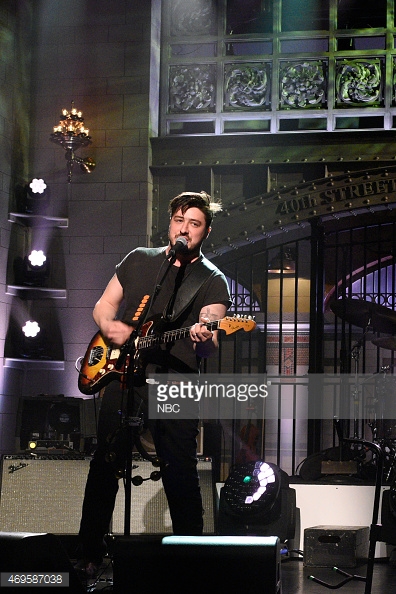
1. Have you seen Winston Marshall’s hair lately?  It’s beautiful.  I realized this as I watched him tossing it around during the band’s frenetically kinetic performance on SNL this past week.  Sometimes long hair, on a man or a woman, can look lank and stringy, but not so on Winston.  I love the fact that he’s just letting his rather thick hair go where it pleases instead of trying to tame it.  That’s usually been my own personal hair styling method as well.  I have a lot of respect for people (particularly for women) who just let their hair be awesome even if it doesn’t look put-together according to the current definition of what put-together hair looks like.  You should not be surprised to know that my hair role model is Helena Bonham Carter.

my hair role model

my hair role model

Nice job, Winston.

Nice job, Winston.

2. While watching the same performance, I was confirmed in my long-held belief that Marcus Mumford is very attractive.  He’s not like my number-one celebrity crush, but I like a lot of things about the way he looks (but please note, Marcus, that the small mustache is not one of them).  I like how, speaking of hair, he has a little piece that insists on sticking up–it’s so Harry Potter.  I also love that he’s not ashamed to contort his face in order to express emotion while singing.  His face looks like it’s going to break, but that’s how he gets that gut-wrenching sound that’s part of what makes this band distinctive.  Probably my favorite thing about Marcus, though, is that he doesn’t look like the heroin waif we typically picture when thinking of a rock ‘n’ roll front man.  Now understand me, he isn’t fat.  But he definitely has a soft belly.  And his face isn’t chiseled or angular or gaunt by any means.  And I would guess the only bicep toning he gets on a regular basis comes from playing the guitar like a maniac.  You can really see this in the SNL performance, in which he’s just wearing a t-shirt (and trousers, too–geez, people), since tweed jackets and vests are no longer part of the Mumford and Sons uniform.  I have a lot of respect for this very noticeable, if not flagrant, disregard for a long-established stereotype.

There’s entirely too much body hatred in our world today, and the music industry often hurts rather than helps.  So it makes me very happy that the members of Mumford and Sons–none of whom exactly look like gods of rock–seem to be totally cool to just, as they put it in the last song on Babel, “be who [they] are.”

Huge props to the pudgy rockstar

Huge props to the pudgy rockstar

two good guys and a real woman

There’s apparently something about April that makes me want to write short stories.  (Check out last April’s creations, another brother story and a cousin story.)  This one is a best friend story, but it also has male protagonists.  For some reason I find it easier to write about men, but sometimes I need actual men to let me know if my characters are acting like men.  So feel free to critique.  I’m also aware that the non-male of my three main characters, Ramona, isn’t as compelling as the other two.  Since they clearly think she’s something special, I need to do a better job of showing why.  And I do know that the legal stuff the characters discuss about copyright and fan fiction is a bit murky.  I need to do more research on that, although this ultimately isn’t a very important part of the story. 

Please enjoy this as-yet untitled piece.  Warning: It is fairly long.

Back in college, they used to get pizza wasted.  This doesn’t mean that they ordered pizza while wasted.  This means that they ate so much pizza, they got stupid.  There was one three-week period when they watched Psycho every night, at least that’s how they remembered it later.  Every night they quoted the same lines.  “You’re going to put me in the fruit cellar.  Think I’m fruity, do you?”  After destroying three large stuffed crust Pizza Hut pizzas, they could barely breathe, far less think.  Adrian was skinny in college, even more than now.  Sam was, as now, bless-his-heart fat.  This made little difference.  They both demolished about a pizza and a half each.

Adrian was not exactly wishing, just now, that he was pizza wasted.  But he was thinking, with a twinge of nostalgia, about what a different setting he and Sam were in on this particular evening.  Instead of a B.O.-funky dorm room, they were in a vast hall with crystal chandeliers, which hurt Adrian’s eyes, and thick, somnolent carpets.  Sam was sitting at the front table, wearing a suit and looking flushed and sweaty but radiantly happy.  Adrian was sitting at one of the indistinguishable round tables with Ramona, who was falling asleep.  He saw that she had her phone in her lap and knew it was set to vibrate, so he texted her, “Wake up!”  Her eyes flew open, and she looked at Adrian sheepishly.  He texted again, “My little flower.  You wilt when there’s no natural light. :)”  She texted back, “Shut up and pay attention!,” but she was smiling.

Adrian looked up at the podium and tried to pay attention.  A middle-aged woman, who clearly didn’t read Sigyn: Intra-Yggdrasil Negotiator, was talking about Sam.  Sam wrote and illustrated comic books for a living.  He routinely referred to this as “the ultimate loser job,” but Adrian called it what it really was: living the dream.  Sam had pulled Sigyn out of a footnote in Norse mythology and turned her into the heroine of his hugely cult-popular series.  A national feminist organization had noticed that Sigyn was a “real” woman and now was honoring Sam for his work to advance realistic and positive portrayals of women in the comic book genre.  As far as Adrian, Sam, and Ramona had been able to tell, “real” meant that Sigyn didn’t take crap from people, and it also had something to do with the size of her hips.

Sam had been floored by this honor.  “I wasn’t trying to say anything,” he’d said last night while freaking out over his acceptance speech.  “I mean, she’s just a great character, and I think she’s hot.”  “I don’t think you should mention that last part,” Adrian had warned him.  “No, I don’t think the feminists would like that,” Ramona had agreed.  “Even if it is true.”  The laugh in her voice when she said this had made Adrian stare at her for a few moments, trying to see if he could find some hidden message.  Adrian had long suspected that Sam was modeling Sigyn’s appearance, and some of her mannerisms, after Ramona’s.  It was just little things, like her hair color and her fondness for wearing green.  Since Sam was clearly infatuated with his fictional creation, the possible connection between Sigyn and Ramona was one that Adrian was afraid to pursue.  He hoped he was just being paranoid.

Adrian snapped out of his reverie and realized that he was staring at Ramona, who was looking at Sam, who was now at the podium speaking.  Sam pushed a damp clump of hair off his forehead and took a sip of water.  “I’m so grateful for the love you’ve all shown Sigyn.  I was just trying to create a character who was smart and strong and happy and . . . you know . . . healthy, mentally and emotionally and . . . physically.”

Adrian and Ramona exchanged a glance.  So far Sam hadn’t said anything to get the feminists indignant.  Sam continued, “I think Sigyn’s greatest quality is that she brings peace with her wherever she goes.  She’s able to get these crazy, selfish, combative kings and demigods to stop fighting, and she can do that because she’s . . . like I said, smart, and emp–empathetic.”  He took a bigger swallow of water.  “So, I’m glad you love her too, and thanks for this . . . honor.”  Sam gave a tentative little wave and started to go back to his chair but stopped at a signal from the middle-aged woman who didn’t read Sigyn.  “Oh!” he exclaimed, sounding out of breath.  “Um, questions?”

A younger woman sitting in the press section raised her hand.  “There’s a lot of speculation on the message boards that Sigyn is having an affair with Balder.  What would you say in response?”

“STUPID QUESTION,” Ramona texted Adrian.

“Oh, that’s ridiculous,” Sam said, the hesitation gone from his voice.  “Balder’s not that kind of guy; he’s just a good guy, you know?”

Adrian texted back, “Seriously, what does she think this is, Inside Edition?”

“And besides,” Sam continued, “as weird as it sounds, the whole series is based on the premise that Sigyn actually loves Loki.  And in his limited, narcissistic way, he loves her too.”

The fact that Sigyn, true to the original mythology, was married to Loki was one of the reasons Adrian suspected that she was modeled from Ramona.  Unlike most normal women, Ramona wasn’t particularly attracted to Thor; it was the pale, dark troublemaker who caught her fancy, and for some reason this made Adrian extra jealous.  “Do you have to have a picture of Tom Hiddleston on your desktop?” he’d asked the other day, knowing he sounded petulant and ridiculous.  “Do you have to drool every time a preview with Jessica Chastain comes on TV?” she had rejoined, with a smile that said she didn’t take this nearly as seriously as he did.

Adrian wondered if he was becoming unreasonable, or worse, pathetic.  It wasn’t that he didn’t trust Ramona.  It was just that he sometimes, increasingly often, had the self-esteem of a 14-year-old girl.  There was no other reason for him to feel threatened by mythical gods and unattainable British actors, and by–well, by Sam, who now, it seemed, was finished answering questions.  The middle-aged woman was now making closing-type remarks while Sam stood at a deferential distance from the podium, his cheeks bright pink and his blonde hair turning dark at the ends from perspiration.

“Sam looks miserable,” Ramona texted.

“He’s fine,” Adrian typed at first, but backspaced this and wrote instead, “Those lights up there look really bright.”  What he wanted to write was, “Hey, I’m feeling kind of miserable myself over here, you notice?”  But that would really be pathetic.


Later, in the cab, Sam was happy again now that he’d taken off his jacket and tie and unbuttoned his collar.  “Man, I haven’t worn a suit since you two got married.”

“Yeah, but that time it was a tuxedo.  So this isn’t that bad,” Adrian pointed out.  Sam had been a groomsman in their wedding–not the best man, a distinction that had belonged to Adrian’s brother.  Sam didn’t have any siblings, nor did he have any other close friends, and his parents didn’t like to travel, which was why Adrian and Ramona had been his guests for the banquet.  (Of course, there was also the distinct possibility that Ramona was the inspiration for the character whom all the fuss was about, but nobody talked about that.)  After a brief, awkward spat, Adrian and Ramona had agreed to let Sam pay for their plane tickets and hotel room.  “I’m still shocked that I’ve made any money from writing comics,” Sam had said.  “And what better way to spend my money than to spend it on my best friends?”  Sam had a way of saying embarrassingly sincere things like that.

Now, in the cab back to the hotel, Sam punched Adrian in the arm.  Adrian cringed, which he knew was stupid, because it didn’t hurt and he normally didn’t mind being punched in the arm.  “Hey,” said Sam.  “Have you thought about it?  Are you gonna be Percy?”  Sam wanted to start a new series called Percy Weasley and the Ministry Aides, and he’d asked for Adrian’s permission to let him model the title character’s appearance after his own, which corresponded superficially to J. K. Rowling’s description of Percy.  Adrian found this annoying.  There was nothing particularly special about having red hair and horn-rimmed glasses.  Besides, all this was clearly just a formality, since Sam hadn’t asked for permission to model his other title character after Ramona.  Unless he had, and nobody had ever told Adrian.  But this was too enormous to be considered.

“Can’t you rest on your laurels for a while before starting your next project?” Adrian asked.

“But this one is going to be awesome!” Sam said.  “I’ve got it all planned out.  I think Percy is going to be kind of a hipster.”

“Why?” Adrian asked with an edge to his voice.  He certainly wasn’t hip enough to be a hipster.

“I don’t know; that’s just how I picture him.  I think it’s the glasses.  I’m thinking Cornelius Fudge can send Percy down to the local pub to get him a beer, and Percy comes back with this obscure craft brew called, like, Goblin Hoard.”

Ramona laughed.  She was the biggest Harry Potter fan of them all.  “Is Percy going to get reconnected with Penelope Clearwater?”

“Of course!” Sam exclaimed.  “I haven’t quite figured out how, though.  I think she’s working for the Daily Prophet.  Oh!  And I’ve already got the Christmas issue planned out.  Percy is going to get a card from his mom that just says, ‘Come home.’  And he isn’t going to come home, because this is before all the Battle of Hogwarts stuff, but he’s going to have this whole Christmas meltdown thing.  Great stuff.  I can’t wait.”

“Percy has always broken my heart,” Ramona said.

“J. K. Rowling is probably going to sue you,” Adrian said, even though Ramona had sounded like she was going to say more.  He was looking straight out the windshield; Sam and Ramona were leaning across him to talk to each other.  He felt a little sick.

“No, she isn’t,” Sam said.  “Has Marvel ever tried to sue me for using Loki and Thor and Odin?  I’m not famous enough to be a threat.”

“Yeah, but you might have to be more careful now that you’re a noted feminist artist,” Ramona said in a wink-wink voice.

Sam chuckled, always a fan of Ramona’s humor.  “Naah, this is the 21st century.  The whole concept of copyright is changing.  And I’m basically just writing fan fiction.  I’ve done my research; I won’t get in trouble for the stuff I do.”

“Please don’t go to jail, Sam!” said Ramona in an exaggeratedly worried tone and a proper British accent.  Ramona enjoyed doing British accents, especially when the context didn’t call for it.

“We’re at the hotel,” Adrian said, before the cab had even reached the breezeway.  He was angry at everyone in the backseat, especially himself, and he wanted to go to bed.

After Sam paid the driver, he hustled to catch up with Adrian and Ramona, who were already in the lobby.  “Hey,” he said.  “It’s probably just me, but–are you guys still hungry?”

“Actually, yeah,” said Ramona.  “I thought it was just me.”

“Kind of,” Adrian conceded.  “The food at that banquet was . . .”

“Not great,” Sam said apologetically, as if he felt bad for taking his friends to a lousy banquet.  “And there wasn’t much of it.  And I was so nervous, I couldn’t eat.”  He paused for a beat.  “Just kidding!”

Adrian never knew how to respond when Sam made fat jokes about himself, which this seemed to be.  “Earlier I saw a pizza place at the end of this block,” Adrian said.  “I’ll go get some pizzas.”

“We could just get delivery,” Ramona suggested.

“No, I want to walk,” said Adrian.

“I’ll go with you.  You’ll have a lot to carry.  And I want to pay,” said Sam.

“But you have your jacket and tie . . .”

“I’ll take them upstairs,” said Ramona.  “I have some grading to do, so I’ll wait up there for you guys.”

Adrian sighed.  He wanted to be alone, but at least this way Sam and Ramona wouldn’t be alone in adjoining hotel rooms.  “Okay, come on, Sam.”

It was a balmy night.  In spite of himself, Adrian was starting to feel calmer.  Sam seemed a little high from the evening’s events.  “Adrian,” he said.  “I want to tell you something.  I think you already know, but I want to say it out loud.”

“Don’t say anything you’ll regret,” Adrian said dryly, looking down at a pebble he was kicking along the sidewalk.

“Well, like I said, I think you know, but . . . I really . . . I mean I’ve always . . . I love your wife.”

Adrian nearly tripped mid-kick.  “What?”  He stopped and turned to look at Sam, whose face was redder than it had been all evening.  “Why would you tell me that?”

Most people would’ve had the decency to look away, Adrian thought, but Sam just looked at him with those big blue eyes that made him seem desperate even at the best of times.  “Come on, Adrian, I’ve loved Ramona pretty much ever since you two started dating–”

“Stop saying love!” Adrian shouted.  He was shouting, on a street that wasn’t entirely deserted, but he didn’t care.  “You don’t even know what that is!”

Now Sam turned away.  Adrian immediately realized what he’d said.  “I’m sorry, that was . . .” It was cruel, but that word sounded overly dramatic.  “Does she know?  Have you said anything to Ramona?”

Sam shook his head emphatically, still not looking at Adrian.  “Of course not.  You know me.  I would never act on this.”

“Because you’re a good guy,” said Adrian, in a dull voice now.  “And you know that as weird as it sounds, Ramona loves me, and I love her, in my limited, narcissistic way.”

Sam looked at Adrian now.  “What?  Did you think I was saying that about you?  That was just some literary crap that sounded good when I was on the spot.  It was about Loki, and you’re definitely not him.”

“Believe me, I know that!” Adrian turned and started walking briskly toward the pizza parlor.  Sam was shorter and practically had to jog to keep up with Adrian’s stride.  Adrian turned to speak again, as if Sam had kept the conversation going.  “Listen, I know this makes me sound like a douche bag, but it’s true.  You don’t know what it’s like to be married to a woman who’s whole leagues better than you, and to always be baffled about what she sees in you, and to constantly be paranoid about pretty much all the other men in the world, even if they’re fictional characters or . . . or really good guys.”

Sam stopped walking, forcing Adrian to stop too, and indicated his whole person in a sweeping gesture.  “Have you seen me, Adrian?  I’m a fat nerd.”

Adrian flung his arms out too, which he normally only did when he was teaching and making a very important point.  “Sam, did you sleepwalk through that banquet tonight?  Did you hear what those people were saying about you?  You’re like the Stan Lee of our generation.”  Sam snorted.  “Okay, maybe not yet, but you will be!  You spend all day, every day writing incredible stories that people all over the world love.  So don’t tell me–”

“I’m lonely, Adrian,” Sam cut in, not loudly.  It took Adrian a moment to realize what he’d said.  “I’m so lonely.  It’s worse than ever.  If I’d had to go to this thing by myself, I don’t think I could’ve gone.”  He paused to take a breath.  “Do you forget what that’s like?”

Adrian ran his fingers through his hair and straightened his jacket and his glasses, as if he’d been physically hit.  “Geez, Sam.”

They were at the pizza place.  Sam held the door open.  “How much pizza do you think we should get?”

Adrian shook his head.  “I don’t know.  Whatever.  All of it.”  He felt sick again.  “You decide.  I need to sit down.”  He went over to a far corner booth, sat down, took off his Percy glasses, and sat there with his face in his hands, while Sam placed what sounded like a very long pizza order.

Sam came over and slid into the opposite seat.  He let out a long sigh.  “It’s supposed to be ready in 15 minutes.”

Adrian put his glasses back on.  “You know what I was thinking about tonight?  Remember in college, how we used to get pizza wasted?”

Sam briefly chuckled.  “Oh, man.  Remember when we watched Psycho like 21 nights in a row?”

Adrian nodded.  “That’s exactly what I was thinking about.”  He paused, a moment of silence for their former selves.  “How did we pay for all that pizza?”

Sam shrugged.  “Student loans, I guess.”

“But . . . why did we do it?”

“I don’t know.” Sam shook his head.  “Actually, that’s not entirely true.  I know why did it.  I was especially miserable that year, and I was trying to numb it, I guess.  Kind of the story of my life.”

Adrian cringed again.  “Geez, Sam.”

“Sorry.”

“No, don’t be sorry.”  There was a long, comfortable silence, the kind men can generally pull of much better than women.

Finally, Adrian said, “Look.  I know I suck as a friend.”

“No, you don’t,” Sam insisted, with an are-you-crazy face.

“Yes, I do.  I’ve said some awful things to you tonight.  And just so you know, I was totally zoned out during at least half of the speaking part of the banquet.”

“So was I,” Sam laughed.

“Dude, the whole banquet was for you.”  Now Adrian had the are-you-crazy face.

Sam shrugged.  “I know.”

“Well, then we both suck as human beings.  But listen.  I’ll be Percy if you answer me one question.”

“What’s that?” Sam asked slowly, probably thinking that he’d spilled enough guts for one evening.

Adrian took a deep breath.  He thought he already knew the answer, but he was scared to hear it aloud.  “Is Ramona–when you draw Sigyn, are you really drawing Ramona?”

“Yes.”

Adrian let out the breath.  “I knew it.”

“But not on purpose, at least not from the beginning.” Sam closed his eyes for a second, the way people do when they’re trying to look into the past.  “I was just drawing a woman who was all those things I said in the speech earlier, strong, and–you know . . .”

“Smart, and happy, and healthy, and all that.”

“Yeah.  And then one day I was like, ‘Sigyn looks really familiar,’ and it wasn’t just because I’d gotten to know my character, although that was true; it was because I was drawing Ramona.”

Adrian look at Sam and realized he didn’t feel angry.  He then looked down at the table and realized he’d been tearing a straw wrapper to bits.  He brushed the pieces into a little pile.  “Well.  I think you should tell Ramona that she’s Sigyn.”

“What, really?”  Sam had been looking out the window, but he snapped back to look at Adrian when he heard this.  “But if I tell her, won’t she know–”

“Ramona is smarter than the two of us put together,” Adrian interrupted.  “She’s probably known about all this stuff–I mean all of it–for, like, ever.  And besides,” he added, “people like to hear nice things about themselves.”  For once in his life, Adrian wasn’t fishing for a compliment when he said this.  Which was good, because Sam didn’t give him one.

Instead, Sam just said, “Wow, okay.”  And then, after a pause, “Oh, hey.  Do you still like pizza without any tomato sauce?  Because I got you a whole one like that.”

“Sam,” said Adrian.  “I should start calling you Samwise, because you are, without a doubt, the world’s greatest friend.”  After a second of introspection, Adrian was pleased to find that he was perfectly sincere.


Easter every day

This morning, it was my turn to lead our weekly devotions at work, and I tried (through my scratchy allergy voice) to talk to about how Christ’s resurrection is not only a crucial historical event that means a great deal for the believer’s future, but that it also impacts the believer’s everyday life in the present.  This same theme came up later on as I was praying with a student over the phone and I said something about how we live in Christ’s resurrection power.  So you can imagine my delight this evening when I was reading Brennan Manning’s Abba’s Child and I came across chapter six, “Present Risenness.”  Manning says everything I was trying to say today, and more.  I hope you’ll forgive me for quoting at length from the chapter.

Standing on a London street corner, G. K. Chesterton was approached by a newspaper reporter.  “Sir, I understand that you recently became a Christian.  May I ask you one question?”

“Certainly,” replied Chesterton.

“If the risen Christ suddenly appeared at this very moment and stood behind you, what would you do?”

Chesterton looked the reporter squarely in the eye and said, “He is.”

Is this a mere figure of speech, wishful thinking, a piece of pious rhetoric?  No, this truth is the most real fact about our life; it is our life.  The Jesus who walked the roads of Judea and Galilee is the One who stands beside us.  The Christ of history is the Christ of faith.

Biblical theology’s preoccupation with the resurrection is not simply apologetic–i.e., it is no longer viewed as the proof par excellence of the truth of Christianity.  Faith means receiving the gospel message as dynamis, reshaping us in the image and likeness of God.  The gospel reshapes the hearer through the power of Jesus’ victory over death.  The gospel proclaims a hidden power in the world–the living presence of the risen Christ.  It liberates men and women from the slavery that obscures in them the image and likeness of God.

What gives the teaching of Jesus its power?  What distinguishes it from the Koran, the teachings of Buddha, the wisdom of Confucius?  The risen Christ does.  For example, if Jesus did not rise we can safely praise the Sermon on the Mount as a magnificent ethic.  If He did, praise doesn’t matter.  The sermon becomes a portrait of our ultimate destiny.  The transforming force of the Word resides in the risen Lord who stands by it and thereby gives it final and present meaning.

I will say it again: The dynamic power of the gospel flows from the resurrection.  The New Testament writers repeated this: “All I want is to know Christ and the power of his resurrection” (Philippians 3:10).

When through faith we fully accept that Jesus is who He claims to be, we experience the risen Christ. . . .

. . . In other words, the resurrection needs to be experienced as present risenness.  If we take seriously the word of the risen Christ, “Know that I am with you always; yes, to the end of time” (Matthew 28:20), we should expect that He will be actively present in our lives.  If our faith is alive and luminous, we will be alert to moments, events, and occasions when the power of resurrection is brought to bear on our lives.  Self-absorbed and inattentive, we fail to notice the subtle ways in which Jesus is snagging our attention.

I’ll stop here, but you should really read the whole book.  It can be hard for a Christian writer or speaker to convey a message that is kind, tender, and joyful without sliding off into doctrinal squishiness or compromise.  Brennan Manning walks that middle road with great care and wonderful effect.

music about places

Some of my favorite music is the kind that tells a story about a place, or in some cases, not just a story but a whole novel.  In that latter category I put Bruce Springsteen’s “Jungleland,” which ranks with Charles Dickens’s Bleak House in its ability to evoke a city with its depravities, deprivations, and transitory beauties all jumbled together.

Other music is less specific in its description, relying more on sound than on lyrics to call up a picture of a place.  U2’s The Joshua Tree instantly takes me out West, and I know that’s largely because of the album title, but it’s also in the music itself.  As proof of this, I don’t picture the southern California location of the actual Joshua Tree National Park when I hear this album; I actually think of somewhere more like where Nevada meets Idaho.  (N.B. My brother recently said that U2’s music is more American than John Mellencamp’s.  Harsh but true.)

Two of my favorite composers are Aaron Copland (his “populist” works) and Ralph Vaughan Williams, whose music would strongly suggest their respective countries even if they didn’t incorporate famous national folk tunes.  I just read something interesting on Wikipedia: Copland didn’t actually call his famous ballet Appalachian Spring; someone else gave it that title later.  His goal was just to write “music for an American ballet.” (http://en.wikipedia.org/wiki/Aaron_Copland#Popular_works)  This probably explains why I don’t picture the Appalachians when I listen to it; I think of someplace flatter (hence bigger), like Oklahoma.  The point is that I definitely think of America.

One of my favorite things to do in the whole world is to listen to music while driving–any music will do, but the best is music that fits the place I’m driving through.  I love to turn on my Avett Brothers Pandora station while I’m driving back to Lynchburg, VA, after visiting my family in Pittsburgh, PA.  My route stays just east of the Appalachians, in the foothills, pretty much the whole way.  The Avett Brothers are actually from North Carolina (which is close enough), but the kind of music that comes up on the station is more broadly country–and here I don’t mean that extremely popular genre that comes out of Nashville; I mean from the country, the part of America that used to be the frontier back when all the fancy people closer to the coast were creating the United States of America on paper, although now it’s usually just lumped in with the East.  I grew up hearing this kind of music and didn’t appreciate it then.  Now I think it’s so beautiful it sometimes makes me want to cry.

Then there’s the whole category of music that I associate with a particular place not necessarily because of anything in the music itself, but because I had an early or memorable experience with that music in that place.  I still like to listen to my Coldplay library when I’m on an airplane (which is a type of place, right?), because on my first truly long flight, to the U.K. in 2009, I listened to their albums on my iPod all night, coming in and out of sleep to hear Chris Martin’s familiar falsetto.

I could go on, but I’ll turn it over to you.  What songs, albums, or artists make you think of places, because of either the lyrics, the music, or some association personal to you?

The best things about Downton Abbey

In honor of this coming Sunday’s stateside premier of Season 5 of my new favorite show.

1. It makes cleaning more fun, or at least more exciting.  My heart’s a lot more in making beds and dusting if I pretend I’m a housemaid (preferably a nice one with a happy story, like Gwen) or imagine that Mr. Carson will be inspecting.

2. It gives me an alternate family, co-workers, and social circle.  It’s such a fleshed-out world, crowded with characters–like a Dickens novel or the Harry Potter universe.  So if I get tired of the people I’m around, which occasionally happens, I can just go to Downton.

3. It helps me brush up on my knowledge a period of British history I’ve neglected.  Oh…they had the Roaring Twenties too?

4. It makes me appreciate my sister and my mom.  Not only because I watch the show with them, but also because they’re not Mary, Edith, or Cora.  Thank goodness.

5. It’s got some of the most crush-worthy men on television.  Good-looking, capable, smart, upwardly mobile yet humble.  If only they could all stay alive.*

*This is not a spoiler for those still catching up, because it’s extremely veiled.  Speaking of spoilers, if you’ve already seen Season 5, please be courteous and don’t write any devastating comments.

Be Our Guest

As you know if you read my May post entitled Disney Memories, Beauty and the Beast is one of my favorite Disney animated movies. In that post, I wrote about what an excellent role model I think Belle is. (I don’t agree with the assessment that she’s a victim of Stockholm syndrome; I think she makes an independent and well-considered decision to pursue a relationship with the Beast.) But there’s one thing that bothers me about the portrayal of Belle, and that is that during the classic song “Be Our Guest,” practically a hymn to fine dining, she doesn’t actually eat anything. Sure, she takes a little sample of the grey stuff (and apparently finds it, as advertised, delicious), but after all the song’s fanfare about how she’s going to be sated with food as well as with music, she walks away from the table having eaten essentially nothing.
This post is not going to be a diatribe about the unspoken assumption that a Disney princess couldn’t possibly have a physical body that needs to eat, drink, rest, etc., although I think it’s important to discuss that assumption. Instead, I’m going to tell you about a recent way in which Disney has gone some way toward correcting the missed opportunity for somebody to actually eat all that food that Lumiere and co. prepared with such gusto.
Earlier this year, Walt Disney World added a new section to Fantasyland in the Magic Kingdom. Aside from the fun roller-coaster called the Seven Dwarfs Mine Train, a throwback to the first Disney movie, the new section pays homage to two animated features from the early 1990s, now a nostalgic time for people in their 20s and 30s: The Little Mermaid and Beauty and the Beast. The visual focal point of the area is the Beast’s castle, which, unlike the iconic Cinderella’s Castle, is merely a cluster of decorative turrets on top of a huge faux rock formation, giving the impression of a large castle viewed from a distance.
Inside the “rocks” is where the culinary magic happens at Be Our Guest, a full-service restaurant with a French-inflected menu and majestic decor that should please young (and older) princesses looking to step inside their favorite movie, as well as adults who prefer a grown-up atmosphere. Guests can eat in the West Wing, an authentic (if better-lit) re-creation of the Beast’s gloomy Byronic bachelor pad, the Rose Gallery, where the centerpiece is a larger-than-life music box featuring a dancing Belle and Beast, or–where my family was seated–the Ballroom, with a breathtaking high ceiling and tall windows looking out on a dim “French countryside,” where it’s perpetually snowing. Guests are allowed to tour all of the dining rooms, as well as the vestibule with its beautiful tapestries and stained-glass depictions of scenes from the movie. Periodically, the Beast (announced by a striking selection from the film’s musical score) sweeps through the dining room and enters his study, where (as a commanding voice from above informs us) he will be receiving guests.

I ordered hot tea because I often do in restaurants and because I had a cold (alas) and thought it would feel good on my throat. I wasn’t thinking about Mrs. Potts and Chip, but I was delighted when my little teapot and cup arrived (plain white, no faces) and my sister reminded me of the connection. Everything on the menu looked good; I chose the braised pork, coq a vin style, served with creamed cauliflower and asparagus. It was excellent, and I can only imagine how much more excellent it would have been if all my senses had been working properly. Others in my party ordered ratatouille, sautéed shrimp and lobster in a pastry crust, and lamb with a side of buttered celery root, and everyone really enjoyed their meal.
For dessert, we were invited to try the grey stuff (a dessert featuring grey frosting atop a chocolate shell), and everyone else in my family did, but I chose, mainly on the basis of visual appeal (we were shown the desserts table side), a beautiful triple chocolate cupcake topped with a raspberry and a chocolate square embossed with the restaurant name. It also happened to be delicious.
Although we didn’t end up going into the study to meet our host, we felt royally welcomed and thoroughly enjoyed our meal. I tried to enjoy it for Belle, too.

Charles Dickens on Christmas (no, not THAT story)

Good evening, readers, whom I have been sadly neglecting this year.  And merry Christmas.  I am probably losing some of you due to the fact that every time I have posted recently, my post has been about Charles Dickens.  It’s just that I love him, and you know how it is when you’re in love.  I actually bought a Charles Dickens finger puppet/refrigerator magnet the other day.  Yes, I did.

I promise that after this post, I’ll take a break from Charles Dickens.  But I want to quote him in this, my annual Christmas post.  (For previous years’ posts, click the “holidays” category in the menu on the left.  There’s an Easter post and a Thanksgiving post in there, but other than that, they’re all about Christmas.  Most years I’ve written more than one annual Christmas post.)  Every year, whether I write something funny or something profound, or a little of each, my goal is to get you to think about Jesus.  Christmas is his day, after all, even beyond the sense in which every day is his day.

Last night I read a few stories from a massive volume entitled The Selected Illustrated Works of Charles Dickens, purchased in the same transaction as the puppet/magnet.  I came across a piece I’d never read before, “The Seven Travellers,” composed of three short stories.  The piece ends with a description of the narrator’s walk home on a cold, quiet Christmas morning, during which everything reminds him of Jesus.  As soon as I read these few paragraphs, I knew I’d be letting Charles write my annual Christmas post for me.  Please enjoy this excerpt, and may the Founder of Christmas bless you richly.  [Note: A couple of the biblical references are a little obscure–a good reason to read, or re-read, the gospels!]

When I came to the stile and footpath by which I was to diverge from the main road, I bade farewell to my last remaining Poor Traveller, and pursued my way alone.  And now the mists began to rise in the most beautiful manner, and the sun to shine; and as I went on through the bracing air, seeing the hoarfrost sparkle everywhere, I felt as if all nature shared in the joy of the great Birthday.

Going through the woods, the softness of my tread upon the mossy ground and among the brown leaves enhanced the Christmas sacredness by which I felt surrounded.  As the whitened stems environed me, I thought how the Founder of the time had never raised his benignant hand, save to bless and heal, except in the case of one unconscious tree.  By Cobham Hall, I came to the village, and the churchyard where the dead had been quietly buried, “in the sure and certain hope” which Christmas time inspired.  What children could I see at play, and not be loving of, recalling who had loved them!  No garden that I passed was out of unison with the day, for I remembered that the tomb was in a garden, and that “she supposing him to be the gardener,” had said, “Sir, if thou have borne him hence, tell me where thou hast laid him, and I will take him away.”  In time, the distant river with the ships came full in view, and with it pictures of the poor fishermen, mending their nets, who arose and followed him–of the teaching of the people from a ship pushed off a little way from shore, by reason of the multitude–of a majestic figure walking on the water, in the loneliness of night.  My very shadow on the ground was eloquent of Christmas; for did not the people lay their sick where the mere shadows of the men who had heard and seen him might fall as they passed along?

Thus Christmas begirt me, far and near, until I had come to Blackheath, and had walked down the long vista of gnarled old trees in Greenwich Park, and was being steam-rattled through the mists now closing in once more, towards the lights of London.  Brightly they shone, but not so brightly as my own fire, and the bright faces around it, when we came together to celebrate the day.


my continuing Dickens obsession

I have an ongoing love for Charles Dickens, but my devotion sometimes hits these especially high peaks, and I’ve been on one of them for the past couple of weeks.  I finished reading A Tale of Two Cities last weekend (see my last post for an earlier observation), and I read A Christmas Carol yesterday and today.  (Of course, this wasn’t my first time through either book.)  I can’t wait to lead a discussion of Carol at the Liberty University Bookstore on December 2.  In the meantime, I’ve engaged in two particularly nerdy expressions of my love for Charles.  Please enjoy.

1. The story of Jerricho Cotchery.  I’ll try to make the frame narrative short: I’m eating out with two of my work colleagues, and there’s a Thursday night football game on TV.  One of us mentions McSweeney’s delightful piece called “NFL Players Whose Names Sound Vaguely Dickensian.”  Later I look up at the game and notice Jerricho Cotchery, who catches my eye because he’s a former Steeler (current Panther).  I realize that if Jerricho Cotchery were in a Dickens novel, he would definitely be a Methodist minister.  He would have a lean and starved appearance, and his ears would stick out from his head at exaggerated angles.  When he preached, his voice would take on a ranting cadence.  Then my co-worker/friend Kristen and I rapidly concoct a plot in which Dickens attempts, unusually for him, to sympathize with a Methodist minister.  I wish I’d written down some notes from this impromptu creative session, but I do remember that Jerricho Cotchery is in love with a happy, useful, and modest young parishioner named Evangeline, and that in the past he did some undefined injustice to Oliver Twist, for which he now feels horribly remorseful.  I hope to return to this story at some point, so if you have any good ideas for Jerricho, let me know in the comments.

2. The Sydney Carton playlist.  I’m really obsessed with A Tale of Two Cities right now.  I went so far as to make a Spotify playlist for Sydney Carton, and it’s a far, far better playlist than I have ever made.  (Actually, it’s my first Spotify playlist.)  You should be able to find it by searching “Sydney Carton.”  If you find a 10-song playlist by Tess Stockslager, you’ve got it.  Here’s your guide to the songs: The first four are anthems for a wasted/purposeless life, with a particular emphasis on songs about drinking, because–let’s face it, friends–Sydney is an alcoholic.  The next three songs are about unrequited love and/or heartbreak; I think it’s pretty clear why those are on there.  (As Lucie says at one point, “He has a heart he very, very seldom reveals, and . . . there are deep wounds in it. . . . I have seen it bleeding.”)  The next two are about people deciding they don’t want to waste their lives anymore; this corresponds to that point in ATOTC when Sydney starts hanging out with the Darnays in the evening instead of with his stupid boss/”friend”/enabler Stryver.  And the last song is about what Sydney wants to do, and finally succeeds in doing, for Lucie and her family.

So, put on the playlist, and get ready to dance, then cry, then dance again, then cry again.  Or, put on the playlist and read A Tale of Two Cities.  And while you’re at it, don’t forget about Jerricho Cotchery.

my literary crushes

First of all, you’ll all be glad to know that I’ve completed the first draft of the body of my dissertation.  Still to go: revisions, introduction and conclusion, and defense.

I thought I’d write a quick post to address something I’ve been saying a good bit lately.  I’ve been telling people that I “have a crush” on several different fictional characters.  What makes this notable is that I’m not talking about characters in movies, who have the benefit of being played by a cute actor.  I’m talking about characters from books.  Some of them have been portrayed in movies, but not in a way that impressed me in the particular way that I’m talking about.  I’m just going to address three here–two classics and a newcomer–but I’m sure I could come up with more if I thought about it.

1. Hamlet.  I hate it when people reduce Hamlet to the adjectives dark, brooding, and indecisive.  (I don’t think that last one is fair, anyway.  He’s trying to make up his mind about things like whether to believe a ghost and whether to kill his uncle.  These are not decisions to be made quickly.)  He’s also very funny in a reckless sort of way, a devoted son with conflicted but deep feelings about his dead father and his living mother, and a pretty deft swordsman.  He’s got a razor-sharp intellect, but that’s not his defining characteristic.

By the way, the main reason I’m thinking about Hamlet right now is that a friend and I tried to figure out his Myers-Briggs type today.  We settled on INFP.  I would date that.

2. The Deathless Man from Tiger’s Wife by Téa Obreht.  My book club recently read this 2011 magical realist novel.  The deathless man is this guy who shows up from time to time and basically fulfills the function of Brad Pitt’s character in Meet Joe Black, without the social awkwardness.  I fell in love with him early in the novel, when he was described as having large eyes, a feature I find very attractive.  (For a visual, look up a picture of JJ Feild RIGHT NOW.)  He continued to win me with his polite, calm, and occasionally gently sardonic manner, and then he totally stole my heart near the end when he ordered this fantastically sumptuous meal at a hotel in order to make a dying waiter happy, but clearly enjoyed it for what it was, not just for the good deed angle.  I like a man who likes to eat good food.

3. Sydney Carton from A Tale of Two Cities.  I guess it’s a cliché to fall in love with the guy who says, “It is a far, far better thing that I do than I have ever done.”  If so, I’m happy to be a cliché.  This is our current book club selection, and I’m about 100 pages in and remembering how much I love this man who sacrifices himself (in so many ways throughout the novel, not just at the end) without being an insufferable martyr, who is bitter without being cruel, and who loves long and hopelessly without being a sentimental sap.*  I’ve long noticed a similarity in stories between Sydney Carton and Severus Snape, but Carton is a more pleasant character because he doesn’t take himself so seriously.  (Note that this is a theme for me.)

While we’re on this topic: There hasn’t been a good Tale of Two Cities movie in a long time, so I’m taking suggestions for two actors who look similar enough to play Sydney Carton and Charles Darnay.  You can’t have the same actor play them, because then you’d have this weird fantasy doppelganger thing, which would take the focus off what’s really going on.  Please leave me your suggestions, along with your own literary crushes, in the comments.

*Which he could have easily become if Dickens hadn’t restrained himself.  I love Charles Dickens very much, but I’m willing to admit that he sometimes warms my heart so much I want to throw up.