the challenges of historical fiction

I had fun last week interviewing Jordan! Thanks for the questions you submitted and the great feedback you gave me afterwards. If you send more questions, I’d be happy to do a part two (and Jordan will do it whether he’s happy about it or not), so if there’s anything else you want to know about Jordan, please let me know in the comments below or via your favorite method of getting in touch with me.

This week’s topic was suggested by reader Robert Stiles, a prolific writer and a YouTuber at Channel Legendarium, where he explores a variety of historical, literary, and mythological topics. Robert, who’s been doing some research for a new historical fiction work, suggested that I write about the challenges historical fiction writers face. He said, “Stanley Kubrick noted that you have to inform your audience about the period enough to get the story, while still telling a story first and foremost.” (By the way, Robert, if you know the source of that statement, could you let me know? I didn’t come across it in my highly detailed [not] research, which consisted of googling “Stanley Kubrick historical fiction.”)

Although my enjoyment of historical fiction goes all the way back to my early elementary school years, when I had the American Girls catalog memorized, I have never attempted writing in this genre myself. (Exception: A short story called “The Considerate General” that I hand-wrote around third grade, at the peak of my childhood Civil War obsession.) In fact, you probably couldn’t pay me to touch it. There’s no way I’m opening myself up to the criticism of fans who really know their medieval weapons or Regency fashions and who won’t hesitate to call out a mistake on Goodreads. Astute readers of historical fiction can catch anachronisms much more subtle than the standard example I give my students–a cell phone in a Shakespeare play. Here’s the thing: I don’t have the discipline to do the research it would take to write a quality work of historical fiction. But I do teach a class on research for creative writing, and I’ve found (well, I knew this before developing the class, but the class has confirmed it) that historical fiction is probably the most research-heavy fictional genre, with only sci-fi giving it a run for its money.

Brief digression: This is not to say that other genres don’t require research. The whole point of my class is that creative writing never just comes out of the writer’s head. For Sam’s Town, a contemporary novel about an improbable event that nobody, to date, can fact-check (the zombie apocalypse), I still had to do research on everything from broken legs to the Ohio Turnpike. I also wanted my novel to fit into one specific strain of zombie apocalypse lore, so I had to research the rules of that body of lore.

So one of the risks of writing historical fiction is that you won’t do enough research and your readers will expose you as a screwup. (I’m only slightly exaggerating.) But the equal and opposite risk is that you’ll get so bogged down in your research and your world-building (what would you call this in historical fiction? world-recreating? world-evoking?) that you’ll forget you’re actually writing a story. I see this often with my students in the class I mentioned, especially those who choose to write historical and science fiction (or both–I currently have a student who’s researching for a project that involves both time travel and the Black Death). Their proposals are full of excitement about the research they’re going to do, but when I ask them what’s going to happen in the story, they’re at a loss. Or they end up turning in a thinly-veiled research paper, in which all the dialogue consists of characters reporting the author’s findings. I hope this doesn’t come across as mean-spirited toward my students; they have only four weeks to pull off the daunting task I’m asking them to do. And many of them do it quite well. But that risk is always there.

If you’ve written historical fiction, what were some of the challenges you faced? Next week, I might look at this topic from a reader’s perspective, so if you’re a reader of historical fiction, let me know some of your favorite books and authors, as well as some of your pet peeves.
what I’m doing this week: making risotto, being student-centered, and still planning a wedding

This post should not be read as me tooting my own horn (“you should be just like me”) but rather as me sharing some things that I’m doing that may or may not work for you–after all, you may have even better ideas. Also, it’s an aspirational post for me, too; I mean, this is only Monday, and even in a normal week, my best-laid plans can turn into a mess of arrows bumping tasks down to later in the week on my planner page (some of which tasks will fall off the page entirely). So, with all that in mind, here are three things that (you are free to do as you like) am planning to do this week.

  1. Making risotto. This morning, I bought ingredients to make one of my favorite dishes, risotto. I know that not everyone loves cooking, but for me, it’s relaxing and a way for me to use totally different skills than the ones I use in my work. Also, there’s sometimes a temptation, when we are housebound or just generally in stressful situations, to throw basic nutrition guidelines out the window, but I think it’s important for us to continue to be at least mindful of what we’re eating and feeding those we love. I’m not saying risotto is the pinnacle of healthy eating, but it certainly is filling and nourishing, and I’m adding peas and shrimp to mine (thanks for the idea, Betty Crocker) for some green and protein. So, again, I’m not telling you what to do, but perhaps you’d like to use some of your time at home to prepare something special in the kitchen–even if it’s just toast with your favorite nut butter.
  2. Being student-centered. My university, like most, has moved on-campus classes online for the next three weeks. There’s been a lot of talk in higher ed circles about the best way to ensure students are still getting both the rigor and the support of a traditional classroom setting. I’ve chosen to make things relatively easy for myself by using the same format–loosely based on a typical asynchronous* online course–for all three of my on-campus classes. But the really important thing, I think, is that I’m trying to be present for and supportive of my students–answering their emails promptly and encouragingly, commenting on their discussion boards here and there, etc. For me, one of the most crucial (and enjoyable) parts of teaching has always been letting my students know I’m a real person (hence the many times I “accidentally” display my desktop, which features a cute picture of me and my fiance, on the screen in the front of the classroom) and letting them know that I care about them as real people. This can be harder in an online environment, but it’s worth the effort, especially in times when students are facing even more anxiety than usual. So, if you’re looking for takeaways (again, it’s okay if you’re not), here are two: a. Keep doing your best work, even if it looks different than it did last week, and b. Make sure the people you care about know that you care.
  3. Still planning a wedding. So, speaking of my cute fiance…we are planning to get married on May 24. As of now, that’s far enough in the future that we may as well keep planning as if everything’s going forward as normal. When we get closer to the date, we may have to make some difficult decisions, just like couples with March wedding dates are having to make right now. (My heart goes out to them.) But today, I’m working on booking a salon so my bridesmaids and I can get our hair done, because right now, I’m still fully intending to have a wedding on May 24. The takeaway here is that we can’t know what the future is going to look like. We never can; this virus has simply highlighted that truth for us in a particularly poignant way. Not knowing the future is frightening, but acting like we know it usually only leads to despair. As Gandalf once said, “Even the very wise cannot see all ends…and that is an encouraging thought.”

*a fancy word that means “not conducted in real time”

Emma (2020)–not “badly done”

Last week, I went to see the new adaptation of Jane Austen’s Emma, directed by Autumn de Wilde. For a few years now, I have regarded Emma as my favorite Jane Austen novel. Arguably, it’s the funniest and has the most dynamic protagonist, and I like the coziness of it, the fact that it all takes place in one small community and is essentially about neighbors taking care of each other. (While most of Austen’s novels are set in similarly close-knit worlds, usually someone travels somewhere–to Bath, the beach, or London, say–and nothing like that happens in Emma except outside the narrative.) Also, despite the fact that he can be read as bossy and condescending (as in the line I quoted in my post title), I really like Mr. Knightley because he says what he means (unlike certain other secretive and brooding male leads in Austen’s novels) and seems to genuinely respect and care about his neighbors who are less fortunate than he is–which is, basically, everyone.

Until now, my favorite Emma adaptation has been Clueless, but I may have to update my ranking after seeing the new movie. In some respects, such as its lush, Oscar-hopeful costumes, it was a typical period piece; in many others, though, it was a surprise. For example, I really enjoyed all the traditional vocal music incorporated into the film, both diegetic* (like when Mr. Knightley and Jane Fairfax sing and play “Drink to Me Only with Thine Eyes”) and extra-diegetic, like the rousing rendition of the hymn “How Firm a Foundation” that played whenever someone visited Robert Martin’s farm–an odd choice, but in keeping with Martin’s steady nature.

The amount and silliness of the humor in the film also buck the staid tradition of BBC Austen adaptations and, actually, align this Emma a lot more with Clueless than with its Regency-era predecessors. But I never thought the humor was unkind or mocking, except insofar as certain self-important characters, like Mr. Elton, totally deserve to be mocked. (It would be ironic if the humor in the film were mean, since one of the main lessons Emma learns is not to be mean in her humor.) And possibly my favorite thing about the movie was how sincere and unabashed everyone’s emotions seemed. In the climactic proposal scene, both Emma and Mr. Knightley were visibly crying.

Some things about this Emma (e.g. the Wes Anderson-looking sets, as well as a couple of naked butts) are going to anger some of those people who act like the Masterpiece Theater versions of Austen are the Bible, but I don’t think there’s much, if anything, about this adaptation that Austen herself would quibble with. It made me laugh and warmed my soul, and I recommend it with a full heart.

*a fancy word I learned in a film class that refers to music that is part of the story–i.e. the characters can hear it.


Sam’s Town revisited

This past weekend, I received another royalty payment (which I know is a crass and demeaning topic that true artists are supposed to avoid [kidding!]) for my novel, Sam’s Town, so I want to take a moment to thank everyone who has purchased, read, reviewed, or recommended it. As Mac Barnett and Adam Rex’s recent picture book How This Book Was Made reminds us, a book really isn’t finished until it has readers. So thank you for making my book a real book!

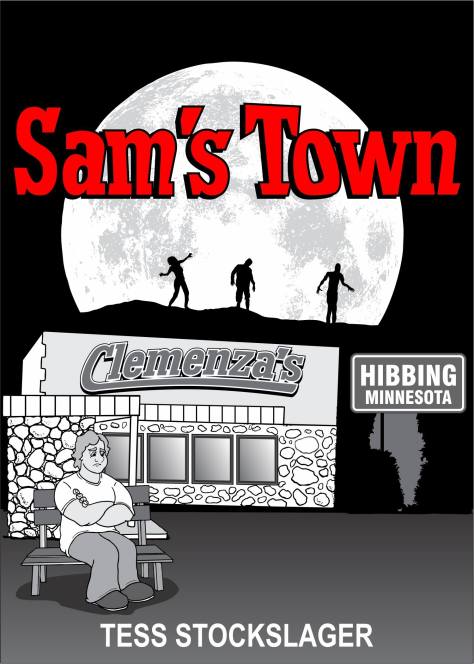
In case you missed basically all of my posts last fall, in October I self-published (via Kindle Direct Publishing) my zombie apocalypse novel Sam’s Town, which has a title borrowed from a Killers album and fantastic cover art by Mike Nair. It’s more about relationships than about zombies, but fans of George Romero and The Walking Dead should find it satisfying. You can read more about it here and in most of my September and October posts. It’s available in paperback and e-book formats; the shopping link is in the post above. If you have questions, let me know in the comments!

one of my periodic existential crises

This afternoon, a colleague who edits a theological journal came to my office and invited me to contribute an article to an upcoming issue on theology and literature. He assured me that I wouldn’t need to write an entirely new piece but could update something I wrote, say, during my doctoral studies. Knowing my love for Harry Potter, he said that a piece on the series would be enthusiastically welcomed. I said I’d be happy to contribute, and the conversation left me feeling honored and excited.

Now, a few hours later, I’m feeling more worried than anything else, for two main reasons. One has to do with the fact that I produced the bulk of my academic writing before cloud storage existed, or at least before I was using it regularly. I have a few PhD. papers in my Dropbox, as well as my dissertation (which–shameless plug–you can read on ProQuest), but the only academic work I still have from my master’s and bachelor’s programs are my respective theses, which are also accessible through library databases. One might correctly argue that most of what I wrote during those first two degree programs is not worth resurrecting, but I can think of a few papers from those years that, with some revision, would fit well with the theme of the journal issue–such as the first paper I ever presented at a conference (in 2008, during my master’s program), which connected Dorothy Sayers’ analogy of the Trinity with the author-character relationship in the film Stranger Than Fiction. This paper, which actually made a lot of sense, exists now only as a line on my CV.

My other, bigger concern has to do with the imposter syndrome I regularly experience, which leads me to believe that I’ve lost the ability to write. I realize the irony of expressing this fear in a blog post, but I worry specifically that I’ve lost the ability to write academically. A few weeks ago, while organizing the files in my Dropbox, I made a folder called “things I’ve written,” and I was pleasantly surprised by the number of written and oral contributions I’ve been able to make in the almost five years since I finished my doctorate–a short reflective essay published in Collegial Exchange (a publication of the professional organization for women educators, Delta Kappa Gamma), two lectures given at meetings of the local creative writing group I belonged to in Virginia, a short story written for my current employer’s annual magazine. I’m proud of these, but not one of them was scholarly in nature. I did present at an academic conference last year, but even that paper was a humor-laced analysis of the character of Loki in the Marvel movies, skimpy on sources and not rigorous enough for publication in a journal.

So I’m nervous. I haven’t written anything truly scholarly since my dissertation. Perhaps I can comb through said dissertation for segments that I might be able to expand into a journal article, but the problem is that there’s no obvious connection to theology or faith in my dissertation. There’s kind of a sideways connection, which I mention in the introduction, but I’m not sure if it would make sense as an article outside the context of the full study.

Underneath this nervousness, though, I still have to admit I’m a little bit excited. This will give me an excuse to go back and read at least parts of my dissertation and see if I still think they’re good. I have a feeling that there’s something there that might work for this assignment. The ideas are vague and formless, but watching an idea take shape was always my favorite part of writing for school. I’m ready to get started.

long stories

I’ve been listening lately to Ann Bogel’s podcast What Should I Read Next?. I have to admit that this show is not at the top of my to-listen list, and that’s because it stresses me out a little, for the simple reason that the question that Bogel says “plagues every reader”–what should I read next?–does not plague me. Setting aside my purely aspirational Want to Read list on Goodreads, I have a list of books that I already own and haven’t read yet, and it’s still quite long despite the fact that I’ve been systematically attacking it since fall 2018 (when I realized it was a problem). So the podcast just gives me a bunch of titles of books that I’ll probably never read. Nevertheless, I get some pleasure out of hearing people chat about books, even ones that I’ll never read, so I keep this podcast in my rotation. If you’ve listened to the show, you know that Bogel asks each guest to name three books they love, one book that didn’t work for them, and a book they’ve been reading recently. So naturally, I’ve been thinking about which books I would name if I were a guest. The first two of the three books I love are easy: Charles Dickens’ David Copperfield and J.K. Rowling’s Harry Potter series (if she forced me to choose one, I’d go with Prisoner of Azkaban, the one that really made me fall in love with the series). I’m still mulling over what I’d choose for my third book (it feels like a high-stakes decision), but in the meantime, I’ve been thinking about what makes me love a book.

I thought about this last night after I got out of the bathtub, where I had spent a relaxing half-hour reading one of my Christmas gifts from my sweet book-loving fiance: The Well of Ascension, the second book in Brandon Sanderson’s Mistborn trilogy. I am now about halfway through the book, which means I’m about halfway through the series, and it just struck me last night how much I am enjoying these books (though I don’t know if I’d use the word “love” yet. For the books, I mean. I love my fiance.). I realized that I am looking forward to long periods of time when I can sit down and read The Well of Ascension, that I can picture the setting vividly even when I’m not reading, and that I really care what happens to the characters. I know part of the reason why I’m just now getting into the story is that there were too many blow-by-blow (literally) action sequences in the first book–and I understand why this might be necessary for the first book of a fantasy series that involves a specific, unique type of magic. But I really don’t care who punched whom and when. This second book is much more about relationships, political intrigue, and human psychology. But I think another reason why I’m so into this book is that it’s long.

Well, not just long. Quantity does not supersede quality for me. But I’ve realized that I love books (and movies and TV series) that have extensive world-building, deep character development, and layered plots–and on top of all this, a sense that the story-world has been lived in, not just made up on the fly. And in order for all that to work, a writer needs space–hence, length. Most of my favorite stories–stories you’ve seen me write about on this blog–have these qualities: Downton Abbey (with its hour-long, commercial-free episodes), the Godfather films (a major time commitment I embark on only about once every other year), the novels of Charles Dickens (it’s no accident that one of Dickens’ shortest novels, Hard Times, is probably my least favorite). [I have written on this blog about Dickens’ “teeming world,” crowded with memorable people.] One of the greatest compliments I can give a story is that I’ve spent so much time inside it that I feel like the characters are my family. That’s why I cried so much when Sibyl died in season three of Downton Abbey, why the birthday party scene at the end of The Godfather Part 2 blows my mind every time I watch it, and why I’ve written fan fiction about the Weasleys going about their mundane lives after the defeat of Voldemort. However flawed they are, I want to be part of those families. I don’t know if Sanderson’s ad hoc family of thieves and kings will make it into my top tier of favorites, but their admission to that circle currently looks promising.

what marriage is all about

You might have looked at my title, knowing that I’m not even married yet, and written me off as a person with a (very small) platform who’s presuming to lecture on things she knows nothing about. Before you tense up, let me put you at ease. All I’m offering today is a quote. I think it’s about all I have the creativity for today, after grocery shopping, emailing distraught students, and calling hotels to hold blocks of rooms for our wedding, a task that had me disproportionately stressed out for some reason. (And I didn’t even teach today, at least not in the formal classroom sense.) Plus, coming up with a blog topic every week is hard work, you guys. Normally, around this time of year, I have something to say about the Oscar nominations, but I haven’t even looked at those closely enough to say anything intelligent about them. Maybe next week.

So, for today, a quote. This is actually a secondary citation, which I typically discourage my college students from using. You’re supposed to go to the original source; it’s a (relatively minor) infraction of academic etiquette to cite the book where you found the quote instead of the book where it originally appears. But this isn’t a dissertation; it’s a blog, so there. Anyway, in my premarital counseling homework reading, I came across this lovely and fairly lengthy quote. I found it in Greg and Erin Smalley’s introductory chapter of Ready to Wed, but they’re quoting Tim and Kathy Keller’s book The Meaning of Marriage. (Note to put that one on our to-be-read list.)

When looking for a marriage partner, each much be able to look inside the other and see what God is doing, and be excited about being part of the process of liberating the emerging “new you.” … This is by no means a naive, romanticized approach–rather it is brutally realistic. In this view of marriage, each person says to the other, “I see all your flaws, imperfections, weaknesses, dependencies. But underneath them all I see growing the person God wants you to be.” … The goal is to see something absolutely ravishing that God is making of the beloved. You see even now flashes of glory. You want to help your spouse become the person God wants him or her to be. … What keeps the marriage going is your commitment to your spouse’s holiness.

This is true. I don’t know much about marriage yet. (I wish I could trade my nearly-useless knowledge of citation etiquette for something useful like marriage wisdom.) But I already know the Kellers’ description to be true. This is why, already, Jordan can point out (he always does it gently and rarely does it at all) an area for improvement in my life without me getting angry or hurt like I would if a stranger, or even perhaps a friend, said the same thing. And why I can do the same for him. This is why we can feel, and act, confident in one another’s presence–because we know that we have already accepted one another.

It is a faint glimpse of the acceptance we find in Christ. Over the past year, I’ve been thinking a lot about the story of the woman at the well in John 4. When she went back to her town to tell people she had met Jesus, she said, “Come, see a man who told me everything I had ever done.” She said this excitedly, like it was a selling point. Because for her, that may have been the best part of her conversation with Jesus: the fact that he knew everything about her–her sin, her social isolation, her confusion about spiritual matters–and still accepted her. He sat and talked with her, took her questions seriously, and after the initial mention, never brought up her sin again. Full knowledge, full acceptance.

Well, that is not the direction I thought this post might take when I started it. I’m actually sitting here crying right now. I hope this will encourage someone else, but if not, it did me. Thank you for reading this quote and my thoughts on it today.

stuff in my life right now

I looked back through my blog archives and realized that it’s been a while since I did one of those themeless list posts. Since people tend to enjoy those, and since I’m not sure if I can generate a coherent argument today, here is a list, in no particular order, of things I have going on right now.

  1. I just put my electric blanket on my bed and tucked it in at the end so that it has officially become part of my bedding for the duration of the winter. This will no doubt enhance my quality of life.
  2. I’m in a Peter Pan season. I went to see the strange and delightful play Peter and the Starcatcher Friday night at the South Bend Civic Theater. (By the way, did you know that the novel on which the play is loosely based is called Peter and the Starcatchers? Play–singular; novel–plural.) This week in my children’s lit class, we are reading Peter Pan, and as part of our discussion of Peter Pan as culture-text (a fancy term for the whole conversation surrounding the text–sources, adaptations, connotations, etc.), I plan to show the student clips from the 1953 Disney Peter Pan and Finding Neverland, read them part of Piers Dudgeon’s The Real Peter Pan, and show-and-tell them my Peter Pan Funko Pop. Maybe I’ll even wear my new  Neverland jacket. In summary, I’m way too engrossed this week in a flying, narcissistic, magical boy.
  3. Jordan and I are doing the Whole30.* I am putting an asterisk next to this statement because we are aware that we cannot truly say we have done the Whole30 if we take a break in the middle, which we did last weekend for a very good reason: our wedding reception tasting, which we weren’t about to delegate to anyone else. Also, you’re not supposed to eat sugar-cured bacon or sausage on the Whole30, but it’s dang hard to find non-sugar-cured versions, and I’m not stressing out about it. So we’re doing the Whole30.* Maybe we’ll do it for real later this year. In the meantime, I’ve learned that you can make a really good barbecue sauce using dates as the sweetener. Who knew?
  4. I am doing Yoga With Adriene’s 30-day yoga “journey” entitled Home. (Look her up on YouTube; she’s a phenomenon.) Instead of doing my daily practice in the morning as I typically have in the past, I am waiting until 4:00 or 4:30 pm. This not only frees up my early mornings for other types of exercise but also gives me a delicious (yummy, as Adriene would say) break after the workday. It’s been fun trying to wrap everything up in order to make sure I can get started at the time I’ve written in my planner. (See last week’s post on why I’m giving non-meeting, non-appointment activities like yoga a specific time in my planner.)
  5. I received six goodly-sized jar candles for Christmas. That sounds like a lot, but I love having a bit of fire in my home, and since I don’t have a fireplace, this works almost as well (and smells better). I did have all six out in various places, but today, in an effort to be seasonally appropriate (something I typically don’t care about), I put away Peach Flambe and Ocean Currant for later. I’m amazed by my restraint.

And now, I must go because it’s almost 4:30 and time to do yoga. Let me know what you’re into right now!

getting my act together

Most people who know me well know that I enjoy routine. I like to wake up, exercise, eat my meals, drink my tea, and go to bed at roughly the same time every day. (I prefer exactly the same time, but I’ve matured at least enough to know that that isn’t always feasible.) Every so often, I have to replace a routine that is no longer serving me. And sometimes, I hang onto routines even though I am fully aware they are no longer serving me. But in general, I think my routines do more good than harm.

I was delighted to receive for Christmas from my future in-laws the 2020 weekly edition of The Simplified Planner by Emily Ley. Aside from the fact that it’s pretty and sturdy, has a large format (which means more room for writing), comes with a list of small suggestions for simplifying one’s life, and is part of a lifestyle and paper products brand with an undeniably supportive and cheery vibe, it’s a fairly standard planner. By this, I mean that there aren’t prescripted categories for what to write each day; most of the pages consist simply of dates and blank lines. I know from watching one of Ley’s supportive and cheery videos that this is intentional: She wanted to create a planner that could become what the user needs it to be. And for me, at this season of my life, I’ve discovered that I need to write down and carry around with me a hyperspecific list of what I must do every day and–this is key–what I want to do every day.

I realized that for a long time now–probably years–I’ve been spending my unstructured time wandering around my house feeling the anxiety of all the things I need to do but unsure of what I should do next. This habit has been exacerbated by my current freeform work schedule (I have to be on campus for classes, office hours, and meetings, and that’s it). So even though I believe that part of being a functioning adult is knowing how to use one’s time without having to be told what to do, I have recently felt that I might actually need someone to tell me what to do, at least for a while. And I decided that that person ought to be me.

So I’m filling out every line of my planner. And as I mentioned, these are big pages. I’m not just writing down classes and appointments; I’m also writing down specific times for things like “prayer while making tea,” “have my first coffee,” “talk to Jordan,” “blog,” and “yoga”–things that I say are important (and that I typically enjoy) but that I apparently have never considered important enough to set a time for on my schedule. (This includes those routine items that I mentioned in the first paragraph–yes, I’m writing “wake up” and “go to bed” in my planner.) The level of specificity might seem ridiculous, but judging by these first few weeks of the year, it seems like it’s helping. The true test, of course, will be once my classes really get going and I have grading to do, but I already have a plan for that: one of my to-do items this week is “Count # of students & divide by # of weekdays to schedule grading.” If it’s important, I’m writing it down.

One good thing about this system is that my to-do list is finite and specific to each day, rather than vague and unending, so I’m getting the added benefit of a major list-crossing-off endorphin rush each day. There were one or two days last week when my to-do list was too ambitious, but I was able to move the items to another day or even the following week after re-assessing their urgency.

I should also mention the weekly routine I’ve added that, so far, is incredibly helpful: taking an hour each Sunday night to plan my week. (I am grateful to life coach Cindy Sielawa for this suggestion.) I create a calm environment by lighting all the candles I got for Christmas (it’s a lot–guys, I like fire) and doing a facemask (the skincare kind, not the football kind), and then I fill out all those blanks in my planner. And my routine-loving heart is happy.

And you can make it even happier by telling me some of your favorite daily routines and planning habits! Please share in the comments!


Sam’s Town–the paperback

cover

Hi everyone, I’m back with some exciting news: I just submitted the paperback of Sam’s Town to Amazon’s Kindle Direct Publishing for review. If it passes quality inspection (and I see no reason why it won’t, with this fantastic cover by Mike Nair!), it will be available for purchase within about two days. I will post another announcement when I receive confirmation, but in case I forget or am busy (a likely scenario, these days), I wanted to go ahead and give you the news. Mark your calendars for the end of this week! Just search the book title and my name on Amazon.com.