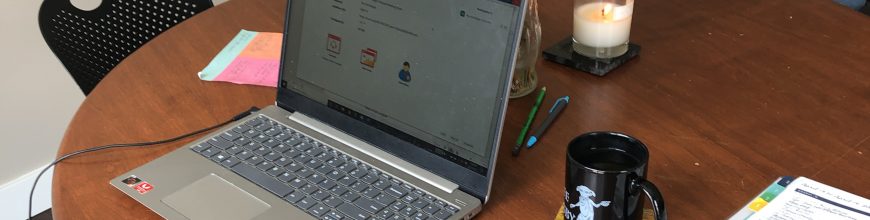
on listening to presentations

I just came from the penultimate session of a class I teach (facilitate, really) during which students complete the research and writing of their senior honors thesis.  Today I listened to the seven students in my all-female class (the Magnificent Seven, as I’ve been calling them in my mind) give short presentations about their thesis research and post-graduation plans.  These are students from majors as diverse as journalism, exercise science, and English/Spanish with teacher licensure, but they crossed disciplinary divides to convey their passion for their topics.

Earlier this afternoon, I served as a judge for five presentations (from history, English, and theology) that were part of our university’s Research Week competition.  Yesterday, I was a moderator in a room of presenters from exercise science and sports management.  Although the topics diverged widely, all the students, in spite of limitations in some of the presentations, showed a clear enthusiasm for their research and its implications in the real world.

On Tuesday, I watched my first master’s thesis student (i.e., the first student for whom I’ve served as thesis chair) defend her project, on moral maturity in the Harry Potter series, with flying colors.  It was a delightful meeting not only because we shared cookies and baked apple bars, not only because all three committee members and (of course) the student herself were Harry Potter fans, but primarily because I got to see the culmination of over a year’s worth of work and my student’s relief as she realized that she knew her stuff really, really well.  It was as if I could see her becoming an expert before my eyes.

Finally, three of my children’s lit students gave in-class presentations on nonfiction books yesterday, and four more will do so tomorrow.  So I’ve spent most of this week listening to students talk.  And although there’s a significant difference between a 10-minute undergrad class presentation and an hour-long master’s thesis defense, I love hearing students at any level talk about what they love, especially when they’ve done the work to know what they’re talking about.  In fact, I love hearing people in general talk about what they love.  Maybe we should all do more asking and listening–we might hear something really cool.

I’m a church lady.

I hinted last week that I might post about Fantastic Beasts and Where to Find Them this week, but after watching the Blu-Ray, including the deleted scenes (which were enjoyable  but didn’t fill in any of the story gaps I’d hoped they would), I found that I don’t have a whole lot that’s new to say about the movie, except that I still love it, story gaps and all.  I will briefly mention, however, that I now have a favorite sequence: the one in which Newt and Jacob work together to catch the Erumpent in Central Park.  It starts off with that lovely little scene in which Newt does the Erumpent mating dance, showing that he has no problem making himself look ridiculous for the benefit of his beloved beasts (and making us love them too, vicariously).  After that, it’s a well-paced, purely fun caper through the park that solidifies the partnership between Newt and Jacob–at the end, the latter puts out his hand as if they’re meeting for the first time and finally says, “Call me Jacob.”  The music is also perfect in this sequence; it’s beautiful and sounds like something that should be in a ballet, but it has just enough of a sense of humor to fit the tone of the events.

But that’s not the topic of today’s post.  Instead, I want to write a little bit about the wonderful time I had this past weekend at my church’s women’s retreat at the Billy Graham Training Center at The Cove in Ashville, NC.  I think I’ve mentioned before on this blog that I’m a mountain lover, so it should come as no surprise that I enjoyed my surroundings, especially the feeling of being enveloped by the woods while zip-lining on Saturday.  I also enjoyed The Cove’s gourmet meals, the music and teaching sessions, and getting to sleep in almost total darkness and quiet.

But my favorite thing about the retreat was looking around and realizing just how many women from my church I recognize and, of those, how many I can call my friends.  This is significant to me not only because I belong to a large church, but also because for a long time, I didn’t think I was a “church lady.”  During college and for a number of years after that, I did not consider myself the type of person who would go to a women’s retreat–nor who would attend a Beth Moore Living Proof event (which I did last fall) or who would wear a piece of jewelry inspired by a book from a women’s Bible study I participated (and I love my necklace pendant that looks like the bird’s nest on the cover of Ann Voskamp’s One Thousand Gifts).

Now, when I look back on the period when I thought I wasn’t a church lady, I realize that my attitude largely stemmed from pride and prejudice.  (I promise that was not an intentional Jane Austen reference, but I decided to run with it.)  I had a very narrow definition of what a church lady was.  Although I couldn’t have pointed to one person who fit this description, my stereotyped mental image of a church lady didn’t like to read non-Christian fiction, hugged everyone who came across her path but didn’t really know them, would have considered me unspiritual and just plain weird for liking Harry Potter and rock music, and used Bible verses in all of her decorating.  She was also, although I may not have ever articulated this is a verbal thought, intellectually and spiritually inferior to me.

Of course, I was wrong, not to mention lousy with pride.  My erroneous thinking derived from two main problems.  First, I was forgetting that the true definition of a “church lady” is any woman who belongs to Jesus Christ, even if she lives in a country that doesn’t have a single Lifeway.  Second, I didn’t know very many women from my local church.  It took me a long time and some deliberate actions–serving in various ministries, becoming an official church member, deigning to attend Wednesday night Bible studies–before I really started getting to know some of them.  Now, in my church, I have running buddies, I have fellow Harry Potter fans, and I have women who may not have any superficial interests in common with me but with whom I can have a genuine conversation about life.  It was beautiful to look out over the crowd in our sessions over the weekend and realize that.

Beauty and the Beast

I wanted to come up with a clever title for this post, like “A Tale as Old as Time and as Fresh as 2017,” but that’s actually pretty cheesy, and since I’m surely the millionth blogger to enter this discussion over the past few days, there’s no point in trying to be original.

Well, I really enjoyed Beauty and the Beast.  For me, it struck exactly the right balance between appealing to the nostalgia of people who were seven-year-old vicarious princesses when the original animated Disney movie was released (e.g., me) and providing the psychological depth and historical detail that has come be expected of fairy tale adaptations in recent years.  I want to focus on the latter and tell you about an innovation that I appreciated in each of the two categories that I just mentioned.

  1. Psychological depth: In the animated film, Belle and the Beast–and even Gaston–were already surprisingly fleshed-out characters, but many of the minor characters were pretty flat (and I’m not talking about the 2D animation).  One of those characters who gets some new depth in the new adaptation is Maurice, Belle’s father.  The animated Maurice was exceedingly absent-minded and a rather clueless father, leading us to wonder where Belle got her good sense from.  (I also always wondered why he was half Belle’s height and perfectly spherical.)  When Gaston had him thrown into the asylum wagon, I felt bad for Maurice, but I kind of saw Gaston’s point.  In the live-action film, Maurice (played by Kevin Kline) is still a bit of a dreamer–perhaps even more so, since he’s now portrayed as an artist rather than an inventor (in a neat twist, Belle is the inventor!)–but his speech and mannerisms are abundantly rational, which underscores the cruelty of Gaston’s and the townspeople’s insistence that he is crazy.  Maurice gets added depth from the film’s revelations about Belle’s mother, who (this is not a spoiler; you find out very early in the movie) died of the plague in Paris when Belle was a baby.  I like how many of the recent Disney movies are either showing two-parent families or at least making it clear that it takes two people to make a baby.  (At the end of this one, we discover that there’s a Mr. Potts!)
  2. Historical detail: The fact that Maurice and Belle came from Paris is also significant because it explains why Belle is even literate, let alone the insatiable reader that we love her for being.  The first few scenes of the new film subtly but clearly demonstrate the low priority that has been placed on reading and writing, especially for girls, throughout much of history and even in many places today.  (I have a feeling that Emma Watson, a well-known campaigner for women’s rights, including the right to education, may have had some influence on this aspect of the movie.)  Notice, especially, the tiny collection of books Belle has to choose from in her town in this version.  Instead of the good-sized bookshop of the animated film, here we see a single shelf of volumes that appear to be owned by a clergyman, probably the only other educated person in town besides Belle and Maurice.  The literacy theme comes back in the Beast’s castle, when we learn that not only does the Beast have a really nice library (cue all the Hermione references you can think of) but that he also has apparently read most of the books in it.  I think this is the moment when Belle starts falling in love with the Beast–when she realizes they’re intellectual equals.

I don’t think I’ve quite done justice to the film yet, so I’ll probably return to this topic next week.  Meaenwhile, go see it, and let me know what you think!

children’s lit roundup

Last week I told you about my new resolution to read one children’s book every weekend.  Well, my resolution-keeping streak lasted exactly one weekend.  Although I contemplated reading the shortest children’s book on my bookcase (The Midwife’s Apprentice by Karen Cushman) this past weekend, I decided I had too much other stuff to do, like making a pot of pasta e fagioli soup.  (So I did continue my Italian cooking streak.)

However, I did buy a children’s book on Saturday.  At a local store with the perfectly explanatory name Estates and Consignments (where I also found a nice drop-leaf table that I’m thinking of buying if it’s still there next time I go), I found a copy of 1971 Newbery Winner Mrs. Frisby and the Rats of NIMH.  It looks like an early edition, and if it is indeed a 45-year-old paperback, it’s in really good shape.  So that’s got to count for something.

And although I didn’t read an entire children’s book over the weekend, I did make progress on a children’s book I’ve been working on for a little over a week: Inkdeath, the final book in the Inkheart trilogy by Cornelia Funke.  I’ve been disappointed with these books because I really wanted to love them, especially after witnessing the enthusiasm of one of my students who claims them as her favorite books and who is doing a major project on them this semester.  Although the story has kept me enough engaged that persevering through these three massive volumes hasn’t been a complete drag, I can’t say I’ll be sad to finish the series.  I find the translation from German clunky, with isn’t Funke’s fault, but I don’t think the translation can be blamed for the unlikeable (in some cases) and forgettable (in most others) characters.  There are a few minor characters with interesting psychologies, but I still don’t really care if they live or die.  The quasi-medieval Inkworld is by turns beautiful and gritty (which is why I think the second and third books, which are set in it, have been better the first one, which is set in our own world), but I kind of wish I could get rid of all the existing characters (except maybe Dustfinger; he’s okay) and create my own story set in the Inkworld.  Which I guess makes me no better than the villain of this third book, who’s basically trying to do just that.  All right; I’ll just own it.  I’m a bad guy.

I am also listening to a children’s book, the recent Newbery Honor book The Inquisitor’s Tale by Adam Gidwitz.  Here’s the premise of this bizarre (and, like Inkdeath, extremely long) story: In medieval France, three kids with superpowers (though nobody actually uses that word), accompanied by a greyhound who’s been resurrected from the dead, are trying to get to a far-away monastery and escape the corrupt knights who are hunting them.  Actually, right now they’re just trying to get to an inn where one of the boys left his donkey, which he calls his ass, which led to some Chaucer-esque broad humor that I have to admit made me LOL.  The structure of the novel is also Chaucer-esque: The “inquisitor” of the title is a writer (voiced in the audiobook by Gidwitz himself) who keeps asking questions while drinking in an inn, and the story gets pieced together by a colorful cast of adult characters who seem to be in awe of the plucky trio–and who are just as interesting as the kids themselves.  I’m enjoying this book for several reasons: It’s funny but it also has a real sense of danger (a balance that many good children’s books strike); the characters are likeable, except the ones we aren’t supposed to like; and the most of the readers are good, which, as I’ve noticed since I started listening to audiobooks recently, can make a huge difference in my appreciation of a book (which, I suppose, isn’t entirely fair to the author).

Well, that’s about all the children’s lit I can handle in one week.  Let me know if you’ve read any of these books or if you have any suggestions for ones I should read next!

my favorite fictional couples that never happened

Tomorrow is Valentine’s Day, and some of you may be feeling like your true Valentine is out there somewhere (maybe in a very specific location whose exact address or coordinates you know) and just hasn’t found his or her way to you yet.  This is kind of the way I feel about Tom Hiddleston, and I now know, since I read that article about him in GQ that came out last week, which part of London he lives in.  (Like Charles Dickens, he comes straight outta Camden.)  In honor of all of you who are feeling frustrated in love, here are a few fictional couples who never get together despite my best shipping efforts.

  1. the unnamed narrator and Frank Crawley in Rebecca.  *spoilers ahead* My book club just read this 1938 Gothic novel by Daphne du Maurier.  I described it as “creepy Downton Abbey,” so if you like stories about rich people with no jobs, and their household staff who know way too much about the family, you will probably enjoy this book.  (I also thought the writing style was beautiful, the setting haunting, and the human psychology spot-on.)  I had several theories about what was going to happen in this book, some of which were based on superficial resemblances to Jane Eyre, and all of which turned out to be wrong.  The theory that I clung to the hardest was that the narrator’s husband, Maxim, was going to either go to jail or get the death penalty for having killed his first wife, the narrator was going to realize that he never really loved her but was just using her to try to have a normal life, and she was going to end up with the longsuffering and loyal estate agent Frank Crawley, whom I pictured as the subdued and diplomatic Tom Branson of the later seasons of Downton Abbey.  It just seemed so clear to me that the narrator was much more comfortable around Frank than around her preoccupied and moody husband.  I went so far as to go back and make sure the first chapter, which occurs chronologically at the end of the story, didn’t have any proper nouns in it–“We thought she was talking about Maxim, but she could have been talking about Frank!”  I was wrong; she stuck with the wife-killer.  Poor Frank.
  2. Liesel and Max in The Book Thief.  I’ve read Markus Zusak’s remarkable Holocaust-era novel in two different book clubs, and both times some people, including myself, have stated that we wished Liesel, the book thief, and Max, the young Jewish man who hid in Liesel’s family’s basement, had gotten together at the end.  I get all the reasons why that relationship wouldn’t work: he’s older (not that much older, though); she sees him as a brother; it’s not really a book about romantic relationships, but at the same time Liesel will always carry a torch for Rudy.  I do get all that, but I can’t stand to think of Max being all alone for the rest of his life.  Liesel, we learn, marries some random guy and ends up having a bunch of grandchildren, so I’m not worried about her.  But Max is such a lonely figure throughout the book–he arrives alone; he leaves alone; he has to stay in the basement when everyone else is going to the air-raid shelter.  It breaks my heart to think he’ll have to stay that way forever.  He made you a book, Liesel.  Did your random guy do that?
  3. Harry Potter and Luna Lovegood. Speaking of the trope of marrying a random-guy-ex-machina, I’m sure I’m not the only Harry Potter fan who used to think it was a total copout when J.K. Rowling declared that Luna Lovegood, one of my favorite fictional characters of all time, ended up marrying some guy named Rolf Scamander.  Now that I know and love Newt Scamander, I guess I’m okay with Luna marrying his grandson.  But still, like everyone else, I wanted her to get together with Neville.  And yet, there’s a part of me that also thinks Harry and Luna would have been a great couple.  I think she would have helped him not to take himself so seriously, and he would have helped her get some street cred at Hogwarts (not that Luna cares what people think of her).  They have some sweet exchanges in the books (like when Luna tells Harry about her faith that she’ll see her mother again) and the movies (like when Luna says that hanging out with Harry is “kind of like being with a friend,” and Harry says, “I am your friend, Luna”), and I think this mutual kindness and confidence could have gone somewhere romantic.

I’d love to hear about your adventures in shipping.  Meanwhile, don’t forget that chocolate goes on clearance February 15!

This is going to make a good story.

Last Tuesday night–Wednesday morning, technically–between 2:00 and 4:00 am, I found myself driving around Bedford and Amherst counties, including brief stints on the Blue Ridge Parkway and the ominously named (and very dark and narrow) Father Judge Road north of Madison Heights.  I saw a lot of deer and a raccoon, and I almost hit a small waddling creature that I didn’t have time to identify.  This isn’t the place to go into why I was doing all this nocturnal driving, but I assure you that it was all legal and mostly safe, and I wasn’t up to anything unsavory.  My point in sharing about this adventure is that although I was in a constant state of frustration, with occasional moments of mild terror, a small part of me–the creative part–was having a good time, because it kept thinking, “This is going to make a good story later.”

Because I spend a large percentage of my waking time reading, watching, and interpreting stories (and some of my sleeping time dreaming stories–I had a really stressful one after going back to bed at 4:08 Wednesday morning), I tend to see my own life as a narrative, with some experiences standing out as particularly excellent story material.  I’m a pretty decent storyteller, I think (actually, someone told me that last week, and I was flattered), and I have to admit that I enjoy keeping an audience entertained and feel like I’ve failed when my stories don’t have the impact I’d imagined they would.  And of course, there’s always a temptation to make my stories a little bit funnier or more shocking by altering events a bit.  Telling stories always involves editing–deletion, highlighting, etc.–but I try to avoid crossing the line into fabrication, not least because I find it satisfying to think that my real life (just like your life, reader) is stranger than anything I could make up.  I don’t think it’s an accident that some of my favorite–and most popular–blog posts have simply been stories about stuff that happened to me, like when I almost choked on the fumes of some spicy soup I was cooking or when I got angry and went all Hulk in my office.

Another occupational hazard of being a storyteller, even an amateur one, is the compulsion to come up with a lesson at the end of every story.  So bear with me while I draw a spiritual parallel here: We can see our lives as a lot more bearable, exciting, and significant if we keep saying to ourselves, “This is going to make a good story later.”  One of the hallmarks of a Christian worldview is the idea that God has written and yet somehow still is writing a story in which our planet is a major setting and every human being is an important character.  The theological implications of this are too gigantic to even be broached in a short blog post like this, but I’m just asking you right now to think of yourself as a character in a story.  That means a number of things: the decisions you make are significant, you are significant, and there’s more story to come.  Isn’t that exciting?  Even more exciting than a 3:00 am drive on the Blue Ridge Parkway, I’d say.

This is my brain on the first day of classes.

Although I warmed up by teaching an intensive class last week, nothing ever really prepares me for the first day of a semester.  Today, after teaching a maxed-out children’s lit class (there’s a waiting list–not because of my popularity, but because it’s a required course for education majors), conducting a meeting while hungry (I hate that), and answering the emails that kept pouring in–plus the ones I neglected over the weekend–I barely have enough brain function left to make a cup of tea, let alone craft a memorable blog post.  But I think it’ll be easy enough to list some of the things that made me happy over the weekend and today.  So here we go.

  1. Saturday-Sunday, I went camping, backpacking (though I barely carried the pack a quarter of a mile, since our campsite was so close to the car), and scrambling up a popular local rock face known ominously as Devil’s Marbleyard.  Although I love hiking and being outdoors, I’ve rarely camped and never backpacked. Fortunately, I was with a friend who is a certified wilderness EMT and adventure guide and I don’t know what else, so she showed me how to set up a tent, boil water for hot chocolate (very important) in a Kelly Kettle, and wash dishes with hippie soap (it seriously had hemp in it) in a freezing cold creek by the light of a headlamp.  The part I was most worried about was staying warm at night, but with a zero-degree sleeping bag and a lot of those Hot Hands packs that are popular with hunters at this time of year, I was downright cozy.  As for scrambling up the rock face, I just pretended like I was Frodo or Sam traversing the Emyn Muil–just without the elven rope.
  2. Last night I went to see Hacksaw Ridge (side note: I went out last night wearing leggings as pants, and I was regretting that style choice all the way to the theater and thinking, “Wow, I’ve really let myself go.”  Immediately after getting there, I saw at least three women wearing leggings as pants.).  If all you’ve heard about Hacksaw Ridge is that Andrew Garfield has a bad accent in it (he really doesn’t, though, and he is adorable), you should give it a chance.  It’s about Desmond Doss, a WW2 medic who refuses to carry a gun due to his religious convictions and past traumas, but ends up saving dozens of lives in one night, under relentless attack, through his (figuratively) insane work ethic and (literally–almost) insane fearlessness.  It was especially poignant to watch the film in Lynchburg, VA, where Doss grew up.  (We actually drove on the PFC Desmond T. Doss Memorial Expressway while coming back from the mountains yesterday.)  If you think you’ve seen enough WW2 movies, see this one anyway; you’ve probably never seen one about a conscientious objector.  They tend not to make movies about conscientious objectors.
  3. After the movie, I rushed home to watch the second half of the Steelers-Chiefs game.  I rarely write about football on this blog, and I won’t take the time to start now, but since I’m listing things that have made me happy, I’ll just say that I’m happy that the Steelers won–and, like all good Western Pennsylvanians, sick with apprehension about next week.
  4. Finally, my students, as they so often do, have made me happy today.  My children’s lit students seem to think I’m a comedienne (I try), and most of them appear to be totally on board with the Walt Disney World-style character breakfast I’m planning for the last day of class.  Meanwhile, a student from last week’s class sent me a Harry Potter article and a recording of Neil Gaiman reading A Christmas Caroland he told me that I’m currently his go-to person to discuss Harry Potter with.  Just what I’ve always wanted to hear.

Time to go outside and try to clear my head with fresh air.

my discussion board post

I’m teaching my first real graduate class this week (it’s in a one-week intensive format), and let me just tell you that I’ve been having major imposter syndrome (i.e., that voice in your head that tells you you’ve fooled everyone into believing you’re smarter than you actually are and that the truth is about to come out) all weekend and into today.  Fortunately, these graduate students are kind and understanding and (since most of them are graduate student assistants) know something about feeling unprepared to teach, so today went pretty well.

I teach at a Christian university, and tonight I’m having my students write a discussion board post about how their Christian worldview impacts their scholarly career.  (These are English M.A. students, many of whom will go on to careers in academia.)  So I thought I, too, should do what I’m asking them to do, but since I don’t want to crash their creative party by becoming the awkward authoritative presence in the virtual room, I’m writing my thoughts here.

  1. How my Christian worldview has impacted me as a writer and researcher.  As Gilderoy Lockhart once said, “For full details, see my published works” (flashes award-winning smile).  All I mean by that is that I won’t take the time to go into great detail here because I’ve already written about this at length in the introduction to my dissertation.  In summary, I said that I’m more comfortable than a secular scholar would be with talking about authors as real personalities, not merely constructs, because I believe that God, a very real personality, inspired the Bible and had a clear authorial intent in mind when he did so.  Therefore, even though I know that a degree, perhaps a large degree, of uncertainty is inevitable when we interpret texts (even when we interpret the Bible with our finite rational capabilities), it is imperative that we respect the text–any text–and its author and do our best to understand the intention, even if we don’t agree with it, and even if we see interpretive possibilities that may not have been in the author’s conscious thought.  That’s not a popular view in literary criticism, but I think it’s a Christian view.
  2. How my Christian worldview has impacted me as a teacher.  In many ways, I hope!  I hope my Christian worldview, along with the Holy Spirit inside me, has helped me to see the value of all students, to be patient with them, and to listen to them before I start telling them what I think they should think.  (I don’t always succeed at all of this.)  I know my Christian worldview has helped me to see teaching as a meaningful calling, not a frustrating but necessary side effect of being a scholar.  My Christian worldview also has a direct impact on what I say in class, something I’ve been focusing on more deliberately in the past few years as I’ve come to realize that not all of my students a) are Christians and b) understand the Bible and their faith well.  I teach English, not theology, but there are so many opportunities to speak Jesus’s name and the truth of the gospel in my classes, whether we’re looking at the triumph of grace over law in The Lion, the Witch and the Wardrobe or the resurrection symbolism in Much Ado about Nothing.  (A lot of the depressing short stories I assigned in English 102 were great purely for their clear demonstration of how badly sin has messed up our world.)

There it is, my discussion board post.  I’ve written twice as much as I asked my students to write, but we teachers are known for being a bit long-winded. 😉

for your New Year’s resolution to read more children’s lit

Because if that isn’t one of your New Year’s resolutions, it should be.

When I was grading my children’s lit students’ response papers on contemporary realism, for which at least five of them chose to write about Louis Sachar’s Holes, I realized that I had never read this novel, though I had seen the 2003 movie (which is excellent, and which I’ll address shortly).  So during my Christmas break, I decided to spend an afternoon reading it.  Now, I’m pretty sure I’ll use it as an assigned text if I teach the course again next fall.  Let me tell you why Holes is so good.

In slightly over 200 pages, Sachar weaves a five-generation family saga together with a hundred-year-old mystery and the story of a teenage boy’s developing self-esteem and moral consciousness.  In the process, he meaningfully addresses the penal system, homelessness, and race relations in America.  Yet there’s nothing pretentious or alienating about this novel.  It’s exciting, it’s funny, and it’s perfectly pitched toward that elusive reading demographic, elementary to middle school-aged boys.

When I get around to teaching Holes, I’ll have to comb through it to find all the symbolism, parallelism, and other literary devices that Sachar uses in such a not heavy-handed way.  For now, here’s one example: the situational irony.  I love the little detail at the end of the novel that tells us that Camp Green Lake ends up turning into a Girl Scout camp, a wonderful conclusion to all Mr. Sir’s lame jokes about how it isn’t a Girl Scout camp.  As ironic reversals go, this ranks right up there with Haman’s nasty shock in the book of Esther, my current go-to example of situational irony.

I’ll also have to find time in the course to show the movie, which is one of the most faithful page-to-screen adaptations I’ve ever seen (not that I valorize faithfulness; I understand that books and films are two totally different media), probably because Sachar himself wrote the screenplay.  (He also appears in a brief cameo–he’s the balding guy that Sam the Onion Man tells to rub onion juice on his scalp.)  One thing I appreciate about the film is that all the characters from the book are in it; none of them are collapsed together for simplicity’s sake, as so often happens in adaptations.  I also think it’s important that each of the actors who portrays one of the boys in D Tent is the same race as the character in the book, since race is such a major (though relatively subtle) theme in this novel.

The one place where the movie diverges significantly from the book is also one of its areas of strength: the casting of the protagonist, Stanley Yelnats.  Shia LaBeouf plays this role with great sensitivity and humor (whatever he may be now, Shia used to be a really good actor), but he doesn’t fit the novel’s description of Stanley as a very overweight kid.  Stanley’s weight is important to the themes and even the plot of the novel, and it adds painful overtones to scenes that are already emotionally fraught (like when ZigZag tries to force Stanley to eat his cookie).  I wonder if some young fans of the novel were disappointed that the movie didn’t address this element–especially, perhaps, some kids who identified with Stanley.  I was a little disappointed myself, but it’s my only complaint about the film.

In conclusion, you should read Holes, watch the movie, and let me know what you think.  And get working on that New Year’s resolution.

Advent week 3: Christmas rituals

Last week, actual tears came to my eyes while I was writing my blog post, and I don’t feel like going through that emotional wringer again (plus I can’t think of anything profound to say this week), so I’m going to write about something more fun.  But first, I have to tell you about a book I checked out of my church library.  It’s called Simply SenseSational Christmas.  The title, interestingly enough, isn’t the cheesiest thing about the book.  Let’s just say that it savors strongly of the 1990s, when it was published.  But although the hip DIY bloggers of 2016 might sneer at much of this book’s aesthetic, its central points are perhaps more relevant than ever: 1. Christmas is about the time when God was born in a stable, so stop stressing yourself out trying to have the perfect showplace home, and 2. Appealing to all five physical senses is possibly the best way to create a memorable, delightful, and even worshipful experience for yourself and your loved ones at Christmas.  The book goes on to offer simple strategies like scattering a handful of cloves around candles so that they give off a spicy, festive scent when they get warm.  This might not be life-changing stuff–then again, it might.

This book has got me thinking about some of the rituals, most if not all of them involving the physical senses, that I enjoy in my own home each Christmas.  This is the second Christmas I’ve spent in my house.  Before that, I was renting an apartment, and while I enjoyed some Christmas rituals there too, there’s something special about celebrating in one’s very own home.  (I also enjoy a number of Christmas rituals in my parents’ house, where I always spend the actual day of Christmas and usually the week or so before and after it, but those aren’t the subject of this post.)  Here are some of them.

  1. I have a number of Christmas albums in my iTunes library, including some that I’ve been listening to with my family since childhood (The New Young Messiah) and some that I’ve acquired in recent years (Christmas at the Renaissance Fair by Moat Jumper–exactly what it sounds like).  I start listening to these while I’m decorating on December 1, and I usually get through the whole collection about three times during the Christmas season.  I also have some individual Christmasy tracks from other albums that I include in the rotation, such as Ralph Vaughan Williams’ “Fantasia on Greensleeves” and John Williams’s “Christmas at Hogwarts” from the Harry Potter and the Sorcerer’s Stone soundtrack.  I also like to listen to the Nutcracker suite on record #12 of the Festival of Light Classical Music record collection I bought at Goodwill last year for $2.50.
  2. I light candles like a pyromaniac all year, but at Christmas, it really gets out of hand.  I go through tealights like my family goes through toilet paper at a large gathering.  The last year I lived in the apartment, my neighbor made me a lovely set of candleholders created from upside-down stemware decorated to look like Santa Claus, a snowman, and other festive characters.  I also have a balsam-and-cedar scented large Yankee jar candle that almost compensates for the fact that my 1.5 trees (I have a big one in the living room and a little one in my home office) are artificial.  My Pier One Holiday Forest room spray, a gift from a friend last year, also helps.
  3. I love mail.  I check my mailbox obsessively on Saturdays when I’m home to check it, and I actually have a real honest-to-goodness pen pal.  So it’s no surprise that I enjoy sending Christmas cards.  I love writing in them (even if it’s just a simple “Love, Tess”), sticking Christmas seals on the envelopes, and putting a big fat stack of them out in the mailbox.  In turn, when I receive Christmas cards, I hang them with tiny clothespins on twine in the corner of my entryway.  It’s an easy and beautiful decoration, especially when I get cards with gold on the front, which catch the light from my many candles and my tree lights.

I could go on–I haven’t said a word about food–but I think you get the idea.  These rituals are so common as to sound almost banal, but they’re meaningful to me.  I’m sure you have some that are meaningful to you.  Feel free to share in the comments!