things I dig right at this moment

Every so often (okay, pretty often) my brain is too scattered to produce a unified blog post, but I can still manage to make a list of disunified things I’m thinking about.  Here is one such list: Things I Dig Right at This Moment.

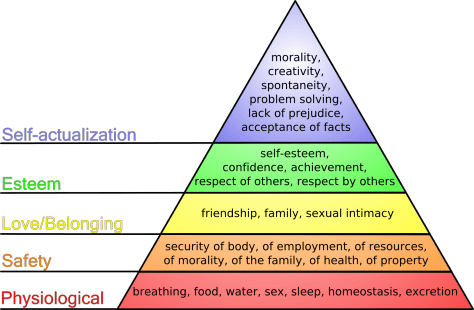
  1. Maslow’s Hierarchy of Needs. Maslow's_hierarchy_of_needs I showed this to my children’s lit students this morning, and I was reminded once again of how much sense this makes.  (Maslow’s basic argument is that the bottom levels of the hierarchy are necessary in order to achieve the higher levels.)  It applies to so many situations: the difficulty abused and neglected kids have in school, the poor work output of people who aren’t getting enough sleep, the writer’s block I get when I’m worried about other things (hey, didn’t I just mention that?).  It even explains the phenomenon of being hangry.  Sure, there are amazing stories about people who aren’t getting their foundational needs fulfilled (such as concentration camp victims) who nevertheless achieve the highest level of the pyramid by creating beautiful works of art or performing heroic acts of self-sacrifice, but what makes those stories so amazing is their rarity.  They are the exception that proves the rule.
  2. The emoji with no mouth. You’ve seen it: It’s a smiley face, minus the smile.  And yet it’s so eloquent.  I use it to mean “There are no words”–a phrase which, like Maslow’s hierarchy of needs, applies to so many situations.
  3. To Kill a MockingbirdI finished rereading this classic yesterday, and I was confirmed in my opinion that Scout Finch is one of the greatest narrators, and Atticus one of the greatest dads, of all time.  Very few books juxtapose humor and danger (recall that Scout is wearing a ham costume throughout the climactic scene), wisdom and innocence (Atticus’s words interpreted through the child Scout’s limited understanding and recalled from the adult Scout’s perspective) in such an effective way.  And the evocative descriptions—the humid warmth of a summer evening, the cracks in a sidewalk that has a tree root pushing through it—take me back to my own childhood, even though mine wasn’t spent in Alabama.
  4. The Grey Havens. My friend told me about this band Saturday morning, I impulse-bought their album Ghost of a King for $10 on iTunes without sampling it first, and I ended up listening to it over and over while driving that day.  Although their style is a little inconsistent (fluctuating from the folksy and dramatic sound of Mumford and Sons to a poppier but still substantial sound that reminds me of Imagine Dragons), I don’t mind that because I like both kinds of music, and their themes are consistent.  This is Christian music that doesn’t advertise itself as such.  On Ghost of a King, without using the names “God” or “Jesus,” they pretty much outline the whole history of the Bible, hitting the major points of creation, fall, and redemption.  My favorite song on that album is “Diamonds and Gold,” definitely on the pop/electronic end and very fun to dance to in the car (and probably out of the car, too).
  5. using flavored cream cheese as a dip for pretzels. Last night I used the Philadelphia brand roasted vegetable cream cheese as a comparatively “healthy” Super Bowl “dip.”  (Oh, my gosh.  Philadelphia.  I just made the connection.  I am the reason they won.)  Today, I polished off the rest of a tub of honey pecan cream cheese (also Philadelphia) as a lunch snack at work.  Seriously, this is good.  You should try it.

What are you digging right now?  Let me know in the comments.

the humility of Jesus

Yesterday morning, I wasn’t planning to go to church; I was going to donate platelets instead.  (My prioritization of church, or lack thereof, is a topic for another post.)  But my hemoglobin was a little too low to donate, so I ended up walking into the 11:00 church service about 15 minutes in, toward the end of the singing.  Normally I carry a big, black leather-bound ESV study Bible to church, as well as a hardcover journal for taking notes.  (Never mind that I take notes mostly in order to stay awake in my church’s soft-seated, dimly-lit sanctuary and rarely go back and look at my notes.  Having the journal makes me look serious.)  But yesterday, because I didn’t think I was going to church, I didn’t have my Bible and journal.  So I walked in late, with no Bible (in a church where most people still carry bound Bibles) and with a new short, somewhat asymmetrical haircut that could, I suppose, be interpreted as countercultural.  And, because I don’t know the words very well yet, I didn’t sing most of the song that had just started when I walked in.  Taking together all of these factors, I was worried that the people next to me were going to assume I was a visitor, probably an “unchurched” one.

When my pastor began preaching on Matthew 12:15-21 (at least I had the YouVersion Bible app on my phone and could follow along), I quickly realized how silly my worries were–even if the people next to me were actually thinking about me, which is unlikely.  In that passage, Jesus heals a lot of people and then forbids them to tell anyone.  My pastor pointed to this action as a demonstration of Jesus’ humility: Jesus’ goal on earth was to do his Father’s will, not to “make his own name famous” (a phrase that is popular today in some church circles but is inconsistent with Jesus’ whole way of operating).  It’s not that Jesus didn’t want people hearing his message; he just didn’t want fame, which is shallow and temporary.  We as Christians, my pastor said, spend too much time doing image control, worrying about whether we’re giving a good impression of Christianity.  Even when we say that we don’t care what people think, we’re showing that we care what people think.  My pastor said that all we are called to do is to live in obedience (which sometimes means proclaiming a message verbally–that’s not what is being forbidden here); it is not our job to control how we’re perceived.

It made me think of Shusaku Endo’s Silence (okay, I haven’t read the book, but the movie absolutely wrecked me), which is about a man who has an intensely personal faith in God of which he cannot speak, but which, we understand in retrospect, has driven his actions all through his life.  This character doesn’t have the luxury of branding himself as a Christian, as so many of us do in America today, but all that matters to him is that he knows that God knows of his faithfulness.

I ended up putting away my phone and just listening to the sermon.  My church follows the current trend of putting the words of Scripture on the screens at the front, so I didn’t really need to follow along in my app anyway (unless I wanted to look at the context, which using the screens can’t really replace).  I tried to think of myself not as an individual sticking out like a sore thumb, but as another member of Christ’s body, just like the people next to me.  It helped.  I listened.  I worshiped.  And, wonderfully, I didn’t fall asleep!


your New Year’s inspiration

I hope you had a wonderful Christmas (although, as we learned in my last post, we are still in the Christmas season and will be until next Saturday, which is Epiphany) and didn’t miss me too much during my unannounced hiatus last week.  Today, I have a story to inspire you toward whatever goals you may be pursuing in the new year.

Last week, we were staying in a hotel while visiting family in Ohio.  One morning, I was in the fitness center doing a walking incline workout on the treadmill, when a little old lady–I use the term quite literally, with no disrespect intended–came into the room and hoisted herself up onto the elliptical.  My initial reaction was “Bless her heart,” but as the minutes went by, I could see in my peripheral vision that she was holding her own pretty well.

When I got off the treadmill, she was still going at it, and she wished me a good day, a merry Christmas, and a happy new year.  (At least I think she did–I had my music up loud.)  I thanked her and asked if she wanted the TV remote, which had been sitting unused on my machine, but she couldn’t hear me very well either (she didn’t have her hearing aids in, as she told me a few minutes later), so she got off her elliptical to find out what I was talking about.  I felt bad that she had to interrupt her workout, but it quickly became apparent that she wanted to talk.  We had one of those polite little strangers-in-public exchanges, but this wouldn’t be an interesting story at all (sorry about the long set-up) if not for what she asked me while I was on my way out the door.

“Have you ever run a marathon?” she asked.  I popped out one of my earbuds and answered, “No, I’ve run a half-marathon, but not a full marathon.”

“Oh, you have to run a marathon,” she said.  “I’m training for my 13th marathon.  I didn’t run my first one until I was 61.”

[From here on, I’m not going to continue with this dialogue thing–just imagine me saying variations of “Wow, amazing!”]

She began speaking as if me signing up for a marathon were a done deal.  “Just have fun,” she said.  “You can alternate between walking and running, at least on your first two marathons.”  (Now she was assuming I was going to run two.)  “Don’t worry about keeping up with the Kenyans.”  Here I laughed knowingly; my heart always sinks when the first Kenyan runner passes by on the return leg of the Virginia Ten-Miler when I’ve barely gotten started.

The conversation was short, and it ended with an exchange of first names (hers: Connie) and with Connie telling me she would pray for me and my family (this is not really a surprise in Central Ohio, Bible Belt North).  I walked away from the fitness center with a lot to think about, most of which can be summed up in various cliches such as “Don’t judge a book by its cover” and “It’s never too late to try something new.”  So I won’t belabor the point.  I’ll let you draw your own conclusions, and I hope Connie’s example won’t discourage you (“I’m not her, so I won’t try”) but inspire you.  Your thing may not be running marathons (though apparently mine is), but you do have a thing–go do it.

People, look East!

Did you know that, for the first time in 14 years, there are four Sundays in Advent this year?  I learned this yesterday when I attended St. Paul’s Episcopal Church in Lynchburg, VA, as a change of pace from my home church.  I have no intention of switching churches anytime soon, but as I explained to several people, I enjoy attending liturgical services around holidays, especially Christmas.  My boyfriend was a good enough sport (maybe because he got to have breakfast at Market at Main first) to go along with me to this service involving a lot of standing, kneeling, and even walking up to the altar rail for Holy Communion.  (He said he was watching me and doing whatever I did.  I didn’t know what I was doing either; I was watching the person in front of me.)

We were also reminded in the sermon that right now, we are not technically in the Christmas season.  We are in Advent, and we will be until December 24, that rare fourth Sunday.  Christmas begins that night and goes until January 6, variously called Epiphany, Twelfth Night, and Three Kings Day.  Of course, as my evangelical friends will rightly remind me, we can celebrate Christmas all year, and the dates matter less than the substance of what actually happened and what it means for us.  But the significance of Advent is that it’s all about hope, expectation, and waiting.  These are not only essential disciplines for the Christian life but also just good general life habits.  Advent and Christmas, if we see them in their true Christian light, teach us that what we await far exceeds even the weeks of excitement and preparation.  The days after December 25 are not a letdown, as we often think of them, but a continued celebration of the long-expected Christ who has finally come.

Yesterday’s service closed out with a beautiful hymn by Eleanor Farjeon that I had never heard before.  I loved it so much (especially the bird verse, of course) that I wanted to share it with you.  Please enjoy it, and think about it this week when you start to wonder if Christmas is really worth all the fuss.  It is, and far more!  Think about it later this winter when you feel exhausted from walking around in the dark and shivering all the time.  Spring is coming!  And think about it throughout your life when you are tired of waiting for a break, waiting to see the fruits of your labor, waiting for your prayers to be answered in a way that you can see and understand.  Love is on the way.

(Note: I added the exclamation points because I felt they fit the tone of the song better than the periods that were printed in the bulletin.)

1. People, look East!  The time is near of the crowning of the year.

Make your house fair as you are able, trim the hearth and set the table.

People, look East and sing today: Love the guest is on the way.

2. Furrows, be glad!  Though earth is bare, one more seed is planted there:

Give up your strength the seed to nourish, that in course the flow’r may flourish.

People, look East and sing today: Love the rose is on the way.

3. Birds, though you long have ceased to build, guard the nest that must be filled.

Even the hour when wings are frozen, God for fledging time has chosen.

People, look East and sing today: Love the bird is on the way.

4. Stars, keep the watch! When night is dim, one more light the bowl shall brim,

Shining beyond the frosty weather, bright as sun and moon together.

People, look East and sing today: Love the star is on the way.

5. Angels, announce with shouts of mirth Christ who brings new life to earth!

Set every peak and valley humming with the word the Lord is coming.

People look East and sing today: Love the Lord is on the way.


In the Bleak Mid-winter

I graded a paper about Christina Rossetti this weekend, so I’ve been thinking about her poem “A Christmas Carol” and the various ways it’s been set to music, usually under the name “In the Bleak Mid-winter.”  Take a minute to read it, and I’ll meet you back here when you’re ready.

So, obviously, we don’t know if Jesus was born in the winter, and even if he was, there probably weren’t copious snowdrifts on the Middle Eastern hills.  But Rossetti’s poem doesn’t actually imply that the first stanza, which describes a winter scene, is the setting for the next three stanzas, which describe Jesus’ nativity.  The “long ago” of stanza 1 could refer to Rossetti’s childhood when she first learned what Christmas means.  (This would explain the childlike tone of the famous final stanza.)  In general, I think stanza 1 is best read not as a literal description of the setting of Jesus’ birth but as an impression of the dark (literally and figuratively), seemingly hopeless world into which he was born and in which we still live.

Think about winter.  It’s a difficult season for many people simply because of where the earth is positioned in relation to the sun, let alone because of the painful associations that the winter holidays have for many people.  I am fortunate enough to have virtually no memories but happy ones of the Christmas season, but I really struggle with winter.  I find the cold exhausting and the darkness depressing and disorienting.  Of course, winter has a beauty of its own–think of a cardinal against a backdrop of snow or the dark outlines of bare trees at twilight.  And winter has a few pinpricks of warmth (Christmas), hope (New Years), and pure fun (the February holidays: the Super Bowl, Valentine’s Day, and the Oscars).  But these glimpses are scant compensation for a grueling three or four months (or longer, depending on where you live) of huddling against the “frosty wind” and facing a seemingly endless night.

When I think about long periods of darkness, the 400-year silence between the last Old Testament prophets and the birth of Jesus comes to mind.  Isaiah was prophesying about the breaking of this silence when he wrote these words, which Handel later incorporated into The Messiah: “The people who walked in darkness have seen a great light; those who dwelt in a land of deep darkness, on them has the light shone” (Isaiah 9:2).  We, too, live in a time when we want God to speak up and explain why life is so hard and what he’s going to do about it.  But we, unlike those inter-testamental Jewish people, can look both backward at the moment where God came to be with us–Immanuel–and forward at the time when the Prince of Peace will “establish [his kingdom] with judgment and with justice from henceforth even forever” (Isaiah 9:7).  When he comes to set things right, winter will no longer be bleak.


Silobration: more than just a lot of shiplap

This past weekend, I traveled with my mother and sister to Waco, Texas for Silobration 2017, a festival marking the third anniversary of Magnolia Market at the Silos, the anchor location of the home decor and lifestyle empire of HGTV it couple Chip and Joanna Gaines.  Waco is a small city that seems to be in the middle of economic revitalization, surely due in large part to the jobs created and tourism attracted by the Silos and other businesses that would not exist if not for Fixer Upper–such as Harp Design Co., a boutique in a residential part of town that probably has never been fashionable.  Waco is in what used to be (and maybe still is, though I didn’t see much evidence of it other than a ton of hamburger joints) cattle country, in the middle of the rural space between Dallas and Austin.  The city is home to Baylor University, museums about Texas Rangers, prehistoric mammoths, and Dr. Pepper (which was invented in Waco), and what used to be, a long time ago, the tallest building west of the Mississippi (the Alico building familiar to those who watch Fixer Upper).  Yet none of those attractions–even at the now-past height of the Baylor football program–could bring in a crowd the size of what we saw this past weekend.

Why did all these people stand in the blazing heat to wait in line for cupcakes at the bakery, push through crowds in the Magnolia Market itself to buy #shiplap t-shirts, and stand on tiptoe during Friday and Saturday nights’ concerts to see Chip and Joanna on stage?  Something about this couple–their laid-back yet charming aesthetic, their work ethic, their countercultural emphasis on family and hospitality–has struck a chord with Americans of a surprisingly wide range of ages, ethnicities, and styles.  (And there were a lot of men there too.)  I’m not going to wear a t-shirt that says, “Love me like Chip loves Jo” (I saw several of those on people, though it wasn’t sold in the store), but I am on the Magnolia bandwagon.  And if nothing else, I’d like to go back to get another grilled cheese sandwich from the Cheddarbox food truck permanently stationed behind the Market.  I think grilled cheese is a bandwagon we can all get on.

what I’m reading

This is the second in the trilogy of posts on what I’m watching, reading, and listening to.  I may make this a regular, periodic feature.  

I teach a college-level children’s literature course, so I read a lot of children’s books, and I have no reason to be ashamed of that.  Most of the below list of books I’ve finished or started within the past week are children’s or YA (young adult, technically a subcategory of children’s lit).

  1. Salt to the Sea by Ruta Sepetys.  I mentioned this YA novel in my recent post about World War 2 stories.  It’s about the sinking of the Wilhelm Gustlav (an overcrowded ship that was evacuating civilians, many of whom were not ethnic Germans, from nearly-defeated Germany in 1945), the largest maritime disaster of the 20th century.  I think being informed about this little-known event is important, but I was disappointed with the book.  Sepetys was too ambitious in trying to write in the voices of four very different adolescents, some of which voices succeed more than others.  In particular, I became increasingly annoyed over the course of the book with the voice of Emilia, a character with whom readers are clearly meant to sympathize.  I think part of the problem was the too-precious voice of the audiobook narrator, but beyond that, the character was overly dreamy and seemed strangely unmoved by the horrors that had occurred in her young life.  Several of her overwrought similes made me cringe.  In contrast, the most successful voice belonged to Alfred, the probably sociopathic young Nazi sailor.  I occasionally felt sorry for him in his delusions, but I mostly felt disgusted–as the author wanted me to feel–by his racism and cowardice.  But the most effective scenes in the book were the minimalist, objective descriptions of the human and inanimate flotsam that floated by the protagonists during the long, freezing night after the sinking.  These scenes were actually more powerful than similar scenes in Titanic (to the extent that you can compare a book with a movie), but the rest of the book was a disappointment–to me, anyway.  Apparently not to people on Goodreads.
  2. And now for a book with a wonderful narrative voice: Bud, Not Buddy by Christopher Paul Curtis.  I reread this book over the weekend because I’ll be teaching it this fall, and I chose it because the protagonist, who tells the story in first person, is an absolute delight.  He reminds me of Huckleberry Finn in that he’s an at-risk youth in pretty dire circumstances, yet he shows his resilience by finding the humor in everything.  I laughed out loud at several of his flights of imagination, like when he tries to drive a car (he can’t) to escape a man he suspects of being a vampire, or when he pretends his mop is the submarine in “20,000 Leaks under the Sea”–“10,000 leaks stopped, only 10,000 more to go!”  The hilarious, genuine voice of Bud–along with the fact that readers are learning unobtrusive lessons about the Great Depression, labor unions, and the Jim Crow era–is probably why this book won the Newbery Medal.
  3. A Ring of Endless Light by Madeline L’Engle.  I’ll probably finish this one tonight.  I read An Austin Family Christmas every Christmas as a child, so I’m enjoying reading about Vicky and her family (and Mr. Rochester the Great Dane) now that they are all a little older.  It took me a little while to get used to the dialogue–it seemed stilted at first, but I eventually realized that these are just really thoughtful and articulate people.  This isn’t a fantasy in the sense of A Wrinkle in Time, but Vicky’s dolphin communication project hovers at the line between science and magic (to quote a Thor movie).  The rest of the novel, though, is firmly realistic.  It’s about death, family, growing up, dating–it’s pretty weighty.  But Vicky’s subtle faith and strong support system make it a hopeful story.
  4. Extremely Loud and Incredibly Close by Jonathan Safran Foer.  This is a book that breaks textual convention (it includes blank pages, photos, cross-hatching, etc.) in an attempt to articulate the inarticulable–death and, more specifically, the deaths of thousands of people (represented by one man) on September 11, 2001.  In keeping with this theme, I won’t say a lot about this book, but I will say that it’s a great example of the principle that having a child narrator (even a successfully authentic one like Oskar in this book) does not make a book a children’s book.

Let me know if you have opinions about any of these books.  Next week, I’ll be back with music I’m listening to.

State of the Blog

Today I thought I would take the time to tell you how I think this blog is doing and to ask for feedback from you, my readers, without whom this blog would be nothing but the digital equivalent of a secret diary hidden under my mattress.  A couple things prompted me to do this.  For one thing, it’s been about a year since I implemented my weekly (usually Monday, sometimes Tuesday) post–before that, I was writing whenever I felt like it, and sometimes months would go by before you heard anything from me.  Another reason I wanted to stop and assess the blog this week is that I heard from some people yesterday who either mentioned a specific post they had enjoyed or indicated they knew something about the style of my blog–people I had no idea were reading it.  So that made me curious as to how many “silent” readers I have out there and what they’re thinking.

Let’s start with the weekly post thing.  I began this practice as part of a larger discipline of writing something (anything–could be a PowerPoint presentation for a class or a sketch of one of my screenplay ideas) for 30 minutes each weekday afternoon, which was inspired by the class on spiritual disciplines in the workplace that I audited last summer at Regent College.  (See below for a link to the series of posts I wrote following the course.)  Besides the fact that I’m now posting every week, another thing this practice changed about my blog is that my posts are now limited to what I can write within half an hour, which–I think–is keeping them to a manageable length, in contrast to the marathon posts that I used to write.  But, with the emphasis on actually writing for 30 minutes, I’m including fewer pictures, videos, and external links in my posts.  What do you think about all this?  Am I posting too often/not often enough?  Have my posts been too short lately, or are they still too long?  Would you like me to shut up occasionally and direct you to other people’s work (through the aforementioned pictures, videos, and links)?

I would also like your feedback about the topics I write about.  My blog has always been, unapologetically, about a wide variety of topics.  I know that I’d probably get a bigger readership and more mentions on the web if I focused in on a niche, like travel or home decor (or even something that I actually know a lot about, like Harry Potter), but I’m not trying to get famous or make money through my blog.  Although, as I hope this post attests, I do care very much about my readers, my blog is just as much a vehicle for me to process what I’m thinking and learning.  So I’m not sorry for writing a string of posts recently about The Godfather, even though most of you–at least those who are talking to me–don’t care about the Corleones (and, I still maintain, don’t know what you’re missing).  But I do want to know which topics you’d like to see more of–and what topics I haven’t addressed that you’d be interested in reading about.  Anecdotally, it seems that some of my most popular posts have been the confessional, gut-spilling ones where I let you snoop into the embarrassing parts of my interior life, usually through the screen of humor.  But I know that many of you also share my love of music, movies, and TV, and so you prefer posts on those topics.  Let me know what you think.  I will take your suggestions seriously, and I’ll write about pretty much anything that I know something about (and maybe even some things I know nothing about!).

In closing, let me share what I think have been some of the highlights of this past year on penelopeclearwater:

  • Here is the first of the series I wrote following the class on spiritual disciplines.  The series continued through July and August 2016–check out the archives.
  • There was a lot of excitement on my blog leading up to and following the release of Fantastic Beasts and Where to Find Them.
  • This post from a few weeks ago–which was both a confessional post and a music post–got a lot of good feedback.

I’ll walk slow.

In the fitness program that I’m in right now, we were asked to choose a “power word” or phrase (that’s the acceptable Christian substitution for “mantra”) and keep a record of how often we used it.  I chose something off the top of my head and ended up using it only a few times during the week in question.  But last Tuesday, two events converged to suggest a power phrase that I’m actually going to use–and that I consider worth blogging about.

Event #1: Tuesday evening, my team completed a tough AMRAP (as many rounds as possible) workout involving sandbags.  It wasn’t a race, but for the first few rounds, it would be very obvious how fast each person was working.  Cocky and obnoxious as I am, I assumed that because I’m already a regular exerciser, I would be one of the faster participants.  So imagine my pride-goeth-before-a-fall devastation when I realized I was the only person still at the starting line doing overhead lifts while every single other member of my team–all nine of them–had moved to the next spot to do squats.  I was in dead last place.

If you’re even a casual reader of my blog, you probably know that I like winning, and I tend to turn things that aren’t competitions into competitions.  So even though I got a really great workout Tuesday night, and my team ended up getting more reps in this workout than any of the other three teams (that part of it actually was a competition), I went home feeling embarrassed at how slow I had been.  The fact that I started out using one of the heaviest sandbags didn’t make me feel better, especially because I had to give it up fifteen minutes into the workout and use a lighter weight.

Event #2: When I got home, I decided to mow my lawn while I was sweaty anyway.  While mowing, I listened to Mumford and Sons’ Babel.  (I was listening to this album over and over last week in preparation for a podcast I recorded on Thursday with my colleague The Pop Song Professor–more on this next week, probably.)  One of my favorite songs on that album is “Lover’s Eyes,” which contains these lyrics, repeated multiple times: “I’ll walk slow/I’ll walk slow/Take my hand, help me on my way.”  I had already noticed that the whole album seems to have a theme of humility and willingness to be taught and led–think of lines like “Keep my eyes to serve, my hands to learn” (from “Below My Feet,” another of my favorites).  But on Tuesday night while I was mowing, the line “I’ll walk slow” struck me for obvious reasons.  And later, yet another of my favorite songs, “Not with Haste,” struck me as well–again, for obvious reasons, I hope.

Since Tuesday night, that line “I’ll walk slow” has come to my mind many times, such as when I worried about once again coming in last place in Thursday evening’s workout.  It may be a counterintuitive “power phrase,” but–like many people, I suspect–I usually don’t have to make myself try harder or go faster.  I have to make myself slow down and enjoy what I’m doing.  I have to learn how to accept not being the best, and specifically, the fastest.  I sometimes have to, as the lyric says, reach out my hand and allow myself to be led by people who are better at things than I am.  I have to be okay with slow progress in areas of my life where I want to see immediate change.  Because–and now I’m going to preach for a second–walking slow is better than standing still.

Here I raise my Ebenezer

What most people think of when they hear the proper noun in my title–if they think of anything at all–is the protagonist of A Christmas Carol.  And since I can’t let a reference to Charles Dickens pass without pausing on it, let me digress before I even begin.  My guess is that Dickens chose the name “Ebenezer Scrooge” for its sound.  Dickens tended to choose names for that reason, and this particular name is odd and old-fashioned like its owner, but also harsh like its owner, with all those long vowels and hard consonants.  “Ebenezer” is the type of obscure Old Testament name that might be given to the child of people who subscribed to the type of bleak, joyless religion that Dickens so hated.  (Dickens fan fiction writers–I know there are a few of you out there–here’s a topic for you.)  Whether Dickens intended it or not, the name may also have a deeper significance in a story about a person reaching a milestone in his life.  And it gets even more interesting: his pivotal moment takes place at a literal stone–a memorial stone.

That’s significant because the name “Ebenezer” was originally given to a stone set up by Samuel the prophet.  The word literally means “stone of help,” and when Samuel dedicated it, he said, “Hitherto hath the Lord helped us” (1 Samuel 7:12).  This statement is quoted almost verbatim in my favorite hymn, “Come Thou Fount of Every Blessing,” which I in turn quoted in my title for today.  Here’s the full line, addressed to God: “Here I raise my Ebenezer; hither by Thy help I’m come / And I hope, by Thy good pleasure, safely to arrive at home.”  A similar idea occurs in another beloved hymn, “Amazing Grace”: “Through many dangers, toils, and snares, I have already come / ‘Tis grace hath brought me safe thus far, and grace will lead me home.”

For the past few days, I’ve been thinking about this concept of stopping and looking back on the road by which God has led me to this point and looking forward in hope–the theological kind of hope, which has a sure basis.  (By the way, it’s almost impossible to talk about this concept without using road metaphors; even the word “milestone” comes from road travel.)  One reason it’s been on my mind is that last week I had to write my salvation testimony and reflect on my spiritual growth over the years since then.  I closed my response by referring to Jesus as the Good Shepherd.  I don’t know where he will lead me next, I said, but I trust that he will lead me into green pastures and beside still waters (and sometimes through the valley of the shadow of death, but never to stay there).

I’m also thinking about the Ebenezer stone because it seems that change is in the air–for an unusual number of people around me, and maybe even for me.  I used to be afraid of change.  I was scared of not being able to control how things changed.  The so-called butterfly effect–the idea that if I go a different route to work this morning, I could change the whole trajectory of my day and even my life and maybe even THE WHOLE OF HUMAN HISTORY–didn’t make me feel powerful; it terrified me.  But I’m coming to understand and trust that God’s guiding hand–what old historians and theologians called Providence–is working to shape those events.  I’m not in control, and that is a very good thing.  I probably wouldn’t have chosen the job I’m in, the friends I have, or–dare I say–the family I belong to, and yet these are the greatest blessings of my life.  God has brought me to a good place, and he will continue to guide me.  Ebenezer!