one of my periodic existential crises

This afternoon, a colleague who edits a theological journal came to my office and invited me to contribute an article to an upcoming issue on theology and literature. He assured me that I wouldn’t need to write an entirely new piece but could update something I wrote, say, during my doctoral studies. Knowing my love for Harry Potter, he said that a piece on the series would be enthusiastically welcomed. I said I’d be happy to contribute, and the conversation left me feeling honored and excited.

Now, a few hours later, I’m feeling more worried than anything else, for two main reasons. One has to do with the fact that I produced the bulk of my academic writing before cloud storage existed, or at least before I was using it regularly. I have a few PhD. papers in my Dropbox, as well as my dissertation (which–shameless plug–you can read on ProQuest), but the only academic work I still have from my master’s and bachelor’s programs are my respective theses, which are also accessible through library databases. One might correctly argue that most of what I wrote during those first two degree programs is not worth resurrecting, but I can think of a few papers from those years that, with some revision, would fit well with the theme of the journal issue–such as the first paper I ever presented at a conference (in 2008, during my master’s program), which connected Dorothy Sayers’ analogy of the Trinity with the author-character relationship in the film Stranger Than Fiction. This paper, which actually made a lot of sense, exists now only as a line on my CV.

My other, bigger concern has to do with the imposter syndrome I regularly experience, which leads me to believe that I’ve lost the ability to write. I realize the irony of expressing this fear in a blog post, but I worry specifically that I’ve lost the ability to write academically. A few weeks ago, while organizing the files in my Dropbox, I made a folder called “things I’ve written,” and I was pleasantly surprised by the number of written and oral contributions I’ve been able to make in the almost five years since I finished my doctorate–a short reflective essay published in Collegial Exchange (a publication of the professional organization for women educators, Delta Kappa Gamma), two lectures given at meetings of the local creative writing group I belonged to in Virginia, a short story written for my current employer’s annual magazine. I’m proud of these, but not one of them was scholarly in nature. I did present at an academic conference last year, but even that paper was a humor-laced analysis of the character of Loki in the Marvel movies, skimpy on sources and not rigorous enough for publication in a journal.

So I’m nervous. I haven’t written anything truly scholarly since my dissertation. Perhaps I can comb through said dissertation for segments that I might be able to expand into a journal article, but the problem is that there’s no obvious connection to theology or faith in my dissertation. There’s kind of a sideways connection, which I mention in the introduction, but I’m not sure if it would make sense as an article outside the context of the full study.

Underneath this nervousness, though, I still have to admit I’m a little bit excited. This will give me an excuse to go back and read at least parts of my dissertation and see if I still think they’re good. I have a feeling that there’s something there that might work for this assignment. The ideas are vague and formless, but watching an idea take shape was always my favorite part of writing for school. I’m ready to get started.
long stories

I’ve been listening lately to Ann Bogel’s podcast What Should I Read Next?. I have to admit that this show is not at the top of my to-listen list, and that’s because it stresses me out a little, for the simple reason that the question that Bogel says “plagues every reader”–what should I read next?–does not plague me. Setting aside my purely aspirational Want to Read list on Goodreads, I have a list of books that I already own and haven’t read yet, and it’s still quite long despite the fact that I’ve been systematically attacking it since fall 2018 (when I realized it was a problem). So the podcast just gives me a bunch of titles of books that I’ll probably never read. Nevertheless, I get some pleasure out of hearing people chat about books, even ones that I’ll never read, so I keep this podcast in my rotation. If you’ve listened to the show, you know that Bogel asks each guest to name three books they love, one book that didn’t work for them, and a book they’ve been reading recently. So naturally, I’ve been thinking about which books I would name if I were a guest. The first two of the three books I love are easy: Charles Dickens’ David Copperfield and J.K. Rowling’s Harry Potter series (if she forced me to choose one, I’d go with Prisoner of Azkaban, the one that really made me fall in love with the series). I’m still mulling over what I’d choose for my third book (it feels like a high-stakes decision), but in the meantime, I’ve been thinking about what makes me love a book.

I thought about this last night after I got out of the bathtub, where I had spent a relaxing half-hour reading one of my Christmas gifts from my sweet book-loving fiance: The Well of Ascension, the second book in Brandon Sanderson’s Mistborn trilogy. I am now about halfway through the book, which means I’m about halfway through the series, and it just struck me last night how much I am enjoying these books (though I don’t know if I’d use the word “love” yet. For the books, I mean. I love my fiance.). I realized that I am looking forward to long periods of time when I can sit down and read The Well of Ascension, that I can picture the setting vividly even when I’m not reading, and that I really care what happens to the characters. I know part of the reason why I’m just now getting into the story is that there were too many blow-by-blow (literally) action sequences in the first book–and I understand why this might be necessary for the first book of a fantasy series that involves a specific, unique type of magic. But I really don’t care who punched whom and when. This second book is much more about relationships, political intrigue, and human psychology. But I think another reason why I’m so into this book is that it’s long.

Well, not just long. Quantity does not supersede quality for me. But I’ve realized that I love books (and movies and TV series) that have extensive world-building, deep character development, and layered plots–and on top of all this, a sense that the story-world has been lived in, not just made up on the fly. And in order for all that to work, a writer needs space–hence, length. Most of my favorite stories–stories you’ve seen me write about on this blog–have these qualities: Downton Abbey (with its hour-long, commercial-free episodes), the Godfather films (a major time commitment I embark on only about once every other year), the novels of Charles Dickens (it’s no accident that one of Dickens’ shortest novels, Hard Times, is probably my least favorite). [I have written on this blog about Dickens’ “teeming world,” crowded with memorable people.] One of the greatest compliments I can give a story is that I’ve spent so much time inside it that I feel like the characters are my family. That’s why I cried so much when Sibyl died in season three of Downton Abbey, why the birthday party scene at the end of The Godfather Part 2 blows my mind every time I watch it, and why I’ve written fan fiction about the Weasleys going about their mundane lives after the defeat of Voldemort. However flawed they are, I want to be part of those families. I don’t know if Sanderson’s ad hoc family of thieves and kings will make it into my top tier of favorites, but their admission to that circle currently looks promising.

emerging from a tunnel

I’m in one of those seasons (and I mean that in the currently trendy in “inspirational” women’s writing sense, though I’m going to talk about the revolution of the earth around the sun sense later in this post)…Let me start over. I’m in one of those seasons in which I’m having a hard time coming up with wise or even coherent things to say on my blog. (You may have noticed that I didn’t post last week.) I promise I’m having smart ideas right now; I’m just wasting them all on my students. (Just kidding about the “wasting” part, students!) I’m having a ball teaching three literature classes this semester: children’s, dystopian, and my usual intro to lit with a little bit of composition thrown in. The fun part about teaching multiple back-to-back classes in a day is that a topic from an earlier class might lead to an apt illustration coming to my mind in a later class. Yesterday, the sinking of the Titanic came up in both of my classes, both times as an oddball illustration that nevertheless seemed to resonate with my students. And I’m pretty sure I’ve talked about World War One in all three of my classes. And I haven’t even seen 1917 yet!

Oh, that reminds me–I was going to say something about the Oscars. I’m mad at 1917, actually, because I picked it to win Best Picture, and it let me down. I’m not ignorant of the historical significance of Parasite‘s win, and I’m mostly pleased that it did, except that it busted my bracket, to borrow a March Madness metaphor. I believe I would have won my family’s prediction competition had I gotten this category correct; as it was, I came in third out of seven (not bad, I guess. *eye-roll*).

Unlike last year, when I very deliberately watched all of the Best Picture nominees before the Oscars, I had only seen one of them this year, Little Women (which I greatly enjoyed, except that I was a bit troubled by the implication that the whole Jo/Bhaer romance was a fabrication added to please the publisher. Did anyone else notice that?). So I’m going to confine myself to making two comments.

  1. I have to say something about my fave category, Best Original Score. Although I would have liked to see my guy Thomas Newman win, I was happy to see the award go to another young composer (and a woman at that), Hildur Gudnadottir, who composed the haunting (yes, I looked it up on Spotify and listened to it in full, along with all the other nominees) score to Joker. I say “another” because last year’s Oscar went to Ludwig Goransson, another member of what I see as the upcoming generation of composers, for his epic and experimental Black Panther score. By the way, if you haven’t seen The Mandalorian yet, Goransson’s very cool score is one reason to check it out.
  2. I have a crush on Adam Driver. I mention this because he was sitting in the front row and they kept showing him. But you know what? I have an even bigger crush on my fiance, Jordan Martinus. And do you know what Adam and Jordan have in common? They have both lived in Mishawaka, Indiana. True story!

Okay, now that I’ve exhausted most of your patience on preliminary stuff, here is what I actually sat down to write. I went for a walk in the park this morning, and although there was snow everywhere and I didn’t see or hear a single bird, I started to have that feeling I get this time of year when spring is juuuuuuust visible on the horizon. It’s like emerging from a tunnel. Some of my usual reliable signs of winter’s approaching end have occurred: the Super Bowl and the Oscars are over (though the Oscars were early this year–did anyone else notice that?); The Walking Dead is coming back soon; it’s still light outside when I sit down at my computer to work for an hour at 5:00 pm. In a month, my students and I will already be back from spring break, and I’ll probably start making more sense in class because I find my brain is generally clearer in the spring. Oh, and there are just over 100 days left until I marry a guy from Mishawaka. (Jordan, in case you were wondering.) Next time I write to you, we’ll be a little closer to the tunnel’s edge.


stuff in my life right now

I looked back through my blog archives and realized that it’s been a while since I did one of those themeless list posts. Since people tend to enjoy those, and since I’m not sure if I can generate a coherent argument today, here is a list, in no particular order, of things I have going on right now.

  1. I just put my electric blanket on my bed and tucked it in at the end so that it has officially become part of my bedding for the duration of the winter. This will no doubt enhance my quality of life.
  2. I’m in a Peter Pan season. I went to see the strange and delightful play Peter and the Starcatcher Friday night at the South Bend Civic Theater. (By the way, did you know that the novel on which the play is loosely based is called Peter and the Starcatchers? Play–singular; novel–plural.) This week in my children’s lit class, we are reading Peter Pan, and as part of our discussion of Peter Pan as culture-text (a fancy term for the whole conversation surrounding the text–sources, adaptations, connotations, etc.), I plan to show the student clips from the 1953 Disney Peter Pan and Finding Neverland, read them part of Piers Dudgeon’s The Real Peter Pan, and show-and-tell them my Peter Pan Funko Pop. Maybe I’ll even wear my new  Neverland jacket. In summary, I’m way too engrossed this week in a flying, narcissistic, magical boy.
  3. Jordan and I are doing the Whole30.* I am putting an asterisk next to this statement because we are aware that we cannot truly say we have done the Whole30 if we take a break in the middle, which we did last weekend for a very good reason: our wedding reception tasting, which we weren’t about to delegate to anyone else. Also, you’re not supposed to eat sugar-cured bacon or sausage on the Whole30, but it’s dang hard to find non-sugar-cured versions, and I’m not stressing out about it. So we’re doing the Whole30.* Maybe we’ll do it for real later this year. In the meantime, I’ve learned that you can make a really good barbecue sauce using dates as the sweetener. Who knew?
  4. I am doing Yoga With Adriene’s 30-day yoga “journey” entitled Home. (Look her up on YouTube; she’s a phenomenon.) Instead of doing my daily practice in the morning as I typically have in the past, I am waiting until 4:00 or 4:30 pm. This not only frees up my early mornings for other types of exercise but also gives me a delicious (yummy, as Adriene would say) break after the workday. It’s been fun trying to wrap everything up in order to make sure I can get started at the time I’ve written in my planner. (See last week’s post on why I’m giving non-meeting, non-appointment activities like yoga a specific time in my planner.)
  5. I received six goodly-sized jar candles for Christmas. That sounds like a lot, but I love having a bit of fire in my home, and since I don’t have a fireplace, this works almost as well (and smells better). I did have all six out in various places, but today, in an effort to be seasonally appropriate (something I typically don’t care about), I put away Peach Flambe and Ocean Currant for later. I’m amazed by my restraint.

And now, I must go because it’s almost 4:30 and time to do yoga. Let me know what you’re into right now!

trains on Thanksgiving

Very early tomorrow morning, my fiance is arriving in Pittsburgh on a train to spend Thanksgiving with my family. I am already here at my parents’ house, benefiting from a work schedule that I admit is almost embarrassingly privileged (I get the whole week off) and the fact that I finished up last week at a conference in Baltimore, about 3.5 hours from my parents. Jordan, who had to work this week like a normal person, is taking an overnight train and then hitching a ride back to the Midwest with me on Friday.

Although it means waking up at an ungodly hour, I am excited to see Jordan at the station. (I’m thinking about making a little sign with his name on it.) There seems to be something inherently romantic, or at least heartwarming, about meeting loved ones at transportation hubs on holidays–just watch the end of Love Actually. Bonus points if it’s in a train station, which is inherently more romantic than an airport–just watch the middle of White Christmas. But my mom and I both went to a different movie reference today: We imagined being late to the station tomorrow morning (a distinct possibility; let’s be honest) and finding Jordan sitting forlornly on a bench with his mittens on and all his worldly possessions (or, you know, his overnight bag) sitting next to him, like Del Griffith at the end of Planes, Trains, and Automobiles, a movie that is actually about Thanksgiving and that I have written about twice over the past year. (This post is about the movie’s theme of “radical hospitality,” as I put it; this one consists mainly of an embarrassing story about something dumb I did, but it does reference the film several times and is also of historical interest since I wrote it shortly after meeting Jordan).

I don’t think I’m saying anything profound here: There’s something special about picking a beloved face out of a crowd. There is something special, too, about the look on the face of the person you have come to pick up. I know from my own experience that even if, unlike Del Griffith, you know someone is coming for you, there’s still a moment of relief: “Oh, they didn’t forget me.”

Keep those feelings in your heart as you celebrate Thanksgiving this week. Don’t take for granted the beloved faces around you. And don’t forget about the people who feel like they have been forgotten. Fred Rogers used to remind us to look for the child in each person we speak with. I would add: Look for the child who is afraid of not getting picked up after school. I think there’s a little bit of that child in all of us still.

the character you’ve been waiting for–and the cover reveal!

Hi everyone, thanks for sticking with me through this month-long tour of the characters of Sam’s Town, my zombie apocalypse novel releasing…any day now! My fantastic cover artist, Mike Nair, has finished his work, and it looks great! I’m going to show it to you at the end of the post, but if you’re too excited to wait, go ahead and scroll down now (Sam and I would just appreciate if you came back here and read the rest afterward).

Today I want to tell you about Sam, who is both the protagonist of my novel and, to a great extent, my concept of what a good (though flawed) man looks like. Forgive me while I get sappy for a second: I was telling a friend the other day that all this character development I did over the past couple of years–for Adrian, Joe, and Frankie too, but mainly for Sam–helped me to figure out what I was looking for in a man I would want to marry. And right around the time I finished writing my novel this past summer, I met a man like that in real life. My boyfriend, Jordan (who I hope is reading this), has many of Sam’s best qualities–his loyalty, his intelligence, and most of all, his gentleness.

But enough about my personal life. What can I tell you about Sam Larson without taxing your patience with an unusually long post? He’s the writer and illustrator of a web comic called The Adventures of Sparky the Sidekick. He loves movies and will watch just about anything, but some of his favorites are the Godfather trilogy and George Romero’s zombie classics (the latter of which serves him well now that he’s living in a world where zombies actually exist). He’s a good cook who specializes in Italian food, though he doesn’t show off that skill very often. He hates conflict. He likes to feel useful. He struggles with depression. He’s smart and persistent, which makes him good at problem-solving. (In the novel, he tinkers with a vending machine until he figures out how to open it without a key. Which reminds me of another fact about Sam–he loves Coca-Cola.) He has a gift for making other people feel calm, which makes him the perfect counterpart to his frenzied best friend Adrian. He has these enormous pale blue eyes (just like his mother’s) that are always making people ask him if he’s okay, which he finds incredibly frustrating. He constantly underrates himself. He’s stronger than he thinks, physically and mentally, as the circumstances of the novel force him to discover.

Here are some fun facts about Sam:

  • I imagined a version of this character years ago, when I was in high school. His name was Sparky (like the aforementioned sidekick). You can read about the evolution of Sam in this post.
  • I once wrote a post about Mr. (Fred) Rogers in the voice of Sam.
  • Just like I gave some of my random quirks to Adrian and Ramona, I endowed Sam with this (understandable, I think) phobia that I have: He hates to watch people using intravenous needles in movies or TV. Stabbing a zombie in the head, fine. Shooting up heroin or getting an IV, no thank you. He has to look away.

And here are the first two paragraphs of my novel, in which we meet the title character:

You could tell by his apartment that Sam Larson lived alone. There were always a few dishes in the sink and a few pencils and sketchpads sitting around, and there was a sag in the middle of the couch where he usually sat. Sam worked from home, mostly. He taught an occasional art class or appeared at a comic book convention (his name was never high on the billing), but mostly he sat in his apartment and made comics. That was how he liked it.

On the last Friday night in July, Sam made spaghetti carbonara and ate a plate of it.  Then he turned on his epic movie scores station on Pandora and started drawing.  He was working on an installment of The Adventures of Sparky the Sidekick, his superhero web comic that capitalized on the ironic potential of foregrounding the affable best friend and downplaying the character who would normally be the hero.  Sam’s fans—they were few but loyal and willing to express their loyalty with their money—loved Sparky because he was witty and long-suffering and always came out okay in the end, despite all the crap he deflected away from his rather useless best friend.  But none of his fans knew that Sam drew Sparky as a version of himself—a short, round guy with straw-yellow hair and big washed-out-blue eyes that were always making people ask if he was okay.

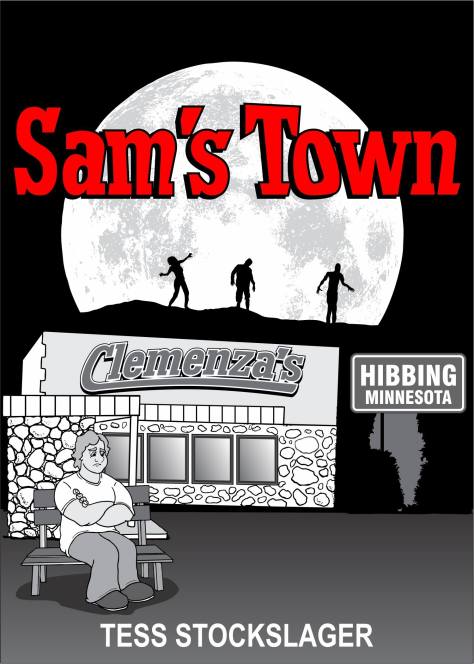
And now, the moment you’ve been waiting for: Here’s the cover of Sam’s Town! What’s your favorite part about it? I’ll pass your feedback along to the artist!

cover

Stay tuned for the official release announcement!

meet Adrian Fallon, who does not suck as a friend

Hi, everyone! I hope you’re enjoying getting to know the characters of my novel Sam’s Town, which is getting so close to being released. I saw a mock-up of the cover last week, and it looks awesome. I can’t wait for you all to see it.

Today, I’d like you to meet Sam’s best friend, Adrian Fallon. At one time, Adrian was basically a second protagonist. I had been written stories about Sam and Adrian for a few years before I decided to throw them into the zombie apocalypse and make a whole novel out of their adventures. Eventually, Sam came to be the main character, but Adrian still has some crucial point-of-view scenes, and I would argue that his friendship with Sam is the central relationship of the novel, even more so than the romantic connection, which I’ll talk about next week. Adrian and Sam have known each other for fourteen years–since their sophomore year of college. They’ve been through hard times together, eaten many pizzas, had many convoluted all-night conversations on various finer points of geekdom, and watched Night of the Living Dead too many times to count. Their personalities contrast, but they share some crucial hopes and fears, and they understand each other better than nearly anyone else in the world. They look out for each other, like brothers.

I mentioned last week that Adrian is more like me than any of my other characters (though Ramona, whom you’ll meet next week, is a close second). Like me, Adrian is a tense person who gets easily frustrated when he himself, other people, and the world don’t meet his high standards. (As you can imagine, the zombie apocalypse poses a problem for him.) Adrian worries–among other worries–that he isn’t the good friend that Sam needs and deserves, but he’s wrong about that. He’s empathetic and fiercely loyal, and if he says something hurtful in his irrational anger, as occasionally happens, he won’t rest until he’s apologized and done all he can to restore the relationship. All of these, I think, are qualities that Adrian and I share.

Here are a couple of fun facts about Adrian:

  • Speaking of things we have in common: Probably my worst physical habit is picking at my cuticles–especially those of my thumbs–when I’m nervous, sometimes to the point of making them bleed. I gave this habit to Adrian as well.
  • Adrian is from Boston, and I wanted to make him Irish-American but not to hit readers over the head with this. So I added a couple of subtle hints, one of which is that his mother, Eileen, used to make and sell “Celtic” clothing and accessories. I also gave him the last name Fallon, which is Irish but not to the point of caricature…
  • …and is also the last name of a musician whose work I enjoy, Brian Fallon, formerly of The Gaslight Anthem. Like Adrian, Brian Fallon has always seemed to me like a deep thinker and a frustrated person who wants to do what’s right. And Adrian is a musician too, a former high school music teacher who can pick up and play nearly any instrument, and who ends up using a broken guitar as a zombie-slaying weapon.

Here’s a scene about Adrian being frustrated:

It was thirty minutes since Adrian had left the restaurant. He knew this because he always wore a watch. He sat down on the edge of the mine nearest to the town and felt the blood and adrenaline coursing through his body.

The Hull-Rust-Mahoning Mine was nearly three miles long. Most of the zombies had been contained at the opposite end, but one had strayed down to this end—or, more likely, had fallen in from above, and was clawing uselessly at the steep, smooth wall of the pit. It hissed monotonously. Adrian concentrated all his anger on the zombie. He wanted to throw a rock at this idiotic creature that was too stupid to give up. He looked around in the moonlight for a rock he could throw. Although he was sitting on the edge of an enormous quarry, he didn’t see any rocks, which made him angrier.

Adrian lay on his back and looked at the pale, round, mild, stupid face of the moon. He put his forearm over his eyes to block the light. He tried to take deep breaths, but his lungs felt like somebody’s knees were pushing down on them. With a strangled cry, he scrambled to his feet and looked around. Nobody was there, of course. Adrian started running toward the far end of the mine.

Okay, so be honest (even though Adrian is like me, he isn’t, actually, me)–do you like Adrian? Do you think you’d want a guy like him around during the zombie apocalypse?

Stay tuned for next week, when we’ll meet the woman who loves the man that the novel is named after.

zombie book releasing soon!

My zombie apocalypse novel, Sam’s Town, is almost here! Thank you all for your patience. Soon I’ll have exciting things to share with you like the fabulous cover art and the all-important release date! I plan to throw a virtual release party, so stay tuned for information about that.

Over the weeks leading up to the novel’s release, I’ll be sharing excerpts centered on each of the novel’s six main characters. (I know–the number of characters makes this book sound like zombie Friends or zombie Saved by the Bell. Tell me in the comments which of those zombified shows you would rather watch.) In the meantime, share this post with your friends who like zombie stuff (especially George Romero’s films and The Walking Dead) or anyone who loves a good story about friendship, family, romance, pop culture, Italian food, and keeping your stuff together when the world is going crazy. I appreciate your support so much!


celebrity crushes, homeschooled geek style

I’m reading Eric Metaxas’ recent biography of Martin Luther, and it’s the first time in many years I’ve studied Luther in any depth. The first time was when I was in middle school. I don’t remember exactly what I read and/or listened to (there may have been some Adventures in Odyssey episodes involved), but I do know that through this process, I developed a crush on the German monk and reformer. Huh? I know. (Google a picture of him now if you don’t know.) It’s a bit baffling, but I don’t think it was his physical appearance I was drawn to. (Years later, though, Joseph Fiennes played him in a movie, and he looked pretty hot.) It must have been his earnestness in pursuing God’s true will for the Church, his clever and sometimes shockingly bold writing style, and the undeniably romantic way in which he met his wife, a former nun (he hid her when she escaped from her convent). And it probably had a lot to do with the fact that back then I didn’t know a lot of guys–young or old, living or dead.

Surely this factored greatly into my even less explicable crush, around the same time, on Union general Ulysses S. Grant, a short man invariably pictured as scowling and chewing on a cigar. And it’s not like he had a pretty face; actually, you can barely see his face in pictures because it’s covered in one of those full-face beards popular at the time. I don’t think I can explain this one, except that he did win the Civil War. Also, I remember reading that he used to get terrible migraines, and his wife would put a “mustard plaster” (I never understood exactly what this was) on his feet to ease his suffering. I guess I appreciated this humanizing weakness, as well as the humility and gentleness expressed by both parties in the anecdote. I don’t know. The ways of love are mysterious.

The next person I would like to tell you about has the advantage of being young and admittedly cute, but the disadvantage of being completely fictional, not to mention animated. Let me preface this by saying that one of my favorite Disney movies has always been Pocahontas. It was the last animated Disney film that came out before I got arbitrarily too old for Disney movies (roughly age 11), and I still think its music and color palette are gorgeous, even if the love story is as sappy as Grandmother Willow. (That was a tree pun.) You probably think I’m about to say that I had a crush on John Smith, but I didn’t. He was too old for me, too blandly handsome and boringly heroic. Nor did I go for Pocahontas’s arranged fiancee, Kocoum, nor her dad, though as an adult I can now appreciate his stately good looks. No, I was into Thomas, the wimpy redheaded sailor voiced by Christian Bale (though I didn’t know that at the time) who accidentally shot Kocoum because he was too nervous to hold his gun straight. Even now, I have to admit he has a sweet face. (Click the link above to see a picture of him, along with my brief review of Pocahontas.) And I’ve always liked his floppy hat.

I like to think that my celebrity crushes have matured over the years, but on the other hand, what’s more impressive–starring in a few movies or starting the Protestant Reformation? I’ll let you decide. I’d also like to hear about your early celebrity crushes.

update on Sam’s Town and Sam’s Home

I haven’t been blogging much this month because I’ve dedicated most of my writing time to editing my zombie apocalypse novel, Sam’s Town, and drafting its sequel, Sam’s Home. Today, I want to give you an update on how all that is going.

My editing of Sam’s Town is nearly complete. I am working through the wonderful comments given to me by a fellow author whose zombie knowledge, eye for sentence structure, and life experience as a young man (something I have never personally experienced!) have been invaluable. I have just a few chapters to go, so I may even finish up within the next few days. From there, my next steps will be to look at self-publishing options, procure a cover illustration (I’m hoping to commission an original work of art), and convert the manuscript from its current format into one that will work for publication. I am planning to release the novel as both an e-book, which I know some of my potential readers will prefer as more cost- and space-effective than a hard copy, and a paperback, because I don’t want to alienate those who don’t own e-readers.

Meanwhile, I have begun working on Sam’s Home, the sequel. Some have asked why I am not planning to combine the relatively short Sam’s Town (just over 50,000 words) and its sequel (which will probably be about the same length) into one novel. The main reason is that I have always thought of the pacing of my novels in terms of a movie. I think that if Sam’s Town were adapted into a film, not much editing would need to be done in order to make it a typical-length feature. I’m not saying this will happen, but it’s easy for me to wrap my mind around a film-like structure. Another, perhaps more important reason is that the ending of Sam’s Town brings Sam’s story to a place of equilibrium. His problems aren’t all solved, but he’s learned a major lesson, and there’s a moment of rest–a deep breath, if you will–before the events of the sequel.

Although Sam’s Home will continue with the themes (which I’ll discuss in a moment) and the style of Sam’s Town, there are a few differences. In the sequel, as in many sequels, the world gets bigger. In the first book, there were basically only six characters. In the sequel, while these six are still the focus, we meet a number of others who aren’t just background characters. Some of them are ill-intentioned, and this is another difference. Whereas in Sam’s Town, the antagonists were zombies and depression, Sam’s Home has some actual bad guys, which I think makes sense because we’re no longer in the opening days of the apocalypse. Bad guys have had time to organize. Another difference is that there are two concurrent plots. While Sam is still the main point-of-view character of one plot, for the other, we are inside the mind of Ramona, who has gone to Ohio to find her sister. It’s been fun for me to write from Ramona’s perspective because I didn’t do that at all in book one. Ramona has a number of superficial resemblances to me, but I’m finding out that we really aren’t that much alike (or maybe we are, and I’m in denial!).

Finally, for those of you who haven’t read or heard any of my novels or talked with me about them at length, I want to give you a little pitch for them, especially for you non-zombie fans. My novels really aren’t about zombies, though I hope that my obvious moments of homage to George Romero’s films and The Walking Dead will satisfy fans of the genre. My novels are about friendship, family, and mental health. I wanted to write about people who are woefully ill-prepared for the zombie apocalypse and show how, despite their clear deficiencies, they survive by taking care of one another. I see my novels as aspirational—not about the ugliness of human evil (though those books are important too), but rather about how we could treat each other if we valued each other. Value, or worth, is a major theme—Sam has to learn that he isn’t just a waste of space, but his life has meaning and is worth saving, even when he feels like there’s nothing he can contribute to the world. If that sounds like an important theme to you, I hope you’ll stay tuned. Sam’s Town is coming soon!