For your listening and reading pleasure

Today, I offer you some podcasts and blogs you should check out.

  1. This one is shameless self-promotion: I was recently a guest on my colleague Clifford Stumme’s pop music podcast.  In this episode, we discuss the story arc of Mumford & Sons’s first album, Sigh No More.  In other episodes, Cliff discusses the meanings of songs by a dizzying array of artists, not all of whose music you might have thought worth taking seriously.  He shows you that pop music (a term he defines broadly) is a lot more than just a great beat you can dance to.
  2. I mentioned the podcast Does Anyone Really Need to Hear This? on my blog years ago, and I think it’s time to give it another shout-out.  Mark Stockslager (who, if you couldn’t guess by the name, is my brother) gives his often strong opinions on movies, books, TV, music, sports, and more.  His most recent episode, is a good one to start with, because in it he introduces some regular segments on some of the above-mentioned topics.  In another recent episode, he and his guests analyze–a more appropriate word would be “dismember”–the season 6 finale of The
    Walking Dead
    .
  3. Another colleague recently sent me two articles from the religion, arts, and culture blog Mockingbird, based out of Christ Episcopal Church in Charlottesville, VA.  The two articles he sent me (this really long but worthwhile one and this shorter one) are both about Harry Potter (people are always sending me Harry Potter stuff, which is fine by me!), but I’m looking forward to reading what these thoughtful bloggers have to say on other topics as well.
  4. If you work at a desk on a computer all day and aren’t using Spotify Free to provide a soundtrack to your day, why aren’t you?  I mostly listen to post rock (Spotify has a good playlist for this genre) and movie scores because they don’t have lyrics to distract me, but they also aren’t boring.  As I write this, I’m listening to John Powell’s exciting scores to the How to Train Your Dragon movies.

Now you have your assignments; go read and listen!

Solitude.

Last week I wrote about my plan to observe a weekly Sabbath rest; now, as the next step in plotting out my rule of life (see my July 15 post for a full explanation), I’d like to tell you about my experience with solitude this past Saturday and how I intend to fit this practice into my life.

On Saturday, I spent three hours in one of the group study rooms in the library at my university, which is quiet on a Saturday afternoon at this time of year.  Not by any particular plan (except maybe God’s), I ended up in a room looking out on the rooftop garden, so I got to see a lot of bees pollinating flowers, which ended up figuring into one of the spiritual observations I recorded in my journal.  I don’t think it’s any accident that some of Jesus’ most famous teachings began with invitations to look at the birds and consider the flowers.

I spent these three hours in fulfillment of a post-class assignment in the Regent College course Taking Your Soul to Work, which inspired my effort to create a rule of life.  I was instructed to spend three hours in complete solitude, using the Bible and the book Taking Your Soul to Work (by the course’s instructors, R. Paul Stevens and Alvin Ung) to identify and meditate on my greatest workplace sin/struggle (I chose anger) and the fruit of the spirit that corresponds to it (gentleness, according to Stevens and Ung).  The prospect of three hours of complete solitude was no big deal; I live alone and enjoy being alone, so I occasionally spend entire days without seeing anyone.  But three hours of slow reading, prayer, and thought, without anything tangible to show for it besides some navel-gazing journal entries–that isn’t something I generally do for fun.

I should be honest: I didn’t spend the whole three hours in that one room.  I got up a few times to use the restroom and the vending machines, and I did see a few people; I just didn’t interact with them.  Yes, I ate some snacks; fasting is a separate discipline that I might write about in a future post.  And I did listen to some instrumental music on my iPod; silence is also a separate discipline that is often combined with solitude but is not essential to the practice.  Different people might want to try the discipline of solitude for different reasons, but for me, the main point of the exercise was to 1) focus my concentration on a single activity for a long period of time (this is very difficult for me, which may surprise people who know that I love to read and have written a dissertation) and 2) meditate slowly and deliberately on what God wants to say to me, without immediately jumping to application (this is very difficult for a lot of evangelicals, I would venture to say).

I wouldn’t say that I received any earth-shattering revelations during those three hours, but I did fully recognize–in some cases for the first time–some things about God’s gentleness, my own deep desire to control everything, and the absolute necessity of contentment to the Christian life.  Of course, another topic of meditation might have taught me something entirely different, and that’s the lovely thing about solitude–what you do with the solitude is up to you, so the experience can be different every time.  I plan to incorporate this discipline by taking one of these three-hour mini-retreats quarterly–i.e., every three months.  I should add, by the way, that the three hours seemed to go by much more quickly than I expected.

If you’d like to share your own experiences with either Sabbath rest or solitude, or if you’d like to tell how you plan to incorporate these disciplines into your own life, please comment below!

Mumford and Sons revisited

Three years ago, I wrote one of my most popular posts of all time, a review/listening guide for Mumford and Sons’s first album, Sigh No More.  I always thought I might do something similar for their second album, Babel, but I never got around to it–though I must say that I think it’s a great album.  I disagree with those who considered it a sell-out album; the band was just getting better at writing tight, radio-playable folk-pop songs, a skill that should not be denigrated.  Now that Mumford and Sons is/are about to release their third, stylistically very different album, I’m returning to them on my blog–but not to write about their music.  This time, I want to mention a couple of things I appreciate about the way the band members present themselves physically, which, as I think we all know, can be nearly as important in our day as the music itself.

1. Have you seen Winston Marshall’s hair lately?  It’s beautiful.  I realized this as I watched him tossing it around during the band’s frenetically kinetic performance on SNL this past week.  Sometimes long hair, on a man or a woman, can look lank and stringy, but not so on Winston.  I love the fact that he’s just letting his rather thick hair go where it pleases instead of trying to tame it.  That’s usually been my own personal hair styling method as well.  I have a lot of respect for people (particularly for women) who just let their hair be awesome even if it doesn’t look put-together according to the current definition of what put-together hair looks like.  You should not be surprised to know that my hair role model is Helena Bonham Carter.

my hair role model

my hair role model

Nice job, Winston.

Nice job, Winston.

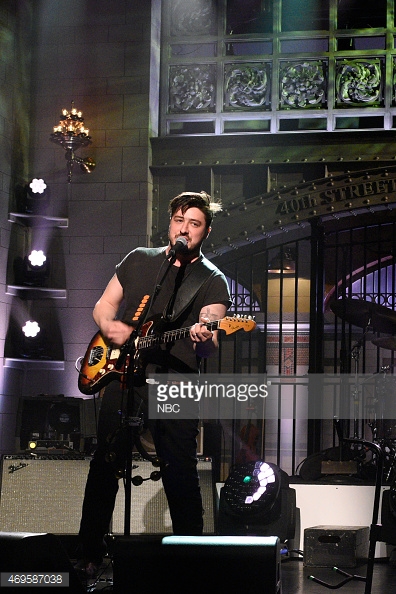
2. While watching the same performance, I was confirmed in my long-held belief that Marcus Mumford is very attractive.  He’s not like my number-one celebrity crush, but I like a lot of things about the way he looks (but please note, Marcus, that the small mustache is not one of them).  I like how, speaking of hair, he has a little piece that insists on sticking up–it’s so Harry Potter.  I also love that he’s not ashamed to contort his face in order to express emotion while singing.  His face looks like it’s going to break, but that’s how he gets that gut-wrenching sound that’s part of what makes this band distinctive.  Probably my favorite thing about Marcus, though, is that he doesn’t look like the heroin waif we typically picture when thinking of a rock ‘n’ roll front man.  Now understand me, he isn’t fat.  But he definitely has a soft belly.  And his face isn’t chiseled or angular or gaunt by any means.  And I would guess the only bicep toning he gets on a regular basis comes from playing the guitar like a maniac.  You can really see this in the SNL performance, in which he’s just wearing a t-shirt (and trousers, too–geez, people), since tweed jackets and vests are no longer part of the Mumford and Sons uniform.  I have a lot of respect for this very noticeable, if not flagrant, disregard for a long-established stereotype.

There’s entirely too much body hatred in our world today, and the music industry often hurts rather than helps.  So it makes me very happy that the members of Mumford and Sons–none of whom exactly look like gods of rock–seem to be totally cool to just, as they put it in the last song on Babel, “be who [they] are.”

Huge props to the pudgy rockstar

Huge props to the pudgy rockstar

music about places

Some of my favorite music is the kind that tells a story about a place, or in some cases, not just a story but a whole novel.  In that latter category I put Bruce Springsteen’s “Jungleland,” which ranks with Charles Dickens’s Bleak House in its ability to evoke a city with its depravities, deprivations, and transitory beauties all jumbled together.

Other music is less specific in its description, relying more on sound than on lyrics to call up a picture of a place.  U2’s The Joshua Tree instantly takes me out West, and I know that’s largely because of the album title, but it’s also in the music itself.  As proof of this, I don’t picture the southern California location of the actual Joshua Tree National Park when I hear this album; I actually think of somewhere more like where Nevada meets Idaho.  (N.B. My brother recently said that U2’s music is more American than John Mellencamp’s.  Harsh but true.)

Two of my favorite composers are Aaron Copland (his “populist” works) and Ralph Vaughan Williams, whose music would strongly suggest their respective countries even if they didn’t incorporate famous national folk tunes.  I just read something interesting on Wikipedia: Copland didn’t actually call his famous ballet Appalachian Spring; someone else gave it that title later.  His goal was just to write “music for an American ballet.” (http://en.wikipedia.org/wiki/Aaron_Copland#Popular_works)  This probably explains why I don’t picture the Appalachians when I listen to it; I think of someplace flatter (hence bigger), like Oklahoma.  The point is that I definitely think of America.

One of my favorite things to do in the whole world is to listen to music while driving–any music will do, but the best is music that fits the place I’m driving through.  I love to turn on my Avett Brothers Pandora station while I’m driving back to Lynchburg, VA, after visiting my family in Pittsburgh, PA.  My route stays just east of the Appalachians, in the foothills, pretty much the whole way.  The Avett Brothers are actually from North Carolina (which is close enough), but the kind of music that comes up on the station is more broadly country–and here I don’t mean that extremely popular genre that comes out of Nashville; I mean from the country, the part of America that used to be the frontier back when all the fancy people closer to the coast were creating the United States of America on paper, although now it’s usually just lumped in with the East.  I grew up hearing this kind of music and didn’t appreciate it then.  Now I think it’s so beautiful it sometimes makes me want to cry.

Then there’s the whole category of music that I associate with a particular place not necessarily because of anything in the music itself, but because I had an early or memorable experience with that music in that place.  I still like to listen to my Coldplay library when I’m on an airplane (which is a type of place, right?), because on my first truly long flight, to the U.K. in 2009, I listened to their albums on my iPod all night, coming in and out of sleep to hear Chris Martin’s familiar falsetto.

I could go on, but I’ll turn it over to you.  What songs, albums, or artists make you think of places, because of either the lyrics, the music, or some association personal to you?

my continuing Dickens obsession

I have an ongoing love for Charles Dickens, but my devotion sometimes hits these especially high peaks, and I’ve been on one of them for the past couple of weeks.  I finished reading A Tale of Two Cities last weekend (see my last post for an earlier observation), and I read A Christmas Carol yesterday and today.  (Of course, this wasn’t my first time through either book.)  I can’t wait to lead a discussion of Carol at the Liberty University Bookstore on December 2.  In the meantime, I’ve engaged in two particularly nerdy expressions of my love for Charles.  Please enjoy.

1. The story of Jerricho Cotchery.  I’ll try to make the frame narrative short: I’m eating out with two of my work colleagues, and there’s a Thursday night football game on TV.  One of us mentions McSweeney’s delightful piece called “NFL Players Whose Names Sound Vaguely Dickensian.”  Later I look up at the game and notice Jerricho Cotchery, who catches my eye because he’s a former Steeler (current Panther).  I realize that if Jerricho Cotchery were in a Dickens novel, he would definitely be a Methodist minister.  He would have a lean and starved appearance, and his ears would stick out from his head at exaggerated angles.  When he preached, his voice would take on a ranting cadence.  Then my co-worker/friend Kristen and I rapidly concoct a plot in which Dickens attempts, unusually for him, to sympathize with a Methodist minister.  I wish I’d written down some notes from this impromptu creative session, but I do remember that Jerricho Cotchery is in love with a happy, useful, and modest young parishioner named Evangeline, and that in the past he did some undefined injustice to Oliver Twist, for which he now feels horribly remorseful.  I hope to return to this story at some point, so if you have any good ideas for Jerricho, let me know in the comments.

2. The Sydney Carton playlist.  I’m really obsessed with A Tale of Two Cities right now.  I went so far as to make a Spotify playlist for Sydney Carton, and it’s a far, far better playlist than I have ever made.  (Actually, it’s my first Spotify playlist.)  You should be able to find it by searching “Sydney Carton.”  If you find a 10-song playlist by Tess Stockslager, you’ve got it.  Here’s your guide to the songs: The first four are anthems for a wasted/purposeless life, with a particular emphasis on songs about drinking, because–let’s face it, friends–Sydney is an alcoholic.  The next three songs are about unrequited love and/or heartbreak; I think it’s pretty clear why those are on there.  (As Lucie says at one point, “He has a heart he very, very seldom reveals, and . . . there are deep wounds in it. . . . I have seen it bleeding.”)  The next two are about people deciding they don’t want to waste their lives anymore; this corresponds to that point in ATOTC when Sydney starts hanging out with the Darnays in the evening instead of with his stupid boss/”friend”/enabler Stryver.  And the last song is about what Sydney wants to do, and finally succeeds in doing, for Lucie and her family.

So, put on the playlist, and get ready to dance, then cry, then dance again, then cry again.  Or, put on the playlist and read A Tale of Two Cities.  And while you’re at it, don’t forget about Jerricho Cotchery.

Things you need to know before watching War Horse

Over the past month or so I’ve watched several long movies. (I consider a long movie to be about 2 1/2 hours. Anything longer than that is a Peter Jackson movie.) These require a major time commitment, so I’ve been rating them on a scale according to how good of a return on my investment I feel I’ve received. They’ve ranged from “OMG I need to call somebody right now and talk about this and then watch it again as soon as possible!” (Prisoners) to “I could have done something much better with those 2 1/2 hours (or with those actors, actually)” (Cloud Atlas).  Gone Baby Gone fell somewhere in the middle.  It was very good, but it didn’t quite suck me in the way Prisoners did, which is probably a good thing for my mental health.

This past week I watched a long movie that I gradually came to realize was really good.  I think I would have realized this about War Horse (2011) earlier (like, before I was over halfway into the movie) if someone had told me what to expect.  So I’m going to tell you some things you need to know about War Horse, and then you should watch it and tell me what you think.

1. The two main characters of this movie are in the title: the war (World War One, or the Great War) and the horse (Joey, a beautiful thoroughbred that even I, by no means a horse connoisseur, could appreciate).  Beyond these two, there is little character development, although you do get to know the central lad (I call him this because he’s somewhere between a boy and a man) and his parents fairly well.  Do not allow yourself to get attached to the other characters.  People die in wars.  And in this movie, even if they don’t die, the flow of the story will steal them away from you.  (See #2 below.)  

Another way of putting this: Don’t watch the movie for the actors.  Benedict Cumberbatch fans, he makes one big speech, gets berated by a German officer, and then is outta here.  David Thewlis fans, don’t expect Remus Lupin.  In this movie, he’s mean and sarcastic and wears ugly tweed suits.  This is not any particular person’s movie, except maybe Steven Spielberg’s.  It’s very telling that there are no opening credits.

 photo-cheval-de-guerre-war-horse-war-horse-424287259

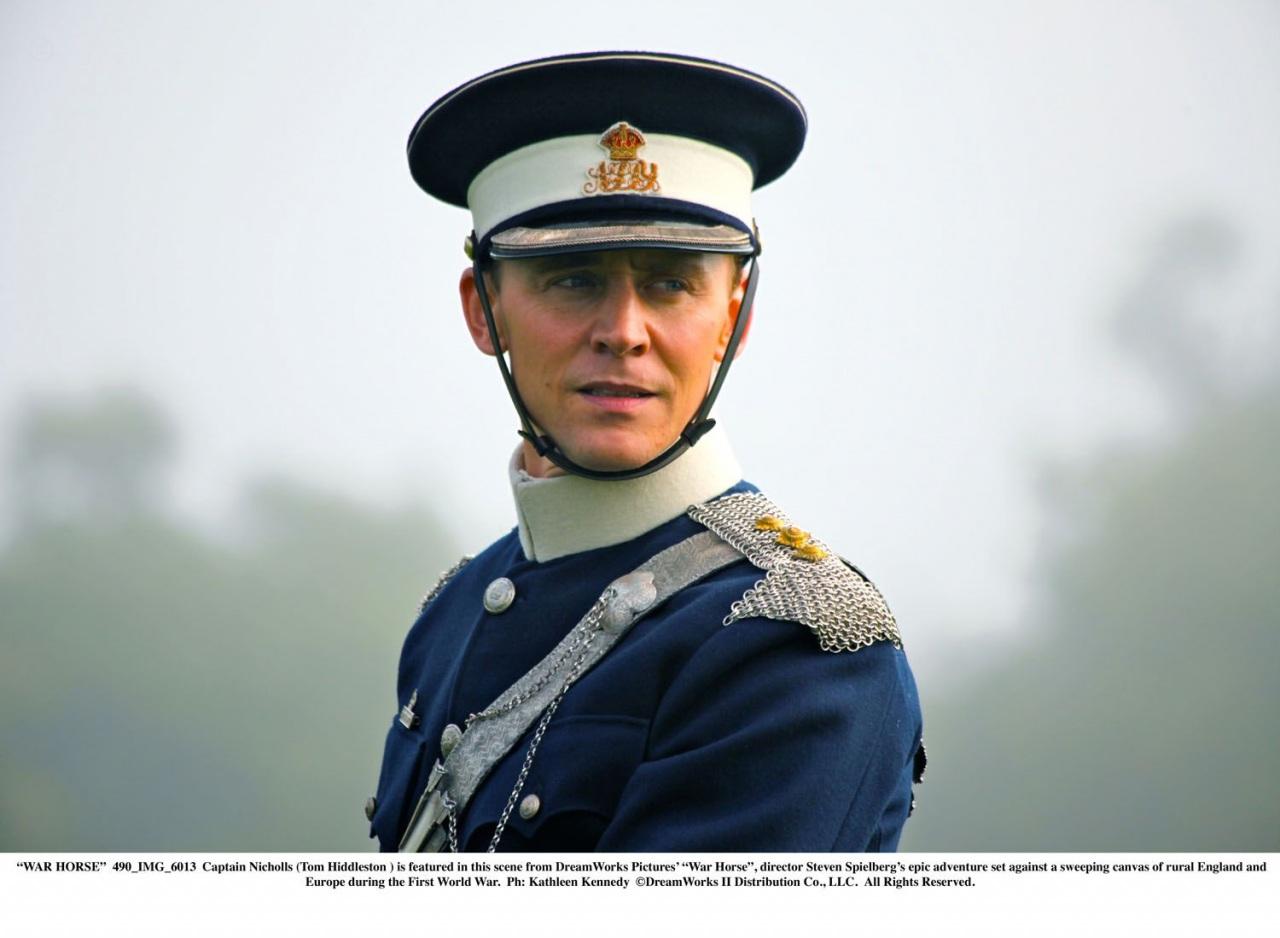
Don’t get attached to Tom Hiddleston’s beautiful face.  You won’t be seeing it for long.

2. This movie is episodic.  It does have one overarching plot (Will there be a reunion between the horse and his boy?), but within that it’s composed of short vignettes tied together by Joey.  This is really cool because you get to see the war from a variety of perspectives, but it is jarring if you’re not expecting it, since we’re so little used to narratives told this way today.  Now that I look back on the movie, I think the episodic nature helped me to enjoy it, because it made the movie feel shorter than 2 1/2 hours.  Be warned, though: the first half-hour, before the war and the vignette-hopping start, is a little boring.  BUT see #4 below.

3. There is very little fanfare in this movie, and I think that’s healthy in a war picture.  This is especially the case with the dialogue.  There is exactly one inspiring speech, and its function is to show you that inspiring speeches (like drawn-sword cavalry charges) have no place in modern warfare.  The dialogue in general is very simple, almost to the point of banality.  But that’s how real people talk, so I much preferred this to the cheesy, overblown banter and speech-making that you often get in war movies.  Just don’t expect to be trading War Horse quotes with your friends after you watch this.  It’s not a quotable movie.

4. Although I said that the first half-hour is a little boring, I must qualify this by saying that the Devon (England) countryside is a feast for the eyes: green pastures, blue skies, gray stone cottages.  But it feels real.  (There’s a lot of brown mud too.)  Also, the very last scene of the movie has this spectacular orange sunset that throws the human figures into these breathtaking silhouettes.  Seriously, even if you hate the whole movie (but you won’t), you have to keep watching for this scene.  And while we’re on the subject of beauty, the score, always an important factor for me, is John Williams doing his best Ralph Vaughan Williams impression–which is not a dig at John.  I just mean that nobody will ever be Ralph Vaughan Williams again, but this score, with its strong English folk song influences, comes respectably close.

Ok, I think you’re now prepared to watch War Horse.  If you do, please comment below and tell me what you think!


a cousin story

On a roll, I wrote another scene for the piece I mentioned in my last post.  I’m calling the overall piece Cousin PercyAfter reading this scene, you will have met all the cousins except for Peter, the one who’s still in college.  I intend for quiet, self-effacing Peter to be the one who unexpectedly breaks through to the frustratingly uncommunicative Percy, but I haven’t quite developed that idea yet.  In this scene, you’ll see just how frustratingly uncommunicative Percy is.  You need to know that Percy doesn’t yet know that Harry was once married and has a rather sad back story.  He thinks he’s got Harry all figured out.  This scene is shorter and, I think, funnier than the last one I posted, but you should still be able to feel the underlying tension.  By the way, I promise that my next post will be on another topic.

Three nights before Christmas, Harry Sinclair sat in a dim, deeply-recessed booth in the corner of the pub nearest the door, nursing a bottle of cream soda and watching the acoustic band intently.  During a particularly loud moment in one of the American folk songs the band was valiantly plowing through, his cousin Percy, whom Harry had known for exactly four days, approached the booth, carrying a pint and wearing the leather jacket that, Harry had already decided, made him look like a Liverpool dockworker circa 1959.

“This is the only empty seat in the place,” said Percy by way of explanation.

“Well, sit down!” said Harry in an unnecessarily expansive voice that sounded, to both men, a bit false.  “What brings you here on this cold evening?”

“Why does anybody come to a pub?” Percy replied flatly as he sat.  “Having an ale.  What are you doing here?”

“Why does anybody come to a pub?”  Harry paused before continuing, “I’m spying on my employee.”

Percy grunted into his pint, possibly indicating interest.

Harry took the indication and ran with it.  “He’s the one on the stool at the front of the band, playing the guitar.”

“The fat kid?”

Harry rolled his eyes.  “Totally unnecessary, but yes.  He’s the portly chap who’s singing right now.  That’s Sam.  He helps me out at the shop.”  Harry made a slight confidential lean toward his cousin; Percy made no response of any kind.  “So I’ll say to him at the end of the day, ‘What are you doing tonight, Sam?’  Just making conversation.  And he’ll always say something like, ‘Oh, I guess I’ll just go home and watch TV.'”  Harry said this in an exaggeratedly glum voice.  “Only he’s a Scotsman, but I can’t do his accent right.”

Percy cleared his throat, which Harry took as another sign of engagement.  “So the other night, I’m leaving the shop, and I see him sneaking in here with a guitar case like he’s about to do a drug deal.  So I said to myself, I can be sneaky too, and the past few nights I’ve been hiding in this booth, thinking, hey, this kid has got some talent.  But the next day, not a word about it from either of us.  So tell me, why do you think he’s trying to hide this from me?”

Percy took a swig of ale and said nothing.  Harry sighed.  “Did you hear anything I just said?”

The cousins stared at the band for a few minutes before Percy looked down and asked, incredulously, “What are you, having a cream soda?”

“Yes, I’m having a cream soda,” Harry replied, glad his cousin was making an effort at conversation.

“Don’t you drink, or what?”

“No, I don’t drink anymore.”

“What were you, a wino or something?”

“I wasn’t a wino,” Harry retorted, beginning to think the uncomfortable silence was preferable.  “I just don’t like myself when I drink.  I’m sarcastic–and obnoxious.”

Percy snorted.  “Only when you drink.”

Harry turned in his seat, trying to force his cousin to make eye contact.  “Well, I think that’s a pretty rude thing to say considering you hardly know me.”

“Oh, I know you,” Percy said into his glass, not looking at Harry.

Harry clenched his hands under the table, determined to remain civil.  “Well, I’m afraid I can’t say the same about you.  Why don’t you ever tell us anything about yourself?  We’re family and all.”

Percy shrugged.  “There’s nothing to tell.”

Harry gave a short, humorless laugh.  “I know you know that I know that that’s bullshit.”

Percy made no sign that this assessment fazed him.  The cousins lapsed back into silence.  The band was playing a twangy song about Raleigh, North Carolina.  Harry tried again.  “I don’t get the fascination these lads have with playing all this American local color stuff.  I mean, half the people in this town have never been more than two hours away.  What do they know about Raleigh?”

“How do you know where they’ve been?” Percy asked, still looking straight ahead.

Harry shrugged.  “I fix their cars; they talk to me.”

The band had moved on to a plaintive song about the Blue Ridge Mountains.  “Have you ever been to the States?” Harry asked.

“Yeah.  Lived there for a while.”

“Oh!” exclaimed Harry, pleasantly taken aback by this rush of self-disclosure.  “Where did you live, exactly?”

“New York City.”  Percy was not equally excited by the conversation.

“Ah, indeed,” said Harry, like someone who knew.  “Where else?”

Percy paused in lifting his pint and gave his cousin a sidelong glance.  “What’s that supposed to mean?”

Harry didn’t actually know what he had meant.  “I just thought…New York City was a sort of melting pot,” he replied lamely.

Percy sniffed–laughed, possibly–and finished taking that drink.

“So, was it a nice place to live?” Harry asked, determined to press on.

“No.”

Harry nodded, hoping for but not really expecting more.  “And…are you going to tell me about it?”

“No.”  Percy put his empty glass down hard on the table and slid out of the the booth.

“I didn’t think so,” said Harry to his cream soda.



Movie score geekout

It’s that time of year when I write a lot of posts about movies! This will be a quick one. I’m not sure if I’ve mentioned this fact on my blog, but I’m kind of a movie score connoisseur. I’m the person who tells my friends, whether they care or not, that the same person who composed the score to Forrest Gump also composed the score to Captain America (that’s Alan Silvestri).  I have a favorite film composer, Thomas Newman, whose beautiful score was one of the many wonderful things about Saving Mr. Banks, a movie everyone should go see.

But for the past couple of days, I’ve been thinking a lot about Patrick Doyle, an underrated composer best known for scoring many of Kenneth Branagh’s films, although he’s done much more.  Although Doyle has composed a few quiet, subtle scores, such as the piano-driven Sense and Sensibility soundtrack, he is at his best when he’s in his joyful and triumphant mode.  For me, a movie score can be just as good as a rock concert for a fist-pumping, adrenaline-rushing  moment, and when I want that, I often turn to Patrick Doyle.  Here is a list of my top five life-affirming P. Doyle tracks.  In most cases, the track I mention is at the very end of the movie.

1. “Merida’s Home” from Brave

2. “Thor Kills the Destroyer” from Thor

3. “Strike Up Pipers” from Much Ado about Nothing (1993) Note: Spotify lists the composer of this soundtrack as “David Snell.”  This is base slander.  I have no idea who David Snell is.

4. something from Harry Potter and the Goblet of Fire.  I couldn’t pick a favorite track here; they are all great.  I love “Hogwarts’ Hymn,” from the credits, but it’s not quite the “fist-pumping” experience I described above.

5. “Papa!” (starting about 1:30) from A Little Princess, which I only recently realized that Patrick Doyle scored.


Christmas miscellany

In my December 5 post I mentioned that I was considering writing a post on Stevie Wonder’s song “Someday at Christmas,” a Christmas song that I’m not ashamed to say makes me cry.  But the post I was crafting in my mind sounded a lot like the one I had just written about “Hark! The Herald Angels Sing” (i.e., me waxing poetic and theological about a song which I would then quote), so I decided not to bore you.  Instead, I’ll briefly mention my thoughts on that song in my list of assorted observations I’ve made so far this month about classic Christmas music and movies.

  • If you believe Jesus is going to come a second time and recreate the world as a place of peace and justice, listen to “Someday at Christmas” with that in mind.  It would only take one or two little tweaks of the lyrics to make it an eschatological song.
  • You know that bird on the Island of Misfit Toys who doesn’t fly . . . he swims?  And you know how during the end credits of Rudolph, that elf in Santa’s sleigh sends each toy down to earth with an umbrella to ensure a safe and pleasant landing?  Well, the other night my friends and I noticed that THE ELF DOESN’T GIVE THE BIRD AN UMBRELLA!  I shouted, “That bird can’t fly!” and everyone laughed, but it was a rather tragic moment for this bird lover.
  • I watch White Christmas pretty much every year, and while it’s hard to resist Bing Crosby’s smooth, warm voice and soulful blue eyes, my real White Christmas crush is Danny Kaye, so debonair when he’s dancing and awkward when he’s not, and adorable either way.*  Until last night, I had always been under the impression that Danny Kaye was an unusually tall man, mainly because his ankles always seemed to be sticking out.  But last night when I was watching White Christmas, I looked closely at that scene near the end when all the soldiers are lined up to honor General Waverley, and I noticed that DK is actually shorter than the guys on either side of him.  So I looked him up on Wikipedia this morning, and it turns out that he was 5’11”–not short by any means, but not unusually tall.  I think one reason he looks tall in White Christmas is that he’s always next to Bing Crosby, a relatively little guy at 5’7”.  But another reason–the reason Danny Kaye’s ankles always seem to be sticking out–is that he’s often wearing his pants too short in what I believe is a deliberate move to show off his awesome socks, such as the mustard yellow ones he’s wearing in the scene where he fakes a broken ankle.  He executes this sartorial maneuver long before it was cool, of course, and it’s just one of several proto-hipster clothing choices that Danny Kaye–or at least his character, Phil Davis–makes throughout the movie, including a deft use of the cardigan.

Perhaps I’ll have some more epiphanies (no holiday pun intended) while watching The Muppet Christmas Carol, Love Actually, and any other Christmas movies I may end up watching over the next week, or while listening to Christmas music, such as the instrumental “Victorian Christmas” albums I was listening to earlier or Bing Crosby’s White Christmas (not affiliated with the movie), which I’m listening to right now.  Let me know about any keen observations you may have had as well!

*Speaking of Christmas movies and crushes on now-deceased actors, can I get a witness to Jimmy Stewart’s gorgeousness in It’s a Wonderful Life?

Born to raise the sons of earth

It’s that time of year again when we celebrate the founding of this blog (thanks for another great year, dear readers!) and–far, far more importantly–the advent and incarnation of Jesus Christ.  If you’re new to my blog, I should tell you that each December I write several posts about my favorite Christmas music, movies, experiences, etc.  This year I’m thinking of doing one on Stevie Wonder’s “Someday at Christmas,” but first, I want to tell you about my favorite Christmas hymn.

What’s the Christmas song you’ve known the longest–maybe one associated with your earliest memories of Christmas?  Mine is “Hark! The Herald Angels Sing.”  I’m pretty sure there’s a video of me singing snatches of it as a toddler.  It’s really an odd song for a little kid to be singing, because it’s full of weighty doctrine and includes some archaic language.  My understanding of it at the time must have been far from perfect.  I think A Charlie Brown Christmas was the reason I knew it.  Remember how near the end of the show the kids all stick their noses up in the air and “loo, loo, loo” to the tune (all lowering their heads and breathing at exactly the same time)?  Then during the end credits they actually sing the lyrics.

I still love “Hark! The Herald Angels Sing,” both for the music and for the lyrics.  The tune, by the well-known classical composer Felix Mendelssohn, is the perfect vehicle for the song’s strong message.  It’s both joyful and stately; it’s complex and wide-ranging yet very singable.  You won’t find any creative young worship leaders trying to write a new tune to this song.

And the lyrics, by Charles Wesley, are even better.  In just three verses, this song elucidates the paradox and mystery of Christmas: God, who has no beginning, was born.  The eternal Christ became a human baby named Jesus, yet he remained God at the same time.  The end of the song also tells why he came.  If you want to know what Christmas is all about, you can ask Linus and get a very good answer from the gospel of Luke, chapter 2.  You can also fast-forward to the end of A Charlie Brown Christmas and listen to this song.

Hark! the herald angels sing, “Glory to the newborn King;

Peace on earth and mercy mild, God and sinners reconciled.”

Joyful, all ye nations, rise, Join the triumph of the skies;

With angelic hosts proclaim,” Christ is born in Bethlehem.”

Christ, by highest heav’n adored, Christ, the everlasting Lord;

Late in time behold Him come, Offspring of a virgin’s womb.

Veiled in flesh the Godhead see, Hail, th’ incarnate Deity!

Pleased as man with men to dwell, Jesus our Emmanuel.

Hail the heav’n born Prince of Peace! Hail the Sun of Righteousness!

Light and life to all He brings, Ris’n with healing in His wings.

Mild He lays His glory by, Born that man no more may die;

Born to raise the sons of earth, Born to give them second birth.