I believe in America.

Because it’s the Fourth of July, and because I indicated last week that I’d be writing about the Godfather trilogy again, I titled my post with the first line of the first film.  In the opening scene, a minor character whose daughter was assaulted by two young men, who were given what he sees as a lenient penalty, is asking Don Vito to help him avenge her.  Fascinatingly, he begins with this qualification, following it up with “I have raised my daughter in the American way.”  It’s like he feels compelled to defend his chosen country before he goes on to express his frustration with its (in his perception) slow, unfair, and heartless (that is, emotionless) justice system–especially for immigrants like himself.

I’ve written elsewhere about how the Godfather trilogy, in addition to being an amazing family saga, is a story about the Italian-American immigrant experience in the 20th century.  But right now I want to focus on those interesting opening words: “I believe in America.”  If you insert the name of another, older nation in that sentence, it doesn’t sound right.  You can love (for example) England, but you probably wouldn’t say that you believe in it.  That’s because America is an experiment, and on the timeline of world history, it’s still a relatively new one.  Another family/political drama I enjoy watching, the AMC show Turn: Washington’s Spies (as in George Washington), makes clear just how close this experiment came to never even getting off the ground.  So if I say that I believe in America, I’m implying that I’m rooting for the American experiment to turn out okay–and that I’m still waiting to see the outcome.

That’s why it’s possible to be a loyal American and still acknowledge times when the experiment has gone off track (and, at risk of getting slightly political here, I would say that immigration, in general, has been one of those areas where America’s efforts have often been clumsy).  In fact, I’d say that it’s imperative to acknowledge those times if you’re a person who truly loves and believes in America and wants what’s best for it.  This reminds me of a conversation I had a couple of days ago in which I was trying to explain Bruce Springsteen’s “Born in the USA” to a friend.  I started by saying that it’s not a patriotic song, and I would still say that it’s not, if by “patriotic” you mean uncritically proud of America.  But I concluded by saying that it’s also not an anti-American song.  For all of its references to the ugly, confusing war in Vietnam and the hardships of growing up in working-class East Coast towns where the factories are closing down, that song really isn’t saying “America is great” or “America is bad.”  It’s just saying, “Living in America is hard,” which is the same as saying, “Life is hard.”

Of course, I need to qualify what I just said by adding that there are a lot of countries where life is a lot harder than it is in America.  Nobody can deny that our standard of living here (and I’m not just talking about money, though that’s certainly part of it) is much higher than in most of the world, and we’re foolish if we’re not grateful for that.  But we should also acknowledge that America is a really big country, so my American experience is not going to be the same as yours.  And for some, life here isn’t easy.

So, America–I believe in you, and I’m cheering for you.  And I’m thankful that I’m allowed to speak up when I think you’ve made a mistake.  But I think you’re doing pretty well, all things considered.

Everybody’s got a hungry heart

I am writing this post from a fog of hunger.  I did just eat a little container of hummus (150 calories) and five naan dippers (another 150), but I don’t think the energy has kicked in yet.  So bear with me.

Last week I started participating in an eight-week weight loss program sponsored by my employer.  When I first signed up, in April, I referred to it as a “wellness” or “fitness” program because I couldn’t bring myself to say the dreaded WL phrase.  And even now, as I’m writing this, a whole host of qualifiers comes clamoring to my mind because I feel like I need to justify my participation to you (and to me): “I don’t want or need to lose a lot of weight, just ten pounds.” Or “I’m doing this because I’m planning to run a half-marathon at the end of the summer” (thereby letting you know that I’m already an active person).  I.e., I don’t really need to lose weight, at least not as badly as that other employee that I just saw walking down the hall, who should have been the one to sign up.  Etc.  In fact, when I showed up for the first session last Tuesday, I kind of hoped they would send me away–“Oh, you’re too skinny for this program!”  But they didn’t.  So I finally had to admit that maybe I actually needed to be there.

That was the first hurdle to be leaped (not that I’m quite up to jumping hurdles yet.  Next obstacle: Committing to a daily calorie goal.  I really, really hate counting calories.  In fact, I have serious philosophical problems with the whole idea of treating food as nothing but fuel.  I’m pretty sure chefs think of themselves as artists, not bioengineers.  And we all recognize that a gift of food–especially homemade–is a lot more meaningful than a free tank of gas, monetary value aside.  (See my post called “food speaks.”)  In addition to my theoretical objections, I hate the inconvenience of having to know or guess the caloric content of everything I eat.  What about the chicken jalapeno popper soup that was already in my refrigerator when the program started, which I made from a recipe that didn’t include nutrition facts?  It has a lot of fresh vegetables in it, and one of the main ingredients of the “creamy” broth is cauliflower, so it’s actually pretty healthy.  But I don’t know how many calories are in it, so I end up making a guess that’s probably wildly inaccurate.  And I know it’s cheating to lowball the estimate, so I guess high–and probably cheat myself out of 100 calories I could have eaten.  (Maybe that’s why I’m so hungry this afternoon, come to think of it.)  Ironically, this calorie-counting thing has me cooking less and eating more packaged foods: at least this way I know what to record in MyFitnessPal.

The exercise part is the easiest for me; as I mentioned (and I’ll say it again, in case you missed it the first time), I’m already a pretty active person.  This works to my advantage because, logically, I get to add calories onto my daily intake whenever I exercise.  So I’ve been doing this thing that I’m pretty sure is antithetical to the spirit of this program: If I’m getting toward the end of the day and I realize I’m not going to have enough calories left to eat a snack while watching Fear the Walking Dead, or whatever, I’ll get in a quick extra workout to buy myself some more calories.  I actually worked out three times on Sunday, and I had three snacks during Fear (hey, it was the two-hour season premiere).

I’m fully aware of how pathetic this is.  I also know that when I go back and read through this post, I’m going to hate how whiny I sound.  And I already want to apologize to Bruce Springsteen for appropriating his song title because it was the first clever saying with the word “hungry” in it that I could think of.  But I’m going to go ahead and post this before I change my mind because I think some of you can relate.  And we all like reading about stuff we can relate to.  Now to find out how many calories are in a fun-size 3 Musketeers, because I’m still hungry.

all of your Oscar questions answered

Ok, so my title is shameless click bait.  I don’t know what all of your Oscar questions are.  But I know the questions that are generating the most buzz in my own circles, so I’m going to extrapolate from said buzz and assume that you’re asking some of the same questions.  And then I’m going to answer them from the perspective of an amateur film critic who’s seen more of the nominated movies than the average American has, which is still not very many.  Here we go.

Q: What does Lion have to do with a lion?

A: Absolutely nothing.  I saw this film over the weekend, and I enjoyed it very much and was moved by it, although I think this was partly due to the extremely emotional soundtrack (nominated for Best Original Score) by Dustin O’Halloran (a favorite on the hip instrumental music playlists I frequent on Spotify) and Hauschka.  But the title is a real stretch.  Here’s what it’s really about: A little boy from rural India gets lost at a train station and ends up over 1,000 kilometers away from his family.  After living on the streets and in an orphanage for a couple of months, he gets adopted by a family in Australia.  Almost 25 years later, while he’s in Melbourne taking a hotel management course (a little Easter egg for Dev Patel fans), he decides to try to find his birth family, but he has almost nothing to go on–not even his mother’s first name.  (As a little boy, he thought her name was “Mum.”  This is why parents should teach their kids their real names.)  Spoiler: He succeeds in finding them.  But he doesn’t run into any lions.  And it’s not called Lion because of the way he lets his hair and beard grow out like a crazy mane while he’s holed up in his apartment searching Google Earth.  No, we find out literally in the last seconds of the movie that his name means Lion.  It doesn’t even really work symbolically–there’s nothing predatory or dominant about this protagonist.  Good movie, iffy title.

Q: Will the ending of La La Land make me sad?

A: It depends on who you are.  I know one person who was absolutely devastated by the ending, in which the main characters do not end up together.  However, the general consensus among my family and friends is that the ending is bittersweet–heavier on the sweet–and appropriate to the story, which is more about pursuing one’s dreams than about finding true love.  When you see the two protagonists smile at each other in the very last scene, I’m confident that you’ll be confident that they are both happy with the way their lives have turned out.

Q: How many Oscars is La La Land nominated for?

A: Fact: 14

Q: How many is it going to win?

A: Research-based opinion: 12.  I think it’s going to win all but Best Actor (my research says that one goes to Denzel Washington for Fences) and Sound Mixing–that will be Hacksaw Ridge‘s only win.

Q: Is Hacksaw Ridge as gory as they say it is?

A: It depends on who “they” are, but it is pretty graphic, and this is coming from a person who eats snacks while watching The Walking Dead.  Also, there are rats.  If you can get past all that, though, it’s a very good movie.

Q: What should I wear to my Oscars party this year?

A: If you’re in it for “the long haul” (a key phrase in La La Land), you should probably wear your pajamas, because you know the telecast never ends when it’s supposed to.  But if you want to wear something thematic, the bright primary colors and swingy skirts (if you’re a lady) and classic-cut suits (if you’re a gentleman) of La La Land would be a fun choice.  You can also look to the Costume Design nominees for some inspiration–the 1920s look of Fantastic Beasts would be fun and not too difficult to pull off.

Q: When do the Academy Awards air?

A: This Sunday night, February 26, at 5:30 if you’re in La La Land, 8:30 if you’re on the East Coast.  See you then!

why I hate Negan

It’s generally considered annoying when people say “needless to say” and then go on to say it anyway.  But sometimes, I find that something I think should be needless to say is actually needful to say.  So, with that out of the way…Needless to say, there will be spoilers in this post about last night’s season premier of The Walking Dead.

A lot of people were angry about the allegedly contrived cliffhanger at the end of last season; I was indifferent.  Similarly, I think the big reveal in last night’s episode was handled as well as could be expected.  It may have been dragged out a bit longer than it needed to be, and the black-and-white flashbacks that Rick had (twice) of every single character may have been overkill, but they made up only a small part of an otherwise phenomenal episode.

The episode was phenomenal largely because of Andrew Lincoln’s acting.  His abject terror and humiliation were so convincing that I felt upset while watching the episode, as if a leader I had trusted in real life were really being emotionally and physically reduced to a crawling, cowering dog by a very evil man (back to this in a few minutes).  [While we’re on the subject, I was also upset (not offended, just shaken) by the violence in this episode–I had to cover my eyes a few times, which I don’t normally do while watching The Walking Dead.]  It was satisfying to watch Lincoln in a rare appearance on Talking Dead and see that he was actually okay!  This was, by the way, perhaps the most on-topic and substantial episode of Talking Dead ever–it’s worth the watch even if you normally skip the aftershow.

But there was one comment made during Talking Dead that was absolutely wrong, and I wish I could have been on the show to contradict it.  (They invited the wrong English teacher!)  Chris Hardwick, obviously trying to come up with an interesting and edgy topic, said something to the effect that Negan doesn’t see himself as a villain, and that our group has done some pretty bad stuff too–it’s all just perspectival.  That is crap.  I will admit that there have been villains on The Walking Dead before who were villains only (or primarily) because of their positioning on the show–because they came into conflict with the protagonists.  But Negan is not one of those villains.  I will also admit that the protagonists have done some very bad stuff–but again, this does not put them in the same category with Negan.  Neither Rick Grimes nor anybody in his group (nor the Governor, nor the people in Terminus) has ever taken obvious delight in bashing a living person’s head into a bloody pulp in an attempt to dehumanize both the victim and everyone watching.  And that’s why we’ve never seen Rick behave the way he did during that horrible, twisted Abraham-and-Isaac scene in which he was nearly forced to chop off Carl’s arm–sobbing, drooling, whimpering.  Rick has been afraid before; he has acted irrationally before, but now he’s having his humanity taken away from him, and this is what is so frightening to watch.  Negan reminds me of the sadistic Japanese POW camp commander I read about recently in Unbroken.  His goal is to reduce his victim to a will-less, soul-less, subservient machine.

I should clarify my post title: I don’t hate Negan as a character; I am grotesquely fascinated by every scene that he’s in, and Jeffrey Dean Morgan is the other phenomenal actor from last night’s episode.  I hate Negan as a human being; I hate him for what he’s trying to do to Rick (still just trying–the final scene of the episode indicates that he hasn’t quite succeeded), and therefore I don’t buy any attempt to get me to see him as a misunderstood “bad guy” who’s just doing what he thinks is best for his group.  He’s evil.

Who am I?

I’m Jean Valjean.  Actually, this post is not about Les Miserables; I just thought I would create a fake segue from last week’s post to this one.  That line is one of the best moments in the musical, though.

This morning the topic of faculty convocation at my institution was “The Modern Identity Crisis.”  We do realize that this is now the postmodern era, but the title was a reference to a paradigm shift that occurred during the Enlightenment.  Broadly speaking, in ancient and medieval times, you were born into a certain family, class, and trade, and you didn’t worry about discovering who you were really meant to be.  (So that question in A Knight’s Tale, “Can a man change his stars?”–nobody was really asking it at that time period.  But they also weren’t listening to classic rock.  That movie is a fantasy, in case you weren’t sure.)  But in the modern period, the question of individual identity became paramount, and it’s only become more confusing as the world has become simultaneously more diverse and more homogenous.

In this post, I want to point out a few recent manifestations of the drive to self-define that may appear silly or harmless, but that are actually quite telling and potentially powerful.  One is the proliferation of assessment tools, ranging from research-based psychiatric tests to three-question quizzes on advertising webpages (“What’s your guest bathroom decorating style?”), designed to help us categorize ourselves and others.  Young adult literature fans very seriously discuss the implications of being in a particular Hogwarts (and now Ilvermorny) house or a certain faction in the dystopian world of Divergent, and each of these fandoms offers a variety of official and unofficial tests and quizzes for determining where one belongs.  Many people, including myself, never tire of talking about the Myers-Briggs Type Indicators and the rampant memes that lead us to identify ourselves with characters from various worlds (The Lord of the RingsThe Office, the Bible) based on MBTI. We give these assessment instruments so much power that they are almost like a postmodern version of divination.  Instead of looking to stars or tea leaves to tell us how are lives are going to turn out, or how to make decisions, we look at our personality types.

Our self-defining statements can also create limitations on who and what we are willing to be and do.  Some of these statements give us excuses for our perceived weaknesses (“English people don’t do math,” or vice versa); others allow us to feel superior to others (“Academics don’t watch football”).  And some of these statements, especially when made and believed by children and teenagers, can actually create deep-rooted habits that can shape the quality of a person’s life (“Nerds don’t do physical exercise”).

I’m not trying to be dire or dour.  I think it’s fun to discuss these things (as long-time readers of my blog know, I’m a Hufflepuff, and I’m also an ISFJ), but I’m afraid too many of us are limiting ourselves because we’re letting our categories determine our destinies.

food speaks

In Fear the Walking Dead, my current Sunday night TV show, a major character named Nick recently wanted to comfort a little girl whose father had been fed as a sacrifice to the infected dead.  But the little girl speaks only Spanish, and Nick speaks only English, so he ended up communicating his care by giving her a Gansito–a little individually-wrapped snack cake he obtained at some peril to his life.

In The Tale of Despereaux, a book I’m getting ready to discuss with my children’s lit students, soup is a pivotal symbol.  The cook makes a surreptitious batch of soup (which has been outlawed) as an act of courage and defiance.  The hero–a mouse–draws strength for his climactic act from a few spoonfuls of the cook’s secret soup.  And at the end of the story, the major characters, some of whom were formerly enemies, celebrate by eating soup (now legal) around a lavish dinner table.

I spent this past weekend at Virginia Beach with three of my dearest friends, and as we discussed on the last night, some of our favorite memories from the trip had to do with meals: the conversations around the table, the atmosphere in the restaurants (or outside on the patio next to the boardwalk), and, of course, the food.  At lunch on Saturday, I traded my last fried shrimp taco for the rest of one friend’s macaroni and cheese, and we both got enough joy out of this simple swap that we were still talking about it hours later.  It was an act that involved giving, receiving, and trying new things: some of life’s greatest joys.

I’ve told these stories because it’s hard to say what I want to say any other way, without resorting to platitudes.  If you’ve ever been moved to tears by a gift of food (even a vending machine snack cake), felt disproportionately happy watching people eat something you cooked, or looked forward for days to a dinner party (or a pizza and movie night), you know what I mean.

This topic isn’t as simple as I wish I could pretend it is.  Not everybody gets a warm glowy feeling from eating with other people.  Some people have dietary restrictions due to allergies, illnesses, or convictions, and other people say insensitive things to them because they can’t understand (I have said these kinds of things more often than I care to think about).  Others have eating disorders that make this a painfully thorny issue.  And we can’t ignore the fact that millions of people don’t have enough food for basic subsistence.

So I’m not going to make sweeping generalizations like “Food is a universal language.”  It’s not.  But just like anything that functions as a vehicle of communication between people (only more so, because food literally becomes part of us), food allows us to make small steps toward understanding.  Small steps like refraining from judging someone because of what they eat or don’t eat, or how they eat.  Like accepting a meal without feeling obligated to give something in return.  Like taking the time to know what a person really likes, wants, and needs.  This is how we connect with people.  This is how food speaks.


For your listening and reading pleasure

Today, I offer you some podcasts and blogs you should check out.

  1. This one is shameless self-promotion: I was recently a guest on my colleague Clifford Stumme’s pop music podcast.  In this episode, we discuss the story arc of Mumford & Sons’s first album, Sigh No More.  In other episodes, Cliff discusses the meanings of songs by a dizzying array of artists, not all of whose music you might have thought worth taking seriously.  He shows you that pop music (a term he defines broadly) is a lot more than just a great beat you can dance to.
  2. I mentioned the podcast Does Anyone Really Need to Hear This? on my blog years ago, and I think it’s time to give it another shout-out.  Mark Stockslager (who, if you couldn’t guess by the name, is my brother) gives his often strong opinions on movies, books, TV, music, sports, and more.  His most recent episode, is a good one to start with, because in it he introduces some regular segments on some of the above-mentioned topics.  In another recent episode, he and his guests analyze–a more appropriate word would be “dismember”–the season 6 finale of The
    Walking Dead
    .
  3. Another colleague recently sent me two articles from the religion, arts, and culture blog Mockingbird, based out of Christ Episcopal Church in Charlottesville, VA.  The two articles he sent me (this really long but worthwhile one and this shorter one) are both about Harry Potter (people are always sending me Harry Potter stuff, which is fine by me!), but I’m looking forward to reading what these thoughtful bloggers have to say on other topics as well.
  4. If you work at a desk on a computer all day and aren’t using Spotify Free to provide a soundtrack to your day, why aren’t you?  I mostly listen to post rock (Spotify has a good playlist for this genre) and movie scores because they don’t have lyrics to distract me, but they also aren’t boring.  As I write this, I’m listening to John Powell’s exciting scores to the How to Train Your Dragon movies.

Now you have your assignments; go read and listen!

#FakeSummerBlockbusters


I was going to tweet these, but since I haven’t posted here in a while, and I think people are just as likely to look at my blog as my Twitter, here are some movies that aren’t actually coming out this summer.

From Christopher Nolan, a football movie that rips the very fabric of time and space: InterCeption.

Which Zombie Is Eating Gilbert Grape? –starring the kid from Fear the Walking Dead who looks like young Johnny Depp.

A boring superhero who wears blue and always does the right thing vs. a rich guy who doesn’t have superpowers but wears a cool suit.

Oh, wait, this movie already has come out this year.  Twice. #justkidding #LuvUCapAmerica

encore: Easter and The Walking Dead

Now I understand why people become professional bloggers. It’s a lot easier to remember to blog when it’s your job.

It’s not my job, but I do plan to get back into posting semi-regularly. Meanwhile, here’s a post I wrote three years ago around this time of year.

This will be a quick post in which I don’t intend to say anything new or profound, except in the sense that the gospel is always profound. I just think the co-occurrence of The Walking Dead‘s season finale with Easter Sunday is too good an opportunity to pass up. If you’re a TWD fan, you’ve probably already noticed this conjuncture and have been tweeting little jokes about it all week. While I can appreciate this subcategory of morbidly irreverent humor, I want to remind us all of a few basic yet important truths.

We often forget that Christ’s resurrection means our resurrection too. Do a search on occurrences of the term “first-fruits” in the Bible–in the Old Testament, you’ll get instructions about bringing your produce to the temple, but in the New Testament, you’ll find all kinds of good doctrine, most if not all from Paul, about how Christ’s resurrection was only the first in a series of resurrections. There will indeed be a day when “all who are in the graves will hear his voice and come forth” (John 5:28-29). It sounds a lot like a Romero-esque scenario in which “the dead will walk the earth,” EXCEPT THAT THEY WON’T BE DEAD. The difference between reanimation–when corpses become mobile–and resurrection–when formerly dead people live again–couldn’t be more pronounced.

So when you watch The Walking Dead tomorrow night and you see all those rotting bodies stumbling around outside the gate of the prison where our friends are holed up, don’t think for a minute that this is what the Bible means when it talks about the defeat of death. There won’t be anything creepy about the resurrection, just like there isn’t anything creepy about having an Easter sunrise service in a cemetery (I saw a sign for one of those while driving past Alta Vista, VA, yesterday). And when you attend a church service tomorrow morning, as I hope you do (whether it’s at sunrise or not), don’t think for a minute that Christ’s resurrection was just a past event that’s nice to remember but that has no effect on the present or future.

“Therefore, my beloved brethren, be steadfast, immovable, always abounding in the work of the Lord, knowing that your labor is not in vain in the Lord.” I Corinthians 15:58

Mumford and Sons revisited

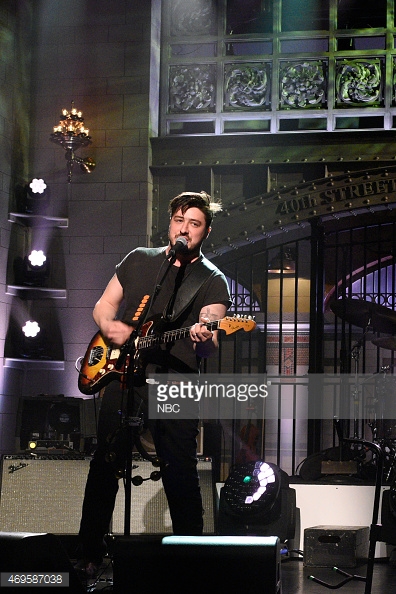
Three years ago, I wrote one of my most popular posts of all time, a review/listening guide for Mumford and Sons’s first album, Sigh No More.  I always thought I might do something similar for their second album, Babel, but I never got around to it–though I must say that I think it’s a great album.  I disagree with those who considered it a sell-out album; the band was just getting better at writing tight, radio-playable folk-pop songs, a skill that should not be denigrated.  Now that Mumford and Sons is/are about to release their third, stylistically very different album, I’m returning to them on my blog–but not to write about their music.  This time, I want to mention a couple of things I appreciate about the way the band members present themselves physically, which, as I think we all know, can be nearly as important in our day as the music itself.

1. Have you seen Winston Marshall’s hair lately?  It’s beautiful.  I realized this as I watched him tossing it around during the band’s frenetically kinetic performance on SNL this past week.  Sometimes long hair, on a man or a woman, can look lank and stringy, but not so on Winston.  I love the fact that he’s just letting his rather thick hair go where it pleases instead of trying to tame it.  That’s usually been my own personal hair styling method as well.  I have a lot of respect for people (particularly for women) who just let their hair be awesome even if it doesn’t look put-together according to the current definition of what put-together hair looks like.  You should not be surprised to know that my hair role model is Helena Bonham Carter.

my hair role model

my hair role model

Nice job, Winston.

Nice job, Winston.

2. While watching the same performance, I was confirmed in my long-held belief that Marcus Mumford is very attractive.  He’s not like my number-one celebrity crush, but I like a lot of things about the way he looks (but please note, Marcus, that the small mustache is not one of them).  I like how, speaking of hair, he has a little piece that insists on sticking up–it’s so Harry Potter.  I also love that he’s not ashamed to contort his face in order to express emotion while singing.  His face looks like it’s going to break, but that’s how he gets that gut-wrenching sound that’s part of what makes this band distinctive.  Probably my favorite thing about Marcus, though, is that he doesn’t look like the heroin waif we typically picture when thinking of a rock ‘n’ roll front man.  Now understand me, he isn’t fat.  But he definitely has a soft belly.  And his face isn’t chiseled or angular or gaunt by any means.  And I would guess the only bicep toning he gets on a regular basis comes from playing the guitar like a maniac.  You can really see this in the SNL performance, in which he’s just wearing a t-shirt (and trousers, too–geez, people), since tweed jackets and vests are no longer part of the Mumford and Sons uniform.  I have a lot of respect for this very noticeable, if not flagrant, disregard for a long-established stereotype.

There’s entirely too much body hatred in our world today, and the music industry often hurts rather than helps.  So it makes me very happy that the members of Mumford and Sons–none of whom exactly look like gods of rock–seem to be totally cool to just, as they put it in the last song on Babel, “be who [they] are.”

Huge props to the pudgy rockstar

Huge props to the pudgy rockstar