I just wrote an email to my graduate students that turned out to be more eloquent than I had originally intended, and since it deals with topics I write about frequently on this blog, I thought I’d share it here, with a few adjustments for confidentiality. As you might be able to tell, this course is at a Christian college.
Dear students,
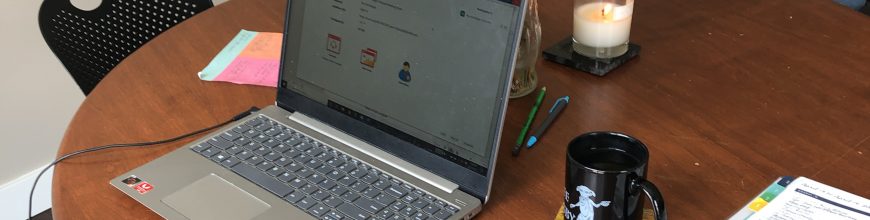
I normally like to make weekly videos for my [this course] students, but here we are, almost halfway into the course, and I haven’t shared one since my introductory video. I won’t be making one this week because my husband and I are on vacation at a family cabin in the woods of western Maryland. There’s no Wi-Fi here, and while my iPhone hotspot worked well enough for me to grade your Module 2 assignments this afternoon, I don’t think I’m going to try uploading a video. So you can picture me sitting at the table in our outdoor kitchen area, with my husband across the table playing a solo board game and the surrounding tall oak and locust trees sighing in the wind. I’m about to close up my laptop and spend the rest of the afternoon reading a good book.
I’m sharing this with you because I want to remind you that I’m a real person, not just a machine who grades your work, and you are too. Online education is weird because we don’t have a designated time and place in which to do it. We take it with us. Perhaps you’ve written a discussion post on your phone while you were in a waiting room. Perhaps, like me, you’ve fit in a bit of schoolwork while enjoying God’s creation in a beautiful place away from where you normally live.
Of course, this is a blessing and a curse. The other side of the coin of flexibility is the absence of any clear boundaries between our schoolwork and the rest of our lives. That’s not necessarily bad if it means that we’re learning to think biblically and intellectually about everything that crosses our paths. Our scholarly pursuits should affect our lives by shaping how we think. But our scholarly pursuits should not dominate our lives, leaving no room for family, community, or rest. So right now, as you start your graduate career, start thinking about how you will create boundaries–or rhythms, if that makes more sense to you–of work and rest, knowing that your classes constitute only one of your responsibilities and only a small part of who you are in God’s eyes.
If my iPhone hotspot holds up, I’ll pop into the discussions later this week. Thank you both for your thought-provoking responses to the prompts and for carrying on the conversation in this tiny class. If there’s anything I can do for you, please don’t hesitate to ask. I am praying for you!
Sincerely,
Dr. Tess
 the Dr. Tess blog