work/life rhythm and the weirdness of online education

I just wrote an email to my graduate students that turned out to be more eloquent than I had originally intended, and since it deals with topics I write about frequently on this blog, I thought I’d share it here, with a few adjustments for confidentiality. As you might be able to tell, this course is at a Christian college.

Dear students, 

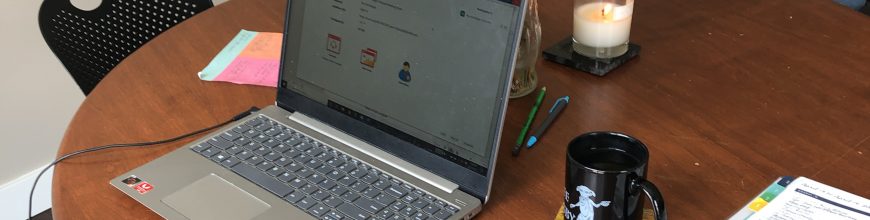
I normally like to make weekly videos for my [this course] students, but here we are, almost halfway into the course, and I haven’t shared one since my introductory video. I won’t be making one this week because my husband and I are on vacation at a family cabin in the woods of western Maryland. There’s no Wi-Fi here, and while my iPhone hotspot worked well enough for me to grade your Module 2 assignments this afternoon, I don’t think I’m going to try uploading a video. So you can picture me sitting at the table in our outdoor kitchen area, with my husband across the table playing a solo board game and the surrounding tall oak and locust trees sighing in the wind. I’m about to close up my laptop and spend the rest of the afternoon reading a good book.

I’m sharing this with you because I want to remind you that I’m a real person, not just a machine who grades your work, and you are too. Online education is weird because we don’t have a designated time and place in which to do it. We take it with us. Perhaps you’ve written a discussion post on your phone while you were in a waiting room. Perhaps, like me, you’ve fit in a bit of schoolwork while enjoying God’s creation in a beautiful place away from where you normally live.

Of course, this is a blessing and a curse. The other side of the coin of flexibility is the absence of any clear boundaries between our schoolwork and the rest of our lives. That’s not necessarily bad if it means that we’re learning to think biblically and intellectually about everything that crosses our paths. Our scholarly pursuits should affect our lives by shaping how we think. But our scholarly pursuits should not dominate our lives, leaving no room for family, community, or rest. So right now, as you start your graduate career, start thinking about how you will create boundaries–or rhythms, if that makes more sense to you–of work and rest, knowing that your classes constitute only one of your responsibilities and only a small part of who you are in God’s eyes.

If my iPhone hotspot holds up, I’ll pop into the discussions later this week. Thank you both for your thought-provoking responses to the prompts and for carrying on the conversation in this tiny class. If there’s anything I can do for you, please don’t hesitate to ask. I am praying for you!

Sincerely,

Dr. Tess

what my online students can expect from me, part 3: constructive challenge

This is the last post in a series on expectations in online education. You can read the previous post here.

You can expect me to gently challenge your thinking. I struggled with whether to share this one because it sounds more lofty than it actually is. I am not Mr. Keating from Dead Poet’s Society; I don’t spend much time exhorting students to seize the day and question the conventional assumptions on which they’ve based their lives. But I do often find myself writing comments along the lines of “I encourage you to keep an open mind as you research this topic” (to students who already know what their thesis is going to be before they start their research) or “Maybe challenge yourself by writing in a genre you’re not used to writing in” or simply (to students who make a confident assertion without proof) “I am not sure this is true.” Sometimes it’s hard for me to challenge students’ thinking because I want them to like me, and I’m afraid that if I appear to disagree with them, they won’t listen to anything I have to say. But most of the time, if I receive feedback from students who have gotten these kinds of comments from me, they are appreciative.

“Critical thinking” is one of those things we all know we’re supposed to integrate into our teaching, but I would venture to say that many of us don’t have a clear idea of what this would actually look like in our own disciplines. I don’t think teaching students to think critically means we have to wield like weapons the Latin names of all the classical logical fallacies. Maybe it just means asking good questions and encouraging students to think about why they’re making the choices they’re making. And sometimes, I find out that what I thought was an error was actually a deliberate choice on a student’s part, and I was the one misunderstanding their meaning. So this is an expectation that can work both ways!

what my online students can expect from me, part 2: appropriate grading feedback

This is the latest post in a series about expectations in online education. You can read the previous post here.

You can expect me to give you grading feedback in an amount and kind appropriate to the assignment. I use the word “appropriate” instead of “substantial,” a term greatly emphasized at one of my institutions in relation to grading feedback, because I don’t think all assignments require substantial feedback. For example, when I am grading students’ participation in a peer review discussion, it’s probably enough for me to say, “Thank you for your participation.” When I’m grading a topic proposal, I might record a three-minute video giving the student guidance on narrowing down the topic and starting to look for sources, but I probably won’t launch into a nitpicky critique of their APA format. However, when I’m grading a final/summative paper, I will give feedback on all areas of the assignment–content, organization, research, mechanics, and documentation–and my comments will likely consist of several sentences each. But still, there will be issues I overlook (intentionally or not), because my goal is to give students useful suggestions for improving their writing, not to discourage them by making the paper illegible with overlapping marginal comments on every sentence (the digital equivalent of a paper bled through with a red pen). I know from personal experience how discouraging this can be!

I hasten to admit that I’m not perfect at this. I often worry about whether I’m giving enough grading feedback, whether my comments make sense, and whether I got the tone right. And there are definitely times, usually when I’m on vacation or just really not feeling like grading, when I give a completion grade on an assignment that I probably should have taken the time to carefully assess using the rubric. But I think I largely succeed at my goal of making the overall message of my grading not “Here’s what you did wrong” (though I realize some students will still read it that way) but “Here are some things you can consider doing differently next time.”

what my online students can expect from me, part 1: collegial communication

Last week, I wrote about the top three expectations I have for my online students. Now, I’m going to write a few posts focused on things my students can expect from me. I’m choosing to write these posts exclusively in the first person because I think it’s more difficult to make safe generalizations in this area as compared to the area of my last post. But I’d love to hear from other online faculty members–are your expectations similar?

You can expect me to reply to your communication and not be annoyed about it. First, I want to clarify what this does not mean. It does not mean I’ll reply to your emails, text messages, or voicemails (I do sometimes get those!) immediately. I go to bed pretty early, and I put my phone in sleep mode when I do. Another rather countercultural practice I have, which I believe has done wonders for my mental health, is that I do not receive email notifications on my phone. I sit down to check email, usually on my computer, at designated times when I’m ready to focus on email. So this may mean that, especially on weekends, a student may go 24 hours, or slightly more, without receiving a reply from me. But here’s what this expectation does mean: When I respond to your message, I’m going to read it carefully and give you a substantial answer. (And yes, I may occasionally say, “Go look at p. 24 in the APA guide” or something similar, but I won’t be snarky about it.) I’m not going to be annoyed at you because, as I explained in my post last week, email and other personal communication forums are where I do some of my best work. In fact, right now I have a student who’s been sending me some fairly lengthy emails a couple times a week–sometimes to ask questions, other times to say she appreciated something I said in a video, etc.–but I’m not irritated at her, because our email exchange is allowing us to build a collegial relationship. Also, it helps that when she doesn’t expect a reply to one of her messages, she will actually say that in the subject line.

I’m always baffled when students are profusely grateful that I responded to their emails, when to me this seems like a bare minimum expectation. Apparently, some professors aren’t doing this, or they’re giving their students the impression they’d rather not. I’m thankful for this simple practice that allows me to tailor my instruction to individual students, build relationships, and get good course evaluations in the process. 😉

    What online instructors want from their students

    I’ve been thinking a lot lately about the misconceptions–or complete mystification–some online students have about what their professors are looking for. In an asynchronous online class, there’s no regular meeting time when students can ask questions and professors can pointedly emphasize certain desired behaviors. I don’t want my students to have to guess what my expectations are for them–nobody likes that game. While every instructor will have expectations specific to each of their courses, there are some that, at least in my opinion, transcend contexts. In this post, I’m going to list and briefly explain several of these close-to-universal expectations.

    1. We want you to write like a real person, not a robot. I’ve been saying this for years, but the recent revolution in accessible generative AI tools has made this advice particularly urgent and very literal! An essay written by ChatGPT and an essay written by a student in a stilted, impersonal academic-ese, while ethically different, are both really boring to read. I want to get to know you through your writing, especially in an online class where writing is about the only thing we have to build a relationship on. Let your own voice come through!
    2. We want you to communicate with us. Often, students who email me will preface their message by saying something like “I’m so sorry to bother you.” I always reassure these students that answering their questions is what I’m paid to do and that my best teaching often happens through email. Again, since you’re not sitting in a classroom with me, I don’t have that weekly or daily time to check that you’re understanding the material and doing okay in life in general. If you’re turning in assignments, at least I know you’re alive, but I’ve found that the students who do best in online classes are those who communicate with me outside of assignments–asking questions, running ideas by me, letting me know what you think of the course materials, etc. And this might go without saying, but if you’re not turning in assignments and you’re not emailing me, then I have no choice but to assume that you’ve fallen off the face of the earth! I would much rather receive an email explaining that it’s been a hard week and asking for an extension than receive no communication at all. Talk to me!
    3. We want you to read our feedback. This one may sound like a pet peeve rant (“I spent all that time writing feedback and they didn’t even read what I wrote!”), but there’s more to it than that. I guess I can’t speak for all instructors here, but I try to grade with the goal of helping my students on future assignments, both in my class and later classes. I don’t make as many grading corrections as I used to (I was trained in the bleeding red pen school), but the comments I do leave are substantial and, I sincerely hope, constructive. If you don’t read my feedback, you’re missing out on a big part of what you’re paying for in my class. If an assignment has a rubric (and I think rubrics are used pretty much across the board in online education today), find out how to open and read the filled-out rubric–otherwise, you don’t know why you lost the points you did, and you’re left to assume the professor just doesn’t like you. I can’t promise that I like all my students (that’s a different topic for a different post!), but I never deduct points just because–the rubric always makes it clear!

    I’ll stop there for now, because those are by far the three biggest expectations I have for my online students. Of course, students also have a right to know what they can expect from their professors, so look for a future post on that!

    revisiting the idea of home as a co-working space

    Since I’m sharing our home today with three dogs (we’re dog-sitting for my in-laws), my husband (who is doing an all-day virtual professional development training in his home office), and our friend who just moved here and is staying with us until her apartment is ready, I thought I’d share a post from nearly four years ago about home as a co-working space. Though things have changed (Jordan is back at his worksite most days; I have a permanent workspace in the corner of our living room; we regularly get a wide variety of birds at our feeder, and I’m learning their names pretty well), I think the ideas explored in this post are still worth considering.

    writing goals for 2024

    As I think about my goals for the new year, I’m considering how I want writing to fit into my life in 2024. I have always seen myself as a writer, but after a few highly productive years leading up to the completion of a novel in 2019, I’ve been in a dry spell, at least by comparison. I do a lot of writing for my work–mainly emails and grading feedback–but in this post, I’m thinking about writing that is both more enjoyable and less ephemeral than those, important as they may be. So here are some writing goals I’d like to focus on in the new year.

    1. Get back into the habit of writing in my notebook for 15 minutes a day. I started doing this in September after I read Writing Down the Bones by Natalie Goldberg and wanted to rediscover the joy of writing, especially in longhand (a practice Goldberg speaks highly of). Throughout that month, I wrote for 15 minutes every morning. Most of what I wrote will never be shown to the world (though this post was a result of one particularly productive day), but it was a good practice, and I’d like to get back into it consistently in 2024.
    2. Research and revise two short stories based on incidents in the life of Christ that I drafted in 2023. These stories resulted from my daily writing practice. They are quick sketches that need research give them accuracy and authenticity. I may use my research and revision process to help me develop some resources for my students (I wrote about this idea here), but even if I don’t end up doing that, I would like to get these stories into a state that I’m happy with.
    3. Reread Sam’s Town to help me decide whether I want to work on the sequel. Sam’s Town is the novel I self-published in 2019. Soon after I completed it, while still riding a writing high, I started the sequel, Sam’s Home. But then I got married, moved, and lived through the pandemic, and the few brief attempts I’ve made to pick the manuscript back up haven’t really gone anywhere. So in 2024, I’d like to reread Sam’s Town in hopes of recapturing some of that excitement. Even if I ultimately decide not to make writing the sequel one of my goals for this year, I think I’ll enjoy revisiting those characters who played such an important role in my life for several years.

    Three is a magic number when it comes to goal-setting, so I’ll stop there. What are some of your goals for 2024, writing-related or otherwise?

    a quick bite of food for thought about grading time

    Yesterday, I was watching a video about creating a teaching calendar (which I can’t share here because it’s part of a paid professional development package one of my universities subscribes to), and I heard some research findings that caught my attention. The study was conducted by the video presenter, B. Jean Mandernach, Executive Director of the Center for Innovation in Research and Teaching at Grand Canyon University, and her colleagues.

    Here’s a summary: The research team approached a group of doctoral-level faculty who taught writing-heavy courses and asked them how long it took them, on average, to grade a paper. They monitored their grading time and came up with an average of one hour per paper. The researchers asked if they could lower this to 30 minutes. The faculty expressed doubt, but limited themselves to 30 minutes per paper. In a third round of grading, the faculty then limited themselves to 20 minutes per paper. Next, an objective rater scored the quality of the professors’ feedback, and there was no qualitative difference between the three sets of papers.

    I’m just going to leave you with that. I think the data speaks for itself. I’ll simply say that as English professor who tends to reflexively equate more feedback with better teaching–but who feels overwhelmed by the volume of writing I have to respond to each week–I found these results to be encouraging. Let me know what you think! And if you’re not a teacher, could these findings apply to other areas of life?

    a prayer for humility

    I wrote this prayer in my journal a few weeks ago. For clarity, Jordan is my husband, and BSF stands for Bible Study Fellowship.

    When I think I know how Jordan is feeling and I really don’t

    When I think I have the most insightful comment that could be made at that moment in my BSF group

    When I assume a student’s tone in an email

    Lord, help me to pause.

    Help me to remember how little I know, and how good that is.

    Don’t ask your students to do anything you haven’t done yourself.

    This post is part of a series on bringing a human touch to online education. See the series introduction here.

    I recently wrote a rough draft of a story, provisionally titled “Sunrise at the Sea of Tiberias,” and I know it needs some historical research. So I have an idea: I’m going to do the Writing in Your Field Project, the major multi-step assignment in my graduate writing class, along with my students.

    I have never done the project, and I know that’s a classic teacher mistake: expect my students to do something I haven’t done myself. I know what some of the common challenges of the project are based on student feedback, but as I often tell my students regarding their research, there’s no substitute for firsthand experience.

    I’m thinking of taking notes on my experience as I go through it (maybe using a combo of written and voice notes), then creating some supplemental videos/documents I can share with students and maybe eventually make an official part of the course. I would also like to write about this experience, with a teacher audience in mind, on the blog!

    I hope to start this project soon, when (I’m hopeful) some extra space will be opening up in my grading schedule. Stay tuned for details!