Sam’s Town–the paperback

cover

Hi everyone, I’m back with some exciting news: I just submitted the paperback of Sam’s Town to Amazon’s Kindle Direct Publishing for review. If it passes quality inspection (and I see no reason why it won’t, with this fantastic cover by Mike Nair!), it will be available for purchase within about two days. I will post another announcement when I receive confirmation, but in case I forget or am busy (a likely scenario, these days), I wanted to go ahead and give you the news. Mark your calendars for the end of this week! Just search the book title and my name on Amazon.com.

the character you’ve been waiting for–and the cover reveal!

Hi everyone, thanks for sticking with me through this month-long tour of the characters of Sam’s Town, my zombie apocalypse novel releasing…any day now! My fantastic cover artist, Mike Nair, has finished his work, and it looks great! I’m going to show it to you at the end of the post, but if you’re too excited to wait, go ahead and scroll down now (Sam and I would just appreciate if you came back here and read the rest afterward).

Today I want to tell you about Sam, who is both the protagonist of my novel and, to a great extent, my concept of what a good (though flawed) man looks like. Forgive me while I get sappy for a second: I was telling a friend the other day that all this character development I did over the past couple of years–for Adrian, Joe, and Frankie too, but mainly for Sam–helped me to figure out what I was looking for in a man I would want to marry. And right around the time I finished writing my novel this past summer, I met a man like that in real life. My boyfriend, Jordan (who I hope is reading this), has many of Sam’s best qualities–his loyalty, his intelligence, and most of all, his gentleness.

But enough about my personal life. What can I tell you about Sam Larson without taxing your patience with an unusually long post? He’s the writer and illustrator of a web comic called The Adventures of Sparky the Sidekick. He loves movies and will watch just about anything, but some of his favorites are the Godfather trilogy and George Romero’s zombie classics (the latter of which serves him well now that he’s living in a world where zombies actually exist). He’s a good cook who specializes in Italian food, though he doesn’t show off that skill very often. He hates conflict. He likes to feel useful. He struggles with depression. He’s smart and persistent, which makes him good at problem-solving. (In the novel, he tinkers with a vending machine until he figures out how to open it without a key. Which reminds me of another fact about Sam–he loves Coca-Cola.) He has a gift for making other people feel calm, which makes him the perfect counterpart to his frenzied best friend Adrian. He has these enormous pale blue eyes (just like his mother’s) that are always making people ask him if he’s okay, which he finds incredibly frustrating. He constantly underrates himself. He’s stronger than he thinks, physically and mentally, as the circumstances of the novel force him to discover.

Here are some fun facts about Sam:

  • I imagined a version of this character years ago, when I was in high school. His name was Sparky (like the aforementioned sidekick). You can read about the evolution of Sam in this post.
  • I once wrote a post about Mr. (Fred) Rogers in the voice of Sam.
  • Just like I gave some of my random quirks to Adrian and Ramona, I endowed Sam with this (understandable, I think) phobia that I have: He hates to watch people using intravenous needles in movies or TV. Stabbing a zombie in the head, fine. Shooting up heroin or getting an IV, no thank you. He has to look away.

And here are the first two paragraphs of my novel, in which we meet the title character:

You could tell by his apartment that Sam Larson lived alone. There were always a few dishes in the sink and a few pencils and sketchpads sitting around, and there was a sag in the middle of the couch where he usually sat. Sam worked from home, mostly. He taught an occasional art class or appeared at a comic book convention (his name was never high on the billing), but mostly he sat in his apartment and made comics. That was how he liked it.

On the last Friday night in July, Sam made spaghetti carbonara and ate a plate of it.  Then he turned on his epic movie scores station on Pandora and started drawing.  He was working on an installment of The Adventures of Sparky the Sidekick, his superhero web comic that capitalized on the ironic potential of foregrounding the affable best friend and downplaying the character who would normally be the hero.  Sam’s fans—they were few but loyal and willing to express their loyalty with their money—loved Sparky because he was witty and long-suffering and always came out okay in the end, despite all the crap he deflected away from his rather useless best friend.  But none of his fans knew that Sam drew Sparky as a version of himself—a short, round guy with straw-yellow hair and big washed-out-blue eyes that were always making people ask if he was okay.

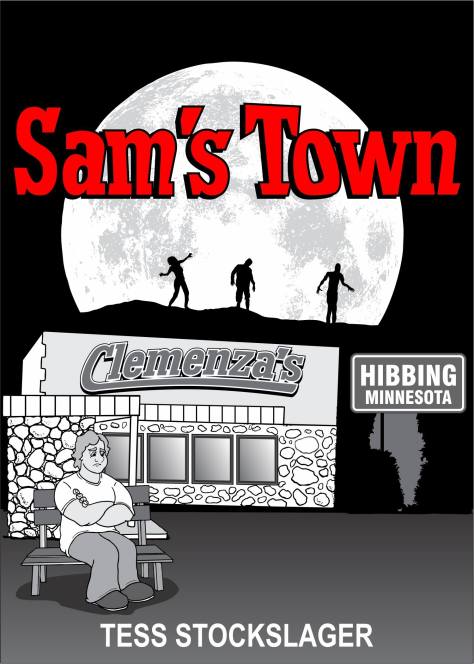
And now, the moment you’ve been waiting for: Here’s the cover of Sam’s Town! What’s your favorite part about it? I’ll pass your feedback along to the artist!

cover

Stay tuned for the official release announcement!

#Samona, part one

In these final weeks before the release of Sam’s Town, I want to introduce you to two more characters. Next week we’ll finally meet Sam, but today we’re focusing on Ramona Bates (her last name never appears in the novel), a former English professor from “the hillbilly part of Ohio” (her words) who, unlike Sam and Adrian, has never watched a zombie movie or TV show, yet takes to this post-apocalyptic world quite naturally, discovering survival and weapons skills she never knew she had. And oh yes, she falls in love with Sam, though she ends the novel still undecided on whether she would truly describe herself as “in love”—Ramona is an overthinker (and this, along with the English professor part, is directly autobiographical). Although, as I stated last week, Sam and Adrian’s friendship is the cornerstone relationship of the novel, Ramona and Sam’s awkward, by-fits-and-starts romantic relationship plays a key role in both characters’ development. It’s also a favorite storyline of the friends and fellow writers who have read and given feedback on my novel, as evidenced by the celebrity couple hashtag that one of them coined, #Samona.

With Ramona, I hope I have successfully portrayed a realistic female lead character: neither a damsel in distress nor a one-dimensional tough girl. When Sam and Adrian first meet Ramona, who is hitchhiking along a deserted highway in Michigan, she impresses them as strong, smart, and a bit intimidating. (Before taking a nap in the backseat, she threatens to kill anyone who touches her.) But after some late-night, emotionally vulnerable conversations, Sam learns that Ramona is just as insecure as he is. They are drawn together by their mutual kindness and respect, even after they have learned each other’s insecurities. I have learned in my own life that honesty can be kind of sexy. Not coincidentally, it is after Sam opens up to Ramona about his mental health struggles that she first kisses him.

Here are some fun facts about Ramona:

  • In Sam’s Town, we learn that Ramona has a sister that she believes is still living in their hometown. In the sequel, Sam’s Home (which I plan to work on next month during NaNoWriMo!), we learn that the sister is indeed still alive and is named Melissa, that Ramona is the older sister, and that Melissa has an ex-husband named Mike with whom she is back together (and who might turn out to be a bad guy—I haven’t gotten that far in my plotting yet).
  • This is the first time I’ve used the name “Ramona” in a story, but I’ve been tossing it around in my head ever since I heard Bob Dylan’s song “To Ramona” when I was in college. Though I never state this in the novel, I like to think that Ramona’s parents were Dylan fans and that this is perhaps why Ramona so readily recognizes the name of the town where Sam and Adrian are headed: Hibbing, Minnesota (Bob Dylan’s hometown—and Sam’s).

Here’s a 100% autobiographical, totally self-indulgent scene about Ramona’s past as a college professor. It begins with Sam asking her to define a term she has just used, “FERPA” (you’ll have to read the novel to find out how that came up in conversation!).

“It stands for Family Educational Rights and Privacy Act. It means I don’t have to talk to parents unless my students give their permission, because…” She stopped walking and turned to face him but held onto his hand. “Because my students are legally adults. Sam, I’m a college professor.” She looked down at her feet.

“Oh!” he exclaimed as it all clicked into place. “Sorry, I’m slow. But wait—why do you seem embarrassed about that?”

She sighed, lifting her shoulders exaggeratedly like a little kid. “Because people always treat me differently when they find out. Especially guys. They act like I’m from another planet when they find out—“ she lowered her voice to a whisper—“I have a Ph.D.”

“You have a Ph.D.?!” Sam practically yelled.

“See? Exactly like that,” Ramona huffed.

“Sorry,” he said, laughing a little. “Well, I won’t lie; I’m impressed. But you still seem to be from this planet.” He smiled and tried to make eye contact with her, but she kept looking down.

She absently swung their hands back and forth. “I feel like such a pretentious—person.” She cleared her throat. “And I don’t know; I still feel like a poser when I say I’m a college professor. Like people are thinking I’m too young. Or too—too something. Or not something enough. Sorry.” She finally looked up. “Clearly I’m very insecure.”

“Well, hey! So am I,” Sam said with a fake heartiness, fighting a grin.

Ramona snorted. “Glad we got that off our chests.”

This scene also gave you a little preview of the guy you’ve all been waiting to meet—Sam Larson. Come back next week to learn about my protagonist, whom I love (and I hope you will too!).

meet Frankie Clemenza and his resplendent car

Welcome to the first in my series of posts introducing you to the six main characters in my zombie apocalypse novel, Sam’s Town! Today I want you to meet Frankie Clemenza, an old friend of my main character, Sam. Frankie is a lifelong resident of Hibbing, Minnesota, where most of the story takes place, and although he’s a little self-conscious about the fact that he’s never gone to college, married, or done much traveling outside of Hibbing, he loves his life. Frankie has recently inherited the family restaurant from his aunt and uncle, and he’s opened it up (along with his upstairs apartment) as a safe house for Hibbing zombie apocalypse survivors. As the only true extrovert in my novel, Frankie loves the constant flow of people in and out of the restaurant, even if they’re sweaty and bloody. He also loves giving hugs. And he’s a bit of a klutz. Frankie can come across as “an unambitious goof-off” (his uncle Bobby’s words), but beneath his weight-lifting, pasta-cooking, classic-car-restoring surface, there’s a loyal friend and maybe even a capable leader.

Fun facts about Frankie:

  • Yes, his last name (and thus the name of the restaurant) was inspired by that of Peter Clemenza, one of the capos (and one of Vito Corleone’s oldest friends) in The Godfather. My Clemenzas have no organized crime connections, but because they’re chefs and restaurant owners, I associate them with Peter Clemenza, who once took a break from planning a Mafia war to teach Michael Corleone how to make tomato sauce–and uttered the famous line, “Leave the guns; take the cannoli.”
  • Frankie drives a 1960s Cadillac DeVille (I didn’t specify the year), which saves the day at a crucial point in my novel and which Sam describes as “resplendent.” I loved the idea of him in a chrome-plated “pontoon boat” of a car, but I knew that four-door cars were less common mid-century, so I had to do a little research to make sure that Cadillac came out with a DeVille in the 60s that had rear doors, which I needed for plot reasons. (That’s all I’m telling you right now!)

And now, for your reading enjoyment, here’s a snippet of the scene in which Frankie first appears. Frankie is having his arm bandaged due to an accident in which a gun went off while he was holding it. (Did I mention he’s a bit of a klutz?)

The man in the chair stood up. He looked to be in his mid-thirties, a few years older than Sam. He had the arms of someone who spent a lot of time in the gym and the abs of someone who spent a lot of time around garlic bread. “I just grazed the top of my arm. Could have been a lot worse, as klutzy as I am.”

“Frankie Clemenza!” Sam grinned.

The other man furrowed his brow. “Frankie was a dumb kid. I go by Frank now.”

“Oh, sorry…” Sam took a step backward.

Frank’s serious face split into a smile, and he stepped forward. “Just kidding, man! You can call me whatever you want!” He grabbed Sam in a fierce yet lingering hug. “I missed you, buddy. It’s been way too long. You never come home! But—” he pulled back to look Sam in the face but kept hugging him—“I read your comic every week when it comes out. Every week!”

What do you think of Frankie so far? Would you want a guy like him around during the zombie apocalypse, or is he a bit much to handle? Let me know in the comments!

Next week, we’ll meet Sam’s parents, Joe and Anna Larson, one of whom has been called Clemenza’s best customer of all time…

zombie book releasing soon!

My zombie apocalypse novel, Sam’s Town, is almost here! Thank you all for your patience. Soon I’ll have exciting things to share with you like the fabulous cover art and the all-important release date! I plan to throw a virtual release party, so stay tuned for information about that.

Over the weeks leading up to the novel’s release, I’ll be sharing excerpts centered on each of the novel’s six main characters. (I know–the number of characters makes this book sound like zombie Friends or zombie Saved by the Bell. Tell me in the comments which of those zombified shows you would rather watch.) In the meantime, share this post with your friends who like zombie stuff (especially George Romero’s films and The Walking Dead) or anyone who loves a good story about friendship, family, romance, pop culture, Italian food, and keeping your stuff together when the world is going crazy. I appreciate your support so much!


update on Sam’s Town and Sam’s Home

I haven’t been blogging much this month because I’ve dedicated most of my writing time to editing my zombie apocalypse novel, Sam’s Town, and drafting its sequel, Sam’s Home. Today, I want to give you an update on how all that is going.

My editing of Sam’s Town is nearly complete. I am working through the wonderful comments given to me by a fellow author whose zombie knowledge, eye for sentence structure, and life experience as a young man (something I have never personally experienced!) have been invaluable. I have just a few chapters to go, so I may even finish up within the next few days. From there, my next steps will be to look at self-publishing options, procure a cover illustration (I’m hoping to commission an original work of art), and convert the manuscript from its current format into one that will work for publication. I am planning to release the novel as both an e-book, which I know some of my potential readers will prefer as more cost- and space-effective than a hard copy, and a paperback, because I don’t want to alienate those who don’t own e-readers.

Meanwhile, I have begun working on Sam’s Home, the sequel. Some have asked why I am not planning to combine the relatively short Sam’s Town (just over 50,000 words) and its sequel (which will probably be about the same length) into one novel. The main reason is that I have always thought of the pacing of my novels in terms of a movie. I think that if Sam’s Town were adapted into a film, not much editing would need to be done in order to make it a typical-length feature. I’m not saying this will happen, but it’s easy for me to wrap my mind around a film-like structure. Another, perhaps more important reason is that the ending of Sam’s Town brings Sam’s story to a place of equilibrium. His problems aren’t all solved, but he’s learned a major lesson, and there’s a moment of rest–a deep breath, if you will–before the events of the sequel.

Although Sam’s Home will continue with the themes (which I’ll discuss in a moment) and the style of Sam’s Town, there are a few differences. In the sequel, as in many sequels, the world gets bigger. In the first book, there were basically only six characters. In the sequel, while these six are still the focus, we meet a number of others who aren’t just background characters. Some of them are ill-intentioned, and this is another difference. Whereas in Sam’s Town, the antagonists were zombies and depression, Sam’s Home has some actual bad guys, which I think makes sense because we’re no longer in the opening days of the apocalypse. Bad guys have had time to organize. Another difference is that there are two concurrent plots. While Sam is still the main point-of-view character of one plot, for the other, we are inside the mind of Ramona, who has gone to Ohio to find her sister. It’s been fun for me to write from Ramona’s perspective because I didn’t do that at all in book one. Ramona has a number of superficial resemblances to me, but I’m finding out that we really aren’t that much alike (or maybe we are, and I’m in denial!).

Finally, for those of you who haven’t read or heard any of my novels or talked with me about them at length, I want to give you a little pitch for them, especially for you non-zombie fans. My novels really aren’t about zombies, though I hope that my obvious moments of homage to George Romero’s films and The Walking Dead will satisfy fans of the genre. My novels are about friendship, family, and mental health. I wanted to write about people who are woefully ill-prepared for the zombie apocalypse and show how, despite their clear deficiencies, they survive by taking care of one another. I see my novels as aspirational—not about the ugliness of human evil (though those books are important too), but rather about how we could treat each other if we valued each other. Value, or worth, is a major theme—Sam has to learn that he isn’t just a waste of space, but his life has meaning and is worth saving, even when he feels like there’s nothing he can contribute to the world. If that sounds like an important theme to you, I hope you’ll stay tuned. Sam’s Town is coming soon!

rebranding the blog–Let’s try this again.

In spring 2018, I talked a lot about rebranding my blog as a Hufflepuff leadership blog–i.e., a leadership blog for people who are emotionally intelligent and perceptive but don’t feel like natural leaders and maybe don’t feel comfortable in the spotlight at all. I went so far as to come up with a new logo, a badger in a business suit (how cute is that?). I wrote a number of posts related to the proposed focus, which you can read if you look back at February through May 2018, or just search “Hufflepuff leadership.” But right before I was going to make the transition, I left my job, in which I had a leadership role, and took a new position that does not involve leadership except insofar as teachers are leaders in their classrooms. So I didn’t see the point of going through with the rebranding.

Now, I’m once again considering the possibility of giving my blog a facelift and a narrower focus. This time, I am thinking of using the blog as part of my strategy for marketing my zombie apocalypse novel, Sam’s Town, which I would like to release later this year. The rebranding would probably mean a new name and address and a new look, but it would probably not mean that I would only ever post about my novel and/or about zombies–just that these topics would appear more often. I don’t want to alienate readers who aren’t interested in zombies, and I certainly don’t want this blog to become nothing more than a self-promotion instrument (that would be boring for me, too), but I do think it’s smart to “leverage my platform” (did I just write that?) so that my blog can help promote my book, and vice versa.

I’d love to hear your feedback. As always, thank you for reading!

exploring my characters’ pasts

This is going to be an arcane and self-indulgent post that probably only one or two people who read my blog will actually care about. There, you’ve been warned. I may share this in my writing group, though, since some of them might care about it. I have decided to use this post to explore an idea I had the other day regarding my fictional work in progress, “Sam’s Town”–the zombie apocalypse story I have mentioned a number of times on my blog. Originally, Sam was going to be this lonely soul who never got a girlfriend and died at the end of the story. Now, not only does Sam survive, but there’s also Ramona, this “brilliant and startling” (his words) woman who is into him, which he doesn’t understand because he thinks he’s an affable sidekick at best. And now, after this thing I’m about to share, it seems that he may have a history of seemingly out-of-his-league women falling in love with him. It sounds wildly improbable, and it also sounds like a cliche. But as I’m finding that people who read about Sam usually come to love him, it makes sense to me that he would also be lovable (and not just to his parents and friends) within the world of the story.

I’m getting ahead of myself, though. Here’s what happened: In one of the Facebook writing groups I’m in, an administrator shared a picture of a pretty young woman with stylish hair and clothes, sitting in front of wallpaper with a tortuous yellow pattern on it (this so distracted me with thoughts of Charlotte Perkins Gilman’s haunting short story “The Yellow Wall-Paper” that for a while I couldn’t think of anything original to write), and lobbed some character development questions at us. This is what I finally wrote in response:

You guys are all so good at politically complex fantasy, dystopian, and historical stories. I’m going with plain old contemporary realism.

This is Charlotte (a nod to the author of “The Yellow Wallpaper” 😁). She is the most popular girl in school, but not a mean queen bee—everyone likes her, even teachers. She is smart, poised, and articulate, and she knows what she wants out of life. Well, that last part isn’t true. She has no idea what she wants—only what others expect of her.

She is hiding the fact that she really hates herself most of the time. She hates that she always has to perform. She hates her body, and she is bulimic. This is an open secret among her group of friends—most of them are bulimic too—but she’s hiding the fact that she doesn’t want to do that to herself anymore. (So are all of her friends, actually.)

She is also hiding the fact that she likes the boy who sits in front of her in English. He is quiet and terribly awkward, and his goal in life seems to be to disappear. But Charlotte sees him. She hasn’t told her friends because they wouldn’t understand. They call him Ghost Boy. (And no, he’s not an actual ghost—contemporary realism, you guys. His real name is Peter, by the way.) And she can’t tell him because he would think she was just making fun of him. So she just keeps playing her role. THE END (for now)

Almost immediately after I wrote that–actually, maybe while I was still writing it–it occurred to me that this Peter fellow sounds an awful lot like my character Sam (now in his early 30s) as he describes his teenage self. The disappointing interpretation of this is that I only know how to write one male character, over and over, with slight variations. The more cheerful interpretation is that this is Sam and I need to incorporate this into his backstory. I had already come up with a vaguely outlined character named Becky Olson, whom Sam had liked in high school and who might show up again (not as a zombie) in my vaguely planned sequel, but this so-called Charlotte is quite a bit different from Becky, who was supposed to be sweet and quiet and sort of a background type like Sam.

It would be interesting and perhaps vindicating for my Sam fans if the adult Charlotte (also not a zombie) confessed her teenage feelings for Sam, but would it be realistic? Even if she did like Sam back then, would she remember all these years later? Is it a bit corny and idealistic for all these attractive, put-together women to be falling in love with shlubby, semi-reclusive Sam? I think the answers to those questions are probably no, no, and yes, and yet–I can’t help imagining a flashback scene in which Charlotte goes (with her parents, or some friends, or a date) to Clemenza’s, the restaurant where Sam works, and they strike up this awkward, “oh, you’re in my English class” conversation (even though each knows perfectly well who the other is), and even though Sam is just a busboy, he gets her some cannoli in a takeout box, and he rambles on to her about all the ingredients and how good the cannoli is at Clemenza’s and how he’s been practicing at home and he can almost make it like the chefs here do. And she still remembers all these years later.

I’m almost equally torn between gushing and gagging at what I just wrote. If you’ve read this far, let me know what you think.
writing for joy

My grandfather, John Vernon Stockslager (we called him Pappy), passed away last week. My uncle preached his funeral sermon on Monday, and he mentioned something I had almost forgotten about: Almost 20 years ago, when Pappy first got a computer, he created a series of comic strips about two birds named Tweets and Blu. Technically speaking, they’re simple and even a bit rough–he used the Draw program in Windows to create them–but they’re funny and big-hearted and short, just like Pappy. Also at the funeral, one of my cousins read aloud a poem that Pappy had written not long ago. (We had also read one of his poems at my grandmother’s funeral nine years ago.) At some point during the service, I was struck by the sudden realization that although it had always seemed normal to me that my grandfather, a retired electrician and farmer, drew cartoons and wrote poems for fun, it’s actually not that common for adults to do these things. Kids do these things, and then when they grow up and decide they’re not good enough to get paid to do them, they get embarrassed and stop. Pappy never stopped.

I see this same impulse to write for the pure joy of it in Pappy’s children and grandchildren, particularly in my own immediate family. The examples range from the short-lived family newspaper my sister headed up when we were kids–The Fine Five–to my brother’s songwriting to my dad’s extensive reviews he posts on Goodreads for every book he reads. I see it in my own blogging and fiction writing. None of us are getting paid to do these things. Maybe we could, if we worked harder at marketing ourselves or knew the right people. But while I can’t speak for anyone else in my family, I can say that I’m content with writing for a small audience of family, friends, and Facebook connections–and for the delight it brings me. Sometimes I have to remind myself that I’m content with this, like when I see colleagues’ blogs and YouTube channels going viral or when I watch other people in my Facebook writers’ group (which I feel like a poser even belonging to) finding great success in self-publication through a combination of persistent marketing and real writing skill. I admire those people, and what I’m about to say is not, by any means, meant to fault them. But for me, I think it’s a useful discipline to be able to see the value in sharing my writing with the people who matter most to me, even if it reaches no further than that. That’s what Pappy did. I remember there was some talk of looking for a wider distribution channel for Tweets and Blu, but his family was always his favorite audience, whether for his comic strips, his poems, or his music, which I haven’t even mentioned in this post. (And he did get to play and sing in front of a wide range of audiences throughout his life.)

I’m not trying to make the worn-out, false argument that getting paid for doing something makes you love it less. But I do think there’s something to be said for writing–or drawing, or singing and playing–for nothing but joy. I’m thankful that Pappy taught me that.