I just watched Tim Burton’s Corpse Bride (2005), and I enjoyed it more than I have enjoyed the past few Tim Burton movies I’ve seen: Dark Shadows, Alice in Wonderland, and Sleepy Hollow (which, I realize, is not a recent film, but I saw it for the first time this year). Corpse Bride was better than those others for several reasons.
1. It’s short, which means it doesn’t have time for a ridiculously convoluted plot. It would have been even shorter without the songs, which I thought were unnecessary.
2. Instead of deriving from a single source (novel, short story, or soap opera), it instead is an homage to/parody of the Victorian marriage plot in general. This means that there is less opportunity for fans to accuse it of not being “like the original.”
3. It’s animated, which allows Tim Burton to indulge to full extent his fancy for caricature of the human form. Many characters have delightfully exaggerated noses, chins, or eyes, and the contrast between the tall, thin characters and the short, fat characters is reminiscent of some of Phiz’s illustrations to Dickens’ novels. (Check out this illustration in particular; I love it.)
I think Corpse Bride may have restored my faith in Tim Burton. You should do yourself a favor and watch it. If you hate it, you’ve only wasted about an hour and fifteen minutes.
Author Archives
Haunted by dead European males
I’m working on my Moneyball paper, and I’m afraid I’m about to argue myself out of the point I’m trying to make. I want to argue that Moneyball isn’t really about money; it’s about worth, something for which money is merely a symbol. But the evil little Marxist inside my head keeps saying that everything is about money, and that by silencing the issue, the film is complicit in the economic disparity it initially gestures toward critiquing. I think the evil little Marxist’s argument is reductive, but I don’t know how to refute it. I just can’t buy that everything is about money. Similarly, as intrigued as I am by Freud’s ideas, I just can’t buy that EVERYTHING is a phallic symbol. Someone did a presentation on Star Wars yesterday in which it seemed that pretty much every scene was a castration, and I was really frustrated. I think I just need to get OUT OF HERE and back to people who talk about normal stuff.
Penelope hasn’t died.
Weep not for me, my friends. I’m still alive. (Someone please tell Hermione Granger to stop using my name as a convenient alias.) I’m just finishing up my PhD coursework. (So, not quite alive, actually.) I fully intend to make a big comeback in August with some really awesome posts, some of which will, I’m sure, draw on some of the themes I’ve been thinking and writing about this summer. Think that sounds like a snooze? Think again!!
Preview: I’m working on a paper right now about Moneyball, so get ready, Brad Pitt fans (also Jonah Hill fans). I might even post a picture of your guy–accompanied, of course, by some amazing insights about the movie.
Things I liked about Brave…
…the new Pixar movie released this weekend, which I saw today.
1. Scotland
2. Emma Thompson
3. Mumford and Sons
4. a heroine with spectacularly explosive hair
5. a heroine who doesn’t think getting married should be her #1 goal in life (but who is open to getting married at some point)
6. a great, and realistic, mother-daughter relationship
7. bagpipes
8. beautifully animated scenery
9. magic
10. kilt humor
Two texts that inquire into the moment just before death
“If I Only Knew”
a poem by Nelly Sachs, Holocaust survivor and Nobel laureate
If I only knew
On what your last look rested.
Was it a stone that had drunk
So many last looks that they fell
Blindly upon its blindness?
Or was it earth,
Enough to fill a shoe,
And black already
With so much parting
And with so much killing?
Or was it your last road
That brought you a farewell from all the roads
You had walked?
A puddle, a bit of shining metal,
Perhaps the buckle of your enemy’s belt,
Or some other small augury
Of heaven?
Or did this earth,
Which lets no one depart unloved,
Send you a bird-sign through the air,
Reminding your soul that it quivered
In the torment of its burnt body?
“The ’59 Sound”
a song by The Gaslight Anthem, the greatest presently active band in any genre
Well, I wonder which song they’re gonna play when we go.
I hope it’s something quiet and minor and peaceful and slow.
When we float out into the ether, into the Everlasting Arms,
I hope we don’t hear Marley’s chains we forged in life.
’cause the chains I been hearing now for most of my life.
Did you hear the ’59 Sound coming through on Grandmama’s radio?
Did you hear the rattling chains in the hospital walls?
Did you hear the old gospel choir when they came to carry you over?
Did you hear your favorite song one last time?
And I wonder were you scared when the metal hit the glass?
See, I was playing a show down the road
when your spirit left your body.
And they told me on the front lawn.
I’m sorry I couldn’t go,
but I still know the song and the words and her name and the reasons.
And I know ’cause we were kids and we used to hang.
[Chorus]
Young boys, young girls, ain’t supposed to die on a Saturday night.
Fraternitas
Last night, as part of my recent Robert De Niro fascination, I watched Raging Bull, an unrelenting film about the humiliating self-destruction of a boxer who has Othello-esque jealousy issues. I don’t necessarily recommend that you watch it for fun. It is a great piece of film-making, though. It was directed by Martin Scorcese, who is good at stripping attractive Italian-American actors of their dignity (cf. Leonardo DiCaprio in The Aviator).
I’ve been ruminating since last night on the final scene of the movie, in which De Niro’s character, Jake LaMotta (a real person, BTW) is preparing himself for an event in which he plans to recite from a variety of authors including Shakespeare and Tennessee Williams. (Don’t ask how that happened; it’s complicated.) While looking in a mirror at his ravaged face and rapidly aging body, he quotes at length, and with proper attribution, from the “I coulda been a contender” scene in On the Waterfront, starring Marlon Brando (who, along with De Niro, played Don Vito Corleone in The Godfather I and II, respectively–irrelevant movie nerd fact). In that scene, Brando’s character is essentially blaming his brother for the failure of his prize-fighting career. So when LaMotta quotes those lines, he is not only commenting on his own downfall as a fighter but also touching upon his fraught relationship with his own brother, who was his manager until they had an ugly falling-out.
Anyway, I didn’t plan to say that much by way of introduction to a poem I wrote this morning, but I always say more than I plan to say. The poem, which is called “Fraternitas” (brotherhood), includes allusions, some more overt than others, to not only the two above-mentioned sets of brothers but also some other pairs you might recognize.
I coulda been a contender
But I’ve been walking around my whole life with your hand grabbing my heel.
I could have been king
But you were born first
And Dad liked your noble deeds better.
You said, “Let us go out to the field,”
And you beat out my brains
My manhood
My heart
And you left what was left over
A bad imitation of a man
A second son
Even if I came out of the womb first.
I blamed it on our parents
I blamed it on a woman
But it was you
It was you
You were the one who shot me in the back
And sucked out what nourished me.
But we’re brothers.
Of course I love you.
Swallowed in the sea
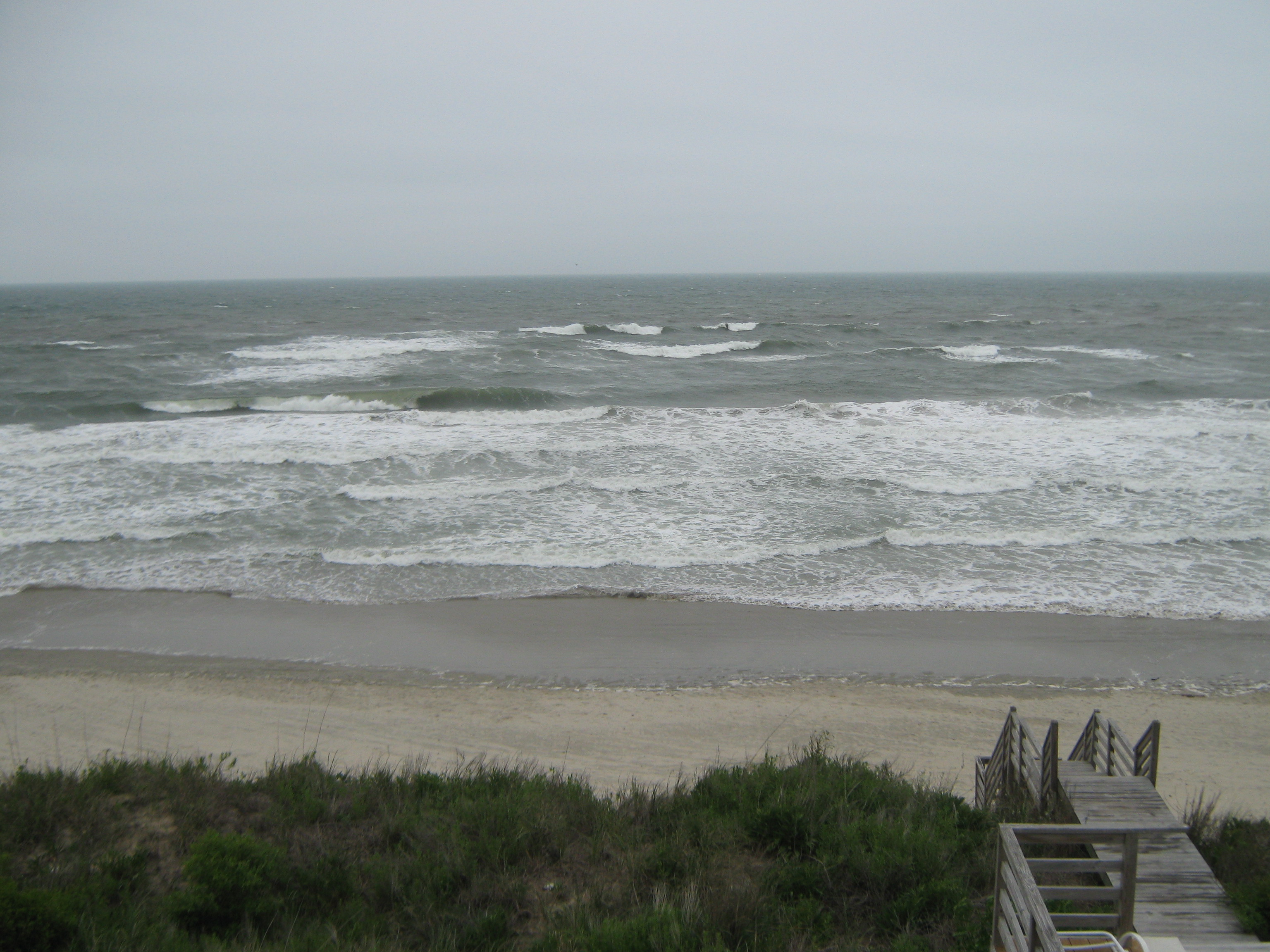
I wish you could hear the wind where I am right now. Then you might begin to understand with me that the old literary commonplace about the wind sounding like a human voice–moaning, screaming, calling–is more than just an old literary commonplace. It’s a blustery day at Whalehead Beach, the tide is freakishly high (at least it looks that way to landlubber eyes), and the ocean’s surface is frothy. The wind sounds like the voice of someone lost at sea (sorry, another cliche). A formation of large birds flies by, and I think of the Ancient Mariner’s albatross. I am also thinking about the climactic storm at Yarmouth in David Copperfield, and also about a Coldplay song, as you can tell by my title. I am so little acquainted with the ocean that apparently I am unable to think about it except in terms of books and music.
These pictures will make you think I’m exaggerating; I am too scared (and cold) to go down on the beach and get a better view. Anyway, you would need audio to really get a sense of what the sea is like right now.
Charlie Chaplin and Peter Pan
This evening I watched probably the saddest comedy I’ve ever seen. It had a happy ending, but only after the protagonist had survived a great deal of physical danger, loneliness, and mockery. The film, a selection from my PhD candidacy exam “reading” list, was Charlie Chaplin’s The Gold Rush (1925). It was only an hour and nine minutes long, and it was originally a silent film, though Netflix sent me a 1942 version that had a cheesy narrator and some dubbed-in dialogue in the narrator’s voice–even the female voices. (If I were a silent film purist, which I’m not, that probably would have ruined the experience for me. Fortunately, the narrator knew when to keep his mouth shut.) Despite what might sound like obstacles to good storytelling (short running time and characters who don’t talk–even at the ending; you hear that,The Artist?), this turned out to be a hilarious comedy at times (I LOL-ed when the protagonist trashed the cabin in his joy after the girls promised to come over for New Year’s Eve dinner) and at other times a heart-breaking tale of man’s inhumanity to man. Actually, it was mostly woman’s inhumanity to man; the men had guns and axes, but the women had cruel laughter, which the resilient “lone prospector” (Chaplin) was able to shake off less easily. (Spoiler: The girls don’t show up for dinner.)
Other fun things about The Gold Rush: The special effects were pretty darn good for 1925. (I didn’t even know they had special effects in 1925!) Also, and perhaps most importantly, this is the movie from which Johnny Depp’s character in Benny and Joon draws his impression of the “dance” of two rolls on the ends of two forks. Now I realize how stunningly accurate the homage is, right down to the facial expression. If only for that reason, you should watch this movie. But see if you can get the original version.
And now for my other, unrelated topic. You know I love Peter Pan, the character, right? You know how excited I was to see him at the Melbourne Zoo; you saw the picture I took as proof. (See the post “Fairies in Melbourne.”) I want to establish this because I’m going to share a poem I scribbled down Sunday night after watching the Alluvion Stage Company production of the musical Peter Pan. The poem is rather critical of Peter, the character. But my love for someone doesn’t mean that I can’t see the point of view of other characters who may not have such a rosy outlook on said person (eg. Harry Potter, Snape). You can probably guess easily enough which character is speaking in this poem. I’m probably reading more animosity into the story than is actually there, but I enjoy pulling out subtexts. This poem isn’t great; I need to work more on the vocabulary and sentence structure because I want the voice to start out sounding like an adult (or someone who wants us to think he’s an adult) and descend gradually into childishness. But, for now, here it is.
A clever chap, I suppose.
A good swordsman, you’d be a fool to deny it.
Very smart at plotting, and that sort of thing.
But really, what English young person doesn’t know the ending of Cinderella?
But he isn’t English, after all.
He’s some sort of heathen.
Probably doesn’t even know what the British Empire is.
And doesn’t understand how a shadow works?
Ridiculous, really.
Not as clever as Wendy thinks he is.
Not as clever as he thinks he is.
A horrid boy, actually.
Always has to be the father.
Always has to be the chief.
Always has to be the hero.
A horrible selfish boy
Who never,
Never
Lets anyone else be the leader.
Man is a giddy thing. (William Shakespeare said that.)
Tonight I chose Mumford and Sons’ Sigh No More as my falling-asleep music. Bad idea. These are songs for thinking, some for dancing, but not for falling asleep. So I’m still awake with this review/listening guide in my head, and I want to write it down before I do fall asleep and forget everything I want to say.
In case you have been living under a rock (in which case you probably need to “Roll Away Your Stone”) and have not yet listened to Mumford and Sons, let me try to encapsulate their style for you: exuberant, theatrical bluegrass with an English Renaissance twist. (In fact, that’s their genre on iTunes. That entire phrase. Just kidding.) I say “bluegrass” because of the prominence of the banjo and mandolin and because Marcus Mumford’s accent sounds, to my American ears, like the British equivalent of hillbilly. (Example: In several songs, such as “White Blank Page,” which include non-verbal syllables, he says “Arr,” not “Ahh.”) The English Renaissance part comes in with the Shakespeare references, found in the album title, the title track (whose lyrics are largely lifted from Much Ado about Nothing), and “Roll Away Your Stone,” where the line “Stars, hide your fires” is wrenched rather startlingly from its original Macbeth context and put to effective use. Other early modern touches include a song that seems to be about the Black Plague (“Winter Winds,” which contains a rare 21st-century use of the sadly neglected word “pestilence”) and some tunes I can only describe as troubadour-ish (hear, for example, the little melody at the beginning of “Roll Away Your Stone”; it sounds like something they might have danced to in the movie Elizabeth).
My favorite thing about the album is that it subtly tells a story. There is a clear introduction, conflict, climax, and resolution. I’ll try to outline the plot here without getting too long-winded. (Yeah, good luck with that.) After “Sigh No More,” which is the prologue, we have a solid line-up of hits: “The Cave,” “Winter Winds,” and “Roll Away Your Stone.” These are songs that you should roll down your car windows and shout along with. They are also triumphant, almost defiant, declarations of independence (especially “R.A.Y.S.”–I think it’s time to start abbreviating this title). The series of songs ends with the line, “You have neither reason nor rhyme / With which to take this soul that is so rightfully mine.” These numbers are life-affirming, but all of this brazen exuberance so early on the album makes us wonder whether it can last.
Alas, it cannot. With “White Blank Page” and “I Gave You All,” something bad happens. (I mean in the plot, not to the music.) This bad thing is all the more frightening because it remains undefined. These are break-up songs, I suppose, but the singer/narrator seems not only to be breaking up with a girlfriend but with himself and even with God. (Yes, I think the lyrics justify these weighty interpretations. This is a weighty album. It’s good when you find a weighty album that you can dance to.) In the midst of it all, however, there’s still an ember of hope (a key word on this album). The last words in “White Blank Page” (besides “Arr”) are “Lead me to the truth, and I / Will follow you with my whole life.”
There’s a little bit of a turning point in the next song, “Little Lion Man.” For one thing, this is the first “upbeat” song since “R.A.Y.S.” For another, the singer is able to make a confession: “It was not your fault, but mine.” After the blame-casting of the two previous songs, this admission is refreshing, though perhaps it goes too far in the self-castigating direction. The song is cathartic, anyway. It’s another fun one to yell out the window, not least because you get to yell the f-word several times.
The next song, “Timshel,” is a puzzle, like its title. It’s one of only two songs on the album (the other is “After the Storm”) that stays quiet the whole way through and doesn’t swell to a climax. In this bittersweet song, someone seems to be dying. Or giving birth? Or being baptized? I don’t know whether the death is literal or symbolic, but the water imagery seems to indicate it will be followed by some sort of rebirth. The most profound line on the album, in my opinion, is in this song: “Death is at your doorstep / And it will steal your innocence / But it will not steal your substance.” Someone should preach a sermon about that. This song ranks, along with some David Crowder songs (“Come Awake” from A Collision and pretty much the entire Give Us Rest album), as one of my favorite songs about death.
Next comes the climax of the whole album: “Thistle and Weeds.” Unlike some of the earlier numbers, this one doesn’t necessarily catch your attention from the beginning; you might be tempted to skip it, but don’t. Soon enough you’ll get to a percussive thunderstorm of piano and drums, over which Marcus hollers a line from an earlier song: “I will hold on hope.” In “The Cave,” it’s easy to mentally skip over this line; here, we get its full significance. The protagonist of the story is holding on for dear life. Someone or something is trying to steal his hope, hence the desperation of the vocal. The song ends quietly, but without much resolution. We have to wait until the next song to find out what happened. (N.B. “Thistle and Weeds” contains easily the creepiest line on the album: “Let the dead bury their dead / And they will come out in droves.”)
The next song is “Awake My Soul,” and it might be my favorite, although it’s nearly impossible to choose. This song doesn’t have the wild abandon of the set of hits at the beginning of the album, but its happiness is richer and deeper because it’s been tempered by sadness. Yes (spoiler alert), the protagonist has held onto his hope. As you can probably guess from the title, with this song comes the resurrection (if not bodily, then at least spiritual) that has been foreshadowed in earlier songs, such as “Winter Winds” (“You’ll be happy and wholesome again”) and “Timshel.” Here, the expression “meet your maker” is not ominous, like it tends to be in common usage, but joyful.
Part bad-ass gunslinger ballad, part jeremiad against greed and oppression, “Dust Bowl Dance” is the only song that seems out of place on this album. Don’t get me wrong; it’s a good song. I just think they should have saved it for their next album. For one thing, it breaks up the flow of the story; there shouldn’t be anything bleak after “Awake My Soul,” and “Dust Bowl Dance” is pretty bleak. For another, with its distorted guitar and manic cymbals, it’s more rock than (remember?) exuberant, theatrical bluegrass with an English Renaissance twist. And finally, speaking of the English Renaissance, the Dust Bowl was a 20th-century American event, so it’s weird to encounter it here. Still, I love the inflection in Marcus’s voice on the last line: “You haven’t met me; I am the only son.” It should be in a good tragic action movie.
The aptly-named “After the Storm” is the last song and the other quiet song. It could be anti-climactic, but only if you’re not paying attention. The guitar is lovely, and the lyrics are rain-drenched with meaning. It’s not a happily-ever-after ending because it’s not really an ending. The song uses a lot of future tense: “There will come a time, you’ll see / With no more tears, and love will not break your heart.” You’re admonished to “Get over your hill and see / What you find there.”
What will we find there? A second Mumford and Sons album? Yes, happily, later this year! But for now, go back and listen to Sigh No More (or “Come out of your cave” and listen to it for the first time). I’ve told you what I’ve found in this album; now I’d love to know what you find there.
Seeking unlikely hero who’s good with plants
I realize this morning’s post was probably a bit of a snooze for people who haven’t read The Rise of Silas Lapham (even though the novel itself is not a snooze–I’ve been flying through the last hundred pages this afternoon and evening), so this evening I decided to write something more fun, or something that at least nerds like me will consider fun.
I was thinking earlier about the two fictional characters I’m most in love with. One, Sam Gamgee, I’ve loved since I first read The Lord of the Rings at age 13; the other, Neville Longbottom, I’ve loved for a shorter time but no less fervently (I have a larger-than-life-sized representation of him in glossy cardboard). The similarities between the two are significant: both appear somewhat incompetent on first impression but turn out to be undeniably capable and even heroic, and both have a knack for botany (or Herbology, in Neville’s case). Also, now that I think of it, both are intimidated by angry wizards. But who wouldn’t be?
Based on these ideal figures, I’ve compiled a list for the reference of any guy who may, for whatever reason, want to impress me.
1. I would be really impressed if you could slay something, preferably something that urgently demands to be slain, such as a squadron of orcs or a snake that’s actually a Horcrux.
2. You need to be able to locate plants with magical properties in case I need them in an emergency. For example, if I am stabbed by a Morgul blade, I will need you to find me some athelas, also known as kingsfoil. Or, if I need to spend a prolonged period of time underwater (I was thinking about visiting the Titanic site with James Cameron), I will require gillyweed.
3. It would also be nice if you had some skill with regular, non-magical plants, particularly edible plants like po-ta-toes and strawberries (do you remember the taste of strawberries, Mr. Frodo?). Here Sam has a decided advantage over Neville. I guess it’s possible that Neville is cultivating a little kitchen garden next to his venomous tentacula plants, but we know for a fact that Sam cooks (unintentional 1960s popular music reference!). But if we’re talking about advantages and disadvantages, let’s be fair: Neville owns a pair of shoes. Also, Neville is human; technically, Sam is not. But this isn’t a competition.
4. If you have a domineering older person in your life, such as your old Gaffer or your Gran, you will always have someone whose good opinion you strive to live up to or whose poor opinion you strive to prove wrong. This will play a large part in your emerging heroism.
5. I don’t mind if you say lots of ridiculous things; in fact, I will probably find it endearing. But try to come up with at least one awesome line to deliver at a tense moment. For example, if someone asks you how your parents are, try saying, “Better, now they’re about to be avenged.” Or, here’s one that works in all kinds of different situations: “I can’t carry it for you, but I can carry you!”
Well, that should give you something to work with. If you think you could live up to my exacting standards, and especially if you’ve ever had your Remembrall stolen or gotten excited about seeing an oliphant, please inquire.